This Report Provides In-Depth Analysis of the Pressure Vessel Market Report Prepared by P&S Intelligence, Segmented by Type Analysis (Boiler, Reactor, Separator), Material Type (Steel Alloys, Composites), Application (Storage Vessels, Processing Vessels), Heat Source (Fired, Un-fired), End User (Power, Oil & Gas, Food & Beverages, Pharmaceuticals, Chemicals), and Geographical Outlook for the Period of 2019 to 2032
Explore the market potential with our data-driven report
Pressure Vessel Market Future Outlook
The pressure vessel market size stood at USD 51.9 billion in 2024, and it is expected to grow at a CAGR of 4.7% during 2025–2032, to reach USD 74.1 billion by 2032.
This market is driven by technological advancements, specifically automation, IoT-Enabled devices, and wireless connectivity; increasing demand from the oil & gas sector, and expansion of renewable energy capacity.
Moreover, pressure vessels are highly used in oil refineries, nuclear reactor vessels, mining operations, under-pressure hydraulic reservoirs, petrochemicals plants, pneumatic reservoirs, submarine and spaceship habitats, road and rail vehicle air-brake reservoirs, and storage vessels for liquefied gases such as chlorine, ammonia, and propane.
In addition, the chemical industry is witnessing strong growth despite persistent supply chain restrictions as a result of inventory rebuilding, sustained demand across many end-use industries, and a continued competitive edge in natural-gas-based chemistries.
Furthermore, heavy investment by companies in the industry, rebounding domestic oil and gas output, growing end-use markets, and the expansion in economies of trading partners are paving the way for increased chemical production, which in turn, drive the demand for pressure vessels.
Pressure Vessel Market Emerging Trends
Technological Advancements and Automation Are Major Trends in Market
The increasing need for enhanced operational efficiency, real-time monitoring, data analytics, improved safety, compliance, scalability, and flexibility impels the adoption of advanced and automated technologies in pressure vessels and other kinds of industrial equipment.
Smart monitoring via IoT sensors enables plant managers to track the condition of the vessels against various parameters, such as pressure and temperature.
The data gathered is put together to create a digital twin, which simulates the working of and conditions inside the pressure vessel in real time.
This allows factories to shut down the system in case the pressure and temperature exceed danger levels, potentially initiating a complete cooling procedure.
The technology also allows for the detection of metal fatigue due to the consistently high pressure and temperature, potentially preventing a catastrophic explosion and spilling of the dangerous fluid inside.
Advanced materials with higher strength relative to their weight are being used to manufacture pressure vessels, to save on expenses and yet ensure durability under harsh conditions.
Carbon-fiber-reinforced polymers are being used for this purpose as they are lightweight, strong, and resistant to corrosion.
The usage of 3D printing enables the creation of customized designs and complex shapes, at the same time, reducing material wastage and energy consumption.
The PLI Scheme of the Indian government plans to increase domestic manufacturing, specifically in heavy industries, such as power and chemicals.
The government has invested USD 26 billion in various sectors, which would enhance the sales potential of pressure vessels and related equipment.
The U.S. Department of Energy’s Advanced Manufacturing Office (AMO) has allocated USD 100 million to support the development of energy-efficient manufacturing technologies.
Expansion of Chemical Industry Drives Market
Chemicals are necessary for food, clothes, healthcare, comfort, and convenience in everyday life.
The chemical industry is also an integral part of the global economic landscape.
Chemicals are used in about 96% of all manufactured goods, and they cannot be replaced by other materials.
More than 80% of chemicals are sold to other companies and through many transformations in different value chains before they are used by final consumers.
Chemicals are the underlying foundation on which economies are built because they are the input materials required for nearly every product.
India is on the verge of becoming a major producer of chemicals and petrochemicals worldwide.
The Aatmanirbhar Bharat Abhiyan and Make in India are two of the Government of India’s flagship initiatives that aim to boost this industry and foster an environment that will encourage additional investment.
With the current low levels of consumption and a sizable prospective consumer base, the Indian chemical and petrochemical industry is projected to maintain its rapid development trajectory.
Moreover, in the U.S., the chemical sector is one of the largest manufacturing industries, which serves both global and domestic markets.
Also, it is one of the top exporting sectors of U.S. manufacturing.
For instance, the sector accounts for 15% of global chemical shipments, which makes the country one of the leaders in chemical production and exports.
Pressure Vessel Market Segmentation and Category Analysis
Type Analysis
Boiler held the largest market share, of over 60%, in 2024. This is due to the initiation of various refinery projects and aging power infrastructure. 215 planned refinery projects around the world are now in the building phase and projected to begin operations between 2022 and 2026. The other two important project stages are feasibility and approval, with 108 and 97 projects, respectively. Additionally, as per the World Nuclear Association, around 70 reactors are under construction around the world.
These types were analyzed:
Boiler (Largest Category)
Reactor (Fastest-Growing Category)
Separator
Material Type Analysis
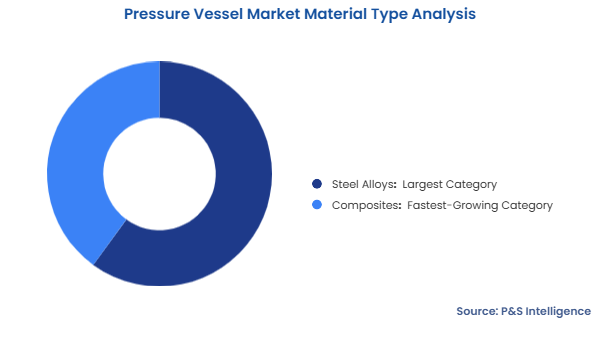
Steel Alloys held the largest market share, of over 60%, in 2024. This is because of its proven strength, durability, and cost-effectiveness for traditional industries, such as oil & gas, chemical, and power generation. They handle harsh operating conditions, such as high pressures, well and have established manufacturing processes, backed by the availability of raw materials.
Composites will have the highest CAGR, of 5%, during the forecast period. This is because polymers reinforced with carbon fiber or glass fiber offer a higher strength-to-weight ratio, making them ideal for applications where decreasing weight is critical, such as hydrogen and natural gas vehicles. Moreover, composites are less affected by corrosion, which increases their lifespan and lowers maintenance costs.
These material types were analyzed:
Steel Alloys (Largest Category)
Composites (Fastest-Growing Category)
Application Analysis
Storage vessels had the larger market share, of over 55%, in 2024. This is because these vessels are designed to store large volumes of substances, such as crude oil, natural gas, chemicals, and water, under extreme pressure and temperature. They also have a longer service life, lower replacement frequency, and higher importance in maintaining supply chain continuity and process safety.
These applications were analyzed:
Storage Vessels (Largest Category)
Processing Vessels (Fastest-Growing Category)
Heat Source Analysis
The unfired bifurcation had the larger market share, of over 60%, in 2024, and it will have the higher CAGR, of 5.5%, during the forecast period. This is because of the various applications in the chemical processing, oil & gas, pharmaceutical, water treatment, and food & beverage industries. Moreover, the global shift toward clean energy solutions and environmental sustainability is increasing the demand for un-fired pressure vessels for hydrogen storage and carbon capture.
These heat sources were analyzed:
Fired
Un-fired (Larger and Faster-Growing Category)
End User Analysis
Chemicals had the largest market share, of over 40%, in 2024, This is due to the use of pressure vessels for the storage, processing, and transportation of substances such as ammonia, chlorine, and various solvents. Essentially, the increasing demand for chemicals in the agriculture, manufacturing, and consumer goods sectors in Asia-Pacific drives the market.
Oil & gas will have the highest CAGR, of 5.4%, during the forecast period, because of the requirement of pressure vessels for upstream and downstream processes. Additionally, increment in offshore exploration and enlargement of refinery capacities in the Middle East, Africa, and Southeast Asia propels the demand for high-pressure, high-temperature vessels.
These end users were analyzed:
Power
Oil & Gas (Fastest-Growing Category)
Food & Beverages
Pharmaceuticals
Chemicals (Largest Category)
Drive strategic growth with comprehensive market analysis
Pressure Vessel Market Regional Outlook
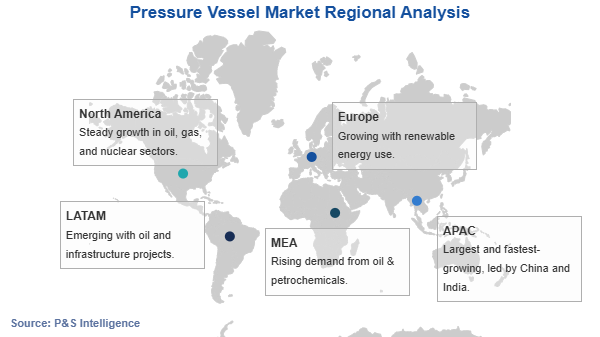
Asia-Pacific held the largest market share, of over 40%, in 2024, and it will have the highest CAGR, of 6%, during the forecast period. This is because of the high investment, fierce competition, and fragmentation within the chemical industry of China.
Moreover, in APAC, Japan holds the second-highest food consumption percentage of more than 20%, next to China with around 40%. Korea has around 5% while the rest of the countries in the region contribute around 30%. In Japan, people adopted Western habits for food choice and consumption.
A majority of people have begun to consume more wheat, meat, milk, and other dairy products. As an increasing number of Japanese consumers allocate a higher budget percentage for food, many opportunities are getting open for international brands and investors to enter the country to introduce new food preferences for local consumption.
Moreover, the regional market is being driven by the increasing need for power. For instance, India's power demand growth rate is expected to roughly double over the next five years. According to the plan, India would increase its power generation capacity by 165.3 gigawatts (GW) over a five-year period ending in March 2027, with the majority of this capacity coming from renewable energy sources.
The regions and countries analyzed for this report include:
North America
U.S.
Canada
Europe
Germany
U.K.
France
Italy
Spain
Asia-Pacific (Largest and Fastest-Growing Category)
Japan
China
India
South Korea
Australia
Latin America
Brazil
Mexico
Middle East and Africa
Saudi Arabia
South Africa
Pressure Vessel Market Share
The market is fragmented because a large number of players offer a wide range of products for specific needs in the power generation, oil & gas, chemical, and food processing industries. Key players in this market are Babcock & Wilcox Enterprises Inc., Larsen & Toubro Limited, Mitsubishi Heavy Industries Ltd., Doosan Heavy Industries & Construction, Samuel Pressure Vessel Group, IHI Corporation, Westinghouse Electric Company LLC, and Halvorsen Company. The requirement for high-pressure and low-pressure vessels enables even regional and local players to thrive, especially in developing countries. They compete on product innovation, technology, presence in various regions, and customer service.
Top Pressure Vessel Manufacturers:
Babcock & Wilcox Enterprises Inc.
General Electric
Larsen & Toubro Ltd.
Mitsubishi Power Ltd.
IHI Corporation
Bharat Heavy Electricals Limited
Doosan Mecatec Co. Ltd.
Dangfang Turbine Co. Ltd.
Hitachi Zosen Corporation
Samuel Son & Co
Pressure Vessel Market News
In March 2025, the China Nuclear Energy Association announced the lifting in place of the first reactor pressure vessel at the Unit 1 of the under-construction Lianjiang nuclear power station in Guangdong province.
In February 2025, DEEP Manufacturing Limited received the DNV approval in principle, allowing it to use 3D printing based on wire-arc-directed energy deposition to create pressure vessels that will house humans.
In January 2025, GE Hitachi Nuclear Energy (GEH) awarded a contract to BWX Technologies Inc. to manufacture the reactor pressure vessel for the first BWRX-300 small modular reactor for the Nuclear Project site of Ontario Power Generation in Darlington.
In January 2025, Akkuyu Nuclear announced the successful installation of a reactor pressure vessel at the Akkuyu-3 nuclear power plant, which is being constructed in Turkey.
In June 2023, Saudi Arabia L&T opened a heavy wall pressure vessel factory to increase local manufacturing capacities.
Want a report tailored exactly to your business need?
Leading companies across industries trust us to deliver data-driven insights and innovative solutions for their most critical decisions. From data-driven strategies to actionable insights, we empower the decision-makers who shape industries and define the future. From Fortune 500 companies to innovative startups, we are proud to partner with organisations that drive progress in their industries.
Client Testimonials
Working with P&S Intelligence and their team was an absolute pleasure – their awareness of timelines and commitment to value greatly contributed to our project's success. Eagerly anticipating future collaborations.
McKinsey & Company
India
Unmatched Standards
Our insights into the minutest levels of the markets, including the latest trends and competitive landscape, give you all the answers you need to take your business to new heights
Complete Data Security
We take a cautious approach to protecting your personal and confidential information. Trust is the strongest bond that connects us and our clients, and trust we build by complying with all international and domestic data protection and privacy laws