This Report Provides In-Depth Analysis of the Post-Quantum Cryptography Market Report Prepared by P&S Intelligence, Segmented by Component (Solutions, Services), Organization Size (Large Enterprises, Small & Medium Enterprises), Deployment Mode (On-Premises, Cloud-Based), Deployment Environment (On-Premises Data Centers, Cloud Environments, Hybrid Environments, Edge Computing Environments), Algorithm Type (Lattice-based Cryptography, Hash-based Cryptography, Code-based Cryptography, Multivariate Polynomial Cryptography, Supersingular Isogeny-based Cryptography), Application (Network and infrastructure security, Digital signatures and identity verification, Secure communications, Data protection for storage and databases, IoT and embedded system security, Secure software and code signing), End-User (Government & Defense, IT & Telecommunications, BFSI, Healthcare, Retail & E-commerce, Energy & Utilities), and Geographical Outlook for the Period of 2021 to 2032
Explore the market potential with our data-driven report
Post-Quantum Cryptography Market Future Outlook
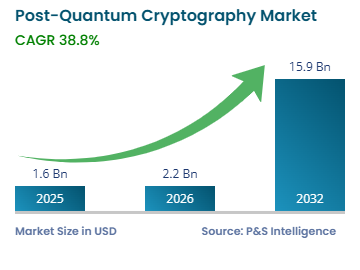
The post-quantum cryptography market size was USD 1.6 billion for 2025, and it will grow by 38.8% during 2026-2032, to reach USD 15.9 billion by 2032.
The market is expanding because organisations are increasingly preparing for a future security environment where quantum computing could weaken the encryption methods that currently protect digital communications, financial transactions, government records, and sensitive enterprise data. As digital systems become more interconnected, the volume of information requiring long-term confidentiality continues to grow. Businesses are recognising that data encrypted today could remain valuable for years, creating concerns that future quantum capabilities may expose information that was previously considered secure. Furthermore, the growing reliance on cloud platforms, connected devices, digital identities, and cross-border data exchanges is increasing the importance of cryptographic resilience across critical infrastructure and commercial networks.
The shift towards quantum-resistant security frameworks is creating stronger demand for post-quantum cryptography solutions across both public and private sectors. Governments, defence agencies, financial institutions, healthcare providers, and technology companies are assessing how existing security architectures can be adapted to support next-generation encryption standards without disrupting operations. Moreover, regulatory guidance and cybersecurity modernisation initiatives are encouraging organisations to begin long-term migration planning rather than waiting for large-scale quantum computing deployment. This transition is influencing investment in cryptographic agility, secure communications, software upgrades, and hardware security technologies. As organisations build strategies to address future cyber risks, post-quantum cryptography is becoming an important component of broader cybersecurity programmes designed to strengthen data protection, operational continuity, and trust in digital ecosystems.
Key Market Insights
Solutions is the larger component, holding a market share of 75%, due to rising enterprise demand for deployable quantum-safe encryption and authentication tools.
Cloud Environments is the fastest-growing deployment, registering a CAGR of approximately 39.4%, driven by expanding enterprise cloud infrastructure requiring scalable quantum-resistant cryptographic protection.
Lattice-based cryptography is the largest technology, holding a market share of 40%, due to its adoption in NIST post-quantum standards for encryption and digital signatures.
North America holds the largest share of 40%, due to strong federal funding for quantum research and early migration planning for quantum-resistant security.
Asia-Pacific is the fastest-growing region, registering a CAGR of approximately 39.7%, driven by expanding government quantum technology programs and rising cybersecurity investment.
Post-Quantum Cryptography Market Trends and Drivers
Shift toward Hybrid Cryptography and Early Commercial Deployments Is a Major Trend
The market is witnessing a clear shift toward hybrid cryptography, where organizations combine existing encryption systems with quantum-safe algorithms instead of replacing security infrastructure at once. This approach is gaining traction because banks, cloud providers, government agencies, and software vendors need migration paths that reduce disruption across protocols, authentication layers, and enterprise applications. Additionally, the National Cybersecurity Center of Excellence reported that dozens of global technology vendors, financial institutions, government agencies, and cybersecurity firms collaborated in its Post-Quantum Cryptography project to test interoperability between NIST-standardized post-quantum cryptographic algorithms and existing cryptographic systems. Furthermore, according to Capgemini, 70% of early-adopter organizations were assessing or deploying quantum-safe measures in 2025, with nearly half running pilot programs. These efforts are supporting commercial readiness by helping vendors validate integration models, improve compatibility, and move quantum-safe security from controlled testing into phased enterprise deployment.
Rising Urgency to Protect Data from Future Quantum Attacks Drives Market
The market is expanding as organizations recognize that future quantum computers could weaken the encryption methods currently used to protect confidential digital information. This concern is especially strong in banking, defense, healthcare, telecommunications, and government networks, where stored data may remain sensitive for decades. Additionally, according to International Business Machines Corporation, the global average quantum-safe readiness score among organizations was only 25 out of 100 in 2025, showing limited preparedness for quantum-era security threats. Furthermore, according to Cisco Systems, Inc., only 3% of organizations had reached a mature cybersecurity readiness stage in 2024, while 73% reported experiencing a cybersecurity incident. These gaps are pushing enterprises to review cryptographic inventories, assess long-term data exposure, and invest in quantum-resistant protection that can be built into security planning before large-scale quantum risk becomes operational.
Complex Integration and Lack of Standardised Implementation Frameworks
The market faces restraints because post-quantum cryptography migration is technically complex and difficult to align with existing enterprise security environments. Many organizations depend on legacy systems where encryption is embedded inside applications, network protocols, payment systems, identity tools, and device-level security controls. Replacing or modifying these layers requires testing for performance, compatibility, key management, and interoperability across multiple digital platforms. Additionally, according to the World Economic Forum Global Cybersecurity Outlook, 52% of public organizations identified a lack of resources and professional cybersecurity skills as their biggest challenge when designing cyber resilience strategies in 2024. This shortage limits the ability of agencies and enterprises to manage cryptographic discovery, migration planning, and validation at scale. It also slows procurement decisions, increases implementation costs, and creates longer deployment cycles for quantum-safe security across critical infrastructure.
Growing Government Mandates and Standardisation Initiatives Creating New Demand
The market presents strong opportunities as governments create cybersecurity strategies that support migration toward advanced and quantum-resistant encryption standards. Clear policy direction helps enterprises understand future security expectations and encourages earlier planning for cryptographic upgrades across public services, financial systems, telecom networks, and defense infrastructure. Additionally, according to the International Telecommunication Union, 132 countries had established a National Cybersecurity Strategy by 2024, increasing from 107 countries in 2021. These national strategies are strengthening demand for secure digital infrastructure, cryptographic research, security audits, and modernization programs that can support post-quantum deployment. They also create a more stable environment for technology vendors, system integrators, and cybersecurity providers to develop migration tools, compliance services, and implementation support for organizations preparing their networks for quantum-era security requirements.
Solutions is the larger category, holding a market share of 75%, because organizations need deployable cryptographic tools that can secure networks, data flows, authentication layers, and communication systems without rebuilding security architecture from the ground up. This connects strongly with large enterprises and on-premises environments, where internal teams need controlled upgrades across complex infrastructure. Additionally, according to the Government of India Press Information Bureau, the Indian Computer Emergency Response Team recorded 2,041,360 cybersecurity incidents in 2024, rising from 1,592,917 in 2023. This pressure is increasing demand for integrated quantum-safe solutions that support faster security modernization.
Services is the faster-growing category, because organizations need expert support to identify exposed cryptographic assets, plan migration stages, and test compatibility with existing platforms. This demand connects with cloud, hybrid, and SME adoption, where internal cybersecurity teams may not have deep post-quantum implementation skills. Consulting, cryptographic audits, integration support, and managed services help companies reduce operational risk while preparing for new standards. Service providers are becoming important partners because migration requires more than software deployment; it needs assessment, governance, training, and validation across business-critical systems.
The components analysed in this report are:
Solutions (Larger Category)
Quantum-resistant encryption and key management solutions
Quantum-safe authentication and digital signature systems
Secure communication platforms with PQC integration
Cryptographic libraries and development frameworks
Blockchain and distributed ledger security solutions
Hardware-based quantum-safe security modules
Services (Faster-Growing Category)
Consulting, design, and integration services
Migration and transition services
Risk assessment and cryptographic audit services
Managed security and support services
Organisation Size Analysis
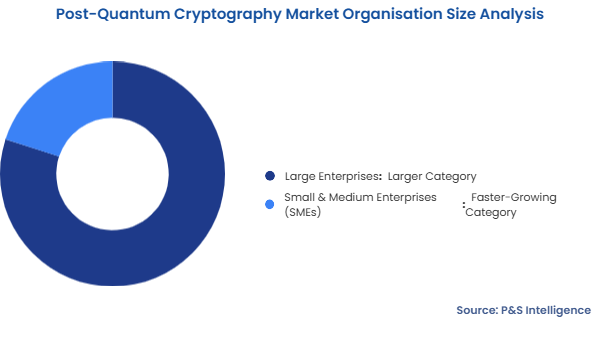
Large Enterprises is the larger category, holding a market share of 80%, because these organizations manage high-value data, global networks, regulated workflows, and complex identity systems that need long-term cryptographic protection. Their adoption connects closely with solutions, on-premises deployment, and government-grade security practices because large firms often control sensitive infrastructure directly. They also have stronger budgets and internal security teams to test quantum-safe tools before broader rollout. This makes them early buyers for encryption upgrades, key management platforms, and secure communication systems that can support compliance while limiting disruption across enterprise operations.
Small and Medium Enterprises are the faster-growing category, because smaller businesses are becoming more exposed to digital risk as they adopt cloud applications, online payments, remote access, and managed IT services. Their growth connects closely with services and cloud-based deployment because they usually need affordable support rather than large internal migration teams. Managed security providers and scalable cryptographic tools make quantum-safe adoption more practical for these firms. This is widening the customer base beyond large enterprises and creating demand for simpler, subscription-based post-quantum security models.
The organization sizes analysed in this report are:
Large Enterprises (Larger Category)
Small & Medium Enterprises (SMEs) (Faster-Growing Category)
Deployment Mode Analysis
On-Premises is the larger category, because organizations in finance, government, defense, and healthcare often keep critical systems inside controlled infrastructure for security, compliance, and operational oversight. This segment connects with solutions and on-premises data centers, where encryption upgrades can be tested under direct supervision. Additionally, according to Cloudscene, approximately 12,000 operational data centers existed worldwide in 2025, including 5,427 facilities in the United States. This infrastructure base supports continued deployment of quantum-safe cryptographic frameworks in environments where organizations require tight control over data and system access.
Cloud-Based is the faster-growing category, registering a CAGR of approximately 39.1%, because organizations are shifting workloads, applications, storage, and identity services to cloud platforms that require scalable security controls. This segment connects closely with SMEs, services, and cloud environments because cloud delivery allows faster updates and easier integration of new cryptographic algorithms. Providers can embed quantum-safe capabilities into managed platforms, reducing the burden on customer-side infrastructure teams. This growth is increasing demand for flexible encryption, secure key management, and authentication tools that can protect distributed data without slowing cloud adoption.
The deployment modes analysed in this report are:
On-Premises (Larger Category)
Cloud-Based (Faster-Growing Category)
Deployment Environment Analysis
On-Premises Data Centers is the largest category, holding a market share of 45%, because organizations handling classified, regulated, or highly sensitive workloads prefer direct control over cryptographic systems and data access. This segment connects strongly with on-premises deployment, large enterprises, and government and defense users that require controlled upgrade paths. Quantum-safe cryptography can be implemented, monitored, and tested within internal facilities before wider expansion. This creates demand for hardware security modules, secure communication platforms, and enterprise encryption systems that strengthen data protection while keeping operational authority inside the organization.
Cloud Environments is the fastest-growing category, because organizations are moving digital workloads into scalable platforms that need encryption across distributed applications, storage, and remote access points. This connects with cloud-based deployment, SMEs, and services, where flexible security models are essential. Additionally, according to Eurostat, 52.7% of enterprises in the European Union used paid cloud computing services in 2025, increasing by 7.4 percentage points compared with 2023. Rising cloud adoption is accelerating demand for quantum-safe encryption, identity protection, and key management built directly into cloud ecosystems.
The deployment environments analysed in this report are:
On-Premises Data Centres (Largest Category)
Cloud Environments (Fastest-Growing Category)
Hybrid Environments
Edge Computing Environments
Algorithm Type Analysis
Lattice-based Cryptography is the largest category, holding a market share of 40%, because it supports strong quantum-resistant encryption and digital signatures while remaining practical for enterprise security protocols. This segment connects with network security, digital identity, and secure communications because its algorithms can protect both data exchange and authentication workflows. Additionally, according to the National Institute of Standards and Technology, two of the first three official post-quantum cryptography standards finalized in 2024, FIPS 203 and FIPS 204, are based on lattice-based mathematical problems. This standardization is strengthening buyer confidence and guiding vendor product development.
Hash-based Cryptography is the fastest-growing category, registering a CAGR of approximately 39.3%, because it offers a trusted approach for digital signatures, long-term data protection, and verification use cases. This segment connects closely with identity verification, secure software signing, and government systems where data integrity is critical. Its appeal comes from mature security principles and relatively clear implementation paths compared with more complex algorithm families. Growing adoption is supporting demand for signature-focused tools, cryptographic libraries, and migration services that help organizations add quantum-resistant verification without replacing every security component at once.
Network and Infrastructure Security is the largest category, because organizations first need to protect data moving across enterprise networks, cloud links, telecom systems, and public-sector infrastructure. This application connects with lattice-based cryptography, secure communications, and on-premises deployment because network protection depends on reliable encryption across complex environments. As digital systems become more distributed, interception and protocol-level exposure create higher risk. This is driving demand for quantum-safe virtual private networks, secure gateways, key exchange tools, and infrastructure upgrades that strengthen communication security without interrupting daily operations.
Digital Signatures and Identity Verification is the fastest-growing category, because online services, digital transactions, and remote authentication need stronger proof of identity and data integrity. This application connects with hash-based cryptography, government digital services, and cloud environments where users access systems from many locations. Additionally, the World Bank reported that people in approximately 45% of countries could obtain at least one government-recognized digital identity credential that enables remote authentication for online services and transactions in 2024. Expanding digital identity infrastructure is increasing demand for quantum-safe signature and verification technologies.
The applications analysed in this report are:
Network and infrastructure security (Largest Category)
Digital signatures and identity verification (Fastest-Growing Category)
Secure communications
Data protection for storage and databases
IoT and embedded system security
Secure software and code signing
End-User Analysis
Government and Defense is the largest category, holding a market share of 35%, because these users manage national security data, classified communications, public records, and mission-critical digital infrastructure that require long-term protection. This segment connects with on-premises data centers, network security, and lattice-based standards because public institutions need controlled and trusted migration paths. Additionally, according to the International Institute for Strategic Studies, global defense spending reached USD 2.63 trillion in 2025, increasing from USD 2.48 trillion in 2024. Rising defense investment is supporting stronger cybersecurity modernization and quantum-safe encryption adoption across national security systems.
IT and Telecommunications is the fastest-growing category, registering a CAGR of approximately 39.5%, because this sector carries large volumes of data across cloud services, broadband networks, 5G systems, enterprise connectivity, and connected devices. This segment connects with secure communications, edge computing, and network infrastructure security because telecom operators and IT providers must protect distributed traffic at scale. Quantum-safe cryptography supports stronger key exchange, identity protection, and data transmission across complex networks. Demand is growing as providers upgrade security architectures while maintaining service reliability for enterprises, consumers, and public-sector customers.
The end-users analysed in this report are:
Government & Defence (Largest Category)
IT & Telecommunications (Fastest-Growing Category)
BFSI
Healthcare
Retail & E-commerce
Energy & Utilities
Others
Drive strategic growth with comprehensive market analysis
North America Post-Quantum Cryptography Market Analysis
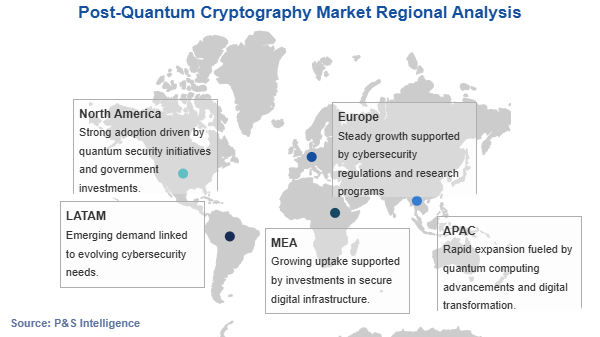
North America holds the largest share, of 40%, because the region has strong cybersecurity maturity, early policy direction, and advanced enterprise readiness for quantum-safe migration. The U.S. and Canada have large financial institutions, defense agencies, cloud providers, and technology companies that manage long-life sensitive data and require stronger encryption planning. Additionally, public-sector guidance and private-sector collaboration are helping organizations assess cryptographic inventories, test post-quantum algorithms, and prepare staged migration roadmaps. The presence of major cybersecurity vendors, research universities, and standards-focused institutions also supports faster product development and pilot deployment. This gives North America a strong adoption base, especially across government, BFSI, IT infrastructure, and secure communications, where organizations need practical transition models that reduce future quantum-related security exposure.
U.S. Post-Quantum Cryptography Market Analysis
The U.S. post-quantum cryptography market is advancing through strong federal research programs and early migration planning for quantum-resistant security infrastructure. Government agencies and technology firms are prioritising long-term protection of national security systems and critical digital infrastructure. Additionally, according to the U.S. Department of Energy, USD 625 million was allocated in 2025 to advance the next phase of the five National Quantum Information Science Research Centres. Moreover, this investment is strengthening national capabilities in quantum computing and cybersecurity, supporting faster development and testing of quantum-resistant cryptographic technologies across government and industry environments.
Canada Post-Quantum Cryptography Market Analysis
Canada’s post-quantum cryptography market is developing through a research-driven ecosystem supported by universities, cybersecurity firms, and government innovation programs. National institutions are focusing on secure communication frameworks and early research in quantum-resistant cryptographic methods. Additionally, according to the Communications Security Establishment (CSE), more than 30 briefings were delivered in 2025 to government, industry, and critical infrastructure partners on quantum-related cybersecurity risks and the transition to quantum-safe cryptography. Moreover, these awareness and preparedness initiatives are encouraging organisations to evaluate cryptographic migration strategies and strengthen national cybersecurity readiness for future quantum-era risks.
Asia-Pacific has the highest CAGR, of approximately 39.7%, because the region is rapidly expanding digital infrastructure while strengthening cybersecurity systems across telecom, financial services, government platforms, and connected device ecosystems. Countries such as China, Japan, South Korea, India, Singapore, and Australia are investing in secure communication networks, cloud adoption, smart manufacturing, and national digital programs. Many organizations in the region are still modernizing their cybersecurity architecture, which creates room to adopt quantum-safe methods alongside newer systems instead of replacing deeply embedded legacy encryption. Furthermore, the growth of 5G, electronics production, digital payments, and cloud-based services is increasing the need for advanced cryptographic protection. This supports faster demand for scalable post-quantum solutions, integration services, and secure infrastructure upgrades across public and commercial networks.
China Post-Quantum Cryptography Market Analysis
China’s post-quantum cryptography market is progressing through centralised government initiatives focused on strengthening national digital security infrastructure. National technology programs emphasise domestic capability development in quantum computing, secure communications, and cryptographic research to reduce dependence on foreign technologies. Additionally, according to the Centre for Strategic and International Studies, China launched a national venture capital guidance program in 2024 designed to mobilise 1 trillion yuan (about USD 138 billion) into strategic technologies, including quantum innovation. Moreover, this large-scale funding framework is accelerating domestic research, startup development, and commercialisation of quantum-related security technologies across the country’s digital ecosystem.
India Post-Quantum Cryptography Market Analysis
India’s post-quantum cryptography market is gradually developing as expanding digital infrastructure increases the importance of advanced cybersecurity capabilities. Government initiatives and research institutions are promoting work in quantum technologies and secure communication systems to prepare for future cryptographic challenges. Additionally, according to the Press Information Bureau, citing CERT-In, India recorded 2,041,360 cybersecurity incidents in 2024. Moreover, the growing volume of digital threats is encouraging enterprises, telecom operators, and public institutions to explore stronger encryption frameworks and gradually evaluate quantum-resistant cryptographic security approaches.
Europe Post-Quantum Cryptography Market Analysis
Europe is growing steadily in the post-quantum cryptography market because the region places strong focus on data protection, digital sovereignty, cybersecurity regulation, and secure public infrastructure. Enterprises and government bodies across Germany, France, the U.K., the Netherlands, and Nordic countries are assessing encryption modernization to protect financial data, citizen records, healthcare systems, and critical infrastructure. The region’s strict privacy and security environment encourages organizations to plan cryptographic migration carefully, with attention to compliance, interoperability, and long-term data confidentiality. Additionally, Europe’s active research ecosystem and cybersecurity vendors are supporting the development of quantum-safe tools for secure communications, identity verification, and cloud security. This creates demand for structured consulting, testing, and deployment support as organizations move from risk assessment toward practical post-quantum implementation.
The regions and countries analysed in this report are:
North America (Largest Regional Market)
U.S. (Larger Country)
Canada (Faster-Growing Country)
Europe
Germany (Largest Country)
U.K. (Fastest-Growing Country)
France
Italy
Spain
Rest of Europe
Asia-Pacific (Fastest-Growing Regional Market)
China (Largest Country)
India (Fastest-Growing Country)
Japan
South Korea
Australia
Rest of APAC
Latin America
Brazil (Largest Country)
Mexico (Fastest-Growing Country)
Rest of LATAM
Middle East and Africa
Saudi Arabia (Largest Country)
U.A.E. (Fastest-Growing Country)
South Africa
Rest of MEA
Post-Quantum Cryptography Market Share Analysis
The market is fragmented, with many players offering different types of quantum-safe solutions across software, hardware, and services. There is no single company dominating because the technology is still evolving, and standards are not fully finalised. Large cybersecurity firms, niche cryptography vendors, and research-driven startups are all competing in this space. Many companies are focusing on specific use cases like secure communication or encryption libraries rather than full platforms. Partnerships and collaborations are also common, as firms work together to build complete solutions and expand their capabilities in this developing market.
Leading Companies in the Post-Quantum Cryptography Market:
NXP Semiconductors
Thales Group
Amazon com Incorporated
Idemia Group
Palo Alto Networks Incorporated
DigiCert Incorporated
Entrust Corporation
International Business Machines Corporation
Utimaco
PQShield Limited
Post Quantum Limited
Quantum Xchange Incorporated
Quantropi Incorporated
Arqit Quantum Incorporated
Keyfactor Incorporated
Post-Quantum Cryptography Market News
In March 2026, Google announced the integration of post-quantum cryptography into its Android ecosystem (Android 17 cycle), introducing quantum-resistant digital signature mechanisms (ML-DSA) primarily for application signing and verification, enhancing long-term security and trust across devices.
In May 2025, NordVPN announced the expansion of post-quantum encryption support across all its applications, integrating quantum-resistant cryptographic algorithms into its NordLynx protocol to enhance secure data transmission and long-term resilience against quantum threats.
Frequently Asked Questions About This Report
What is post quantum cryptography and why is it needed?+
Post quantum cryptography uses algorithms designed to resist future quantum computer attacks on current public key encryption systems used in digital security.
Why are organizations preparing before powerful quantum computers exist?+
Organizations are preparing because sensitive data stolen today may be stored and decrypted later when quantum computers become stronger.
What does harvest now decrypt later mean in cybersecurity?+
It means attackers collect encrypted data now and wait until future quantum computers can break vulnerable encryption methods.
Which encryption methods are most exposed to quantum computing risks?+
RSA elliptic curve cryptography Diffie Hellman and digital signature algorithms are considered vulnerable to future cryptographically relevant quantum computers.
What are the main post quantum cryptography standards from NIST?+
The National Institute of Standards and Technology finalized ML KEM ML DSA and SLH DSA as initial post quantum cryptography standards.
Want a report tailored exactly to your business need?
Leading companies across industries trust us to deliver data-driven insights and innovative solutions for their most critical decisions. From data-driven strategies to actionable insights, we empower the decision-makers who shape industries and define the future. From Fortune 500 companies to innovative startups, we are proud to partner with organisations that drive progress in their industries.
Client Testimonials
Working with P&S Intelligence and their team was an absolute pleasure – their awareness of timelines and commitment to value greatly contributed to our project's success. Eagerly anticipating future collaborations.
McKinsey & Company
India
Unmatched Standards
Our insights into the minutest levels of the markets, including the latest trends and competitive landscape, give you all the answers you need to take your business to new heights
Complete Data Security
We take a cautious approach to protecting your personal and confidential information. Trust is the strongest bond that connects us and our clients, and trust we build by complying with all international and domestic data protection and privacy laws