This Report Provides In-Depth Analysis of the Polyurethane Dispersions Market Report Prepared by P&S Intelligence, Segmented by Type (Solvent-Free, Low-Solvent), Product Type (Single-Component PUD, Two-Component PUD), Raw Material (Polyester-Based, Polycarbonate-Based, Polyether-Based, Polycaprolactone-Based), Chemistry (Anionic, Hybrid, Cationic, Nonionic), End-User (Textile, Automotive, Construction, Leather & Footwear, Furniture, Packaging, Electronics, Pulp & Paper), and Geographical Outlook for the Period of 2021 to 2032
Explore the market potential with our data-driven report
Polyurethane Dispersions Market Overview
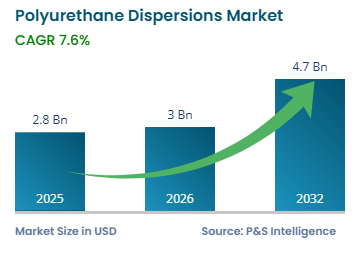
The polyurethane dispersions market size was USD 2.8 billion for 2025, and it will grow by 7.6% during 2026-2032, to reach USD 4.7 billion by 2032.
The market is expanding as manufacturers across coatings, adhesives, textiles, synthetic leather, packaging, furniture, automotive components, and construction materials increasingly replace solvent-based formulations with water-based technologies that reduce volatile organic compound emissions while maintaining high mechanical performance. These dispersions provide strong adhesion, abrasion resistance, chemical resistance, flexibility, weather durability, and long service life, making them suitable for demanding industrial applications. Additionally, tightening environmental regulations and workplace safety requirements are encouraging manufacturers to adopt low-odor, low-emission coating and adhesive systems without compromising production efficiency or product quality.
According to the International Energy Agency, total energy-related CO2 emissions increased by 0.8% in 2024, reaching a record 37.8 Gt CO2. This continued rise in emissions is increasing industrial attention toward cleaner manufacturing materials and lower-carbon production methods. Furthermore, manufacturers are investing in bio-based polyurethane raw materials, advanced resin technologies, and energy-efficient production processes to meet sustainability targets. Moreover, rapid industrial growth across Asia-Pacific is increasing demand for polyurethane dispersions in automotive parts, industrial wood coatings, flexible packaging, electronics, and textile finishing applications, where manufacturers require durable surface protection, regulatory compliance, improved processing efficiency, and reduced environmental impact while maintaining consistent product performance across large-scale manufacturing operations and export-oriented production facilities.
Key Market Insights
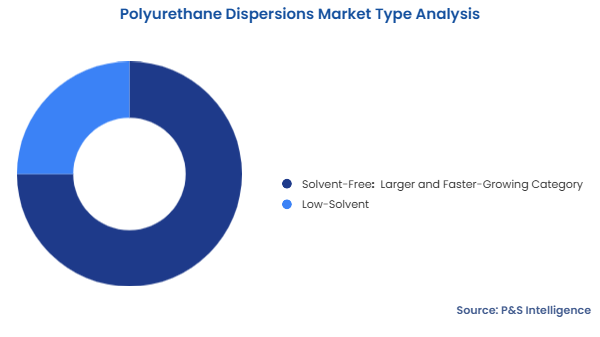
Solvent-Free is the larger and faster-growing type, holding a market share of 75% and registering a CAGR of approximately 7.8%, due to the rising replacement of solvent-based coating systems.
Two-Component PUD is the faster-growing product type, registering a CAGR of approximately 7.9%, due to growing demand for durable automotive, construction, and industrial protective coatings.
Textile is the largest end user, holding a market share of 25%, due to high use in coated fabrics, synthetic leather, and performance apparel.
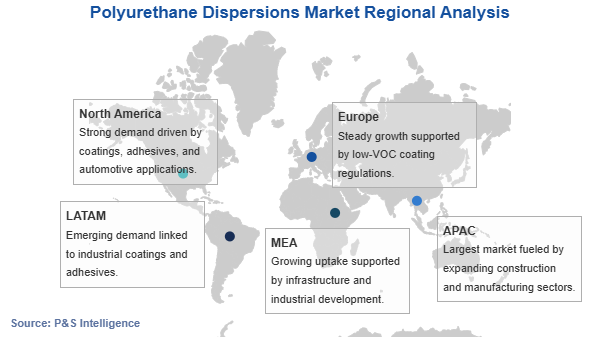
Asia-Pacific is the largest and fastest-growing region, holding a market share of 40% and registering a CAGR of approximately 8.5%, due to strong textile, footwear, automotive, and furniture manufacturing.
China is the largest country market, due to the large-scale production of textiles, synthetic leather, EVs, and industrial coatings.
Polyurethane Dispersions Market Dynamics
Bio-Based and High-Performance Waterborne Formulations Are a Major Trend
Companies in the polyurethane dispersions market are developing bio-based and advanced waterborne formulations for automotive interiors, textile coatings, synthetic leather, wood finishes, and flexible packaging. These grades are designed for lower odor, stronger scratch resistance, matte appearance, chemical protection, heat resistance, and faster drying because these applications need both sustainable chemistry and dependable surface performance. According to the International Energy Agency, 17.3 million electric cars were produced worldwide in 2024, about one-quarter more than in 2023.
According to European Bioplastics, global bioplastics production capacity stood at 2.47 million tonnes in 2024, reflecting wider industrial use of renewable material platforms. Furthermore, this shift is increasing demand for polyurethane dispersions in coated fabrics, seat covers, interior trims, protective films, and premium packaging, where suppliers must provide durability, processing stability, low-emission chemistry, and controlled appearance for high-volume manufacturing programs.
The market is growing as coating, adhesive, textile, synthetic leather, footwear, furniture, and packaging producers replace solvent-based materials with water-based polyurethane dispersions that reduce harmful emissions during manufacturing and application. This change is supported by tighter rules on air pollution, chemical handling, worker exposure, and industrial emissions, especially in countries with large automotive component, textile finishing, and industrial coating supply chains.
According to the Emissions Database for Global Atmospheric Research, global greenhouse gas emissions reached 53.2 Gt CO2eq in 2024, increasing pressure on manufacturers to use cleaner material systems. According to the Organization for Economic Co-operation and Development, the Policy Instruments for the Environment database covered 22 environmental domains in 146 countries in 2024. Moreover, these policy signals are supporting wider use of polyurethane dispersions in packaging laminates, wood coatings, footwear uppers, automotive interiors, and industrial surface protection.
High Production Costs and Raw Material Dependency Restrain Market Growth
The market faces challenges because polyurethane dispersions rely heavily on speciality raw materials linked to petrochemical supply chains, making production costs vulnerable to fluctuations in crude oil prices and global trade conditions. Many small and medium-sized manufacturers struggle to maintain stable operating margins when feedstock prices rise sharply or supply availability becomes inconsistent. Water-based polyurethane dispersions also require controlled formulations and advanced processing technologies to achieve high-performance standards, increasing manufacturing complexity for cost-sensitive producers. According to the U.S. Energy Information Administration, benchmark Brent crude oil futures prices averaged USD 80 per barrel in 2024, with prices fluctuating between USD 68 and USD 93 per barrel during the year, reflecting continued volatility in petrochemical feedstocks. These pricing pressures are slowing adoption across industries where conventional solvent-based products remain cheaper or are already integrated into existing manufacturing systems and production equipment.
Rising Demand for Sustainable Synthetic Leather and Textile Coatings Creates New Opportunities
The market is creating new opportunities through the increasing use of sustainable synthetic leather, coated fabrics, and advanced textile coatings across footwear, furniture, automotive interiors, and fashion products. Manufacturers are developing polyurethane dispersions for waterproof clothing, sportswear, premium upholstery, and flexible packaging applications where durability, softness, scratch resistance, and low-emission performance are increasingly required together. Growth in online retail and branded consumer goods is also increasing demand for visually appealing and high-performance coated materials. According to APICCAPS’ World Footwear Yearbook, global footwear production reached 23.9 billion pairs in 2024, supporting strong demand for polyurethane dispersions in footwear materials, coated textiles, and synthetic leather processing. Expanding textile manufacturing and furniture production across emerging economies is further encouraging suppliers to introduce customised polyurethane dispersion technologies designed for specialised industrial and consumer applications.
Solvent-Free is the larger and faster-growing category, holding a market share of 75% because manufacturers are increasingly replacing solvent-based materials with lower-emission waterborne technologies across coatings, textiles, furniture, and synthetic leather applications. These polyurethane dispersions improve indoor air quality, reduce odour, and support compliance with stricter industrial emission standards. According to the Organisation for Economic Co-operation and Development, the PINE database covered over 4,600 environmental policy instruments across 150 countries in 2024, reflecting growing regulatory pressure on industrial emissions and chemical handling. This regulatory environment continues to strengthen solvent-free polyurethane dispersion adoption across global manufacturing industries.
The types analysed in this report are:
Solvent-Free (Larger and Faster-Growing Category)
Low-Solvent
Product Type Analysis
Single-Component PUD is the larger category, due to its easy application process, lower handling complexity, and wide use across coatings, textile finishing, adhesives, and leather processing industries. Manufacturers prefer single-component systems because they reduce mixing requirements and improve production efficiency in large-scale industrial operations. These dispersions also provide reliable adhesion, flexibility, and surface protection for multiple applications. Their compatibility with existing processing equipment and lower operational complexity continue to support strong demand across cost-sensitive and high-volume manufacturing sectors globally.
Two-Component PUD is the faster-growing category, registering a CAGR of approximately 7.9%, because industries increasingly require higher chemical resistance, stronger durability, and improved mechanical performance in industrial coatings and protective surface applications. These dispersions are widely used in automotive coatings, industrial equipment finishes, and construction surfaces where strong crosslinking properties improve scratch resistance and weather durability. According to the International Organisation of Motor Vehicle Manufacturers, global motor vehicle production totalled 92,504,338 units in 2024, increasing demand for advanced coating technologies used in automotive manufacturing. This growth is encouraging manufacturers to expand the use of two-component polyurethane dispersions across high-performance industrial and automotive applications.
The product types analysed in this report are:
Single-Component PUD (Larger Category)
Two-Component PUD (Faster-Growing Category)
Raw Material Analysis
Polyester-Based is the largest category, holding a market share of 45%, because it provides strong mechanical strength, abrasion resistance, and chemical durability required across coatings, textile finishing, synthetic leather, and adhesive applications. Manufacturers widely use polyester-based polyurethane dispersions in furniture coatings, footwear materials, automotive interiors, and industrial textile products that require long-term surface flexibility and durability. According to Textile Exchange, global polyester fibre production increased to around 78 million tonnes in 2024, supporting strong demand for polyester-based materials across textile and industrial manufacturing sectors. Broad industrial compatibility and high-volume application usage continue to strengthen demand for this polyurethane dispersion category globally.
Polycarbonate-Based is the fastest-growing category, due to increasing demand for premium polyurethane dispersions with superior weather resistance, hydrolysis stability, and long-term durability. These materials are becoming more important in automotive coatings, electronics, high-performance textiles, and industrial protective finishes where extended product life is critical. Manufacturers are also adopting polycarbonate-based formulations for applications requiring better transparency, chemical resistance, and surface appearance. Growing investment in advanced coating technologies and durable industrial materials is creating strong growth opportunities for this raw material segment.
The raw materials analysed in this report are:
Polyester-Based (Largest Category)
Polycarbonate-Based (Fastest-Growing Category)
Polyether-Based
Polycaprolactone-Based
Others
Chemistry Analysis
Anionic is the largest category, because these polyurethane dispersions provide excellent stability, easy formulation compatibility, and broad application flexibility across coatings, textiles, adhesives, and leather finishing industries. Manufacturers widely prefer anionic systems due to their consistent performance in waterborne formulations and strong compatibility with different additives and pigments. These dispersions also offer good mechanical properties and reliable surface protection for industrial and consumer products. Their established industrial use and ability to support environmentally safer formulations continue to maintain strong demand globally.
Hybrid is the fastest-growing category, registering a CAGR of approximately 8.1%, because manufacturers increasingly require multifunctional polyurethane dispersions that combine hardness, flexibility, chemical resistance, and weather durability within a single formulation. These systems are gaining wider use across wood finishes, automotive coatings, industrial surfaces, and protective applications where performance consistency and surface appearance are critical. Companies are also developing hybrid dispersions to improve drying speed and coating durability without increasing environmental impact. According to the Food and Agriculture Organisation of the United Nations, global wood-based panel production reached 393 million cubic metres in 2024, supporting demand for advanced coating and surface finishing technologies used across furniture and industrial wood applications.
The chemistries analysed in this report are:
Anionic (Largest Category)
Hybrid (Fastest-Growing Category)
Cationic
Nonionic
Others
End-User Analysis
Textile is the largest category, holding a market share of 25%, because polyurethane dispersions are widely used in textile finishing chemicals, textile coatings, coated fabrics, synthetic leather processing, and performance apparel manufacturing. These materials provide the flexibility, softness, water resistance, and durability required in sportswear, technical textiles, footwear materials, and functional garments. Manufacturers are also increasingly adopting water-based textile finishing technologies to improve environmental compliance and reduce solvent emissions during production processes. According to Textile Exchange, global fibre production reached 132 million tonnes in 2024, reflecting the large-scale demand for textile materials worldwide. This expanding textile manufacturing activity continues to support strong polyurethane dispersion consumption across global production hubs.
Automotive is the fastest-growing category, registering a CAGR of approximately 8.3%, due to rising demand for lightweight materials, durable interior coatings, and high-performance surface finishes in vehicle manufacturing. Polyurethane dispersions are increasingly used in automotive interiors, seat coatings, trim materials, and protective finishes because they provide abrasion resistance, flexibility, and lower emissions. The rapid expansion of electric vehicle production is also supporting demand for advanced coating technologies with improved durability and sustainability. Automotive manufacturers are increasingly adopting waterborne materials to comply with environmental standards and improve cabin air quality.
The end-users analysed in this report are:
Textile (Largest Category)
Automotive (Fastest-Growing Category)
Construction
Leather & Footwear
Furniture
Packaging
Electronics
Pulp & Paper
Others
Drive strategic growth with comprehensive market analysis
Asia-Pacific holds the largest share of 40% and has the highest CAGR of approximately 8.5%, because the region has a strong manufacturing base for textiles, footwear, automotive components, furniture, and consumer goods that heavily use polyurethane dispersions in coatings and synthetic leather applications. Countries across the region are rapidly expanding industrial production while also shifting toward low-emission and water-based materials. China, India, Japan, and South Korea continue to invest in automotive production, electronics manufacturing, and industrial finishing processes, which support long-term demand for advanced dispersion technologies. The region also benefits from large-scale textile processing and growing exports of coated fabrics and synthetic leather products. Rising environmental awareness and stricter industrial standards are encouraging manufacturers to replace conventional solvent-based materials with waterborne alternatives. Expanding construction activities and increasing demand for durable coatings in consumer and industrial products are further supporting market growth across the Asia-Pacific.
China Polyurethane Dispersions Market Analysis
China is the largest country market in Asia-Pacific because its manufacturing ecosystem strongly supports polyurethane dispersion demand across textiles, footwear, automotive components, synthetic leather, electronics, and industrial coatings. Manufacturers widely use these dispersions in coated fabrics, flexible packaging, and surface finishing applications that require durable and lower-emission materials. The country is also increasing the adoption of waterborne technologies as industrial regulations related to emissions and chemical handling become stricter. According to the National Bureau of Statistics of China, China produced 16.524 million new energy vehicles in 2025, up 25.1% year over year, strengthening demand for polyurethane dispersions in EV coatings, interiors, adhesives, and coated fabric applications.
India Polyurethane Dispersions Market Analysis
India is the fastest-growing country market because expanding textile manufacturing, footwear production, furniture processing, and automotive component industries are increasing demand for polyurethane dispersions across industrial applications. Manufacturers are increasingly adopting water-based polyurethane technologies in synthetic leather, coated fabrics, adhesives, and construction coatings to improve environmental compliance and product quality standards. Rising industrialisation and export-oriented manufacturing activities are also supporting wider adoption of low-emission coating and finishing materials. According to the Council for Leather Exports, India produced 3 billion pairs of footwear in 2024, supporting strong polyurethane dispersion demand in footwear materials, synthetic leather processing, coated textiles, and flexible adhesive applications across domestic and export manufacturing industries.
North America Polyurethane Dispersions Market Analysis
North America holds a significant share because the region has an established market for sustainable coatings, industrial adhesives, and advanced material technologies. Demand is supported by strict environmental regulations related to industrial emissions and workplace safety, especially in the United States and Canada. Manufacturers in the region are increasingly adopting polyurethane dispersions in automotive interiors, wood coatings, packaging applications, and performance textiles to meet sustainability goals. The market also benefits from strong research and development activities focused on high-performance waterborne formulations with improved durability and chemical resistance. Growth in premium furniture, renovation projects, and protective industrial coatings is creating steady demand for advanced polyurethane dispersion products. Companies across the region are also focusing on low-odour and low-VOC materials to improve indoor air quality and comply with changing environmental standards.
Europe Polyurethane Dispersions Market Analysis
Europe maintains a stable position in the market because the region strongly emphasises environmentally responsible manufacturing and sustainable industrial materials. Countries such as Germany, the U.K., France, and Italy are actively using polyurethane dispersions in automotive coatings, textile finishing, furniture applications, and leather processing industries. The market is supported by strict regulatory frameworks that encourage the use of water-based and low-emission coating technologies. European manufacturers are also investing in bio-based dispersions and recyclable coating solutions to support circular economy goals. Demand for premium-quality synthetic leather, decorative wood coatings, and industrial surface protection materials continues to support product adoption across multiple industries. The presence of established automotive and luxury goods industries further strengthens the need for high-performance and aesthetically advanced polyurethane dispersion formulations.
The regions and countries analysed in this report are:
North America
U.S. (Larger Country)
Canada (Faster-Growing Country)
Europe
Germany (Largest Country)
U.K. (Fastest-Growing Country)
France
Italy
Spain
Rest of Europe
Asia-Pacific (Largest and Fastest-Growing Regional Market)
China (Largest Country)
India (Fastest-Growing Country)
Japan
South Korea
Australia
Rest of APAC
Latin America
Brazil (Largest Country)
Mexico (Fastest-Growing Country)
Rest of LATAM
Middle East and Africa
Saudi Arabia (Largest Country)
U.A.E. (Fastest-Growing Country)
South Africa
Rest of MEA
Polyurethane Dispersions Market Share Analysis
The market is fragmented because a large number of global chemical manufacturers, regional producers, and speciality coating companies operate across different application areas and industries. Companies compete mainly through customised formulations, product performance, pricing, and industry-specific solutions rather than through complete market control by a few players. Many manufacturers focus on niche applications such as textile finishing, synthetic leather, industrial coatings, packaging adhesives, or wood coatings, which increases competition across multiple segments. Regional suppliers also maintain a strong presence in local markets by offering tailored products and faster supply capabilities for domestic industries. The market continues to see frequent product launches and formulation developments as companies try to strengthen their position in sustainable and high-performance polyurethane dispersions. Customer requirements often differ by industry and region, which further supports the presence of many active participants across the market.
Key Players in the Polyurethane Dispersions Market:
Covestro AG
BASF SE
Dow Inc.
Wanhua Chemical Group Co., Ltd.
The Lubrizol Corporation
Mitsui Chemicals Inc.
Alberdingk Boley GmbH
Perstorp Holding AB
Stahl Holdings B.V.
Huntsman Corporation
LANXESS AG
DIC Corporation
UBE Corporation
Lamberti S.p.A.
Michelman, Inc.
Polyurethane Dispersions Market News
In April 2026, Covestro AG collaborated with Marquardt GmbH and E Ink Holdings Incorporated to develop a coated automotive interior surface using its INSQIN waterborne PU technology. The solution used Impranil DLC-F polyurethane dispersion as the coating foundation for a transparent synthetic surface integrated with an E Ink Holdings Incorporated display. This development is relevant to the market because it demonstrates the application of a PUD supplier’s dispersion technology in an automotive interior surface demonstrator rather than an end-user purchase.
In October 2025, BASF SE started a new dispersion production line at its Dilovası site in Türkiye for architectural coatings and construction materials. The expansion increased production capacity and added dispersions to the site’s product portfolio. This development is relevant to the market because BASF SE’s Dispersions & Resins business supplies formulation raw materials used in coatings, construction, adhesives, printing, packaging, and related industries.
In July 2025, The Lubrizol Corporation introduced Sancure 942, a waterborne polyurethane dispersion for residential and commercial wood floor finishes and OEM wood coatings. The company positioned the product within its coating technologies portfolio. This development is relevant to the market because it reflects the introduction of a new PUD solution for coating formulators without referencing revenue, investment, or promotional performance claims.
Frequently Asked Questions About This Report
What are polyurethane dispersions used for in industrial applications today?+
Polyurethane dispersions are used in coatings, adhesives, sealants, textiles, leather finishing, wood coatings, automotive finishes, and industrial surface protection.
Why are water based polyurethane dispersions replacing solvent based systems?+
They offer lower volatile organic compound emissions while maintaining adhesion, durability, flexibility, abrasion resistance, chemical resistance, and coating performance.
Which industries create demand for polyurethane dispersions in the market?+
Demand comes from paints and coatings, automotive, construction, textiles, leather, footwear, furniture, packaging, and industrial manufacturing applications.
How do polyurethane dispersions improve coatings and surface finishes?+
They help coatings form flexible, durable films with good clarity, scratch resistance, chemical resistance, water resistance, and long lasting surface protection.
Why are polyurethane dispersions important in textile and leather applications?+
They provide flexibility, breathability, abrasion resistance, softness, water resistance, and strong film properties for coated fabrics, leather goods, footwear, and upholstery.
Want a report tailored exactly to your business need?
Leading companies across industries trust us to deliver data-driven insights and innovative solutions for their most critical decisions. From data-driven strategies to actionable insights, we empower the decision-makers who shape industries and define the future. From Fortune 500 companies to innovative startups, we are proud to partner with organisations that drive progress in their industries.
Client Testimonials
Working with P&S Intelligence and their team was an absolute pleasure – their awareness of timelines and commitment to value greatly contributed to our project's success. Eagerly anticipating future collaborations.
McKinsey & Company
India
Unmatched Standards
Our insights into the minutest levels of the markets, including the latest trends and competitive landscape, give you all the answers you need to take your business to new heights
Complete Data Security
We take a cautious approach to protecting your personal and confidential information. Trust is the strongest bond that connects us and our clients, and trust we build by complying with all international and domestic data protection and privacy laws