Explore the market potential with our data-driven report
Plastic Compounds Market Overview
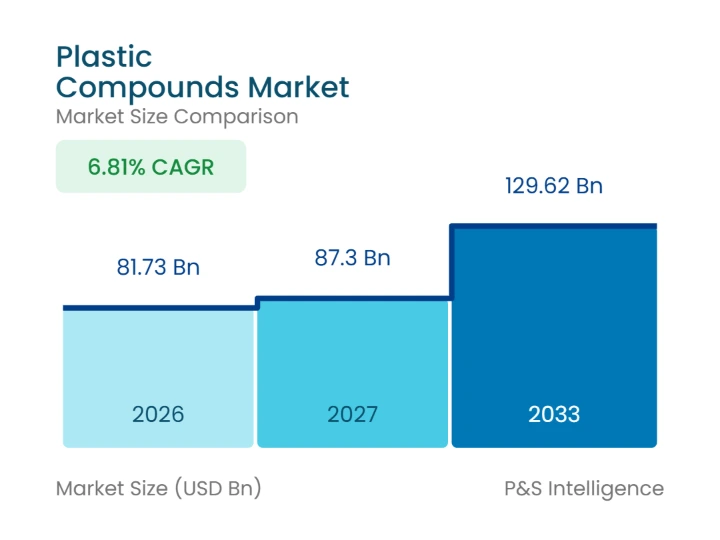
Worldwide, the plastic compounds market is estimated at USD 81.73 billion in 2026, with revenue projected to rise to USD 87.30 billion in 2027. By 2033 the market is projected to be worth USD 129.62 billion, advancing at a CAGR of 6.81% during 2027-2033 as electric vehicle, packaging, and electrical programs specify more formulated grades. Each new part increasingly carries a stiffness, flame-retardancy, or recycled-content requirement that neat resin cannot meet alone, so molders buy ready-to-mold pellets. For compounders, sales therefore depend on how many qualified grade approvals they hold, as much as on tonnage.
Automotive tier-one suppliers and carmakers remain the anchor buyers, specifying talc-filled polypropylene for bumpers and interiors and glass-reinforced polyamide for under-hood and battery parts. According to OICA, global motor vehicle production rose 3.9% to 96.4 million units in 2025. That count sizes the vehicle platform base and does not measure compound use per car, yet each model launched on it starts a fresh round of material qualification. Compounders therefore track carmakers' launch calendars as closely as build volumes, since the approvals won at launch set their order books for years.
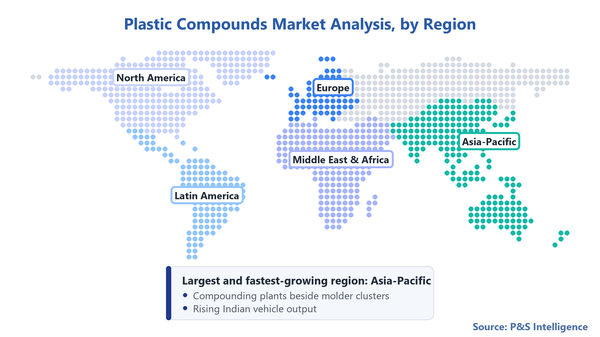
Asia-Pacific accounts for 46% of plastic compounds market revenue in 2026 and is projected to grow fastest, at a 7.3% CAGR during 2027-2033. China's automotive, appliance, and electronics clusters and India's rising vehicle output keep new compounding lines opening close to molders, while Japan and South Korea supply higher-value engineering grades. North America and Europe expand more slowly, with demand tied to model changeovers, lightweighting upgrades, and recycled-content requalification at existing plants rather than new molding capacity.
Key market insights
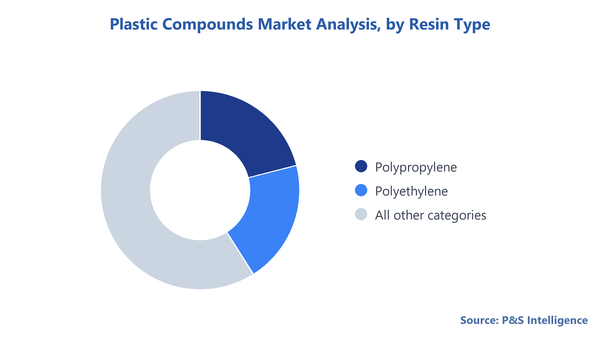
By resin type, polypropylene (PP) accounts for 21% of revenue in 2026, while polyamide (PA) is projected to post an 8.7% CAGR during 2027-2033.
By application, automotive accounts for 26% of revenue in 2026, while packaging is projected to post the fastest growth during 2027-2033.
By source, fossil-based compounds account for 58% of revenue in 2026, while bio-based compounds are projected to expand at an 8.7% CAGR during 2027-2033.
By reinforcement and additive type, unfilled and color compounds account for 34% of revenue in 2026, while carbon fiber reinforced compounds are projected to advance at an 8.3% CAGR during 2027-2033.
By geography, Asia-Pacific accounts for 46% of revenue in 2026 and is projected to record a 7.3% CAGR during 2027-2033.
Recycled-content packaging rules are reshaping compound formulations
European packaging converters are reformulating closures, thin-wall containers, and film grades so that post-consumer recyclate can replace part of the virgin polyolefin in each part. Recyclate arrives with variable melt flow, odor, and color, so converters increasingly buy compounds in which stabilizers, compatibilizers, and impact modifiers have already been added to restore a consistent property window. That change moves spending from neat resin toward formulated pellets, which is the portion of the material bill this market counts.
The European Commission lists the Packaging and Packaging Waste Regulation as in force since February 11, 2025 and applicable since August 12, 2026, with a stated aim of safely increasing the use of recycled plastic in packaging. Its binding minimum recycled-content shares for plastic packaging apply from 2030 at the earliest, which places food-contact and nonfood requalification inside current packaging development cycles. Compounders with secure food-grade recyclate supply and in-house migration testing could see more converter specifications written around their grades as brand owners settle on approved materials ahead of that date.
Electric vehicle platforms are accelerating demand for flame-retardant engineering grades
Carmakers building battery-electric platforms specify engineering compounds for battery module housings, high-voltage connectors, charging inlets, and busbar supports. These parts need flame retardancy, tracking resistance, and dimensional stability at elevated temperature, a combination usually met with glass-reinforced polyamide or PBT carrying halogen-free flame retardants. Each such part often replaces metal or a lower-priced commodity grade, so revenue per vehicle can rise for the plastic compounds market even in years when total vehicle output grows slowly.
Figures from the IEA's Global EV Outlook 2026 put 2025 electric car sales above 20 million, up 20%, meaning one in four new cars sold worldwide was electric. The count sizes the electric platform base and does not measure compound consumption, yet it shows how many new model programs now carry high-voltage architectures that need qualified flame-retardant grades. Compounders already holding flammability certifications and carmaker approvals for these grades are better positioned to win nominations, because swapping a high-voltage material mid-program forces costly revalidation for the tier-one supplier.
Recycled plastic quotas for new vehicles are opening a requalification pipeline
Automotive compounders face a widening gap between the recycled polypropylene and polyamide that carmakers will need and the volume that already passes interior odor, emissions, and impact tests. Plastics recovered from scrapped vehicles arrive mixed and contaminated, so they become usable only after a compounder sorts, stabilizes, and reinforces them into a grade that performs like virgin material. That upgrading step is itself compounding, so recycled-content automotive grades are sold as formulated compounds, which favors suppliers with both recycled plastic sourcing and automotive validation labs.
Under the EU End-of-Life Vehicles Regulation, agreed by the Council and Parliament in December 2025 and formally adopted by the Council in June 2026, plastic in new vehicle types must contain at least 15% recycled material within six years of entry into force and 25% within ten years. A fifth of that recycled plastic must be recovered from end-of-life vehicles. The rule sets content levels without naming a polymer or supplier, so compounders that secure dismantler feedstock and finish carmaker validation early could lock in multiyear nominations on models launching in the 2030s.
Shrinking upstream chemical capacity in Europe is constraining regional compounding margins
European compounders face higher energy and feedstock bills than many competitors in the Middle East, the U.S., and China, while automotive and appliance customers often resist higher part prices. Twin-screw compounding draws heavily on electricity, and many independent compounders rely on nearby polymer plants for short-lead-time resin deliveries. When upstream crackers and polymer units close, these compounders face longer supply chains, higher freight costs, and more exposure to imported resin pricing.
A study commissioned by Cefic, the European Chemical Industry Council, found that announced chemical capacity closures between 2022 and 2025 reached roughly 37 million tonnes, close to 9% of the industry's total production capacity, driven by uncompetitive energy costs, weak demand, and overcapacity. Those closures happen upstream of compounding and do not measure compound output directly. They do shrink the local resin base that European compounders draw on, which weakens their price position against imported compounds and may tilt new compounding investment toward lower-cost regions.
Segmentation Analysis
Resin Type
Polypropylene (PP) accounts for 21% of plastic compounds market revenue in 2026, the largest share of any resin type, because it pairs low density and cost with easy filling and reinforcement. Only PP sold as a formulated compound counts, never neat resin. PP takes talc, glass, and elastomer modifiers readily, so its compounds serve bumpers, door panels, appliance housings, and rigid packaging. The American Chemistry Council's 2026 autos report itemizes 102 pounds of PP in the average North American vehicle, more than any resin it lists. That breadth gives PP compounders large repeat orders that justify dedicated high-throughput lines.
Polyamide (PA) is set to grow fastest among resin types, at an 8.7% CAGR during 2027-2033. Glass-reinforced and flame-retardant PA grades keep their stiffness and creep resistance at temperatures where PP softens, which suits them to electric-drive housings, high-voltage connectors, thermal-management parts, and brackets that replace die-cast aluminum. PA compounds also sell at a higher price per kilogram, so every conversion from metal or a commodity resin adds more revenue per part. Compounders with secure PA 6 and PA 66 supply and in-house flame-retardant formulation skills are better positioned to capture these engineering specifications.
Copyright P&S Intelligence. Reuse requires attribution under CC BY 4.0.
Application
Automotive applications account for 26% of 2026 revenue, the largest share among end uses. Carmakers and tier-one molders buy formulated grades because nearly every exterior, interior, and under-hood part carries a specification for impact, heat aging, scratch resistance, odor, or color match. A vehicle program runs for several years, so a grade approved at launch typically ships for the life of the model, giving compounders a recurring, contracted base. Lightweighting targets widen that base, since each steel or aluminum part redesigned in reinforced plastic becomes new demand for automotive plastics in compound form.
Packaging is set to post the quickest growth of any application over the forecast period. Brand owners and converters are buying more formulated grades for closures, thin-wall containers, and multilayer film because barrier, stiffness, and recycled-content requirements now exceed what a single packaging resin delivers on its own. Food and personal-care packs are redesigned frequently, so a specification change can reach purchase volumes within months. Compounders able to supply recyclate-based packaging grades with consistent food-contact performance stand to gain from this faster reorder cycle.
Source
Fossil-based compounds account for 58% of 2026 revenue. Petrochemical resins come from large integrated plants with stable grade slates, long histories of automotive and appliance approvals, and supply contracts that compounders can price against published feedstock benchmarks. Recycled feedstock is gaining ground, but variable quality still limits its use in safety-critical and food-contact parts without extra testing. For most new part approvals, fossil grades therefore remain the default choice, which keeps integrated resin producers central to compound supply.
Bio-based compounds are projected to grow at an 8.7% CAGR during 2027-2033, the fastest among sources. European Bioplastics estimated global biobased plastics production capacity at 2.31 million tonnes in 2025 and expects it to roughly double to about 4.69 million tonnes by 2030. That expansion widens the pool of biobased polymers that compounders can formulate into drop-in grades. Consumer brands and carmakers with emission-reduction targets are specifying these grades for visible parts and packaging, where a lower carbon footprint can be shown to end customers.
Reinforcement and Additive Type
Unfilled and color compounds account for 34% of 2026 revenue, the largest share by reinforcement and additive type. These grades serve the widest range of molded parts, from appliance housings and consumer goods to packaging and interior trim, where the main need is stable color, UV resistance, or easier processing instead of added stiffness. Simple formulations allow high-throughput lines and quick changeovers, which keeps unit costs low and lets regional compounders compete on lead time and color-matching service.
Carbon fiber reinforced compounds are projected to grow at an 8.3% CAGR during 2027-2033, the fastest among reinforcement types. Short carbon fiber in PA, PBT, or polycarbonate gives higher stiffness per unit weight than glass-filled grades and adds electrical conductivity, which helps designers replace die-cast metal in robot arms, drone frames, EV brackets, and electronics housings that need shielding. Volumes start from a small base at a high price per kilogram, so each design win adds outsized revenue. Compounders with secured chopped and recycled carbon fiber supply are better positioned to accept new programs without allocation delays.
The following segments are analyzed in this report:
Resin Type
Polypropylene (PP)
Polyethylene (PE)
Polyvinyl Chloride (PVC)
Polystyrene (PS)
Polyethylene Terephthalate (PET)
Polybutylene Terephthalate (PBT)
Polyamide (PA)
Polycarbonate (PC)
Acrylonitrile Butadiene Styrene (ABS)
Thermoplastic Elastomers (TPV, TPO, TPU)
Other Resins
Application
Automotive
Packaging
Building & Construction
Electrical & Electronics
Consumer Goods
Industrial Machinery
Medical Devices
Other Applications
Source
Fossil-based
Recycled
Bio-based
By Reinforcement & Additive Type
Unfilled / Color Compounds
Mineral-Filled (Talc, Calcium Carbonate)
Glass Fiber Reinforced
Flame Retardant
Carbon Fiber Reinforced
Others (Elastomer-Modified, Natural Fiber)
Regional Analysis
Asia-Pacific plastic compounds market outlook
Asia-Pacific holds a 46% share of 2026 revenue, the largest of any region, because most of the world's cars, appliances, and consumer electronics are molded there, close to compounding plants. China is the region's largest market, with automotive, appliance, and electronics clusters in Guangdong and Zhejiang that buy compounds in container loads from domestic and multinational suppliers. Local production lets compounders match grades and colors quickly and avoid the freight and duty costs of imported pellets, which favors suppliers that run plants inside each major cluster.
The region is also projected to grow fastest, at a 7.3% CAGR during 2027-2033, and India is its fastest-growing market. SIAM data show domestic passenger vehicle wholesales in India rose 7.9% to 4.64 million units in fiscal 2025-26, a count of the platform base compounders supply that excludes exports and does not measure compound use per vehicle. Rising car, two-wheeler, and appliance output encourages local compounding capacity, since imported grades add weeks to qualification and delivery. Japan and South Korea contribute higher-value engineering and electronics grades, which supports regional revenue per tonne.
Copyright P&S Intelligence. Reuse requires attribution under CC BY 4.0.
Europe market analysis
Europe holds a sizable, value-led position in compound demand, supported by carmakers and machinery builders in Germany, France, Italy, and Spain and by appliance and electrical-equipment makers that specify engineering grades. German compound demand depends heavily on premium vehicle and industrial machinery programs, where each grade carries demanding heat, impact, and flammability requirements. Growth in the region comes mostly from model changeovers, lightweighting upgrades, and the requalification of existing parts with recycled content, so formulation work per tonne rises even when volumes are flat.
Plastics Europe recorded that Europe's share of global plastics production fell from 22% in 2006 to 12% in 2024. A smaller regional production base leaves European compounders with fewer nearby polymer sources, which squeezes margins for those without captive resin supply. Producers that combine circular-feedstock access with validated recycled grades are better positioned to defend volume as carmakers and packaging groups reorder around EU recycled-content rules.
Latin America market analysis
Latin America trails the larger regions, with compound demand concentrated in the vehicle, appliance, and packaging industries of Brazil and Mexico. Mexico's assembly plants buy engineering compounds largely to specifications set by U.S., Japanese, and European carmakers, which draws qualified grades from North American and Asian compounders as well as from local lines. Brazil's demand comes from locally built cars, agricultural machinery, and packaging for food exports, where polyolefin compounds are widely used.
According to ANFAVEA, Brazil's vehicle production rose 3.5% to 2.64 million units in 2025, helped by a 32.1% rise in exports to 528,800 vehicles. Those figures count vehicles built, including exports, and do not measure compound use, yet they show Brazilian assembly lines running higher volumes for both domestic and export programs. Compounders with plants in Brazil can avoid import duties and currency swings on imported pellets, which gives them a cost advantage on high-volume interior and exterior parts.
Middle East and Africa market analysis
The Middle East and Africa accounts for a smaller portion of compound demand, though Gulf petrochemical producers give the region a distinctive cost position. Saudi Arabia and the U.A.E. host integrated producers that make polypropylene and polyethylene from low-cost feedstock, and some add compounding to capture more value per tonne before export. Local demand comes mainly from construction products, pipes and fittings, packaging, and appliance assembly. Until Gulf vehicle assembly and downstream conversion plants reach volume, much of the region's compound output is likely to serve customers in Asia and Europe.
South Africa supplies the region's main automotive demand, built around export vehicle programs. The naamsa quarterly review counted a record 414,268 South African vehicle exports in 2025, up 5.9% and equal to 70.3% of local light vehicle production, with most units shipped to Europe. That count covers exports only and does not measure compound use, yet it shows local molders building interior and exterior parts to export-program specifications. Compounders that pair Gulf polyolefin feedstock with carmaker-approved grades are better positioned to win that business across the region.
North America market analysis
North America remains one of the larger regional markets, supported by automotive, appliance, medical, and packaging industries in the U.S. and Canada. Compound demand there depends mainly on specification changes at model changeovers, on light-truck and SUV production that uses large volumes of talc-filled PP, and on medical-device molders that buy grades certified for biocompatibility and sterilization. New electronics and EV battery assembly plants add molding programs, though many remain in qualification.
The Plastics Industry Association's 2026 Size and Impact Report valued direct U.S. plastics industry shipments at USD 533.6 billion in 2025, a figure covering resin, molding, and finished products that is far broader than compound sales. It still shows the depth of the domestic molding base that compounders supply. Independent U.S. compounders compete through short lead times, custom color and property matching, and small-lot service, which keeps them relevant against integrated resin producers on specialty and medical grades.
The following geographies are analysed in this report.
Asia-Pacific
China
Japan
India
South Korea
Australia
Rest of Asia-Pacific
Europe
Germany
France
U.K.
Italy
Spain
Rest of Europe
Latin America
Brazil
Mexico
Rest of Latin America
Middle East & Africa
Saudi Arabia
U.A.E.
South Africa
Rest of Middle East & Africa
North America
U.S.
Canada
Plastic Compounds Market Competition Analysis
The plastic compounds market is moderately fragmented, with no single supplier holding a commanding position across resin families, applications, and regions. Compounding lines cost far less to build than polymerization plants, so regional and custom compounders can open sites close to molder clusters. Demand is also split across thousands of part specifications in automotive, packaging, electrical, medical, and consumer goods, each with its own property and color requirements, and molders value short lead times and local technical service.
Integrated resin producers such as BASF SE, Saudi Basic Industries Corporation, and LyondellBasell Industries N.V. compound their own polymers and compete on feedstock cost, global plant networks, and long-running carmaker approvals. Engineering and specialty material companies, including Celanese Corporation, Covestro AG, and Asahi Kasei Corporation, concentrate on polyamide, polycarbonate, acetal, and other high-heat grades for electrical, medical, and electric-vehicle parts. Independent compounders such as Avient Corporation, Miller Waste Mills Inc. (RTP Company), Kingfa Sci. & Tech. Co. Ltd., and Washington Penn Plastic Co. Inc. compete on custom formulation, color matching, small-lot flexibility, and regional service.
Ownership in engineering polymers keeps shifting, as Celanese's 2022 purchase of most of DuPont's Mobility and Materials business and XRG's controlling stake in Covestro, completed in December 2025, show. Such deals move scale among large producers without removing the long tail of regional compounders. For molders, switching costs arise at the grade level. Once a compound is qualified on a vehicle, appliance, or medical part, changing supplier usually means new testing, so incumbents tend to keep volume for the program life and new entrants win business mainly at launches and recycled-content requalifications.
Major Companies in Plastic Compounds Market:
BASF SE
LyondellBasell Industries N.V.
Saudi Basic Industries Corporation
Dow Inc.
Asahi Kasei Corporation
Covestro AG
Celanese Corporation
Avient Corporation
Arkema S.A.
Kuraray Co. Ltd.
Teijin Limited
Kingfa Sci. & Tech. Co. Ltd.
Syensqo SA
Miller Waste Mills Inc. (RTP Company)
Washington Penn Plastic Co. Inc.
Adell Plastics Inc.
Polyvisions Inc.
Plastic Compounds Market News
In September 2026, Syensqo SA announced a new aromatic-polymer compounding line at its Panoli site in Gujarat, India, that will double the site's compounding capacity for Ryton PPS, KetaSpire PEEK, Amodel PPA, and Ixef PARA grades from the first quarter of 2028. The line gives automotive manufacturers and suppliers in India a local source of high-heat specialty compounds.
In June 2026, Saudi Basic Industries Corporation launched LNP ELCRIN DC0051RC1, its first carbon fiber-reinforced compound based on post-consumer recycled content, with 75% recycled content and a UL94 V0 rating at 0.8 mm. Available worldwide, the grade targets laptop housings and thin-wall structural parts where electronics brands want recycled content without losing flame performance.
In June 2026, Avient Corporation launched eight Therma-Tech thermally conductive grades based on natural graphite for LED lighting, automotive heat sinks, and heat-exchange systems. The grades respond to tighter fire-safety requirements for electrified polymer parts in automotive, consumer electronics, and industrial equipment, where the formulations are designed to replace aluminum and other metal components.
In February 2026, Kingfa Sci. & Tech. Co. Ltd., through Kingfa Science & Technology (India) Limited, began commercial production at a new manufacturing unit in the RIICO Industrial Area of Bhiwadi, Rajasthan. The unit expands the Indian subsidiary's domestic production base, shortening supply lines to molders serving north India's vehicle and appliance makers.
Last Updated: October 2026
Frequently Asked Questions About This Report
How big is the plastic compounds market?+
Worldwide, the plastic compounds market is estimated at USD 81.73 billion in 2026, with revenue projected to rise to USD 87.30 billion in 2027.
What is the growth rate of the plastic compounds market?+
By 2033 the market is projected to be worth USD 129.62 billion, advancing at a CAGR of 6.81% during 2027-2033 as electric vehicle, packaging, and electrical programs specify more formulated grades.
Which region dominates the plastic compounds market?+
Asia-Pacific accounts for 46% of plastic compounds market revenue in 2026 and is projected to grow fastest, at a 7.3% CAGR during 2027-2033.
Which resin type holds the largest share of plastic compounds?+
Polypropylene (PP) accounts for 21% of plastic compounds market revenue in 2026, the largest share of any resin type, because it pairs low density and cost with easy filling and reinforcement.
Why are polyamide compounds used in electric vehicles?+
Glass-reinforced and flame-retardant PA grades keep their stiffness and creep resistance at temperatures where PP softens, which suits them to electric-drive housings, high-voltage connectors, thermal-management parts, and brackets that replace die-cast aluminum.
Who are the major plastic compound manufacturers?+
Integrated resin producers such as BASF SE, Saudi Basic Industries Corporation, and LyondellBasell Industries N.V. compound their own polymers and compete on feedstock cost, global plant networks, and long-running carmaker approvals.
Want a report tailored exactly to your business need?
Leading companies across industries trust us to deliver data-driven insights and innovative solutions for their most critical decisions. From data-driven strategies to actionable insights, we empower the decision-makers who shape industries and define the future. From Fortune 500 companies to innovative startups, we are proud to partner with organisations that drive progress in their industries.
Client Testimonials
Working with P&S Intelligence and their team was an absolute pleasure – their awareness of timelines and commitment to value greatly contributed to our project's success. Eagerly anticipating future collaborations.
McKinsey & Company
India
Unmatched Standards
Our insights into the minutest levels of the markets, including the latest trends and competitive landscape, give you all the answers you need to take your business to new heights
Complete Data Security
We take a cautious approach to protecting your personal and confidential information. Trust is the strongest bond that connects us and our clients, and trust we build by complying with all international and domestic data protection and privacy laws