This Report Provides In-Depth Analysis of the Philippines Wearable Device Market Report Prepared by P&S Intelligence, Segmented by Device (Smartwatches, Smart Glasses, Smart Clothing, Fitness Bands), Application (Consumer Products, Healthcare, Industrial), Distribution (Online Retailers, Offline Retailers), End User (Personal Users, Enterprises), Connectivity (Wi-Fi, Bluetooth, Cellular, NFC), Price (Low-cost Wearables, Mid-range Wearables, Premium Wearables), Operating System (Watch OS, Wear OS, FitbitOS, Tizen OS), and Geographical Outlook for the Period of 2021 to 2032
Explore the market potential with our data-driven report
Philippines Wearable Device Market Future Outlook
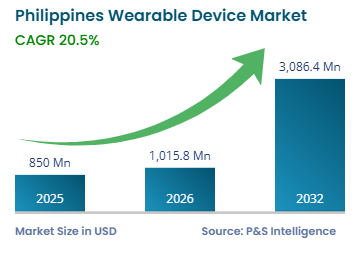
The Philippines wearable device market was worth approximately USD 850 million in 2025 and will grow at a compound annual growth rate (CAGR) of 20.5% from 2026 through 2032. It will be worth about USD 3086.4 million in 2032.
The market growth will be caused by an increase in health-conscious Filipino consumers, increased smartphone penetration (above 90% in urban areas), and increasing digital infrastructure that allows for seamless connections between wearable devices and mobile ecosystems. Smartwatches and fitness bands will lead the market because they provide consumers with real-time health monitoring features such as heart rate monitoring, blood oxygen level measurements, and sleep analysis. The Philippine Statistics Authority (PSA) stated that the digital economy represented 8.5% of gross domestic product (GDP) in 2024. In addition, the PSA stated that 83.8% of digital economic activities were enabled by digital enablers.
In addition, international brands continue to make wearable devices more affordable for Filipino consumers through both online and offline channels. The Universal Health Care Act (Republic Act No. 11223) was passed by the Philippine Congress in 2019 and requires the use of digital health technologies, including wearable devices and remote patient monitoring systems, for the integration of these technologies into the national healthcare system.
Expansion of Digital Infrastructure Is Major Trend
The Philippines has made significant advancements in digital connectivity to enable seamless wearable device functionality. A recent study conducted jointly by the Philippine Statistics Authority (PSA) and the Department of Information and Communications Technology (DICT) found that 67.3% of individuals aged 10 and older (approximately 61.46 million Filipinos) accessed the internet in 2024, representing a significant increase over prior years.
As a result, smartphone penetration in Metro Manila exceeds 90%, creating the necessary ecosystem for smartwatches to connect to the Internet and allow consumers to synchronize apps and manage their health information. As 4G and emerging 5G networks expand beyond the major urban centers, wearable devices connected to cellular networks can operate independently, making wearable devices addressable to secondary cities and rural provinces. As long as the government continues to invest in digital infrastructure under the National Broadband Plan, connectivity barriers will decrease and opportunities for the rapid adoption of wearable devices will continue to develop through 2032.
Increased Health Awareness and Chronic Disease Rates Drive Demand for Wearable Devices
Increasing rates of chronic diseases among adult Filipinos create structural demand for wearable health monitoring devices. More than two-thirds of total deaths in the Philippines are due to chronic illness; most common chronic illnesses include: heart (cardiovascular) disease, cancer, diabetes, and chronic lung (respiratory) disease. Causes of death also include an estimated 4 million adults living with diabetes; and high rates of CKD (chronic kidney disease) have been reported in several studies. These non-communicable diseases result in significant premature mortality and place a heavy economic strain on the country, costing roughly 4.8% of annual GDP due to healthcare expenses and lost productivity.
As a result, there is a direct correlation between the health burden and consumer demand for wearable devices that can continuously monitor vital signs, since cardiovascular diseases cause one in every three deaths from non-communicable diseases in the country. The primary function of wearable devices that offer heart rate tracking, blood pressure tracking, and activity monitoring addresses the self-care imperative of managing chronic diseases. However, this trend also supports the Department of Health's expansion of digital health initiatives through the Philippine Package of Essential Noncommunicable Disease Interventions (PhilPEN), so wearable devices are being positioned as tools for preventing illness, as opposed to luxury items.
Increasing Disposable Income and Expanding E-Commerce Platforms Create Opportunities
The convergence of increasing disposable income and expanding e-commerce platforms creates new paths for growth, particularly for previously underserved consumer segments. The Philippine Institute for Development Studies (PIDS) estimates that the Philippine economy will grow 6.1% in 2025, driven largely by an expansion of household consumption and improving employment conditions that will permit discretionary expenditures on consumer electronics. Household spending on consumer goods is projected to grow at an average of 7.5% per year through 2028 as middle-income households allocate additional resources toward health and wellness products.
The average annual household income increased by nearly 15% in 2023, and the contribution from gross national disposable income to the growth rate for gross savings in 2024 resulted in an estimated 16-17% increase in gross savings for 2024; indicating that income increased at a faster pace than consumption. Growth estimates for the average household disposable income in the Philippines are currently projecting a nearly 9% increase in 2025, totaling approximately PHP 414,000, and if the labor market remains strong, then additional increases will likely continue to occur even in the face of rising costs of living.
E-commerce platforms, including Lazada and Shopee, have expanded access to both premium and affordable wearable options for consumers in rural provinces and provinces, thereby bypassing the traditional concentration of retail outlets in Metro Manila. These twin developments enable international brands to target price-sensitive consumers in rural provinces with affordable smartwatches and fitness bands, while providing installment payment plans to reduce the barrier to purchase. The opportunity for growth will increase as manufacturers begin to launch entry-level smartwatches and fitness bands designed specifically to meet the needs of emerging market consumers.
Smartwatches dominated the wearable device market in the Philippines in 2025 with 40% share. Smartwatches have the highest share of the market due to the combination of their integration into the smartphone ecosystem, their advanced health-monitoring capabilities, and the strong brand presence of global technology companies, including Apple, Samsung, and Huawei.
Filipino consumers in urban areas increasingly see smartwatches as an essential companion to their smartphones, allowing them to receive notifications, make contactless payments (where possible), and track their fitness. According to the Philippine Statistics Authority (PSA), 90.6% of households in the National Capital Region (Metro Manila) have smartphones, thereby creating the required connectivity environment for the adoption of smartwatches among digitally active
Fitness bands are expected to experience the fastest growth in the wearable device market in the Philippines, due to their affordability and appeal to health-conscious consumers looking for entry-level wearable solutions. Xiaomi and Huawei are two of the most popular manufacturers of affordable fitness bands, and are therefore able to bring affordable wearable technology to price-sensitive consumers in rural provinces.
Affordable fitness bands from these manufacturers provide consumers with basic health-tracking functions, such as heart rate monitoring, sleep analysis, and step-counting, without the premium price associated with feature-rich smartwatches. As e-commerce platforms expand their distribution footprint beyond Metro Manila, the availability of affordable fitness tracking devices will increase among rural consumers.
The market is segmented according to the following device types:
Smartwatches (largest category)
Fitness Bands (fastest growing category)
Smart Glasses
Smart Clothing
Others
Application Analysis
Consumer products comprised the largest share of the wearable device market in 2025, of 45%, because wearable devices are primarily adopted by individual consumers for personal fitness tracking, lifestyle management and for integrating with their smartphones. Filipino consumers primarily use wearable devices to track their activity levels, monitor their sleep, and receive notifications. The wide availability of consumer-grade smartwatches and fitness bands through both online platforms and offline retailers supports the dominance of the consumer-products segment in the wearable device market.
Healthcare applications are expected to experience the fastest growth through 2032, driven by the increasing prevalence of chronic diseases among Filipino adults and the increasing awareness of health issues among Filipino adults. The WHO reported that 33% of Filipino adults aged 30 to 79 had hypertension in 2024, and only 19% of those individuals had controlled blood pressure. Wearable devices that provide heart rate tracking, blood oxygen monitoring and irregular rhythm detection will help to address this need for preventive care, especially as the Department of Health integrates digital health technologies into the national healthcare system through the PhilPEN package of interventions.
The wearable market is segmented by application into the following categories:
Consumer Products (largest category)
Healthcare (fastest growing category)
Industrial
Others
Distribution Channel Analysis
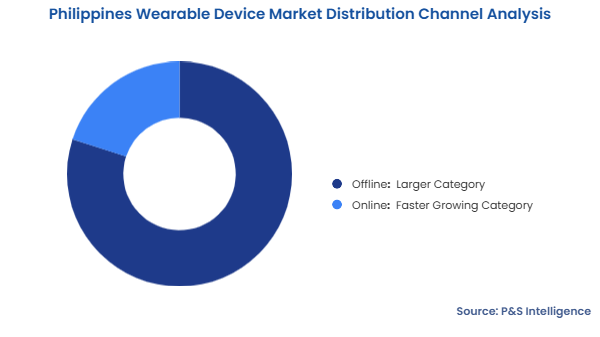
Retailers selling wearable devices off-line held the largest distribution channel share in 2025, comprising approximately 80% of all wearable device sales in the Philippines. Authorized brand stores, electronics retailers (such as Abenson and SM Appliance Center), and mobile phone shops enable consumers to try out wearable devices before purchasing them, pay immediately for the purchase of wearable devices, and obtain after-purchase service and support, all of which are critical in the Filipino retail market. The concentration of flagship stores of well-known brands (including Apple, Samsung, and Huawei) in shopping malls in Metro Manila supports the continued dominance of off-line retailers in the wearable device market.
Online retailers are expected to grow faster than off-line retailers through the forecast period, driven by increasing e-commerce penetration and specific promotions and discounts offered by online retailers. Shopee and Lazada enable consumers to compare prices for wearable devices across brands, pay for wearable devices via installment plans, and have wearable devices shipped to their homes or offices, even if they live in provinces where off-line retailer coverage is limited. The ease of purchasing wearable devices on-line, combined with regular flash sales and other forms of promotional pricing, appeals to younger consumers who place a priority on value and accessibility.
The market is segmented according to the following distribution channels:
Offline (dominant category)
Online (category with fastest growth)
Drive strategic growth with comprehensive market analysis
Philippines Wearable Device Market Regional Outlook
Metro Maina (NCR) Wearable Devices Market Size
Metro Manila dominates the market with 40% share as it is geographically the most important area; it has the largest number of people—more than 14 million people live here—and also the highest level of purchasing power. It therefore accounts for about 45% of the total revenue generated in 2025 from wearable devices throughout the Philippines. The high level of digital connectivity—the Philippine Statistics Authority reported that in 2024, there was a 68.7% household Internet connection rate and a 90.6% smartphone penetration among those aged 10 years or older in the NCR—far exceeds the national average.
There are a large number of multinational technology retailers, and many high-end shopping centers and hospitals in Metro Manila which will make it easier for the people in this area to purchase smartwatches and fitness trackers. There are a large number of electronic retailers in Metro Manila such as SM Cyberzone, Abenson and authorized brand stores that sell their products in large numbers in the NCR area. In addition, there is a high%age of young people in Metro Manila and they all have good knowledge of digital technologies, and they have enough money to buy wearable devices with advanced functions such as mobile network connections, NFC payment and comprehensive health monitoring.
Calabarzon Wearable Devices Market Forecast
Calabarzon is the fastest growing provincial market in the Philippines, with a CAGR, of approx. 21.0%, in the forecast period. It is located in the north-east of Metro Manila and is known as the country’s industrial hub. Because of its location near Metro Manila, the province has attracted a large number of electronics companies. The Department of Information and Communications Technology (DICT) stated in its data that in 2024, household Internet penetration rates were 61.3% in Central Luzon and 56.4% in CALABARZON. These figures indicate that these areas are well-suited for rapid growth in wearable devices.
Provincial and regional analysis in this report includes:
Manila Metri (NCR) (Largest Region)
Calabarzon (Fastest Growing Region)
Central Luzon
Central Visayas (Cebu)
Davao Region
Rest of Philippines
Philippines Wearable Device Market Share
The market is moderately fragmented with global technology leaders and budget-oriented Asian manufacturers operating at different price levels. The fragmentation of the market is due to the varying purchasing power of Filipino consumers, with global technology leaders capturing premium international brands in urban professional markets. The market structure is driven by low barriers to entry into the distribution channel, no local manufacturing capacity, and the ability of the established global supply chain to operate through both authorized retailer networks and e-commerce platforms.
Global technology leaders have maintained strong positions in the premium smartwatch segment through brand reputation, ecosystem integration and retail presence through authorized distributor networks and flagship stores in Metro Manila’s major shopping districts. Global technology leaders compete for customers’ loyalty through advanced health features, seamless smartphone connectivity and premium build quality that enables them to charge higher prices among affluent urban consumers.
In the value segment, aggressive pricing by Chinese manufacturers has significantly increased the market accessibility. As manufacturers continue to develop increasingly feature-rich devices and sell them at increasingly lower prices, competitive intensity is expected to grow further and reduce profit margins while increasing the number of customers that wearable device manufacturers can reach.
Key Philippines Wearable Device Companies:
Apple Inc.
Samsung Electronics Co. Ltd.
Xiaomi Corporation
Huawei Technologies Co. Ltd.
Garmin Ltd.
Fitbit LLC (Google)
Fossil Group Inc.
realme Mobile Telecommunications (Shenzhen) Co. Ltd.
Guangdong OPPO Mobile Telecommunications Corp. Ltd.
Cosmic Technologies Inc. (Cherry Mobile)
Philippines Wearable Device Market News
In July 2025, Samsung Electronics Co. Ltd. released the Galaxy Watch8 Series in the Philippines, with features including an 11% thinner design, a Dynamic Lug System for improving sensor performance, and enhanced health monitoring capabilities.
In November 2024, Xiaomi Corporation released the Smart Band 9 Pro and Smart Band 9 Active in the Philippines at PHP 3,799 and PHP 1,199 respectively, providing users with the opportunity to track their workouts personally using heart rate monitoring, and enjoy up to 21 days of battery life.
In September 2024, Apple Inc. began pre-orders for the Apple Watch Series 10 in the Philippines through authorized retailers including Digital Walker, Power Mac Center, and Beyond the Box, with aluminum models available from PHP 26,490. The new features of the watch include a 40% brighter screen, 10% thinner design, and enhanced health-monitoring capabilities, including the ability to detect sleep apnea.
In September 2024, Garmin Ltd. released the fēnix 8 smartwatch series in the Philippines at PHP 63,490 to PHP 77,790 depending on model specifications, with the following features: Elevate V5 sensor technology for ECG monitoring, advanced GPS navigation, and up to 48 days of battery life with solar charging.
In May 2024, Huawei Technologies Co. Ltd. released the WATCH FIT 3 in the Philippines at PHP 6,499 with a pre-order bundle worth up to PHP 3,598, with features including a 1.82-inch AMOLED display, 10 days of battery life, and TruSleep 4.0 sleep monitoring technology.
In May 2024, Huawei Technologies Co. Ltd. released the WATCH FIT 3 in the Philippines for PHP 6,499; in addition, it will be offered in a package that includes up to PHP 3,598 of value through pre-orders. In terms of its technical specifications, the WATCH FIT 3 is equipped with a 1.82-inch AMOLED screen, 10 days of battery life, and TruSleep 4.0 sleep monitoring capabilities.
Frequently Asked Questions About This Report
What will be was Philippines wearable devices market 2025 size?+
In 2025, the wearable devices market in Philippines was USD XX million.
Which device type dominates the Philippines wearable devices industry?+
Smartwatches dominate the Philippines wearable devices industry with XX% revenue.
Which province has largest Philippines wearable devices market share?+
Manila Metro (NCR) is the largest wearable devices market in Philippines, with XX share%.
What are the key Philippines wearable devices industry drivers?+
The Philippines wearable devices industry is driven by an increase in health-conscious Filipino consumers, increased smartphone penetration, and increasing digital infrastructure that allows for seamless connections between wearable devices and mobile ecosystems
What is the Philippines wearable devices market nature?+
The wearable devices market in Philippines is moderately fragmented.
Want a report tailored exactly to your business need?
Leading companies across industries trust us to deliver data-driven insights and innovative solutions for their most critical decisions. From data-driven strategies to actionable insights, we empower the decision-makers who shape industries and define the future. From Fortune 500 companies to innovative startups, we are proud to partner with organisations that drive progress in their industries.
Client Testimonials
Working with P&S Intelligence and their team was an absolute pleasure – their awareness of timelines and commitment to value greatly contributed to our project's success. Eagerly anticipating future collaborations.
McKinsey & Company
India
Unmatched Standards
Our insights into the minutest levels of the markets, including the latest trends and competitive landscape, give you all the answers you need to take your business to new heights
Complete Data Security
We take a cautious approach to protecting your personal and confidential information. Trust is the strongest bond that connects us and our clients, and trust we build by complying with all international and domestic data protection and privacy laws