This Report Provides In-Depth Analysis of the Philippines Telemedicine Market Report Prepared by P&S Intelligence, Segmented by Type (Tele Hospitals and Clinics, Tele Home), Service (Tele Consulting, Tele Monitoring, Tele Education, Tele Training), Specialty (Dermatology, Gynecology, Neurology, Cardiology, Orthopedics), and Geographical Outlook for the Period of 2021 to 2032
Explore the market potential with our data-driven report
Philippines Telemedicine Market Outlook
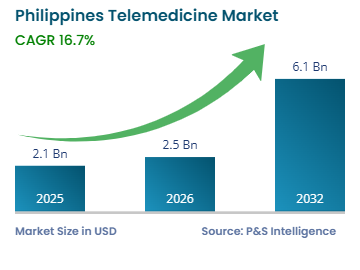
The Philippines telemedicine market was valued at USD 2.1 billion by 2025, and it is estimated that the telemedicine market will grow at an annual rate of 16.7% from 2026 to 2032 to USD 6.1 billion. The expansion of the telemedicine industry is caused by increased demand for healthcare services, a growing number of people suffering from chronic illnesses, the increase in digital infrastructure, and the support of the Universal Health Care initiative to provide remote healthcare services.
The implementation of the Universal Health Care Act (Republic Act No. 11223) in 2019 helped accelerate the incorporation of telemedicine into the country's universal healthcare system, especially to assist those living in geographically isolated and disadvantaged areas (GIDAs). The WHO reported that non-communicable diseases (NCDs) result in more than 500,000 deaths each year in the Philippines, which increases the demand for remote monitoring and teleconsultation services.
Improved digital connectivity continues to support the expansion of the telemedicine industry. Internet penetration now exceeds 83% of the population. The PSA stated that the CALABARZON region had the greatest number of health facilities at 4,415; followed by Central Luzon and Metro Manila, therefore providing infrastructure for the deployment of telemedicine across urban and provincial markets.
Philippines Telemedicine Market Emerging Trends
Expanding Digital Infrastructure Is Key Trend
Improving digital connectivity is fundamentally changing telemedicine service delivery capabilities throughout the entire Philippine archipelago. Internet penetration has surpassed 83% of the population, while mobile cellular subscriptions exceed 150 million connections, which provides fundamental infrastructure for mobile-first telehealth platforms. By 2028, the Department of Information and Communications Technology (DICT) estimates that digital health sector employment will reach 300,000 positions, indicating significant technological ecosystem development to support the growth of telemedicine.
Smartwatch availability will be greatly impacted by the growing use of the internet, as shown by a recent PSA/DICT study which estimated that 67.3%of all Filipino's who are at least 10 years old (or approximately 61.46 million people), used the internet in 2024, which is an increase from previous years. The high rate of smartphone penetration in Metro Manila, exceeding 90 percent, has created the required environment for smartwatches to access the Internet and enable consumers to synchronize their apps and monitor their health information.
In addition to expanding existing 4G networks and new emerging 5G network into major urban areas, with cell phone service available for wearable devices that connect through these networks, the devices can function on their own. Remote video consultations, remote patient monitoring via wearable devices, and AI-enabled diagnostic tools are being incorporated into telemedicine platforms in greater numbers, allowing for better quality care to be delivered to patients remotely. Urban and provincial markets are both seeing rapid adoption of telemedicine due to the growth of telecommunications infrastructure beyond Metro Manila.
Increasing Chronic Disease Prevalence and Healthcare Access Gap Drive Market
Philippines have large-scale healthcare access challenges that generate structural demand for telemedicine services. About 70% of the rural population does not have access to quality healthcare facilities, and physician-to-population ratios remain extremely low at about one doctor for every 26,000 people in underserved areas. Non-communicable diseases represent 67% of all deaths in the Philippines, and cardiovascular diseases, diabetes, and respiratory conditions require ongoing monitoring that telemedicine systems can handle cost effectively.
The increasing number of Filipino adults suffering from chronic conditions creates a growing structural need for wearable health monitoring devices. Chronic illnesses account for more than 2/3 of all deaths in the Philippines; the leading causes of chronic illnesses include cardiovascular (heart) disease, cancer, diabetes, and chronic respiratory (lung) disease. The causes of death also include approximately 4 million adults with diabetes; as well as a considerable prevalence of chronic kidney disease (CKD) that has been demonstrated through numerous studies. Non-communicable diseases are responsible for a great deal of premature mortality and are extremely economically burdensome to the country.
Non-communicable diseases cost the Philippine economy an approximate 4.8% of annual gross domestic product (GDP), in both direct medical costs and indirect costs due to lost productivity. These chronic disease burdens also generate demand for teleconsultation and telemonitoring services across urban and provincial markets and make telemedicine a vital infrastructure for healthcare delivery expansion under Universal Health Care implementation.
Provincial Market Gaps in Specialist Access Create Growth Opportunities
There is a considerable gap in the number of specialized health professionals available for the need in the Philippines; this can be seen by the low amount of health professional-to-population ratios and the uneven geographic distribution of these individuals; the Philippines has approximately 6 doctors per 10,000 population which is below the World Health Organization (WHO) recommended ratio of 10 and it is believed that there is a shortage of nearly 290,000 health professionals in the country when using the global recommended standards for the appropriate numbers.
There is a high concentration of the number of specialists in the urban populations and many of the rural provinces have less than 0.5 specialists per 1,000 people, whereas there are over 3 specialists per 1,000 people in many of the large metropolitan areas. There is also a very low number of dermatologists throughout the Philippines with an approximate total of 1,345 dermatologists across the entire country and a ratio of roughly one dermatologist for every 100,000 people.
The number of dermatologists is particularly low in certain regions such as Mindanao (~.027 dermatologists for every 100,000 people) and BARMM (~.04 dermatologists for every 100,000 people). Furthermore, less than 30%of the dermatologists are accredited by PhilHealth. Similarly, cancer care is severely limited as well; there is only an average of 0.32 medical oncologists, 0.15 surgical oncologists, 0.09 radiation oncologists and 0.03 palliative care specialists for every 100,000 people; these statistics demonstrate the significant lack of cancer care and access to specialized care due to the extreme shortages of health professionals in various parts of the Philippines.
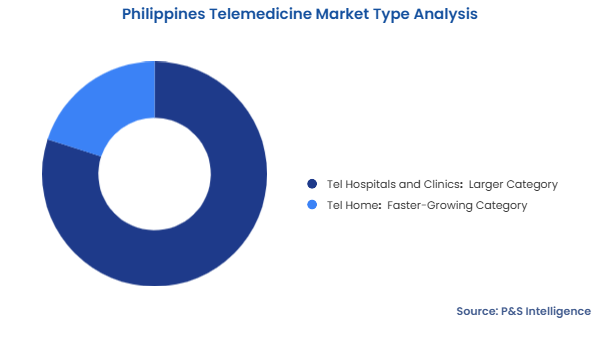
Tele hospitals and clinics represented the largest portion of the Philippines telemedicine market in 2025, accounting for approximately 80% of the overall revenue. Tele hospitals and clinics dominate the market because they have the largest concentrations of specialist physicians and diagnostic resources that allow for telehealth services to be provided to both urban and provincial patients. The majority of the major healthcare providers such as The Medical City, Metro Pacific Health, and St. Luke's Medical Center offer integrated teleconsultation services that connect patients to licensed specialists in various fields of medicine. The DOH considers Hospital Based Telemedicine to be a key method for extending specialist care to underserved communities under Universal Health Care implementation.
Tele home is expected to experience the fastest growth from 2026 to 2032, as a result of the increased adoption of remote patient monitoring devices, mobile health apps, and home based chronic disease management services. As a result of the increased incidence of cardiovascular disease and the affordability of wearable devices that allow for continued health monitoring outside of clinical environments, there is increasing opportunity for prevention based models that decrease hospitalizations.
The market is segmented by type into:
Tel Hospitals and Clinics (Larger Category)
Tel Home (Faster-Growing Category)
Service Analysis
Tele consulting was the largest portion of the Philippines telemedicine market in 2025 and represented approximately 40% of service revenues. Tele Consulting is the largest category because there is substantial patient demand for real time physician consultations regarding acute symptoms, prescriptions renewals, and specialist referrals without physical clinic visits. Several major telemedicine platforms, including mWell, KonsultaMD, and Medgate Philippines, combined serve over seven million registered users who utilize their 24/7 teleconsultation services to cover general medicine, pediatrics, and internal medicine specialties.
Tele monitoring is expected to demonstrate the fastest growth from 2026 to 2032. The PSA stated that ischemic heart disease was the leading cause of death in 2024, generating substantial demand for remote cardiac monitoring, blood pressure tracking, and glucose management services to provide ongoing health oversight between clinic visits.
The market is segmented into the following services:
Tele Consulting (Largest Category)
Tele Monitoring (Fastest-Growing Category)
Tele Education
Tele Training
Other
Specialty Analysis
Cardiology was the largest segment of the Philippines telemedicine specialty market in 2025, with 35% share, driven by the high prevalence of cardiovascular disease and the availability of telecardiology services through several major hospital networks. Cardiology provides services such as remote ECG monitoring, virtual consultations with cardiologists, and post-procedure follow up care that meet the substantial patient demand for remote cardiac health care. The ability of telemedicine platforms to integrate wearable ECG devices with telemedicine platforms allows for the real time monitoring of heart rhythms and the generation of physician alerts.
Dermatology is expected to experience the fastest growth from 2026 to 2032. Teledermatology store-and-forward platforms allow patients to submit images of their skin conditions for evaluation by specialists, meeting the acute shortages of dermatologists in provincial areas and reducing waiting times for consultations. Dermatological conditions lend themselves well to remote diagnoses due to their visual nature.
There are a lot of cases of skin disease in the Philippines because it has been found in many studies that between 50–80%of people in the workplace will suffer from at least one type of skin disease. Dermatitis and eczema (approximately 30%), disorders of pigmentation (approximately 19%) and disorders of the skin appendages including acne (approximately 17%) are the three most common types of dermatological problems, with melasma and acne being two of the most commonly diagnosed conditions. In addition, according to community and clinical studies, superficial fungal infections occur approximately 18% of the population while scabies occurs approximately 2–10% of the general population; however, prevalence rates for scabies have reached as high as 20–40% in pediatric clinics.
Elderly Filipino citizens may experience a variety of conditions including xerosis/xerotic eczema (approximately 10%), contact dermatitis (approximately 7%), psoriasis (approximately 5-6%) and seborrheic dermatitis (approximately 5%). In addition, overall prevalence of psoriasis in the general population is estimated to be approximately 1.7%. However, despite having a high rate of skin disease, there continues to be barriers to accessing quality healthcare with an average of only 1.19 dermatologists available to serve the needs of each 100,000 people, and most of these dermatologists are located in urban areas.
The market is segmented into the following specialties:
Cardiology (Largest Category)
Dermatology (Fastest-Growing Category)
Gynecology
Neurology
Orthopedics
Others
Drive strategic growth with comprehensive market analysis
Metro Manila (National Capital Region) represented the largest portion of the Philippines telemedicine market in 2025, accounting for approximately 40% of the total revenues generated in the Philippines. Metro Manila dominates the market because it contains the largest number of tertiary hospitals, specialist physicians, and major telemedicine platform headquarter locations, and it possesses the most developed telecommunications infrastructure.
Many major healthcare organizations, including The Medical City, St. Luke's Medical Center, and Makati Medical Center, offer telehealth services primarily to patients in the National Capital Region but also extend services to other parts of the country. The DOH has designated digital health services under Universal Health Care as a priority area for expansion, and telemedicine is viewed as a key mechanism for delivering primary care and specialist consultations.
CALABARZON Telemedicine Market Outlook
CALABARZON (Region IV-A) is expected to be the fastest-growing region, and the growth rates in this region are expected to be more than 17.5%. The growth of CALABARZON is expected to be fueled by its proximity to Metro Manila, the rapidly urbanizing population of over 16 million, and the highest number of health facilities in the nation. Central Luzon is another major healthcare hub in the north, and Central Visayas serves as the regional healthcare center in the Visayas, containing some internationally accredited hospitals.
Davao Telemedicine Market Growth
Davao Region is the anchor for healthcare delivery in Mindanao, and there is a large unmet need for telemedicine services in the underserved southern portions of the country. The ITU reported that there were over 150 million mobile cellular subscriptions in the Philippines, providing a foundation for widespread adoption of mobile-based telemedicine services in all regions.
Davao Region is the anchor for healthcare delivery in Mindanao, and there is a large unmet need for telemedicine services in the underserved southern portions of the country. The ITU reported that there were over 150 million mobile cellular subscriptions in the Philippines, providing a foundation for widespread adoption of mobile-based telemedicine services in all regions.
The regions analyzed in this report are
Metro Manila / NCR (Largest Region)
CALABARZON (Fastest-Growing Region)
Central Luzon
Central Visayas
Davao Region
Rest of Philippines
Philippines Telemedicine Market Share
The Philippine telemedicine market is relatively fragmented with a number of local digital health platforms, hospital-based telehealth services, and international telemedicine providers. Although no one company has a monopoly on the Philippine telemedicine market, the growing trend of larger corporations acquiring smaller telehealth platforms is contributing to an increase in market concentration. The relative lack of barriers to entry for developing a telemedicine platform; the variety of regional healthcare needs within the Philippines; and changes to the regulatory environment have all contributed to the ability of numerous competitors to develop a presence in various categories of telemedicine services in the country.
Platform capabilities and healthcare network partnerships are key ways in which competitors differentiate themselves. International competitors operate in the Philippine telemedicine market using regional partnerships and bring to the market global telemedicine technologies. Telemedicine services developed by hospitals such as The Medical City and other major healthcare systems offer additional competition through established relationships with existing patients and specialist physicians.
Key Philippines Telemedicine Companies:
Metro Pacific Health Tech Corporation (mWell)
KonsultaMD
Medgate Philippines
SeeYouDoc Inc.
Medifi Health Technology Solutions
HealthNow Philippines
Doctor Anywhere Philippines
The Medical City (TMC)
Teladoc Health Inc.
American Well Corporation (Amwell)
Philippines Telemedicine Market News
In December 2025, MPHTC launched mWell ECG Ring – a wellness ring with built-in ECG monitoring; priced at PHP 12,999. It allows users to check their heart every day using the mWell App to help reduce cardiovascular disease which has become the number one killer in the Philippines.
In February 2025, MPHTC acquired KonsultaMD from Ayala for a confidential sum of money; combined their platforms serving 5.8 million users to create the Philippines’ largest digital healthcare platform. The acquisition enhances mWell’s tele-consulting capabilities, electronic pharmacy & artificial intelligence powered health management system.
In February 2025, MPHTC launched the first medical drone delivery service in Southeast Asia; mWell On-The-Go Drone Delivery was launched in Barangay Niogan, Pililla, Rizal and will deliver medication to remote areas in less than 10 minutes compared to the usual 2 hours it would take by land or sea.
In May 2024, MPHTC introduced mWell Ring; the mWell Ring is the Philippines’ first smart wellness ring that tracks sleep quality, lifestyle habits and provides daily wellness score at affordable price point. This represents mWell’s entry into the consumer wearable market supporting remote health care services.
In March 2024, The Medical City (TMC) integrated artificial intelligence into their chest X-ray imaging services and increased diagnostic compliance rates to 99.88% from 98%. AI supports TMC’s digital transformation strategy and increase teleradiology capabilities across its hospital network.
Frequently Asked Questions About This Report
What will be was Philippines telemedicine market 2025 size?+
In 2025, the telemedicine market in Philippines was USD XX million
Which provider type dominates the Philippines telemedicine industry?+
Tele hospitals & clinics dominate the Philippines telemedicine industry with XX% revenue
Which province has largest Philippines telemedicine market share?+
Manila Metro (NCR) is the largest telemedicine market in Philippines, with XX share%
What are the key Philippines telemedicine industry drivers?+
The Philippines telemedicine industry is driven by increasing demand for healthcare, growing incidence of chronic illnesses, expanding digital infrastructure, and implementation of the Universal Health Care initiative
What is the Philippines telemedicine market nature?+
The telemedicine market in Philippines is fragmented
Want a report tailored exactly to your business need?
Leading companies across industries trust us to deliver data-driven insights and innovative solutions for their most critical decisions. From data-driven strategies to actionable insights, we empower the decision-makers who shape industries and define the future. From Fortune 500 companies to innovative startups, we are proud to partner with organisations that drive progress in their industries.
Client Testimonials
Working with P&S Intelligence and their team was an absolute pleasure – their awareness of timelines and commitment to value greatly contributed to our project's success. Eagerly anticipating future collaborations.
McKinsey & Company
India
Unmatched Standards
Our insights into the minutest levels of the markets, including the latest trends and competitive landscape, give you all the answers you need to take your business to new heights
Complete Data Security
We take a cautious approach to protecting your personal and confidential information. Trust is the strongest bond that connects us and our clients, and trust we build by complying with all international and domestic data protection and privacy laws