Philippines Electronic Health Record Market Size & Share Analysis - Emerging Trends, Growth Opportunities, Competitive Landscape, and Forecasts (2026 - 2032)
This Report Provides In-Depth Analysis of the Philippines Electronic Health Record Market Report Prepared by P&S Intelligence, Segmented by Delivery Mode (Web/Cloud Based, On Premises), Component (Practice Management, Patient Management, E-prescription, Referral Management, Population Health Management), End User (Inpatient Facilities, Ambulatory care centers, Physician offices), and Geographical Outlook for the Period of 2021 to 2032
Philippines Electronic Health Record Market Size Estimation
Key Highlights
Study Period
2021 - 2032
Market Size in 2025
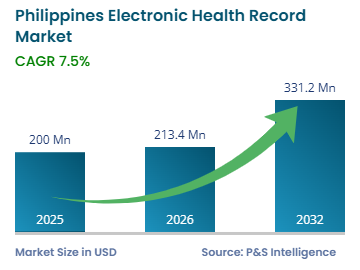
USD 200.0 Million
Market Size in 2026
USD 213.4 Million
Market Size by 2032
USD 331.2 Million
Projected CAGR
7.5%
Largest Province
Manila Metro (NCR)
Fastest-Growing Province
CALABARZON
Market Structure
Fragmented
Market Size
Explore the market potential with our data-driven report
Philippines Electronic Health Record Market Future Outlook
The Philippines electronic health record (EHR) market was USD 200.0 million in 2025, and it is anticipated to grow to USD 331.2 million by 2032 at a compound annual growth rate (CAGR) of 7.5% from 2026 to 2032. This growth will occur due to the implementations of the Universal Health Care Act of 2019 and the Philippine Digital Health Strategy 2024–2028, which will lead to the mandatory digitalization of the Philippines’ more than 40,000 health facilities. EHR adoption is also being accelerated by the Department of Health’s (DOH) eHealth Program and the certification of electronic medical records (EMRs) by PhilHealth for accredited hospitals to receive their Primary Care Benefit Packages.
Due to an expanding healthcare infrastructure in the Philippines, there will be a high demand for integrated health information systems. As of 2024, the DOH estimates that there are more than 1,350 hospitals and 25,800 barangay health stations in the Philippines, providing a great deal of opportunity for digitalization. Lower upfront costs and scalable nature of cloud-based EHR systems are causing them to gain popularity with smaller health facilities, while larger, tertiary hospitals are continuing to implement on-premise EHR solutions primarily due to data sovereignty concerns.
The growth of the EHR market in the Philippines is also being fueled by increasing rates of chronic diseases, rising spending on healthcare, which is nearing 6% of the GDP, and government initiatives to promote the use of interoperable standards for EHRs through the infrastructure of the Philippine Health Information Exchange.
Key Market Insights
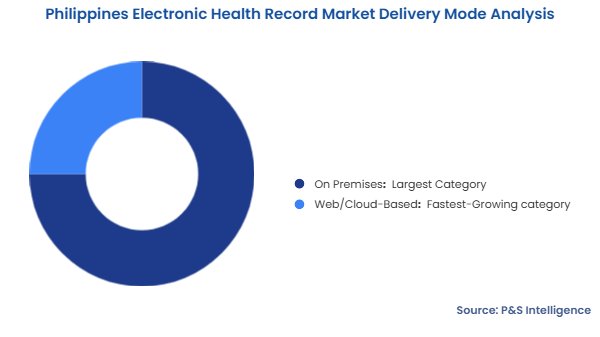
On-premises EHR solutions held about 75% of market revenue in 2025, driven by legacy hospital systems and data sovereignty requirements.
Practice management represented the largest portion of the EHR market in 2025, of 35%, driven by the fact that they are required for the operation of all healthcare facilities.
Ambulatory care centers are expected to witness the fastest growth in the EHR market, growing at 7.9% CAGR, driven by rising outpatient demand and the Universal Health Care Act encouraging EHR adoption in primary care facilities.
In-patient facilities held the largest share of the EHR market in 2025, accounting for about 55% of total revenue, driven by PhilHealth accreditation requirements that encourage hospitals to implement integrated health information systems.
Manila Metro (NCR) accounted for the largest share, while CALABARZON is expected to be the fastest-growing EHR market.
Philippines Electronic Health Record Market Growth Factors
Adoption of Cloud Deployment Is Major Market Trend
The cloud-based EHR model is revolutionizing the way healthcare IT is implemented in the Philippines. On-premise EHR solutions require the purchase of substantial amounts of server equipment, networking infrastructure, and IT personnel to manage the solution — resources that are often limited among smaller hospitals and rural health units. Cloud-based EHR solutions eliminate the need for initial purchases of hardware, allow for pay-as-you-go pricing models, and provide scalability to meet evolving needs of the facility.
Cloud-based EHR solutions benefit the majority of the country’s approximately 25,800 barangay health stations that require low-cost digitalization solutions. Increasingly, Filipino healthcare providers realize the benefits of cloud-based EHR solutions such as the ability to automatically update software, provide remote access to the EHR system, and provide disaster recovery capabilities that are essential for a country that experiences frequent typhoons. The trend of increased adoption of cloud-based EHR solutions is expected to continue through 2032 as internet connectivity continues to improve throughout the Philippines.
Over 50% of the healthcare organizations are actively considering or have adopted cloud-based/AI enabled technologies to support applications including telemedicine, diagnostic services, and the management of patient information. The government has also implemented programs to advance the development of EHRs and digital health infrastructure which will continue to foster the use of cloud based platforms by hospitals, clinics, and other healthcare service providers to provide greater access to telehealth/remote care services to patients.
Growing Chronic Disease Burden Creates Continuing Need for EHR Systems
The Philippines is experiencing an increase in the prevalence of chronic diseases that necessitate ongoing, coordinated care that can be provided using EHR systems. According to the Philippine Statistics Authority (PSA), ischemic heart disease, cerebrovascular disease, and diabetes are among the top three causes of death in the Philippines and therefore will require long-term patient monitoring and coordination between multiple providers.
Longitudinal tracking of patients and medication management, as well as continued care coordination are necessary components of managing chronic conditions and can be accomplished through the use of EHR systems. Modern EHR systems also include the capability to conduct population health management allowing healthcare networks to identify patients who are at risk, monitor adherence to treatment plans and measure the effectiveness of treatments across patient populations. The increasing number of older adults in the Philippines, with the population projected to exceed 15 million by 2030, will create additional demand for EHR systems to manage the complexities associated with caring for older adults with multiple chronic conditions.
Approximately 70% of the rural Philippine population does not have access to quality medical care. In addition, the ratio of doctors to residents in these remote areas is extremely low at 1 per 26,000 residents. Non-communicable conditions require continuous medical monitoring by a doctor or healthcare provider. This type of condition would be a perfect fit for a telemedicine platform as it is very expensive to monitor continuously on an individual basis via traditional methods.
The number of adult Filipinos suffering from chronic illness has increased significantly thus, there is a large structural demand for wearable health monitors. More than two-thirds of all deaths in the Philippines are caused by chronic illness. The top 5 causes of chronic illness include heart disease/cardiovascular disease, cancer, diabetes, and lung disease. There are more than four million adults with diabetes in the Philippines, and there is a very high incidence of CKD in the Filipino population. Non-communicable diseases are a major cause of premature death in the Philippines and place a huge economic burden on the country.
Philippines Electronic Health Record Market Segmentation Analysis
Delivery Mode Analysis
On-premises EHR solutions represented the largest market segment in 2025, representing approximately 75% of the total market revenue. This is due to the long-standing prominence of legacy system installations in major tertiary hospitals and data sovereignty preferences of large healthcare networks. The policies of institutions regarding the retention of patient health information within the institution's controlled infrastructure also make it dominant. The Data Privacy Act of 2012 of the Philippines and implementing regulations specifically relating to healthcare create compliance obligations for many hospital administrators that they resolve by deploying on-premises EHR solutions that allow them to retain direct control over patient data.
Web/cloud-based EHR solutions are expected to experience the fastest growth through 2032, with 7.6% CAGR, driven by lower overall cost of ownership, scalability for growing practice size, and fewer IT infrastructure requirements. The Philippine Department of Health (DOH) and PhilHealth have developed standards that enable the certification of cloud-based EMRs for use with claims processing and for compliance with regulatory requirements.
The market can be segmented based on delivery modes into:
On Premises (Largest Category)
Web/Cloud-Based (Fastest-Growing category)
Component Analysis
Practice management represented the largest portion of the EHR market in 2025, of 35%, driven by the fact that they are required for the operation of all healthcare facilities. Components of practice management include patient scheduling, billing, and automated workflow for administrative tasks that are applicable to both small physician offices and large hospital networks.
E-prescribing is expected to experience the fastest growth through 2032, with 7.7% CAGR, driven by increasing regulatory pressures to digitally prescribe medications from the Food and Drug Administration of the Philippines and the integration of prescription data by PhilHealth into claims verification processes. The growing prevalence of chronic diseases that require ongoing medication management will continue to drive the adoption of E-Prescribing.
The market can be segmented based on component into:
Practice Management (Largest Category)
Patient Management
E-Prescription (Fastest-Growing category)
Referral Management
Population Health Management
Others
End User Analysis
In-patient facilities were the largest segment of the EHR market in 2025, representing approximately 55% of the total market revenue. PhilHealth accreditation requirements for hospitals create a regulatory obligation to implement integrated health information systems for claims processing, driving EHR adoption among the Philippines’ 1,351 hospitals. Tertiary hospitals with higher patient volumes and greater complexity of care coordination needs represent the greatest amount of EHR investment. The DOH reports that the three metropolitan regions of Metro Manila, CALABARZON, and Central Luzon contain more than 580 hospitals, representing the greatest concentration of EHR demand among acute care hospitals.
Ambulatory care centers are expected to experience the fastest growth in the EHR market. with 7.9% CAGR, through the forecast period. The growth in demand for EHR solutions by outpatient facilities, including ambulatory care centers, is driven by provisions of the Universal Health Care Act that expand access to primary care and encourage the adoption of EHRs by outpatient facilities. The growing middle class in the Philippines seeking convenient outpatient services and ongoing chronic disease management are creating sustained demand for ambulatory EHR solutions.
The market can be segmented based on end user into:
Inpatient Facilities (Largest Category)
Acute care
Long-term care
Post-acute care
Ambulatory Care Centers (Fastest-Growing category)
Physician Offices
Drive strategic growth with comprehensive market analysis
Philippines Electronic Health Record Market Geographical Analysis
Manila Metro (NCR) EHR Market Size
In 2025, Metro Manila (NCR), accounted for the largest share, of 40%. This is because it contains the greatest proportion of tertiary hospitals, private healthcare organizations, and corporate headquarters of major hospital organizations, such as Metro Pacific Hospital Holdings, St. Luke’s Medical Center, and The Medical City. In addition, NCR possesses advanced IT infrastructure, the highest level of healthcare spending per capita, and compliance with regulations related to PhilHealth’s central operations, which further enhance NCR’s dominance in the EHR market.
CALABARZON EHR Market Growth Forecast
Between 2026 and 2032, CALABARZON is expected to grow at the highest rate, of greater than 7.8%. The Department of Health in the Philippines reports that CALABARZON has the greatest number of hospitals in the country, with 233 hospitals in comparison to the 157 hospitals located within the NCR. Therefore, there exists a great potential for EHR implementations in the CALABARZON region.
The CALABARZON region is benefiting from population growth of greater than 2.5% each year, proximity to the NCR and the continued development of ambulatory care centers to serve the growing middle class population. Provincial governments in Cavite, Laguna, and Batangas are actively investing in healthcare digitization to enhance service delivery to residents.
The regions analyzed in this study include:
Metro Manila (NCR) (the largest provincial market)
CALABARZON (the fastest growing provincial market)
Central Visayas
Davao Region
Central Luzon
Rest of Philippines
Philippines Electronic Health Record Market Share Analysis
The Philippine EHR market has a moderately fragmented competitive structure, with both domestic and international EHR vendors operating in the market. This fragmentation is a result of the diversity of healthcare facility types—ranging from large tertiary hospitals requiring complex enterprise-wide systems to small physician offices requiring lightweight practice management systems. The regulatory environment creates barriers to entry for non-certified vendors, and certification requirements favor PhilHealth-approved EMR providers, creating a barrier to market entry for non-certified vendors.
Solutions provided by domestic vendors typically include PhilHealth integration, interfaces in the Filipino language, and regional implementation support networks. As international vendors begin to develop cloud-based solutions designed to address the costs of implementing EHR solutions, the competitive dynamics of the market are changing, and domestic vendors are beginning to add new features to their EHR solutions that enable them to serve larger healthcare facilities.
Philippines Electronic Health Record Market Players:
Epic Systems Corporation
Oracle Health
MEDITECH
Allscripts Healthcare LLC
eClinicalWorks LLC
athenahealth Inc.
Bizbox Inc.
SeriousMD Inc.
Global Health Intelligence
Optimum Data Analytics Inc.
Philippines Electronic Health Record Market News & Updates
In October 2024, Oracle Corporation launched its next-generation EHR, based on the Oracle Cloud Infrastructure, with embedded AI capabilities, including clinical AI agents and voice-enabled navigation. The product release positions Oracle Health to build upon its current presence in enterprise healthcare markets globally, including the Southeast Asian region.
In September 2024, Oracle Health announced the migration of more than 1,000 EHR customer sites to Oracle Cloud Infrastructure, as part of its Autonomous Shield initiative. Early adopters of the initiative reported a 50% improvement in the speed at which they could access patient information. The cloud migration also enhanced the security posture and performance of Cerner Millennium deployments.
In February 2024, PhilHealth announced a 30% increase in health benefits and implemented the All Case Rates-Based Global Budget (ACR-GB) to simplify claims processing. The changes are expected to create a greater need for EMR systems to facilitate efficient reimbursement processes for healthcare facilities.
Frequently Asked Questions About This Report
What will be Philippines EHR market 2032 size?+
In 2032, the EHR market in Philippines will be USD 200.0 million.
Which component dominates the Philippines EHR industry?+
Practice management dominates the Philippines EHR industry with 35% revenue.
Which province has largest Philippines EHR market share?+
Manila Metro (NCR) is the largest EHR market in Philippines, with 40% share.
What are the key Philippines EHR industry drivers?+
The Philippines EHR industry is driven by government digital health initiatives, increasing demand for efficient patient data management, expansion of telemedicine services, growing cloud adoption, the need for healthcare data interoperability, and rising healthcare costs.
What is the Philippines EHR market nature?+
The Philippines EHR market is fragmented.
Want a report tailored exactly to your business need?
Leading companies across industries trust us to deliver data-driven insights and innovative solutions for their most critical decisions. From data-driven strategies to actionable insights, we empower the decision-makers who shape industries and define the future. From Fortune 500 companies to innovative startups, we are proud to partner with organisations that drive progress in their industries.
Client Testimonials
Working with P&S Intelligence and their team was an absolute pleasure – their awareness of timelines and commitment to value greatly contributed to our project's success. Eagerly anticipating future collaborations.
McKinsey & Company
India
Unmatched Standards
Our insights into the minutest levels of the markets, including the latest trends and competitive landscape, give you all the answers you need to take your business to new heights
Complete Data Security
We take a cautious approach to protecting your personal and confidential information. Trust is the strongest bond that connects us and our clients, and trust we build by complying with all international and domestic data protection and privacy laws