This Report Provides In-Depth Analysis of the Philippines EHealth Market Report Prepared by P&S Intelligence, Segmented by Product Type (Telemedicine, Electronic Health Records (EHR), e-Prescribing, Clinical Decision Support, Consumer Health Information, Mobile Health (mHealth )), Service Type (Monitoring Services, Diagnostic Services, Healthcare Strengthening), End User (Healthcare Providers, Healthcare Consumers, Payers), and Geographical Outlook for the Period of 2021 to 2032
Explore the market potential with our data-driven report
Philippines EHealth Market Overview
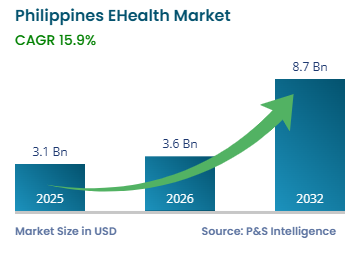
The Philippines eHealth market revenue was USD 3.1 billion in 2025, and it is expected to witness a compound annual growth rate of 15.9% over 2026–2032, reaching USD 8.7 billion by 2032. The growth in this industry will be due to the growing burden of chronic diseases which require continuous remote monitoring; the expansion of digital infrastructures; and the development of government programs to incorporate technology into the delivery of healthcare under the Universal Health Care Act.
The rapid adoption of telemedicine platforms, electronic health records and mobile health applications indicate significant changes in how individuals consume healthcare throughout the archipelago. According to the Philippine Statistics Authority, the top three causes of death in the Philippines in 2024 were ischemic heart diseases, neoplasms, and cerebrovascular diseases, emphasizing the need for digital health solutions for active disease management and remote patient monitoring.
In addition, the penetration of smartphones into the population exceeded 76% and the access to the Internet was at about 73%, which provides a conducive environment for the adoption of eHealth. The Department of Information and Communications Technology (DICT) has identified digital health as one of the priority components of its Digital Health Strategy 2024–2028, with an aim to provide digital health as an integral part of achieving universal healthcare coverage particularly in underserved and geographically isolated communities.
Telemedicine Integration and Mobile-First Healthcare Models Are Trending
The eHealth market in the Philippines is experiencing a paradigm shift as telemedicine platforms transition from stand-alone consultation services to fully integrated healthcare ecosystems which combine virtual consultations, e-pharmacy, laboratory coordination, and remote patient monitoring. In addition, mobile-first healthcare delivery models are becoming the preferred mode of interaction for the population, given the widespread use of smartphones and the preference of many to interact digitally.
Many major platforms, including mWell and KonsultaMD, have evolved their offerings from basic teleconsultations to include full health management functions such as electronic prescriptions, delivery of medicines, referral for diagnostics, and artificial intelligence (AI)-powered assessments of health. This trend toward integrated digital health ecosystems positions telemedicine as a central element of healthcare delivery, as opposed to being an ancillary service, and platform consolidation is accelerating as larger companies acquire smaller, specialized service providers to create comprehensive portfolios.
Increasing Burden of Chronic Disease Is Primary Driver for Market
The increasing prevalence of chronic disease necessitating continuous monitoring is encouraging both healthcare systems and patients to seek out eHealth solutions to facilitate proactive disease management. The World Health Organization (WHO) estimates that non-communicable diseases comprise about 68% of all deaths in the Philippines, with cardiovascular disease, diabetes, cancer, and respiratory disease being the top four causes of death requiring long-term clinical supervision.
Traditional healthcare delivery models are struggling to accommodate the increasing number of chronic disease patients, thereby creating a structural demand for remote monitoring technologies, mobile health applications, and telemedicine platforms that permit regular clinical contact without the requirement of hospital visits. Physicians using wearable devices to monitor glucose levels, blood pressure, and cardiac rhythms can continuously track the health data of their patients and adjust treatment plans based upon real time data, resulting in fewer hospital readmissions and better health outcomes at a lower cost to the healthcare system.
Approximately 70% of rural Filipinos do not have access to quality medical services. The physician-to-resident ratio is very low in these underserved locations, at one doctor for approximately 26,000 people. Cardiovascular, diabetes and respiratory related illnesses are primarily non communicable conditions which require continuous medical follow up. These types of conditions are a primary use case for telemedicine platforms because they are costly to monitor on an individual basis using traditional methods.
There is a significant increase in the number of adult Filipino’s who suffer from chronic illness creating an ever increasing structural demand for wearable health monitoring devices. Chronic illnesses cause more than two thirds of all deaths in the Philippines. The top five most common causes of chronic illness are heart disease (cardiovascular), cancer, diabetes, and lung disease. There are over four million adults with diabetes in the Philippines; and there is a high incidence of chronic kidney disease (CKD) among the Filipino population. Non communicable diseases are a major contributor to premature death in the Philippines and place an immense economic burden on the country.
Gaps in Rural Healthcare Access Create Market Opportunities
Large disparities in access to healthcare in urban versus rural settings in the Philippines create opportunities for growth in eHealth solutions that can bridge geographical gaps through mobile enabled healthcare delivery. The Department of Information and Communications Technology (DICT) reports that the national level of Internet penetration has reached 72.7%, with continued investment in broadband infrastructure through the Broadband ng Masa program, extending Internet availability to geographically isolated and disadvantageous areas.
The lack of specialists in medicine and advanced medical facilities in provincial areas represents underserved markets where telemedicine can provide specialist consultations, diagnostic support, and prescription services previously unavailable or difficult to obtain without considerable travel to urban centers. As well, government initiatives such as the Universal Health Care Act create policy supports for the deployment of eHealth in underserved communities and position digital health as critical infrastructure for achieving universal coverage objectives.
Philippines EHealth Market Segmentation Analysis
Product Type Analysis
Telemedicine held the largest share of the Philippines eHealth market in 2025, accounting for about 35% of the total revenue. This reflects the fundamental shift to remote healthcare delivery that occurred due to pandemic era adoption patterns, and continues due to the structural advantages of telemedicine such as reduced travel required, 24/7 access, and lower consultation costs relative to hospital visits.
The archipelagic nature of the Philippines creates inherent barriers to accessing healthcare physically that telemedicine is able to address, enabling specialist consultations irrespective of the location of the patient. Many large platforms such as mWell and Medgate have developed extensive physician networks providing video consultations, chat-based medical advice, and e-prescriptions that are now viewed as normal modes of accessing healthcare in urban and increasingly rural populations.
Mobile health (mHealth) applications are expected to experience the fastest growth during the forecast period as a result of the widespread use of smartphones, exceeding 76%, and the consumer preference for self-directed health management.
The market can be segmented into the following product type categories:
Telemedicine (Largest Category)
EHR
ePrescribing
Clinical Decision Support
Consumer Health Information
mHealth (Fastest-Growing Category)
Others
Service Type Analysis
Monitoring services represented the largest portion of the Philippines eHealth market in 2025, of 40%, reflecting the need for continuous health tracking of patients with chronic conditions such as diabetes, cardiovascular diseases, and hypertension. With the ability to remotely monitor vital signs, medication compliance, and disease progression, healthcare providers are able to improve clinical outcomes and reduce the burden on healthcare systems through fewer hospital visits.
Diagnostic services are anticipated to show the greatest growth of 16.1% CAGR, during 2026-2032 as AI-powered diagnostic tools, laboratory coordination platforms, and image interpretation services increase access to diagnostic capabilities. Non-communicable diseases account for approximately 68% of all deaths in the Philippines, creating ongoing demand for diagnostic services to facilitate early detection of diseases and ongoing assessment of disease status.
The market can be segmented into the following service type categories:
Monitoring (largest category)
Diagnostic (fastest growing category)
Healthcare Strengthening
Others
End User Analysis
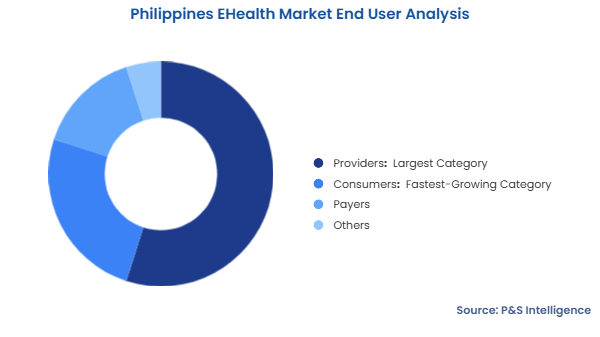
Providers represented the largest end user market in 2025, with 55% share. Hospitals, clinics, and physician practices increasingly implement electronic health records, clinical decision support systems, and telemedicine platforms to enhance operational efficiencies and quality of care provided to patients. Private hospital networks in Metro Manila, Cebu, and Davao are making significant investments in health information technology infrastructure to modernize clinical workflows and enable integrated management of patient data across multiple locations.
Consumers are expected to experience the fastest growth as individual patients increasingly adopt mobile health applications, wellness tracking tools, and direct-to-consumer telehealth services for self-managed health. Ischemic heart diseases, neoplasms, and cerebrovascular diseases remain the top three causes of mortality in the Philippines according to the Philippine Statistics Authority, driving consumer adoption of digital health tools for proactive management of chronic diseases and prevention.
The market can be segmented into the following end user categories:
Providers (Largest Category)
Consumers (Fastest-Growing Category)
Payers
Others
Drive strategic growth with comprehensive market analysis
Philippines EHealth Market Regional Outlook
Manila Metro (NCR) eHealth Market Size
In 2025, approximately 45% of the total e-Health industry revenue generated in the Philippines is attributable to the Manila Metro (NCR). The reason for this high concentration is due to the large number of hospitals (approximately 186) within the metropolitan area and the location of the head offices of several telemedicine companies, such as mWell, Konsulta MD, and Medgate. In addition, Metropolitan Manila enjoys better quality broadband connectivity, higher household income levels to support subscription to digital health services, and a higher density of private hospitals that invest in health information technologies. The WHO also reported that 68% of all deaths in the Philippines were attributed to Non-Communicable Diseases and that urban populations demonstrated a higher use rate of e-Health for the management of chronic conditions.
Cebu eHealth Market Forecast
Cebu City was found to be the most rapidly expanding provincial e-Health market, with CAGR of over 16.%. Cebu City is a central hub for healthcare services within the Visayas region and is experiencing rapid growth in urbanization, improvements in digital connectivity and expansions in private healthcare networks. These factors have positioned Cebu City as a key regional center for the deployment of telemedicine and the adoption of health information systems. Davao City serves as the anchor for the development of digital health in Mindanao and is working with telemedicine companies to provide specialist consultations to remote communities under the direction of the provincial government.
Provinces included in this study are:
Metro Manila (NCR) (Largest Provincial Market)
Cebu (Fastest-Growing Provincial Market)
Davao
Rest of Philippines
Philippines EHealth Market Share Analysis
Competitive structure of the Philippines e-Health market is characterized as moderately fragmented with an emerging trend towards consolidation. Larger integrated healthcare organizations are acquiring specialized digital health organizations to establish a comprehensive service ecosystem. Fragmentation exists because of the numerous e-Health subsegments — telemedicine, electronic health record, mobile health application, and e-pharmacy — that attract different competitors with unique capabilities.
However, platform integration strategies are changing competitive dynamics among major players who want to offer an end-to-end health journey to patients rather than a series of point solutions. Barriers to entry include the cost of establishing a digital health platform, creating a network of physicians, meeting regulatory requirements, and acquiring customers. Customer acquisition costs are particularly challenging due to the fact that customer trust and reliability are critical drivers in the adoption of digital health services.
Philippines EHealth Producers:
KonsultaMD Inc.
Medgate Philippines Inc.
HealthNow Philippines Inc.
AIDE Philippines Inc.
Lifetrack Medical Systems Inc.
Docquity Philippines Inc.
Zennya Health Inc.
CareSpan Health Inc.
MediCard Philippines Inc.
Philippines EHealth Market News
In July 2025, the University of the Philippines-Manila collaborated with FUJIFILM Asia Pacific Healthcare Learning Academy to introduce a certificate program in medical imaging and health informatics. The program will train radiographers and medical professionals in health information system and EHR implementation, helping address workforce capability gaps in the implementation of digital health.
In June 2025, Manila-based telemedicine startup &you received funding from international investors to grow its engineering team and expand services. Funding will enable the company to build a local version of its telemedicine system, which includes features for mobile onboarding, medical history collection, and prescription services along with national medicine delivery to underserved communities.
In February 2025, Metro Pacific Health Tech Corporation (mWell) acquired KonsultaMD Inc. from the Ayala Group in an all-cash deal. The acquisition created a combined user base of over 5.8 million subscribers and solidified mWell as the dominant player in the digital healthcare ecosystem of the Philippines.
In March 2024, the Department of Health (DOH), Asia eHealth Information Network, and the UNICEF held the Philippine Digital Health Summit 2024 at Makati Diamond Residences, bringing together 149 stakeholders to move forward the Philippine Digital Health Strategy 2024–2028. At the summit, the DOH linked investment in digital health with eight priority programs that support the implementation of the Universal Health Care Act.
Frequently Asked Questions About This Report
What will be Philippines ehealth market 2025 size?+
The ehealth market in Philippines was valued at USD 3.1 billion in 2025.
Which end user dominates the Philippines ehealth industry?+
Providers dominate the Philippines ehealth industry with 55% revenue.
Which province has largest Philippines ehealth market share?+
Manila Metro (NCR) is the largest ehealth market in Philippines, with 45% share.
What are the key Philippines ehealth industry drivers?+
The Philippines ehealth industry is driven by the growing burden of chronic diseases and government programs to incorporate technology into the delivery of healthcare under the Universal Health Care Act.
What is the Philippines ehealth market nature?+
The ehealth market in Philippines is fragmented.
Want a report tailored exactly to your business need?
Leading companies across industries trust us to deliver data-driven insights and innovative solutions for their most critical decisions. From data-driven strategies to actionable insights, we empower the decision-makers who shape industries and define the future. From Fortune 500 companies to innovative startups, we are proud to partner with organisations that drive progress in their industries.
Client Testimonials
Working with P&S Intelligence and their team was an absolute pleasure – their awareness of timelines and commitment to value greatly contributed to our project's success. Eagerly anticipating future collaborations.
McKinsey & Company
India
Unmatched Standards
Our insights into the minutest levels of the markets, including the latest trends and competitive landscape, give you all the answers you need to take your business to new heights
Complete Data Security
We take a cautious approach to protecting your personal and confidential information. Trust is the strongest bond that connects us and our clients, and trust we build by complying with all international and domestic data protection and privacy laws