This Report Provides In-Depth Analysis of the Philippines Connected Healthcare Market Report Prepared by P&S Intelligence, Segmented by Component (Hardware, Software, Services), Type (Telemedicine, mHealth Services, mHealth Devices, Remote Patient Monitoring, ePrescription), Application (Diagnosis & Treatment, Monitoring Applications, Wellness & Prevention, Healthcare Management), Delivery Mode (Cloud-Based, Web/Mobile, On-Premises), End User (Hospitals & Clinics, Home Healthcare, Healthcare Providers, Payers, Individual Consumers), and Geographical Outlook for the Period of 2021 to 2032
Explore the market potential with our data-driven report
Philippines Connected Healthcare Market Overview
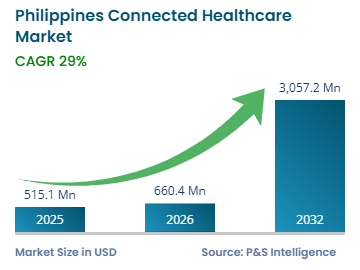
The Philippines connected healthcare market was valued at USD 515.1 million in 2025, and it is forecast to grow to USD 3,057.2 million by 2032, a CAGR of 29.0% during 2026–2032. The market is growing due to an increased use of smartphones, which stands at 83% of the population, rising rates of chronic illnesses, and the government’s Universal Healthcare Act which created a favorable regulatory environment for digital health innovation. Solutions for telemedicine, remote patient monitoring, and mobile health applications are increasingly used to deliver healthcare services. In 2021, the WHO reported that NCDs were responsible for 68% of deaths in the Philippines.
Key Market Insights
Telemedicine is the largest type, with 35% share, as a result of the widespread adoption of virtual consultation platforms.
Monitoring application is expected to grow the fastest through 2032, at 29.4% CAGR, as a result of the requirement for chronic disease management.
Cloud deployment dominates market with 60% share as it enables telehealth platforms to serve geographically dispersed populations.
Home healthcare end user is expected to have the highest CAGR during the years 2026–2032 as a result of the aging demographics of the population
National Capital Region (Metro-Manila) has the largest share, of 40%, due to high total healthcare spending and presence of many telehealth companies.
Calabarzon is the fastest-growing regional market, with 29.1% CAGR, due to its large population and improving broadband connectivity.
Digital technologies, such as telemedicine, remote monitoring, EHR, and AI-driven data analysis are changing how healthcare is delivered across the Philippines. Digital adoption will continue to grow due to growing digital infrastructure, increased smartphone penetration, and efforts by the Philippine government to modernize its healthcare system and provide better access to care for the entire archipelago with a focus on rural and underserved areas. Acceptance of virtual consultations and remote care has grown during the COVID-19 pandemic and will be sustained as patients seek convenient, patient-centered solutions.
Future growth opportunity lies in developing interoperability among various digital platforms, development of AI and data analytics, mobile health applications, and collaborations between tech innovators and traditional healthcare providers to drive improved health outcomes, reduced costs and bridge the remaining healthcare infrastructure gaps.
Expanding Digital Infrastructure and Mobile-First Healthcare Are Trending
The connected healthcare market in the Philippines is transforming fundamentally due to changes in digital infrastructure and the way it can be used to improve access to healthcare services throughout the archipelago. Smartphone penetration in the Philippines exceeds 83% and mobile cellular subscription exceeds 150 million, providing a solid base of digital infrastructure upon which to build mobile-first telehealth platforms.
The expanded digital infrastructure also facilitates real-time teleconsultations, remote diagnostics, and cloud-based exchanges of health information across urban and previously underserved island communities. By 2028, the DICT expects the number of jobs available in the digital health sector to be 300,000, indicating that technology enabled healthcare delivery models are being structurally adopted within the regular clinical practices of healthcare professionals.
The increased number of people using the internet will have a major effect on how many smartwatches are available, according to the most recent PSA/DICT survey which found that 67.3% of the Filipinos aged 10 or older (approximately 61.46 million people) used the internet in 2024, with a higher percentage of people than previously used the internet. In addition to the 90% of Metro Manila residents owning smartphones, this is enabling smartwatches to connect to the internet so they can allow consumers to sync their applications and track their health data.
Increasing Rates of Chronic Diseases Drive Market
The increasing prevalence of NCDs, combined with long-standing healthcare access disparities, have accelerated the structural adoption of connected healthcare solutions in the Philippines. Cardiovascular disease, diabetes, cancer, and chronic respiratory diseases account for approximately 68% of deaths in the Philippines, and create a large need for continuous remote monitoring and teleconsultation services. According to the World Health Organization (WHO), the likelihood of death from NCDs for individuals in the Philippines aged 30–70 is 24.5%, significantly greater than the regional average of 15.6%. This disease burden creates substantial demand for the healthcare system that cannot be met by traditional facility based care, especially in rural and geographically isolated areas where physician density remains extremely low.
About 70% of the rural Filipino residents lack access to quality health care services. In these underserved areas, there is a very poor ratio of physicians to residents; with there being roughly one physician for 26,000 residents. NCDs typically require ongoing monitoring by a healthcare provider, driving the demand for telemedicine services. Connected healthcare platforms allow for the management of chronic disease management protocols, medication adherence monitoring, and specialist consultations that decrease the need for expensive hospital visits and improve overall health outcomes.
In the Philippines, chronic illnesses account for more than two-thirds of all deaths. Heart disease (cardiovascular), cancer, diabetes, and lung disease are the top five most prevalent chronic illnesses in the Philippines. The number one killer is ischemic heart disease or other cardiovascular conditions, then cancer and cerebrovascular disease. It has been estimated that over four million adults suffer from diabetes in the Philippines. There are significant numbers of Filipinos who suffer from CKD.
NCDs are a leading cause of premature death in the Philippines and cause an enormous financial burden on the country. In addition, many published studies report very high prevalence of hypertension in the adult population at approximately 30%, and elevated rates of other cardiometabolic risk factors including diabetes and dyslipidemia. Additionally, chronic kidney disease and chronic respiratory conditions add significantly to the morbidity of the Filipino population resulting from these lifestyle, aging, and challenges of the healthcare delivery systems.
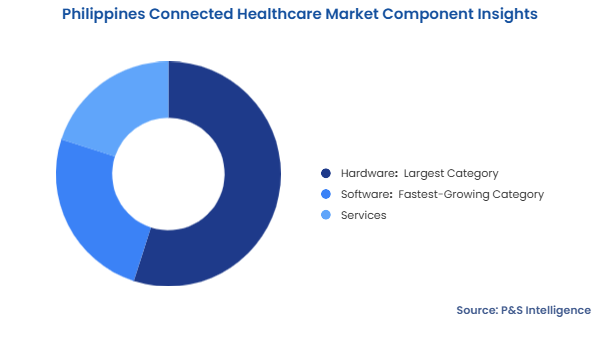
Hardware accounted for the largest portion of the market in 2025, of 55%. This is because includes diagnostic equipment, wearable monitors, and medical grade sensors, which are necessary for the delivery of connected healthcare. Hardware has benefited from existing supply chains for hospital equipment and from the increasing use of smart health devices by consumers.
Software is expected to grow faster during the forecast period 2026–2032, with 29.2% CAGR, as healthcare organizations continue to develop electronic health record systems, practice management platforms, and AI-enabled diagnostic tools that can increase operational efficiency and clinical decision-making support.
The market is segmented into the following components:
Hardware (Largest Category)
Software (Fastest-Growing Category)
Services
Type Insights
Telemedicine was the largest type segment in 2025, with 35% share, as a result of the widespread adoption of virtual consultation platforms following the mandate of the Universal Health Care Act to integrate digital health into the national healthcare system. The type segment is dominated by established infrastructure from telemedicine platforms such as mWell and KonsultaMD with over 5.8 million combined users. The DOH has integrated telemedicine into primary care delivery protocols and therefore the use of telemedicine is rapidly expanding among both public and private healthcare networks (DOH Philippines). Telemedicine Spending in the Philippines is projected to reach USD 6.1 billion by 2032.
mHealth Services are expected to grow fastest during the forecast period 2026–2032, with 29.3% CAGR. This will be a result of the smartphone penetration exceeding 83% and consumers migrating toward mobile-first healthcare interactions, including symptom checkers, medication reminders, and wellness tracking apps.
The market is segmented into the following types:
Telemedicine (Largest Category)
mHealth Services (Fastest-Growing Category)
mHealth Devices
Remote Patient Monitoring
ePrescription
Others
Application Insights
Diagnosis & treatment accounted for the largest share of the market in 2025, of 40%, as a result of the priority given by the healthcare system to the delivery of clinical care through teleconsultations and connectivity to diagnostic imaging. These applications are addressing the large disease burden in the Philippines with cardiovascular disease and diabetes requiring ongoing diagnostic support for the approximately 7.2 million people with hypertension identified in health surveys conducted by the Philippine Statistics Authority (PSA).
Monitoring is expected to grow the fastest through 2032, at 29.4% CAGR, as a result of the requirement for chronic disease management and the increasing use of continuous monitoring solutions for conditions including diabetes, hypertension, and cardiac disorders in home settings.
The market is segmented into the following applications:
Cloud-based solutions represented the largest category in 2025, with 60% share. They represents scalable infrastructure that enables telehealth platforms to serve geographically dispersed populations without the need for large upfront investments in capital. Cloud-based architectures facilitate the real-time data synchronization required for teleconsultation services.
Web/mobile delivery modes are expected to grow the fastest through 2032, as a result of the movement of consumers to smartphone accessible health applications and web-based platforms that eliminate the need for installations and increase service accessibility.
The Philippines records nearly 140 million cellular connections; roughly 120% of the population has mobile phone service, while 90% are connected via a broadband network (3G, 4G, or 5G). With over 100 million online users, this represents an over 80% online penetration rate, as well as a significant portion of that use being delivered through mobile devices—over 85% of web traffic in the country was generated from mobile devices. In addition to the high share of people owning smartphones nationally —with smartphone penetration rates estimated to be between 73–75%.
The market is segmented into the following delivery mode segments:
Cloud-Based (Largest Category)
Web/Mobile (Fastest-Growing Category)
On-Premises
End User Insights
Hospitals & clinics accounted for the largest share in 2025, of 65%, as they are the primary point of contact for the delivery of healthcare and early adopter of electronic medical records, telemedicine platforms and connected diagnostic equipment. PhilHealth has supported the adoption of digital health solutions through reimbursement policies for teleconsultation services, which has contributed to the modernization of hospitals.
Home healthcare is expected to have the largest CAGR during the years 2026–2032 as a result of the aging demographics of the population, the preference for aging in place, and the proliferation of affordable connected monitoring devices that enable remote patient observation.
The market is segmented into the following end users:
Hospitals & Clinics (Largest Category)
Home Healthcare (Fastest-Growing Category)
Healthcare Providers
Payers
Individual Consumers
Drive strategic growth with comprehensive market analysis
Philippines Connected Healthcare Market Regional Outlook
Manila Metro (NCR) Market Size
The National Capital Region (Metro-Manila) has the largest share, of 40%, as it accounts for high total healthcare spending and serves as the main hub for the country’s telehealth companies, including mWell and KonsultaMD. Moreover, it contains 2,784 healthcare facilities, based on the Philippine Statistics Authority (PSA) data. As such, these facilities present large opportunities for connected health to facilitate communication between patients and providers throughout the metropolitan area, which has been described as a patchwork of healthcare systems.
Calabarzon Market Growth
Calabarzon is positioned as the fastest-growing regional market, with 29.1% CAGR, due to its population of 16 million, improving broadband connectivity and 4,415 healthcare facilities that make it the number one in the country for healthcare facilities. The region benefits from being close to Metro-Manila’s tech industry and also provides telehealth infrastructure to rapidly urbanizing municipalities. Although less populated than Calabarzon, Central Luzon Region III has a strong presence in the telehealth market with 196 hospitals and the Department of Information and Communication Technology’s (DICT) plans to deploy broadband in the region will allow for the rollout of telemedicine to the agriculture-based communities of the region.
The Philippines connected healthcare market is moderately fragmented, as existing hospital digital health initiatives, telehealth platforms, and international technology companies providing the infrastructure to enable telehealth, operate simultaneously in the market. The fragmentation reflects the relative infancy of the telehealth market in the Philippines, the lack of barriers to entry for software-based services, and the diversity of customers ranging from enterprise hospital systems to individuals who require telehealth services. Currently, no single entity controls the majority of the telehealth market, although, the rate of consolidation among players is increasing as conglomerates seek to build out comprehensive digital health ecosystems.
Telehealth competition is intensifying as hospital systems develop digital front doors, telehealth platforms extend their offerings into new geographic markets, and technology vendors partner with healthcare organizations. While the entry barrier for consumer-facing telehealth applications remains relatively low, the entry barrier for enterprise telehealth solutions, which require regulatory compliance, hospital system integration and clinical validation, is significantly higher.
Key Philippines Connected Healthcare Companies:
Metro Pacific Health Tech Corporation (mWell)
KonsultaMD Inc.
Ayala Healthcare Holdings Inc. (AC Health)
Siemens Healthcare Inc.
Koninklijke Philips N.V.
GE HealthCare Technology Inc.
International Business Machines Corporation
Microsoft Corporation
Medifi Technologies Inc.
The Medical City Inc.
Philippines Connected Healthcare Market News
In December 2025, Metro Pacific Health Tech Corporation (mWell) launched the mWell ECG Ring–the Philippines’ first wellness ring with an integrated electrocardiogram (ECG) monitor. The mWell ECG Ring is priced at PHP 12,999 and does not incur any subscription fees.
In September 2025, Metro Pacific Health Tech Corporation (mWell) released the mWell Health ID—a fully digital health identity. Users can securely store their medical records, prescriptions, and vaccination history using the mWell Health ID.
In September 2025, ABC Impact Fund II LP, supported by Temasek Trust and Temasek, finalized the acquisition of a nearly 16% minority stake in Ayala Healthcare Holdings Inc. (AC Health). The investment will support AC Health’s goal of expanding to ten hospitals, 300 clinics, and 1,150 pharmacies by 2027.
In February 2025, Metro Pacific Health Tech Corporation (mWell) acquired KonsultaMD Inc. from the Ayala Group via 917Ventures. The acquisition combined mWell’s and KonsultaMD’s user bases to approximately 5.8 million people.
In January 2025, Metro Pacific Health Tech Corporation (mWell) partnered with the Department of Information and Communications Technology (DICT) and Philippine Flying Labs to launch mWell OnTheGo Drone Delivery in Pililla, Rizal.
Frequently Asked Questions About This Report
What will be Philippines connected healthcare market 2032 size?+
In 2032, the connected healthcare market in Philippines will be USD 3,057.2 million.
Which type dominates the Philippines connected healthcare industry?+
Telemedicine dominates the Philippines connected healthcare industry with 35% revenue.
Which province has largest Philippines connected healthcare market share?+
Manila Metro (NCR) is the largest connected healthcare market in Philippines, with 40% share.
What are the key Philippines connected healthcare industry drivers?+
The Philippines connected healthcare industry is driven by the government
What is the Philippines connected healthcare market nature?+
The connected healthcare market in Philippines is fragmented.
Want a report tailored exactly to your business need?
Leading companies across industries trust us to deliver data-driven insights and innovative solutions for their most critical decisions. From data-driven strategies to actionable insights, we empower the decision-makers who shape industries and define the future. From Fortune 500 companies to innovative startups, we are proud to partner with organisations that drive progress in their industries.
Client Testimonials
Working with P&S Intelligence and their team was an absolute pleasure – their awareness of timelines and commitment to value greatly contributed to our project's success. Eagerly anticipating future collaborations.
McKinsey & Company
India
Unmatched Standards
Our insights into the minutest levels of the markets, including the latest trends and competitive landscape, give you all the answers you need to take your business to new heights
Complete Data Security
We take a cautious approach to protecting your personal and confidential information. Trust is the strongest bond that connects us and our clients, and trust we build by complying with all international and domestic data protection and privacy laws