Pet Health Monitoring Devices Market Size & Share Analysis - Trends, Drivers, Competitive Landscape, and Forecasts (2025 - 2032)
This Report Provides In-Depth Analysis of the Pet Health Monitoring Devices Market Report Prepared by P&S Intelligence, Segmented by Device Type (Smart Collars, Smart Harnesses and Vests, Smart Tags and Sensor Patches, Implantable Devices, Non-Wearable Monitors), Animal Type (Dogs, Cats, Horses), Monitoring Application (Vital Sign Monitoring, Activity and Mobility Tracking, Disease and Anomaly Detection, Behavior and Sleep Monitoring, Nutrition, Weight, and Elimination Monitoring), Distribution Channel (Online Stores and Direct-to-Consumer, Veterinary Clinics and Hospitals, Pet Specialty Stores), and Geographical Outlook for the Period of 2021 to 2032
Pet Health Monitoring Devices Market Size Estimation
Key Highlights
Study Period
2021 - 2032
Market Size in 2025
USD 3.90 Billion
Market Size in 2026
USD 4.30 Billion
Market Size by 2032
USD 8.80 Billion
Projected CAGR
12.6%
Largest Region
North America
Fastest Growing Region
Asia-Pacific
Market Structure
Moderately Fragmented
Market Size
Explore the market potential with our data-driven report
Pet Health Monitoring Devices Market Overview
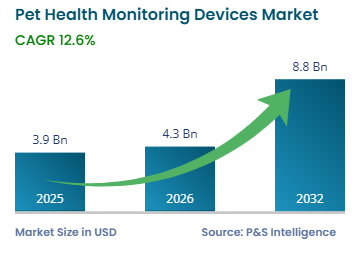
Global revenue in the pet health monitoring devices market reached USD 3.9 billion during 2025. The 2026 estimate is USD 4.3 billion, and sales are projected to total USD 8.8 billion by 2032. This path represents a 12.6% CAGR during 2026–2032. Pet owners and veterinary teams are buying connected collars, sensor-equipped wearables, and home monitoring devices to build clearer records between clinic visits and decide when an examination is warranted.
Spending is moving toward products that convert routine activity, sleep, vital-sign, feeding, and elimination data into simple alerts, but purchase decisions remain price-sensitive. The 2025 PDSA Animal Wellbeing Report found that 51% of surveyed U.K. pet owners were worried about affording veterinary care. Devices therefore need a clear role in organizing observations for veterinary review, although they do not replace clinical diagnosis. Suppliers that make readings easy to interpret and share with clinics can give buyers a stronger reason to keep using the product after the initial purchase.
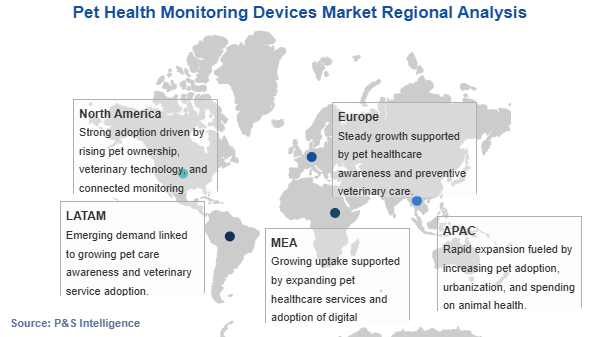
North America's Pet Health Monitoring Devices Market share was 42% in 2025, supported by a large companion-animal base, established online sales channels, and broad access to connected consumer products in the U.S. and Canada. Asia-Pacific is projected to advance at a 16.7% CAGR during 2026–2032, the highest regional rate. Rising pet spending in China, Japan, India, and South Korea is widening the customer base for compact devices sold through mobile-first retail channels and local veterinary partners. Veterinary integration and affordable service tiers will influence which brands retain these new buyers.
Key market insights
By device type, smart collars held 42% in 2025, and smart harnesses and vests are forecast to expand at a 16.2% CAGR over 2026–2032.
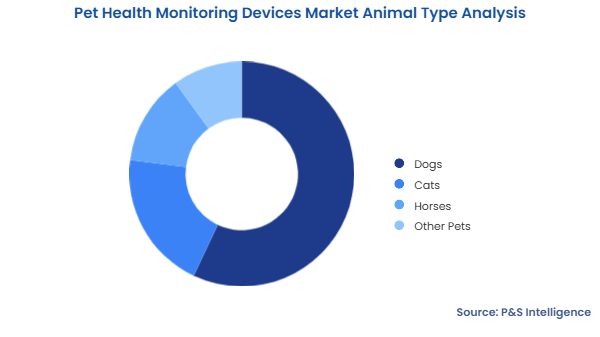
By animal type, dogs held 57% in 2025, and other pets are forecast to advance at a 16.3% CAGR over 2026–2032.
By monitoring application, vital sign monitoring held 42% in 2025, and disease and anomaly detection is forecast to rise at a 16.7% CAGR over 2026–2032.
By distribution channel, the 2025 share of online stores and direct-to-consumer was 57%, and the 2026–2032 CAGR is projected at 15.1%.
By geography, North America held 42% in 2025, and Asia-Pacific is forecast to advance at a 16.7% CAGR over 2026–2032.
Pet Health Monitoring Devices Market Trends and Growth Drivers
Large pet populations are accelerating continuous monitoring purchases
Pet owners increasingly want a record of what happens between occasional examinations, especially when changes in movement, sleep, appetite, or elimination develop gradually. This behavior supports Pet Health Monitoring Devices Market growth because a device can collect repeat observations without requiring the owner to recognize every change at the moment it occurs. Households with older animals or pets receiving long-term treatment have the clearest reason to buy. Device makers gain when they present trends that owners can discuss with a veterinarian.
FEDIAF reports that 140 million households in the European Union own a pet, equal to 49% of households. That installed base gives suppliers a large pool of potential users before accounting for replacement sales or multi-pet purchases. Growth depends on turning general interest in connected care into continued daily use, since a device that is uncomfortable or difficult to charge will not produce a useful health record. Smaller hardware, longer battery life, and clear alerts therefore influence purchases as much as the number of measurements offered.
Longitudinal clinical use is opening a veterinary channel
Veterinary practices can create a new route to market by recommending devices for rehabilitation, chronic-disease follow-up, and post-treatment observation. This opportunity matters to the Pet Health Monitoring Devices Market because professional involvement can give owners a clear reason to keep a sensor active after the novelty of a new purchase fades. Clinics may use trend reports to prioritize follow-up conversations and decide which animals need an in-person assessment. Suppliers that fit reports into normal clinical routines can earn referrals and reduce customer churn.
A 2025 exploratory case series published in Animals followed five dogs with osteoarthritis for 56 to 126 days. Sensor deviations aligned with the onset, progression, or recovery of eight of nine clinically relevant events, although the authors called for larger studies. The small sample does not establish diagnostic performance. It does show how longitudinal readings can add context to owner reports and veterinary records. Vendors that validate narrow use cases with clinicians have a stronger commercial path than products that make broad health claims from activity data alone.
Multisensor analytics are reshaping device value
Current trends in the Pet Health Monitoring Devices Market center on combining several routine signals instead of displaying isolated step counts. Wearables are adding resting heart and respiratory rates, while feeders, fountains, litter systems, cameras, and radar devices contribute data on intake, elimination, movement, and behavior. The broader pet wearable market is moving in the same direction. Buyers receive more value when software establishes an individual baseline and flags a sustained departure, which encourages suppliers to sell coordinated hardware and recurring analytical services.
A 2026 Frontiers in Toxicology study of Beagle dogs in a controlled nonclinical setting reported a 0.965 correlation between computer-vision locomotor activity and accelerometer measurements. The correlation supports the technical feasibility of combining contactless and body-worn observations, but it does not establish performance in homes or clinical value. Suppliers still need testing across breeds, room layouts, and ordinary household routines. Manufacturers that show where each alert comes from can compete on the usefulness of the combined record instead of the number of sensors alone.
Security and interpretation costs are limiting adoption
Connected pet devices collect household network information and recurring behavioral or physiological data, so suppliers must fund security updates, vulnerability handling, and privacy controls throughout the product life. Those costs weigh more heavily on low-price devices and smaller brands. Owners may also stop using a product when alerts are frequent, unclear, or disconnected from veterinary advice. The resulting problem is commercial as well as technical, because poor interpretation raises support costs and weakens renewal rates for services bundled with hardware.
The European Commission states that Cyber Resilience Act reporting obligations took effect on September 11, 2026, and full application is scheduled for December 11, 2027. Manufacturers of products with digital elements must plan support periods and handle vulnerability reporting, which adds work after a device is sold. Suppliers with documented update processes can absorb the requirement across a larger installed base. New entrants must price lifecycle support into the product from launch, while buyers will increasingly compare support duration and data controls alongside sensor accuracy.
Pet Health Monitoring Devices Market Segmentation Analysis
Device Type
Smart collars accounted for 42% of revenue in 2025. The Pet Health Monitoring Devices Market analysis separates this purchase pattern from animal, application, and channel choices. The collar position supports consistent wear, gives motion sensors a stable reference point, and fits an accessory routinely used for dogs. The peer-reviewed Pet Insight Project trained behavior algorithms with more than 2,500 dogs and over 11 million device-days, showing the data scale this familiar format can support. Suppliers can serve broad owner groups with one established form factor.
Smart harnesses and vests are projected to record a 16.2% CAGR during 2026–2032. Their larger surface area can accommodate more sensors and distribute weight across the body, while giving developers more freedom to position electrodes for a specific use case. Colorado State University researchers tested a wireless harness on 19 hospitalized dogs in 2025 and found that it tracked heart-rate and respiratory-rate trends, although individual readings required manual confirmation. Suppliers that deliver accurate sizing, washable materials, and validated trend reporting can turn this design flexibility into repeat purchases.
Animal Type
Dogs generated 57% of revenue in 2025. Regular walking, training, and outdoor activity give owners frequent reasons to review movement and rest data, and collar or harness use is already routine for most dogs. The American Pet Products Association reported that 68 million U.S. households owned a dog in its 2025 industry study, compared with 49 million that owned a cat. The large addressable base encourages manufacturers to validate algorithms across dog breeds and offer several device sizes.
Other pets are forecast to advance at a 16.3% CAGR during 2026–2032. Growth starts from a smaller base and depends on devices moving beyond dog and cat body shapes. A 2025 Journal of Equine Veterinary Science scoping review identified 42 equine monitoring technologies across wearable and non-wearable formats, showing the range of species-specific designs already under study. Lightweight tags, implantable sensors, cameras, and radar can serve animals that cannot wear a conventional collar. Vendors still need species-specific baselines before extending algorithms beyond their validated animals.
Monitoring Application
Vital sign monitoring held 42% of revenue in 2025. Resting heart rate, respiratory rate, and temperature trends give owners and veterinary teams a direct reason to keep a device in use, particularly during recovery or long-term care. The AI-COLLAR prospective study followed 703 apparently healthy dogs for a median of 189 days, illustrating the longitudinal datasets that biometric devices can build. Purchases still depend on stable readings and understandable ranges because movement, fit, and environment affect individual values. Suppliers that explain measurement quality can support higher-value positioning.
Disease and anomaly detection is expected to post a 16.7% CAGR during 2026–2032. A Frontiers in Veterinary Science observational study based on 1,042 U.S. clinics reported that the odds of a veterinary visit within four weeks were 1.6264 times higher during a second 10-month period with owner-facing pruritus alerts than during an initial 10-month period without them. The comparison does not establish diagnosis by the device. It does show that targeted alerts can affect owner behavior, giving vendors a case for directing users toward professional assessment.
Distribution Channel
Online stores and direct-to-consumer sales represented 57% of revenue in 2025. Connected products suit online comparison because buyers can assess device size, battery claims, monitored parameters, and subscription terms before ordering. Chewy Inc.'s fiscal 2025 filing reported that autoship customers generated 83.3% of net sales across its broader online pet business, showing how digital accounts support recurring purchases. Direct sales also let device makers manage activation and updates from the first order, although returns and customer support can erode the cost advantage.
Online stores and direct-to-consumer sales are also projected to grow at a 15.1% CAGR during 2026–2032. ZZF and IVH estimated German online pet-care sales at EUR 1.521 billion in 2025, confirming that pet buyers already use this route at scale. Smartphone setup, home delivery, and automatic replacement offers shorten the path from product discovery to activation. Veterinary clinics and specialty stores remain important where buyers want fitting or clinical guidance, so suppliers that connect online ordering with local support can address a wider range of purchase preferences.
The following segments are analysed in this report:
Device Type
Smart Collars
Smart Harnesses and Vests
Smart Tags and Sensor Patches
Implantable Devices
Non-Wearable Monitors
Smart Feeding and Hydration Monitors
Smart Litter and Elimination Monitors
Camera- and Radar-Based Monitors
Other Devices
Animal Type
Dogs
Cats
Horses
Other Pets
Monitoring Application
Vital Sign Monitoring
Activity and Mobility Tracking
Disease and Anomaly Detection
Behavior and Sleep Monitoring
Nutrition, Weight, and Elimination Monitoring
Distribution Channel
Online Stores and Direct-to-Consumer
Veterinary Clinics and Hospitals
Pet Specialty Stores
Other Channels
Drive strategic growth with comprehensive market analysis
Pet Health Monitoring Devices Market Geographical Analysis
North America Pet Health Monitoring Devices Market outlook
North America accounted for 42% of global revenue in 2025. Buyers in the U.S. and Canada have broad access to connected consumer products, online retail, and veterinary services that can interpret longitudinal readings. The U.S. anchors regional demand through its large pet-owning population and early adoption of subscription-linked collars and cameras. Canada adds a smaller base with similar buying patterns and a developed network of clinics, distributors, and specialty retailers. High household incomes also support premium device bundles.
Statistics Canada counted 6,574 veterinary-service business locations nationwide in December 2024, including animal hospitals, clinics, and surgical services. That network gives device suppliers potential referral and follow-up points beyond direct online sales. Regional demand is likely to shift toward replacement units, broader health features, and clinic-compatible reports as early users upgrade. Brands with established customer support and clear policies for subscriptions, batteries, and data access are positioned to retain buyers through this replacement cycle.
Asia-Pacific is forecast to advance at a 16.7% CAGR during 2026–2032, the highest rate among regions. China, Japan, India, South Korea, Australia, and Singapore combine rising companion-animal spending with mobile-first shopping and a growing supply of locally designed connected devices. China provides scale in manufacturing and online retail, while Japan and South Korea offer buyers accustomed to compact electronics. India widens the entry-level customer base as organized pet care expands in large cities. Dense urban living also favors indoor monitoring products.
The Japan Pet Food Association estimated 6.82 million dogs and 8.847 million cats in the country in its 2025 ownership survey. The figures show a sizable installed base in one of the region's mature pet markets, while newer markets add first-time buyers. Regional growth will favor suppliers that adapt device size, language, mobile connectivity, and pricing for individual countries. Local marketplaces and veterinary distributors can reduce the cost of customer acquisition for brands entering beyond their home market.
Europe contributes a substantial base of demand through widespread pet ownership, established veterinary care, and rules governing connected products and personal data. Germany, the U.K., France, Italy, Spain, and the Netherlands support sales through specialty chains, clinics, and online channels. Buyers often compare durability, privacy terms, and the length of software support before accepting a recurring service. Products that provide practical health summaries without making diagnostic claims fit this purchasing environment. Cross-border online sales widen access to smaller brands.
UK Pet Food's 2026 population survey estimated 36.5 million pets in the country and pet ownership in 62% of households. That customer base supports mainstream dog and cat devices as well as more specialized monitoring for horses, birds, and small animals. European suppliers will also spend more on security documentation and updates as digital-product requirements expand. Companies that spread those costs across several national markets can compete more effectively than single-country sellers.
Latin America remains an emerging sales region, with Brazil, Mexico, and Argentina providing the main urban customer bases. Online marketplaces make imported collars and home monitors accessible, while local distributors help with language support, warranties, and price-sensitive product bundles. Brazil's large pet population gives suppliers room to sell beyond premium households as lower-cost devices reach the market. Currency movements and import costs can still delay upgrades or push buyers toward simpler products. Clinic recommendations can reduce uncertainty around unfamiliar products.
A 2026 Brazilian Ministry of Tourism program document, drawing on IBGE and industry-association data, cited about 160 million pets in Brazil and pet ownership in more than half of households. That scale gives device makers a meaningful addressable base even when connected-device penetration remains limited. Growth should come first from large cities with dense clinic and retail networks. Regional manufacturing and repair partnerships can reduce import delays and preserve margins as buyers expect faster warranty service from connected-device brands.
The Middle East & Africa market is developing through different national pathways. Saudi Arabia and the United Arab Emirates offer higher-spending urban customers and expanding veterinary businesses, while South Africa has a broader companion-animal base across income groups. Importers and veterinary clinics remain important because they can explain device use and handle warranty issues. Products that tolerate heat, dust, intermittent connectivity, and irregular charging can address practical conditions that differ from those in Europe or North America. Local import partners also shape pricing and availability.
Statistics South Africa's 2025 General Household Survey estimated that households owned 7.4 million dogs and 2 million cats. The new national figures give suppliers a clearer view of the potential customer base and show why South Africa can serve as an entry point for the region. Adoption elsewhere will depend on local distribution, smartphone connectivity, and access to veterinary interpretation. Veterinary retailers can help unfamiliar buyers choose the right form factor and distinguish wellness alerts from diagnosis, lowering returns as product availability widens.
The following geographies are analysed in this report.
North America
U.S.
Canada
Asia-Pacific
China
Japan
India
South Korea
Australia
Singapore
Rest of Asia-Pacific
Europe
Germany
U.K.
France
Italy
Spain
Netherlands
Rest of Europe
Latin America
Brazil
Mexico
Argentina
Rest of Latin America
Middle East & Africa
Saudi Arabia
U.A.E.
South Africa
Rest of Middle East & Africa
Pet Health Monitoring Devices Market Competitive Landscape
The market is moderately fragmented, with specialist wearable brands, connected home-device suppliers, and diversified electronics companies competing across distinct use cases. Hardware production can be outsourced, which lowers the capital needed to enter, but accurate algorithms, comfortable industrial design, reliable connectivity, and continued software support take time to build. Differences among animal species, monitored parameters, and national sales channels leave room for specialized products. The structure is likely to remain fragmented as suppliers expand into adjacent monitoring functions.
Tractive GmbH, PetPace Ltd., FitBark Inc., Invoxia SAS, and Barking Labs Corp., trading as Fi, form a wearable-centered cluster that competes through collar-based activity, behavior, physiological, and safety features. PETKIT Network Technology (Shanghai) Co. Ltd., SureFlap Limited, trading as Sure Petcare, Pet Technology Limited, trading as Felcana, and Petcube, Inc. span connected home monitoring, cameras, feeding, access, and behavioral records. Apsyrtus Biotechnology Pty Ltd, trading as VetChip, addresses implantable monitoring, giving buyers a different balance of wearability and data continuity.
Entry barriers rise after the first device sale. Suppliers must keep mobile applications compatible, protect customer data, update firmware, replace failed hardware, and explain alerts without crossing into unsupported diagnosis. Veterinary credibility and species-specific validation can shorten the path to clinic recommendations, while direct-to-consumer brands need efficient onboarding and support to control returns. Buyers benefit from product choice, but they must compare the full cost of subscriptions, replacement cycles, data access, and security support alongside the initial hardware price. Long-term service quality can decide which brands retain that installed base over time.
Key Players in the Pet Health Monitoring Devices Market:
Tractive GmbH
PetPace Ltd.
FitBark Inc.
Invoxia SAS
Garmin Ltd.
Datamars SA
SureFlap Limited
PETKIT Network Technology (Shanghai) Co. Ltd.
Pet Technology Limited
Barking Labs Corp.
Apsyrtus Biotechnology Pty. Ltd.
Petcube Inc.
Pet Health Monitoring Devices Market Developments
In August 2026, PETKIT Network Technology (Shanghai) Co., Ltd. Showcased Kitbo and two connected pet-care devices at Asia Pet Fair 2026 in Shanghai. The lineup pairs monitoring hardware with a software layer designed to interpret feeding, elimination, and activity records from compatible devices.
In April 2026, Tractive GmbH introduced the DOG 6 XL and CAT 6 Mini, adding two device formats with app-based activity, sleep, vital-sign, and behavior features. The launch extends health-oriented monitoring to large dogs and cats while keeping location and wellness functions in one product relationship.
In February 2026, Invoxia SAS launched the Biotracker 2026 Edition with second-by-second live location updates, resting heart and respiratory rate tracking, and heart-rate variability measurement. The product shows how collar suppliers are combining safety functions with physiological monitoring to support a higher-value device proposition.
Frequently Asked Questions About This Report
What was the global market size in 2025?+
Global revenue in the pet health monitoring devices market reached USD 3.9 billion during 2025. The 2026 estimate is USD 4.3 billion, and sales are projected to total USD 8.8 billion by 2032.
Which region leads the market?+
North America's pet health monitoring devices market share was 42% in 2025, supported by a large companion-animal base, established online sales channels, and broad access to connected consumer products in the U.S. and Canada.
Which device type held the largest share?+
Smart collars accounted for 42% of revenue in 2025. The pet health monitoring devices market analysis separates this purchase pattern from animal, application, and channel choices.
What is driving veterinary adoption?+
Clinics may use trend reports to prioritize follow-up conversations and decide which animals need an in-person assessment. Suppliers that fit reports into normal clinical routines can earn referrals and reduce customer churn.
Want a report tailored exactly to your business need?
Leading companies across industries trust us to deliver data-driven insights and innovative solutions for their most critical decisions. From data-driven strategies to actionable insights, we empower the decision-makers who shape industries and define the future. From Fortune 500 companies to innovative startups, we are proud to partner with organisations that drive progress in their industries.
Client Testimonials
Working with P&S Intelligence and their team was an absolute pleasure – their awareness of timelines and commitment to value greatly contributed to our project's success. Eagerly anticipating future collaborations.
McKinsey & Company
India
Unmatched Standards
Our insights into the minutest levels of the markets, including the latest trends and competitive landscape, give you all the answers you need to take your business to new heights
Complete Data Security
We take a cautious approach to protecting your personal and confidential information. Trust is the strongest bond that connects us and our clients, and trust we build by complying with all international and domestic data protection and privacy laws