This Report Provides In-Depth Analysis of the Patient Engagement Technology Market Report Prepared by P&S Intelligence, Segmented by Component (Solutions, Hardware, Services), Delivery Mode (Web-based platforms, Cloud-based platforms, On-premise systems), Application (Health management, Home health management, Social and behavioral health management, Financial health management), Therapeutic Area (Chronic diseases, Women, Fitness and wellness, Mental health), End User (Healthcare providers, Healthcare payers, Pharmaceutical and biotechnology companies, Patients and caregivers), and Geographical Outlook for the Period of 2021 to 2032
Explore the market potential with our data-driven report
Patient Engagement Technology Market Future Outlook
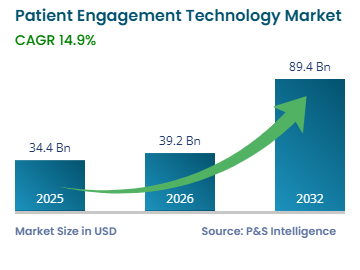
The patient engagement technology market size was USD 34.4 billion for 2025, and it will grow by 14.9% during 2026-2032, to reach USD 89.4 billion by 2032.
The expansion can mainly be attributed to the rising incidence of chronic illnesses and the escalating demand for sophisticated pharmaceuticals. Additionally, the enhancement of healthcare infrastructure, the increasing demand for wearable health technology, the rapidly growing elderly population, and the rising adoption of mobile health solutions are propelling market growth.
The market is growing as healthcare organisations prioritise continuous care and digital communication. Healthcare facilities rely on these platforms to efficiently manage appointments, track patient status, and facilitate remote consultations. According to the World Health Organization, 129 Member States had developed national digital health strategies by 2024, reflecting a massive global institutional push to integrate technology into routine care.
Key Market Insights
Solutions are the largest component with 65% share, as hospitals and clinics spend heavily on software for patient management.
Services are the fastest-growing component, with approx. 14.7% CAGR, driven by healthcare organisations needing third-party help to implement and manage engagement technologies.
Health management is the largest application with 40% share, utilised broadly for managing chronic diseases and preventive care.
Chronic diseases are the largest therapeutic area with 40% share, requiring continuous monitoring and regular long-term patient interaction.
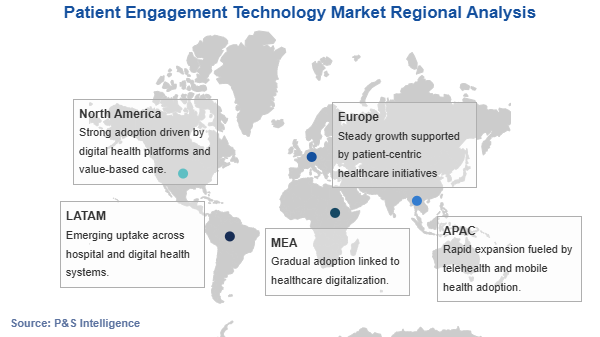
North America remains the largest regional market, while Asia-Pacific is the fastest-growing due to rapid digital infrastructure expansion.
Rising Use of Wearable Devices and Connected Health Tools Is Major Trend
Healthcare organisations are increasing the use of wearable and connected health products along with patient engagement platforms to improve clinical data collection. Many smartwatches and biosensors track patient health metrics daily, transmitting information directly to digital physician systems. As per studies, people around the world will spend at least USD 67.2 billion on wearable medical devices in 2030. Furthermore, the share of individuals utilising smartphone-based health apps to access their medical records reached 57% in 2024, according to the Office of the National Coordinator for Health Information Technology. This massive hardware adoption allows engagement platforms to provide continuous monitoring and real-time communication between patients and care teams globally.
Growing Need to Manage Chronic Diseases Efficiently Drives Market
The patient engagement technology space is expanding due to increasing demand from healthcare systems managing growing populations with chronic conditions. Patients with heart disease and diabetes require continuous monitoring and medication adherence support outside traditional clinical settings. Noncommunicable diseases, including heart disease and diabetes, are collectively responsible for 74% of all deaths worldwide in 2025, including around 18 million premature deaths between the ages of 30 and 69, according to the World Health Organization.
Cardiovascular diseases are the leading cause, causing about 19.8 million deaths, according to the WHO cardiovascular disease fact sheet. The International Agency for Research on Cancer’s Global Cancer Observatory estimates roughly 19.3 million new cancer cases and 10 million globally per year. Chronic respiratory diseases, including chronic obstructive pulmonary disease and asthma, accounted for around 4 million deaths in 2021 according to WHO data.
Furthermore, approximately 589 million adults were living with diabetes globally in 2024, according to the International Diabetes Federation. Diabetes and its complications were responsible for approximately 1.6 to 2 million deaths globally in 2021 based on WHO Global Health Estimates. This massive clinical burden compels providers to utilise digital platforms to track patient outcomes and send care reminders, significantly decreasing preventable hospital visits and improving general chronic condition management.
Solutions are the largest category, holding a market share of 65%, as hospitals dedicate the majority of their capital to core patient management software. Medical facilities fundamentally require these digital platforms to schedule appointments, conduct remote consultations, and continuously monitor patient health outcomes. According to the Office of the National Coordinator for Health Information Technology, 80% of hospitals had adopted foundational patient engagement capabilities, such as secure messaging and online health records, by 2024. This massive institutional integration directly forces healthcare networks to continually procure and upgrade comprehensive software solutions to execute these critical care initiatives.
Services are the fastest-growing category, because healthcare Organisations increasingly hire third-party experts to deploy and maintain complex digital infrastructure. Medical facilities typically lack the specialised internal technical personnel required to seamlessly connect diverse medical applications. According to the World Health Organization, while over 60% of countries possessed digital health strategies in 2024, the majority still lacked the technical integration to connect new technologies with existing health infrastructure. Consequently, hospitals heavily outsource their IT operations, driving continuous demand for consulting and professional system integration.
The component analysed in this report are:
Solutions (Largest Category)
Patient portal platforms
Mobile health (mHealth) applications
Telehealth and virtual consultation systems
Remote patient monitoring software
Patient communication and engagement platforms
Appointment scheduling and care coordination tools
Digital patient education and self-management solutions
Services (Fastest-Growing Category)
Consulting and strategic advisory services
Implementation and system integration
Training and user enablement
Technical support and maintenance
Data analytics and engagement optimisation services
Hardware
Delivery Mode Analysis
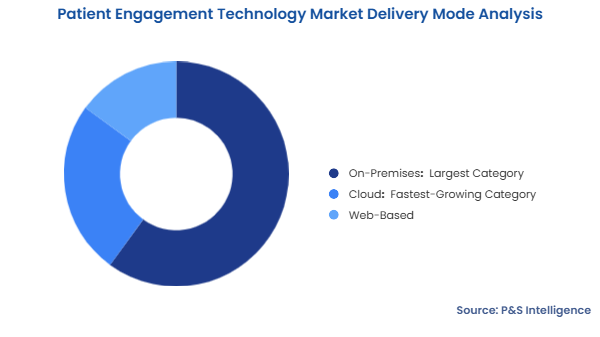
On-premises systems are the largest category, holding a market share of 60%, because healthcare providers must maintain absolute control over highly sensitive patient medical records. Hospitals face strict legal requirements to protect confidential information from escalating external network vulnerabilities and targeted cyberattacks. According to the U.S. Department of Health and Human Services, 720 large healthcare data breaches compromised approximately 186 million user records in 2024. To mitigate these massive cybersecurity risks, major medical centres purposefully install localised, on-premises infrastructure to securely isolate and manage patient data internally.
Cloud-based platforms are the fastest-growing category, driven by a direct demand for scalable healthcare systems that allow clinics to avoid heavy hardware investments. Administrators utilise these platforms to seamlessly update software and offer patients reliable remote access to their personal medical tools. According to the International Telecommunication Union, 96% of the global population was covered by a mobile broadband network in 2024. This widespread wireless connectivity enables modern cloud platforms to instantly deliver remote patient engagement services and integrate digital health applications across virtually any geographic boundary.
The delivery mode analysed in this report are:
On-Premises (Largest Category)
Cloud (Fastest-Growing Category)
Web-Based
Application Analysis
Health management is the largest category, holding a market share of 40% in the patient engagement technology market. Healthcare providers rely on these digital platforms to continuously communicate with patients and monitor chronic conditions. Patients utilise these systems daily to track medications, schedule physician appointments, and receive automated health reminders. For instance, 589 million adults lived with diabetes globally in 2024, according to the International Diabetes Federation. As a result, medical facilities actively integrate advanced patient engagement tools to maintain continuous preventive care and improve long-term outcomes.
Home health management is the fastest-growing category, registering a CAGR of 14.6%. The healthcare industry is actively shifting care delivery from traditional hospital settings directly to patients' homes. Patients utilise remote monitoring devices and digital tools to manage their treatments comfortably without frequent clinic visits. The global population aged 65 and older reached 830 million people in 2024, and it will reach 1.7 billion by 2054, according to the United Nations. Consequently, medical facilities continually invest in remote home management platforms to support ageing demographics and reduce hospital readmissions.
The application analysed in this report are:
Health Management (Largest Category)
Home Health Management (Fastest-Growing Category)
Social & Behavioural Health Management
Financial Health Management
Others
Therapeutic Area Analysis
Chronic diseases are the largest category, holding a market share of 40% within the global patient engagement technology market. Healthcare providers rely on digital platforms to manage complex long-term illnesses through continuous remote monitoring and patient communication. Patients consistently use these digital tools daily to track vital health metrics and maintain rigid medication adherence. Cardiovascular diseases caused approximately 19.2 million deaths globally in 2023, according to the American College of Cardiology. Consequently, healthcare providers increasingly integrate advanced patient engagement systems to support preventive care and improve long-term treatment outcomes.
Mental health is the fastest-growing category, registering a CAGR of 15.2% within the global patient engagement technology market. Consumers increasingly bypass traditional, in-person clinical visits in favour of highly accessible digital therapy sessions. The severe shortages of localised psychiatric professionals leave millions of patients without physical access to necessary psychological support. The global median number of mental health workers stood at 13 per 100,000 people in 2024, according to the World Health Organization. This extreme workforce deficit directly drives consumers to rely on online counselling platforms and remote virtual consultations.
The therapeutic area analysed in this report are:
Chronic diseases (Largest Category)
Mental health (Fastest-Growing Category)
Women’s health
Fitness and wellness
Others
End User Analysis
Healthcare providers are the largest category, holding a market share of 45%. Medical facilities actively utilise these advanced digital platforms to coordinate complex care and manage routine patient appointments. Doctors and nurses heavily rely on these specific tools to communicate continuously and monitor remote patient treatments. The global health workforce exceeded 70 million active professionals in 2024, according to the World Health Organization. Consequently, hospitals continually integrate patient engagement systems to streamline clinical workflows across multiple health service areas.
Healthcare payers are the fastest-growing category, within the global patient engagement technology market. Insurance companies actively adopt these digital tools to encourage routine preventive care and ensure strict medication adherence. These targeted health interventions directly help payers effectively manage escalating chronic conditions and control soaring medical treatment costs. Approximately 1.4 billion adults globally lived with hypertension in 2023, according to the World Health Organization. Consequently, payers rapidly deploy remote engagement platforms to monitor high-risk patients continuously and drastically reduce expensive hospital admissions.
The end user analysed in this report are:
Healthcare providers (Largest Category)
Healthcare payers (Fastest-Growing Category)
Pharmaceutical and biotechnology companies
Patients and caregivers
Drive strategic growth with comprehensive market analysis
North America Patient Engagement Technology Market Analysis
North America holds the largest share, of 40%, as healthcare systems in the region widely use digital health platforms to manage patient communication and care coordination. The majority of hospitals and clinics in North America are using electronic health records (EHR) and telemedicine for their regular operational needs. A robust healthcare IT environment, along with governmental policies that support a patient-centric approach to care, will likely support continued widespread adoption of digital health technologies by healthcare providers. These platforms improve both patient satisfaction and long-term management of patient care through increased digital engagement.
U.S. Patient Engagement Technology Market Analysis
Hospitals and healthcare networks in the U.S. lead the utilisation of digital patient engagement platforms. Medical facilities actively integrate secure patient portals and remote monitoring tools directly with electronic health records. Doctors strongly rely on these interconnected virtual care solutions to manage vulnerable patient populations continuously. Over 96% of U.S. hospitals operated certified electronic health records in 2023, according to the Department of Health and Human Services. Providers processed 21 million traditional Medicare telehealth claims in 2023, according to the Centers for Medicare and Medicaid Services. These scalable technologies directly improve care coordination and strictly support value-based models to enhance overall outcomes.
Patient engagement technology adoption is growing across Canada as regional healthcare Organisations actively invest in modern digital health systems. Virtual care platforms and digital appointment systems improve patient access to healthcare by addressing challenges caused by geographic dispersion. According to Health Canada, 92.6% of family physicians utilised electronic medical records across the country in 2024. Additionally, 30.1% of Canadians accessed personal health information electronically in 2024, according to Canada Health Infoway. Consequently, these digital solutions allow patients to access medical records online and communicate more efficiently with healthcare providers.
Asia-Pacific has the highest CAGR, of 15.5%, because healthcare systems across the region are rapidly expanding their digital health infrastructure. Governments, as well as healthcare organisations, have introduced telemedicine programs and mHealth platforms to reach large and diverse populations. The increasing use of smartphones and improved internet accessibility allows for easier access to healthcare services by patients. Digital engagement platforms for healthcare providers help to manage an increasingly large number of patients and provide better access to healthcare services for patients in both rural and urban settings.
China Patient Engagement Technology Market Analysis
China is rapidly developing patient engagement technologies as large hospitals and technology companies create advanced digital health platforms. Online consultation systems and health management applications allow patients to interact with doctors remotely and reduce physical hospital workloads. The number of internet healthcare users in China reached 365 million in 2024, according to the China Internet Network Information Centre. This massive digital user base demonstrates the rapid adoption of online healthcare services across the country. Consequently, healthcare providers and technology companies continue expanding mobile health platforms to improve access to care and enhance overall service efficiency.
India Patient Engagement Technology Market Analysis
India is actively expanding patient engagement technologies through national telemedicine platforms and secure mobile health applications. Healthcare Organisations utilise these digital tools to deliver essential medical services to rural and underserved populations across diverse regions. The eSanjeevani platform facilitated over 338 million remote patient consultations by 2025, according to the Ministry of Health and Family Welfare. This large-scale utilisation demonstrates the rapid adoption of digital health services across the country. Consequently, healthcare networks continue expanding telemedicine infrastructure to improve access to care and support rising patient demand across decentralised regions.
Europe Patient Engagement Technology Market Analysis
Many hospitals throughout Europe have been slowly beginning to use digital platforms to improve the way they deliver care and to improve communication with their patients. In addition, many European countries have expanded their national digital health programs, which support electronic medical records and online patient services. Hospitals throughout Europe are now using digital tools that enable patients to schedule appointments, view health information, and interact with care team members. Increased focus on preventative care and efficient healthcare delivery will continue to drive the adoption of PET solutions.
The regions and countries analysed in this report are:
The market is fragmented because many technology providers offer different types of patient engagement platforms and digital health tools. Large healthcare IT companies compete alongside smaller specialised firms that focus on telehealth, remote monitoring, or patient communication software. The wide range of applications and solutions encourages new companies to enter the space. In addition, healthcare systems often select platforms based on specific clinical or operational needs. This diversity of products and providers spreads market participation across numerous vendors rather than concentrating it among a few dominant players.
Patient Engagement Technology Producers:
Epic Systems Corporation
Cerner Corporation (Oracle)
Allscripts Healthcare Solutions
Athenahealth (Veradigm)
Meditech
McKesson Corporation
Philips Healthcare (Royal Philips)
GE Healthcare (General Electric)
Salesforce Health Cloud
Microsoft (Microsoft Cloud for Healthcare)
Google Cloud Healthcare
Tencent Healthcare (WeDoctor / Tencent)
Zoom Video Communications (Telehealth platform)
Amwell (American Well)
Teladoc Health
Patient Engagement Technology Market News
In January 2026, Universal Health Services deployed generative AI patient engagement agents to assist post-discharge follow-up outreach across its hospitals, improving clinician workflows and patient communication.
In January 2026, TransCelerate BioPharma showcased scalable digital approaches to enhance clinical research efficiency and support patient-centred design at the SCOPE US Summit.
In November 2025, InteliChart introduced its InteliSense intelligent AI platform to support patient engagement workflows across the care journey.
In May 2025, SoundHound AI and Allina Health introduced an AI agent to streamline patient call handling and appointment management, deployed within Allina Health's customer experience systems.
Frequently Asked Questions About This Report
What are the primary factors driving the patient engagement technology market?+
Growth is driven by the rising prevalence of chronic diseases, adoption of electronic health records, and the shift toward value-based, patient-centric healthcare models.
What are the biggest challenges facing the patient engagement technology industry?+
The market faces significant hurdles including high deployment costs, lack of health literacy, strict data privacy regulations, and a shortage of skilled IT professionals.
How does artificial intelligence improve modern patient engagement technology solutions?+
AI enhances engagement by employing predictive risk assessments, providing 24/7 communication through intelligent chatbots, and analyzing behavioral patterns to personalize individual treatment plans.
Which component currently holds the largest share in this technology market?+
The software segment dominates the market, as hospitals and clinics heavily invest in digital platforms for appointment scheduling, secure messaging, and medical record management.
Why is North America leading the global patient engagement solutions market?+
North America leads due to its highly advanced healthcare IT infrastructure, strong government mandates promoting digital health, and high penetration of mobile health applications.
Want a report tailored exactly to your business need?
Leading companies across industries trust us to deliver data-driven insights and innovative solutions for their most critical decisions. From data-driven strategies to actionable insights, we empower the decision-makers who shape industries and define the future. From Fortune 500 companies to innovative startups, we are proud to partner with organisations that drive progress in their industries.
Client Testimonials
Working with P&S Intelligence and their team was an absolute pleasure – their awareness of timelines and commitment to value greatly contributed to our project's success. Eagerly anticipating future collaborations.
McKinsey & Company
India
Unmatched Standards
Our insights into the minutest levels of the markets, including the latest trends and competitive landscape, give you all the answers you need to take your business to new heights
Complete Data Security
We take a cautious approach to protecting your personal and confidential information. Trust is the strongest bond that connects us and our clients, and trust we build by complying with all international and domestic data protection and privacy laws