This Report Provides In-Depth Analysis of the Passive Electronic Component Market Report Prepared by P&S Intelligence, Segmented by Type (Resistors, Capacitors, Inductors, Transformers), Material Type (Ceramic, Polymer, Tantalum, Aluminum), End User (Consumer Electronics, Energy and Electrification, Automotive, Healthcare, Telecommunications, Aerospace, Defense, Industrial), and Geographical Outlook for the Period of 2017 to 2030
Explore the market potential with our data-driven report
Passive Electronic Component Market Overview
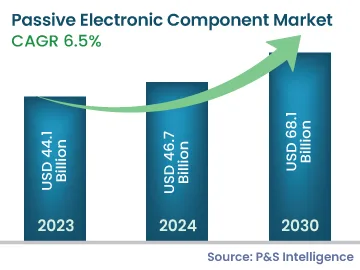
The passive electronic component market size was USD 68.5 billion for 2025, and it will grow by 2.3% during 2025–2030, to reach USD 77.8 million by 2030.
This growth is driven by the increasing electrification of transportation, expansion of renewable energy systems, and rising demand for high-performance electronics across industrial and consumer applications. Passive components, including resistors, capacitors, inductors, and transformers, are fundamental to all electronic circuits, enabling voltage regulation, energy storage, filtering, and signal conditioning. As electronic systems become more complex and power-intensive, the demand for advanced passive components is increasing significantly.
The International Energy Agency reports that global electricity demand is expected to grow by over 3% annually, driven by electrification and digitalization trends. In addition, the International Organization of Motor Vehicle Manufacturers reports that global motor vehicle production reached approximately 93.5 million units in 2023, with increasing vehicle electrification requiring higher volumes of passive components. Government investments in renewable energy, electric vehicles, and industrial automation are further strengthening long-term demand for passive electronic components.
Key Market Insights
The resistors category holds the largest market share, of 45%, in 2025, driven by their universal usage across all electronic circuits for voltage regulation, current control, and signal conditioning.
The polymer category will have the highest CAGR, of 9.6%, driven by increasing demand for high-performance and flexible electronic components.
The energy and electrification category will have the highest CAGR, of 3.4%, driven by the rapid expansion of renewable energy systems, electric vehicles, and power infrastructure.
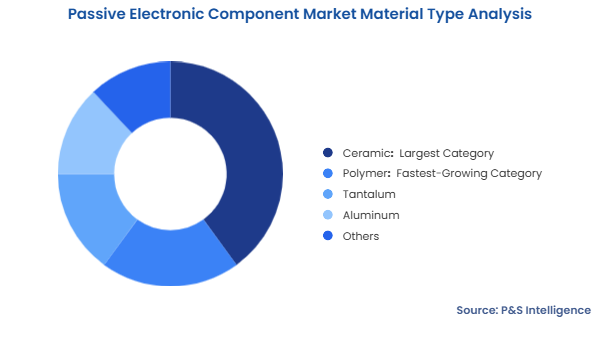
The ceramic category holds the largest market share, of 40%, in 2025, driven by its widespread use in capacitors and resistors due to high stability, reliability, and cost efficiency.
Asia-Pacific holds the largest market share, of 45%, in 2025, and it will have the highest CAGR, of 5.2%, driven by strong electronics manufacturing, rapid industrialization, and government support for semiconductors and electrification.
Passive Electronic Component Market Dynamics
High-Voltage Passives Redefining Power Conversion Standards across Industries Is Key Trend
A major trend in the passive electronic component market is the increasing adoption of high-voltage and high-performance passive components, particularly in power electronics applications such as electric vehicles, renewable energy systems, and industrial automation. These applications require components capable of handling higher voltages, temperatures, and power densities, driving innovation in capacitor materials, resistor stability, and inductor efficiency. High-voltage capacitors and advanced inductors are becoming critical for enabling efficient energy conversion and minimizing power losses in modern electronic systems. Reflecting this trend, TDK Corporation expanded its automotive MLCC series in 2025 with higher capacitance and voltage ratings, including 100 V and 1000 V solutions, supporting compact and efficient power designs in EV and industrial applications.
The International Energy Agency reports that global renewable power capacity additions have exceeded 500 GW annually, necessitating advanced power conversion infrastructure. Additionally, the U.S. Department of Energy highlights the growing importance of high-efficiency power electronics in grid modernization and electrification. Furthermore, the European Commission has set a target to achieve at least 42.5% renewable energy in total energy consumption by 2030, while the Ministry of New and Renewable Energy is driving initiatives to reach 500 GW of non-fossil fuel capacity by 2030. Alongside this, the increasing adoption of high-voltage architectures in industrial systems and data centers, supported by global energy-efficiency regulations, is accelerating the demand for advanced passive components across industries.
Vehicle Electrification Driving Surge in Automotive-Grade Passive Components Is Biggest Driver
The rapid electrification of vehicles is a major driver of the passive electronic component market, as electric vehicles (EVs) require significantly higher volumes of capacitors, resistors, and inductors compared to conventional vehicles. Passive components are essential in battery management systems, inverters, onboard chargers, and power control units, enabling efficient energy conversion and system stability. The increasing complexity of EV architectures is driving demand for high-reliability and automotive-grade passive components, particularly as advanced electronics become central to vehicle performance and safety. Supporting this growth, Panasonic Holdings Corporation commenced mass production of hybrid aluminum electrolytic capacitors for EV control units, offering high-temperature tolerance up to 135 °C and improved reliability.
The International Energy Agency reports that global electric vehicle sales exceeded 14 million units annually, reflecting strong growth in electrification. In addition, governments worldwide are supporting EV adoption through incentives and policy frameworks, with the European Commission promoting zero-emission mobility targets and the U.S. government introducing tax credits and funding programs to accelerate EV deployment. Furthermore, the expansion of charging infrastructure and integration of advanced driver assistance systems (ADAS) are increasing electronic content in vehicles, thereby strengthening demand for passive components across automotive applications.
Cyclicality and Pricing Pressure Continue to Restrain Passive Component Margins
The market is influenced by the cyclical nature of the global electronics industry, which leads to fluctuations in demand and pricing. Periods of strong demand, particularly in consumer electronics and automotive sectors, are often followed by supply corrections, resulting in price volatility and inventory adjustments. This cyclicality creates uncertainty for manufacturers, impacting revenue stability and long-term planning. At the same time, Taiyo Yuden Co., Ltd. expanded its MLCC production capacity through facility expansion, reflecting increasing supply competition in the market.
In addition, intense competition among global suppliers results in pricing pressure, particularly in commoditized segments such as standard resistors and capacitors. Manufacturers face challenges in maintaining profit margins while meeting cost expectations from large OEMs and electronics manufacturers. Fluctuations in raw material prices, including metals and ceramics, further increase cost burdens, collectively restraining profitability and creating operational constraints for market participants.
The resistors category holds the largest market share, of 45%, in 2025, driven by their universal usage across all electronic circuits for voltage regulation, current control, and signal conditioning. Resistors are essential components in virtually every electronic device, from consumer electronics to industrial systems, resulting in consistently high demand. Their widespread application in mass-produced electronics and automotive systems further reinforces their dominance. Additionally, the increasing complexity of electronic circuits is expanding the need for both fixed and variable resistor configurations.
The transformers category will have the highest CAGR, of 7.6%, driven by the rising need for efficient voltage conversion and power distribution across expanding energy and electrification systems. The increasing deployment of renewable energy projects and electrified infrastructure is accelerating the requirement for transformers in grid integration and energy transmission. According to the International Energy Agency, global electricity demand is expected to grow by over 3% annually, reinforcing the need for advanced transformer deployment in modern power networks.
The types analyzed in this report are:
Resistors (Largest Category)
Linear Resistors
Fixed Resistors
Variable Resistors
Non-linear Resistors
Capacitors
Ceramic
Aluminum Electrolyte
Film
Tantalum
Super Capacitors
Others
Inductors
Iron-core
Air-core
Iron-powder
Ferrite-core
Transformers (Fastest-Growing Category)
Surface-mounted
Chips
Network Transformers
Wire-wound Transformers
Film/oxide/film Transformers
Carbon Transformers
Material Type Analysis
The ceramic category holds the largest market share, of 40%, in 2025, driven by its extensive use in capacitors and resistors due to high thermal stability, reliability, and cost-effectiveness. Ceramic materials are widely used in multilayer ceramic capacitors (MLCCs), which are essential for modern electronic devices. The rapid growth of consumer electronics and automotive electronics is further driving demand for ceramic-based components.
The polymer category will have the highest CAGR, of 9.6%, driven by increasing demand for high-performance and flexible electronic components. Polymer materials offer advantages such as enhanced dielectric properties, lightweight structure, and stable performance under high-frequency and high-temperature conditions. These properties make them suitable for advanced applications, including electric vehicles and wearable electronics. Ongoing developments in conductive polymer capacitor technologies by Panasonic Holdings Corporation are further improving high-temperature performance and reliability in automotive and industrial applications. The shift toward miniaturization and flexible electronics is further accelerating the adoption of polymer-based passive components.
The material types analyzed in this report are:
Ceramic (Largest Category)
Polymer (Fastest-Growing Category)
Tantalum
Aluminum
Others
End User Analysis
The consumer electronics category holds the largest market share, of 30%, in 2025, driven by the high-volume production of devices such as smartphones, laptops, televisions, and wearable devices. Passive components are integral to these devices, supporting power management, signal processing, and connectivity. The continued growth in global consumer electronics production is supporting sustained demand for electronic components.
The energy and electrification category will have the highest CAGR, of 3.4%, driven by the rapid expansion of renewable energy systems, electric vehicles, and power infrastructure. Passive components play a critical role in energy storage, power conversion, and grid stability. High-voltage capacitor developments, such as those by Vishay Intertechnology, Inc. with voltage ratings up to 600 V for power inverters, are further supporting efficient energy conversion and infrastructure reliability.
The end users analyzed in this report are:
Consumer Electronics (Largest Category)
Energy and Electrification (Fastest-Growing Category)
Automotive
Healthcare
Telecommunications
Aerospace
Defense
Industrial
Others
Drive strategic growth with comprehensive market analysis
Asia-Pacific holds the largest market share, of 45%, in 2025, and it will have the highest CAGR, of 5.2%, driven by its dominance in electronics manufacturing, rapid industrialization, and strong government-backed investments in semiconductors and electrification. The region accounts for over 60% of global electronics production, supported by large-scale manufacturing ecosystems across Japan, South Korea, and Southeast Asia. The International Energy Agency reports that Asia-Pacific contributes to the majority of global electricity demand growth, with regional consumption rising by over 4% annually, reflecting rapid electrification and industrial expansion. Additionally, East and Southeast Asia are central to over 80% of global semiconductor production, reinforcing the region’s dominance in the semiconductor value chain and electronics manufacturing ecosystem.
Additionally, Japan and South Korea contribute through high-end component innovation and semiconductor leadership, with South Korea announcing investments of over USD 450 billion in semiconductor development, while Japan continues to support advanced electronics manufacturing through national industrial policies. Additionally, Australia is witnessing growth in demand due to renewable energy expansion, with over 35% of its electricity generation coming from renewable sources, driving adoption of power electronics and passive components.
China Passive Electronic Component Market Size
China is the largest country market in the Asia-Pacific passive electronic component market, driven by its dominant position in global electronics manufacturing and strong government-backed expansion of semiconductor and electric vehicle industries. The country serves as the primary production hub for consumer electronics, industrial equipment, and telecommunications systems, creating substantial demand for resistors, capacitors, and inductors across applications. In addition, China leads global EV production, exceeding 8 million electric vehicles annually, significantly increasing demand for power electronics and passive components used in battery systems and inverters.
India Passive Electronic Component Market Size
India is the fastest-growing country in the Asia-Pacific passive electronic component market, driven by strong government support, expanding domestic manufacturing, and rising demand for consumer electronics and electric mobility. The country is rapidly emerging as a key electronics manufacturing hub under initiatives such as Make in India and Production Linked Incentive (PLI) Scheme, which are attracting significant investments across semiconductor, mobile device, and component manufacturing ecosystems. According to the Ministry of Electronics and Information Technology, government projections target the electronics manufacturing sector to exceed USD 300 billion by 2026, supported by increasing localization of supply chains. In parallel, India’s renewable energy expansion, with capacity targets surpassing 500 GW by 2030, along with the rapid growth of electric vehicles, is significantly boosting demand for passive components used in power electronics, battery systems, and grid infrastructure.
North America Passive Electronic Component Market Size
North America represents a significant market in the passive electronic component industry, driven by strong demand from automotive electrification, aerospace, defense, and industrial automation sectors. The region benefits from advanced manufacturing capabilities, high R&D investment, and early adoption of next-generation electronic systems. In addition, the Bureau of Economic Analysis reports that the U.S. digital economy contributes over USD 2 trillion to GDP, reflecting strong demand for electronic components. These factors collectively drive steady demand for passive components across high-performance and mission-critical applications in North America.
The regions and countries of the market are as follows:
North America
U.S. (Larger and Faster-Growing Country Market)
Canada
Europe
Germany (Largest Country Market)
U.K. (Fastest-Growing Country Market)
France
Italy
Spain
Rest of Europe
Asia-Pacific (Largest and Fastest-Growing Regional Market)
China (Largest Country Market)
India (Fastest-Growing Country Market)
Japan
South Korea
Australia
Rest of APAC
Latin America
Brazil (Largest and Fastest-Growing Country Market)
Mexico
Rest of LATAM
Middle East and Africa
Saudi Arabia (Largest Country Market)
South Africa
U.A.E. (Fastest-Growing Country Market)
Rest of MEA
Passive Electronic Component Market Share
The market is fragmented due to the large number of manufacturers producing standardized, low-differentiation products such as resistors and capacitors, which lowers entry barriers and intensifies price competition. Demand spans multiple industries, including consumer electronics, automotive, and industrial sectors, encouraging regional players to serve local markets. Additionally, varying customer requirements and cost sensitivities limit supplier concentration. While global companies like Murata Manufacturing and Yageo Corporation dominate high-performance segments, the widespread presence of small and mid-sized firms keeps the overall market structure fragmented.
Top Passive Electronic Component Market Companies:
Murata Manufacturing Co., Ltd.
TDK Corporation
Panasonic Holdings Corporation
Vishay Intertechnology, Inc.
Nichicon Corporation
Taiyo Yuden Co., Ltd.
KYOCERA AVX Components Corporation
Walsin Technologies Corporation
YAGEO Group
Johanson Technology Incorporated
Samsung Electro-Mechanics Co. Ltd.
Passive Electronic Component Industry News
In October 2025, Murata Manufacturing Co., Ltd. completed a new multilayer ceramic capacitor (MLCC) production facility in the Philippines to expand global capacity and meet growing demand from automotive and mobility applications.
In September 2025, Vishay Intertechnology, Inc. launched its MKP1848e DC-link metallized polypropylene film capacitors with AEC-Q200 qualification, designed for EV powertrain and onboard charging systems.
In September 2025, KYOCERA AVX Components Corporation released the DSCC 25007 Mini BME stacked capacitors, compact X7R MLCC stacks with base-metal electrodes and 100% Group A testing, for aerospace and defense applications requiring high capacitance and high current handling.
In September 2025, Johanson Technology Incorporated launched AEC-Q200-qualified LTCC UWB antennas and filters for keyless entry and in-cabin detection, combining compact size with high gain and low insertion loss.
In April 2025, Nichicon Corporation launched the GYG series of conductive polymer hybrid aluminum electrolytic capacitors, delivering up to 1.8 times higher ripple current than earlier GYA/GYF models. Targeting automotive and communications equipment, samples were released in April, with mass production scheduled for July 2025 at the Iwate plant.
Frequently Asked Questions About This Report
Why are passive electronic components critical in modern electronics?+
Passive components such as resistors, capacitors, and inductors are essential for regulating voltage, storing energy, filtering signals, and ensuring stable circuit performance across all electronic devices, from consumer electronics to industrial systems.
How is electric vehicle growth impacting demand for passive components?+
Electric vehicles require 2–3 times more passive components than conventional vehicles, as they rely heavily on power electronics in battery management systems, inverters, and charging infrastructure, significantly increasing demand.
What role do passive components play in renewable energy systems?+
Passive components are critical in solar inverters, wind turbines, and energy storage systems, enabling efficient power conversion, voltage regulation, and grid stability in renewable energy infrastructure.
What factors are driving the growth of the passive electronic component market?+
Key drivers include electrification of transportation, expansion of renewable energy, increasing consumer electronics demand, and growth in industrial automation and digital infrastructure.
What are the key challenges in the passive electronic component market?+
The market faces challenges such as pricing pressure due to high competition, cyclic demand fluctuations in electronics industries, and raw material cost volatility affecting profitability.
Want a report tailored exactly to your business need?
Leading companies across industries trust us to deliver data-driven insights and innovative solutions for their most critical decisions. From data-driven strategies to actionable insights, we empower the decision-makers who shape industries and define the future. From Fortune 500 companies to innovative startups, we are proud to partner with organisations that drive progress in their industries.
Client Testimonials
Working with P&S Intelligence and their team was an absolute pleasure – their awareness of timelines and commitment to value greatly contributed to our project's success. Eagerly anticipating future collaborations.
McKinsey & Company
India
Unmatched Standards
Our insights into the minutest levels of the markets, including the latest trends and competitive landscape, give you all the answers you need to take your business to new heights
Complete Data Security
We take a cautious approach to protecting your personal and confidential information. Trust is the strongest bond that connects us and our clients, and trust we build by complying with all international and domestic data protection and privacy laws