Key Highlights
| Study Period | 2019 - 2032 |
| Market Size in 2024 | USD 2.9 Billion |
| Market Size in 2025 | USD 3.0 Billion |
| Market Size by 2032 | USD 4.4 Billion |
| Projected CAGR | 5.6% |
| Largest Region | APAC |
| Fastest Growing Region | APAC |
| Market Structure | Fragmented |

| Study Period | 2019 - 2032 |
| Market Size in 2024 | USD 2.9 Billion |
| Market Size in 2025 | USD 3.0 Billion |
| Market Size by 2032 | USD 4.4 Billion |
| Projected CAGR | 5.6% |
| Largest Region | APAC |
| Fastest Growing Region | APAC |
| Market Structure | Fragmented |
|
Explore the market potential with our data-driven report
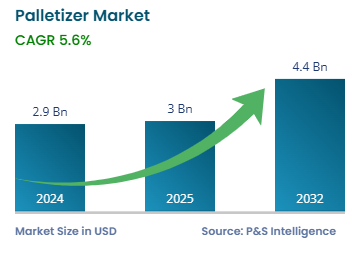
The global palletizer market will generate an estimated revenue of USD 2.9 billion in 2024, which is expected to witness a CAGR of 5.6% during 2025–2032, to reach USD 4.4 billion by 2032.
This growth can be attributed to the increasing demand for automation in industries such as food and beverage, pharmaceuticals, logistics, and manufacturing, where efficient packaging and palletizing solutions are essential to optimizing production lines and reducing labor costs.
The global logistics industry has expanded rapidly with the surge in e-commerce and just-in-time delivery models. Palletizers—both conventional and robotic—are increasingly used in large distribution centers to automate material handling. Robotic palletizers now account for an estimated 40–45% of new installations, particularly in high-volume sectors like food and beverage, pharmaceuticals, and consumer goods.
These systems enhance stacking precision, reduce manual labor, and increase throughput. With billions of parcels handled annually, logistics providers are turning to automation to improve speed and efficiency. Palletizers have become essential in modern warehousing, especially in regions with high labor costs or space constraints.
Moreover, technological advancements in robotic systems, artificial intelligence, and machine learning are enhancing the precision, flexibility, and speed of palletizers, further driving their adoption across a wide range of applications. The need for streamlined supply chain operations, along with the rising focus on minimizing human intervention and maximizing operational efficiency, is also fueling the market's expansion.
The boxes and cases category are projected to grow at the highest CAGR, during 2025–2032, after holding the largest market share in 2024, of 45%. This growth can be attributed to the increasing demand for efficient and scalable packaging solutions across a variety of industries, particularly in e-commerce, consumer goods, and food and beverage sectors. Boxes and cases are essential packaging materials for storing and transporting a wide range of products, making them a key component of logistics and supply chain operations.
Furthermore, the rise in e-commerce and online retail has significantly increased the volume of packaged goods being shipped globally. Automated palletizers can handle a variety of box sizes and configurations, making them highly adaptable to the diverse needs of e-commerce fulfillment centers. Additionally, the need for uniformity and protection in packaging, especially for fragile or perishable goods, has further driven the demand for palletizing systems designed specifically for boxes and cases.
During the study, we have analyzed the following product types in the report:
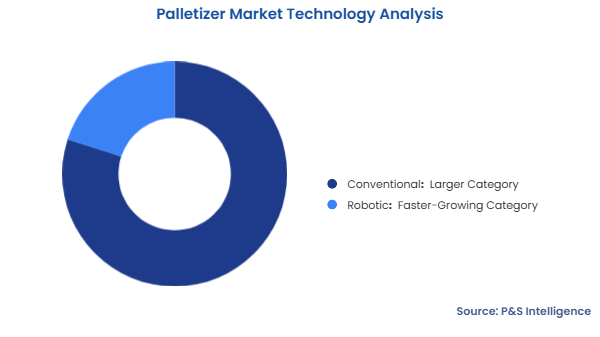
The conventional technology category holds the largest market share, of 80%, in 2024. This is primarily due to its widespread adoption and proven reliability across various industries. Conventional palletizers, which include traditional mechanical systems and automated solutions with fixed functionalities, have been in use for decades and are trusted for their simplicity, robustness, and cost-effectiveness.
These systems are well-established and widely integrated into production lines, particularly in industries such as food and beverage, pharmaceuticals, and manufacturing, where they have demonstrated consistent performance in high-volume environments. Additionally, the relatively lower upfront investment and straightforward implementation process of conventional palletizers make them an attractive option for businesses that are either new to automation or looking to optimize existing operations without significant overhaul.
Robotic is the faster-growing category, with 6% CAGR, on account of their precision, flexibility, and labor-saving advantages for industries. Unlike conventional systems, they can handle mixed products, variable load patterns, and frequent SKU changes, making them ideal for dynamic production environments. Industries such as food and beverage, pharmaceuticals, consumer goods, and logistics rely on robotic palletizers to streamline operations, ensure consistent stacking quality, and reduce workplace injuries associated with manual palletizing. These systems also require less floor space and offer easy integration with conveyors, AGVs, and warehouse software. Their reliability and adaptability make them a key component in modern, high-throughput, and automated supply chain facilities.
Below are the technologies analyzed:
The food & beverages category accounts for the largest share in 2024. This is driven by the industry's need for high-speed automation, efficient packaging, and reliable handling solutions. The food and beverage sector are characterized by high-volume production and stringent hygiene standards, making automation a critical solution to ensure consistency, speed, and safety in operations. Palletizers in this sector are essential for streamlining the packaging and distribution of a wide range of products, from bottled beverages to packaged snacks, dairy, and frozen foods.
Automated palletizing systems enhance productivity by handling large volumes of goods quickly and accurately while reducing labor costs and minimizing human error. Additionally, the growing demand for ready-to-eat and packaged food, coupled with the rise of e-commerce and retail distribution channels, has further increased the need for efficient palletizing solutions. Furthermore, the ability to customize palletizing solutions to handle diverse packaging formats and sizes makes automated systems particularly well-suited for the dynamic needs of the food and beverage industry.
The pharmaceutical category is expected to witness the fastest growth, with a CAGR of 6.5%. The pharmaceutical industry, valued at over USD 1 trillion globally, relies heavily on automation technologies like palletizers to ensure safe, sterile, and efficient packaging and distribution. Palletizers are used to handle cartons, cases, and shrink-wrapped bundles of medicines and medical supplies. Their precision reduces contamination risks, ensures traceability, and supports compliance with strict regulatory standards.
Robotic palletizers, in particular, are favored for their ability to manage small, high-value packages and adapt to varying product lines without manual intervention. With rising production volumes and global distribution demands, palletizers play a vital role in maintaining product integrity and accelerating fulfillment in pharmaceutical supply chains.
The following end users are included in the report:
Drive strategic growth with comprehensive market analysis
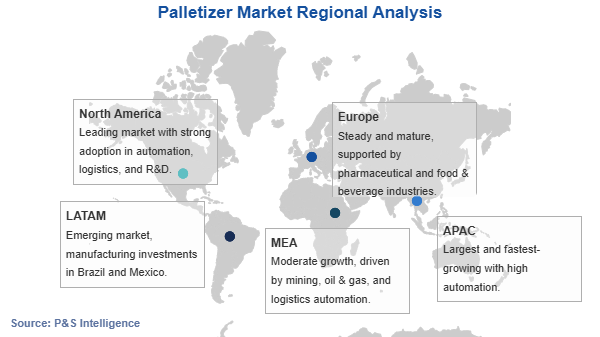
Geographically, APAC holds the largest market share, of 40%, in 2024, and it also has the highest CAGR. In Asia, palletizers are used across industries to improve logistics, reduce labor reliance, and boost productivity. In 2023, China maintained its position as the global manufacturing powerhouse with industrial output contributing significantly to its GDP and accounting for nearly 29% of global manufacturing production.
South Korea’s manufacturing sector was valued at approximately USD 416 billion, representing about a quarter of its GDP, driven by technology and heavy industries. Japan’s industrial output reached around USD 1.1 trillion, with manufacturing making up roughly 20% of its economy, focused on automotive and electronics sectors. India’s manufacturing output was about USD 456 billion, constituting nearly 13% of its GDP, with rapid growth fueled by pharmaceuticals, textiles, and steel production.
With the rapid urbanization and changing consumption patterns in China, food & beverage manufacturers are investing in automated packaging lines, particularly for bottled drinks, dairy, and packaged foods. The sector’s vast scale—millions of tons in annual output—requires consistent palletizing to handle distribution volume efficiently.
South Korea’s electronics industry relies on precision and speed in packaging delicate components and consumer goods like smartphones and televisions. Cleanroom-compatible palletizing systems are particularly valued due to stringent contamination controls. Moreover, with Japanese automotive factories emphasizing lean manufacturing, robotics—including palletizers—are essential in handling parts, tires, and finished vehicles. Palletizers help streamline internal logistics and reduce manual lifting, aligning with ergonomic and efficiency goals.
India ranks among the largest medicine producers globally, exporting to over 200 nations. Strict packaging standards and high-volume production have made automated palletizing crucial, especially for boxed medicines and bulk shipments. Each of these sectors shapes regional demand in distinctive ways.
Further, regions and countries analyzed for this report include:
The market is fragmented with a wide range of players operating in various segments and offering different types of palletizing solutions. This is due to the diversity of industries and applications that require palletizing systems, as well as the varying needs for automation across different regions and production environments. Companies range from small and medium-sized enterprises (SMEs) to large multinational corporations, each catering to specific market niches, such as robotic palletizing, conventional mechanical systems, and specialized palletizers for industries like food and beverage, pharmaceuticals, and logistics.
Additionally, the market is characterized by the presence of both established players with extensive product portfolios and innovative startups that are pushing the boundaries of automation with advanced technologies like AI and robotics. While larger companies dominate in terms of market share and technological capabilities, there is significant competition from smaller firms that focus on cost-effective and customizable solutions. This diversity in players leads to intense competition, driving innovation and enabling businesses to choose from a variety of solutions that best fit their unique operational needs.
Want a report tailored exactly to your business need?
Request CustomizationLeading companies across industries trust us to deliver data-driven insights and innovative solutions for their most critical decisions. From data-driven strategies to actionable insights, we empower the decision-makers who shape industries and define the future. From Fortune 500 companies to innovative startups, we are proud to partner with organisations that drive progress in their industries.

Working with P&S Intelligence and their team was an absolute pleasure – their awareness of timelines and commitment to value greatly contributed to our project's success. Eagerly anticipating future collaborations.
McKinsey & Company
India
Our insights into the minutest levels of the markets, including the latest trends and competitive landscape, give you all the answers you need to take your business to new heights

We take a cautious approach to protecting your personal and confidential information. Trust is the strongest bond that connects us and our clients, and trust we build by complying with all international and domestic data protection and privacy laws


Customize the Report to Align with Your Business Objectives

Request the Free Sample Pages