This Report Provides In-Depth Analysis of the Orthopedic Contract Manufacturing Market Report Prepared by P&S Intelligence, Segmented by Product Type (Implants, Instruments, Cases, Trays), Class of Device (Class I, Class II, Class III), End User (Hospitals, Outpatient Facilities, Rehabilitation Centers), and Geographical Outlook for the Period of 2019 to 2032
Explore the market potential with our data-driven report
Orthopedic Contract Manufacturing Market Future Outlook
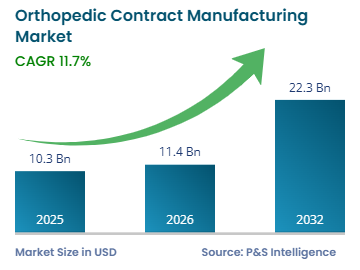
The orthopedic contract manufacturing market size will be an estimated USD 10.3 billion for 2025, and it will grow by 11.7% during 2026–2032, to reach USD 22.3 billion by 2032.
The market expansion is primarily driven by the rising prevalence of musculoskeletal disorders, increasing adoption of minimally invasive surgical techniques, and growing demand for specialized precision manufacturing services across the orthopedic industry.
The surging geriatric population is a key factor contributing to the rising demand for orthopedic implants and devices. Older populations experience higher rates of musculoskeletal conditions requiring surgical interventions. Approximately 1.71 billion people globally live with musculoskeletal conditions, including lower back pain, neck pain, fractures, osteoarthritis, amputation, and other injuries. This massive disease burden drives consistent demand for orthopedic implants and instruments, compelling original equipment manufacturers to outsource production to specialized contract manufacturers who offer precision engineering, regulatory compliance, and cost-effective solutions.
The shift toward minimally invasive surgeries is creating substantial opportunities for contract manufacturers. These advanced surgical techniques demand highly specialized instruments and implants manufactured with extreme precision. Contract manufacturers provide critical capabilities in CNC machining, additive manufacturing, and advanced finishing processes that enable the production of these complex devices while allowing OEMs to focus on innovation and market expansion. This makes contract manufacturers an increasingly important part of the orthopedic value chain, bridging the gap between design innovation and large-scale, compliant production.
Adoption of Minimally Invasive SurgeriesIs Key Trend
Minimally invasive surgical techniques have transformed orthopedic procedures by offering significant advantages over traditional open surgeries.
These advanced techniques require smaller incisions, result in reduced blood loss, enable faster patient recovery, and lower the risk of post-operative complications.
The growing preference for minimally invasive approaches among both surgeons and patients is reshaping the orthopedic device landscape.
Contract manufacturers are responding to this trend by investing in advanced precision machining capabilities, developing specialized coating technologies, and expanding their expertise in manufacturing complex, miniaturized instruments.
The production of minimally invasive devices demands extremely tight tolerances, innovative material selections, and sophisticated surface treatments that contract manufacturers are uniquely positioned to provide.
According to industry estimates, approximately 28.3 million orthopedic procedures were performed globally by 2022, reflecting continued growth driven by aging populations and advances in surgical techniques.
This shift is driving contract manufacturers to continuously enhance their technical capabilities and expand their service offerings to meet evolving surgical needs.
A global survey found that for minimally invasive spinal surgery techniques, 96.7% of surgeons in Asia, 88.9% in Europe and South America, and 87.5% in Africa & Middle East reported performing MIS in practice.
The minimally invasive surgical instruments market is set to cross USD 66.4 billion by 2032.
Growing Aging PopulationIs Biggest Driver
The expanding elderly population worldwide represents the most significant driver for orthopedic contract manufacturing demand.
As per the WHO, by the year 2030, one in every six individuals globally will be 60 years of age or older.
At that point, the proportion of the population aged 60 and above is projected to rise from 1 billion in 2020 to 1.4 billion.
By 2050, the global population of individuals aged 60 years and older will double, reaching 2.1 billion.
Furthermore, the number of individuals aged 80 years or older is expected to increase threefold between 2020 and 2050, ultimately reaching 426 million.
The United Nations projects that the global population aged 65 and older will more than double from 761 million in 2021 to around 1.6 billion by 2050, increasing this age group’s share of the total population to approximately one in six.
This demographic shift directly correlates with increased incidence of age-related orthopedic conditions such as osteoarthritis, osteoporosis, and degenerative bone diseases.
As individuals age, they experience greater susceptibility to joint deterioration, bone fractures, and mobility limitations that often require surgical intervention.
Joint replacement surgeries, particularly hip and knee replacements, have become increasingly common among older adults.
The high success rates of these procedures encourage more patients to seek surgical solutions, creating sustained demand for orthopedic implants and instruments.
Contract manufacturers play a vital role in meeting this demand by providing scalable production capabilities, specialized expertise in biomaterials, and rigorous quality control processes that ensure device safety and performance.
The aging population trend is particularly pronounced in developed markets but is rapidly accelerating in emerging economies.
This global demographic shift ensures consistent long-term growth opportunities for contract manufacturers across all geographic regions.
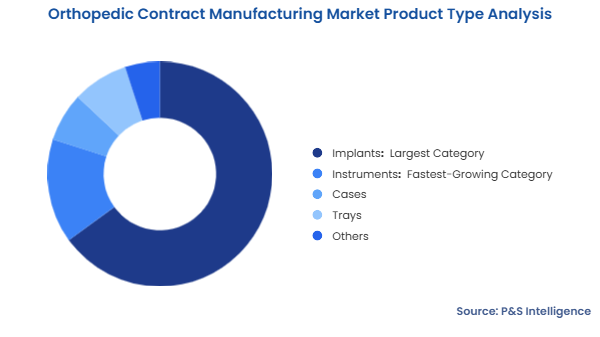
The implants category holds the largest market share, of 65%, in 2025, driven by the rising demand for joint reconstruction implants, spinal devices, and trauma fixation products across global healthcare systems. The increasing prevalence of musculoskeletal disorders and the growing number of joint replacement surgeries create sustained demand for high-quality implants manufactured with precision and reliability. Contract manufacturers provide specialized capabilities in forging, casting, machining, and finishing processes that are essential for producing complex implant geometries with biocompatible materials.
The instruments category will have the highest CAGR, of 11.9%, owing to the increasing complexity of orthopedic surgical procedures and rising demand for precision-engineered surgical tools. Both reusable and single-use instruments require specialized manufacturing processes, including precision machining, laser cutting, and advanced coating applications. Contract manufacturers offer comprehensive instrument manufacturing services that enable OEMs to optimize costs while maintaining the highest quality standards. The growing adoption of robotic-assisted surgeries and sensor-enabled instruments is driving innovation in instrument manufacturing, underscoring the critical role of contract manufacturers in enabling innovation, precision, and scalability across the orthopedic product landscape.
The product types analyzed in this report are:
Implants (Largest Category)
Instruments (Fastest-Growing Category)
Cases
Trays
Others
Class of Device Analysis
The class II category holds the largest market share, of 60%, in 2025, due to the substantial volume of orthopedic devices falling under this FDA classification. Class II medical devices represent the majority of orthopedic implants and instruments used in common procedures such as joint replacements, spinal surgeries, and trauma fixation. These devices require moderate regulatory oversight and must demonstrate substantial equivalence to existing marketed devices.
Contract manufacturers specializing in Class II devices provide comprehensive services, including design support, manufacturing process validation, quality management systems, and regulatory compliance assistance. The growing demand for joint reconstruction devices, particularly hip and knee implants, drives consistent production volumes in the Class II category.
The class III category will have the highest CAGR during the forecast period, owing to increasing innovation in advanced orthopedic technologies, including novel spinal implants, bone healing devices, and next-generation joint replacement systems. Class III devices require more extensive regulatory review and clinical data, creating opportunities for contract manufacturers who offer specialized regulatory expertise and advanced manufacturing capabilities.
The classes of devices analyzed in this report are:
Class I
Class II (Largest Category)
Class III (Fastest-Growing Category)
End User Analysis
The hospitals category holds the largest market share, of 70%, in 2025. Hospitals represent the primary procurement and utilization centers for orthopedic implants and devices, performing the vast majority of orthopedic surgical procedures globally. The high volume of joint replacements, trauma surgeries, and spinal procedures conducted in hospital settings drives substantial demand for contract-manufactured orthopedic products.
Hospitals typically maintain established relationships with multiple orthopedic device manufacturers who, in turn, rely heavily on contract manufacturers for production. The trend toward hospital consolidation and group purchasing organizations creates opportunities for contract manufacturers to secure large-volume supply agreements. Hospitals increasingly prioritize device quality, regulatory compliance, and cost-effectiveness, all of which are core competencies of specialized contract manufacturers.
The outpatient facilities category will have the highest CAGR, of 12.0%, owing to the accelerating shift toward same-day discharge for joint replacement surgeries and other orthopedic procedures. Ambulatory surgery centers are experiencing rapid growth due to their cost advantages, patient convenience, and focus on elective procedures. This trend is driving demand for specialized orthopedic devices tailored to outpatient settings, including pre-configured surgical kits, single-use instruments, and standardized implant systems, to enable efficient surgical workflows. Contract manufacturers are adapting their service offerings to meet the specific needs of the outpatient market segment.
The end users analyzed in this report are:
Hospitals (Largest Category)
Outpatient Facilities (Fastest-Growing Category)
Rehabilitation Centers
Others
Drive strategic growth with comprehensive market analysis
Orthopedic Contract Manufacturing Market Regional Outlook
North America Orthopedic Contract Manufacturing Market Size
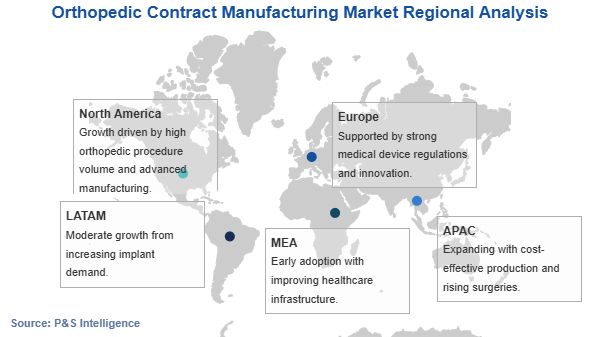
North America holds the largest market share, of 40%, in 2025. This dominance is primarily attributed to the presence of a well-established medical device industry, advanced healthcare infrastructure, and high procedural volumes for orthopedic surgeries.
The rapid expansion of ambulatory surgery centers across North America is transforming the region’s orthopedic device landscape. The Centers for Medicare & Medicaid Services recorded an 8% rise in orthopedic procedure volumes, reflecting increased surgical activity that drives demand for contract manufacturing services.
North American contract manufacturers are investing heavily in advanced technologies, including additive manufacturing, automation, and digital quality systems. The region's regulatory environment, while stringent, is well-established and predictable, enabling efficient product development and commercialization. Strong intellectual property protections and access to skilled engineering talent further strengthen North America's position as a leading market for orthopedic contract manufacturing.
U.S. Orthopedic Contract Manufacturing Market Size
The U.S. represents the single largest market for orthopedic contract manufacturing, driven by substantial healthcare spending and strong demand for innovative orthopedic solutions. This regulatory activity demonstrates the robust innovation pipeline and increasing reliance on contract manufacturers to bring new products to market. The region benefits from the presence of major orthopedic device manufacturers, including Stryker, Zimmer Biomet, and DePuy Synthes, which maintain extensive outsourcing relationships with contract manufacturers.
Asia-Pacific will have the highest CAGR, of 11.8%, during the forecast period. The growth of the market can be mainly attributed to rapidly expanding healthcare infrastructure, cost-competitive manufacturing capabilities, and increasing demand for orthopedic procedures across the region. China, India, and Japan are experiencing significant growth in orthopedic surgery volumes driven by aging populations and rising healthcare expenditure. The region offers substantial cost advantages for contract manufacturing while maintaining high quality standards. Many global orthopedic device manufacturers are establishing or expanding their manufacturing footprint in Asia-Pacific to optimize production costs and access growing local markets.
Moreover, Government initiatives supporting medical device manufacturing, favorable regulatory reforms, and investments in healthcare infrastructure are accelerating market growth. For instance, India’s National Medical Devices Policy 2023 and China’s ‘Made in China 2025’ initiative are encouraging domestic orthopedic device manufacturing under supportive FDI frameworks. Furthermore, rising awareness of advanced surgical options and improving insurance coverage are expanding the patient pool for orthopedic procedures. These demographic and economic trends position Asia-Pacific as the highest-growth region for orthopedic contract manufacturing over the forecast period.
The regions and countries analyzed are as follows:
North America (Largest Regional Market)
U.S. (Larger and Faster-Growing Country)
Canada
Europe
Germany (Largest Country)
U.K. (Fastest-Growing Country)
France
Italy
Spain
Rest of Europe
Asia-Pacific (Fastest-Growing Regional Market)
China (Largest Country)
India
Japan (Fastest-Growing Country)
South Korea
Australia
Rest of APAC
Latin America
Brazil (Largest Country)
Mexico (Fastest-Growing Country)
Rest of LATAM
Middle East and Africa
Saudi Arabia (Largest Country)
South Africa
UAE (Fastest-Growing Country)
Rest of MEA
Orthopedic Contract Manufacturing Market Share
The market is fragmented due to the presence of numerous specialized contract manufacturers, ranging from large multinational companies to smaller regional players. The industry is characterized by intense competition, with manufacturers differentiating themselves through technical capabilities, quality systems, regulatory expertise, and customer service. Companies offering comprehensive end-to-end services from design support through final packaging and sterilization maintain competitive advantages. Additionally, regional players often serve localized OEMs or cater to specific regulatory markets, contributing to the decentralized nature of the industry. The limited standardization in orthopedic manufacturing processes and regulatory variations across regions also contribute to the persistence of a fragmented competitive landscape.
Key Orthopedic Contract Manufacturing Companies:
Tecomet, Inc.
Orchid Orthopedic Solutions
Viant
Paragon Medical
ARCH Medical Solutions Corp.
Avalign Technologies
LISI Medical
Cretex Companies
Norman Noble, Inc.
Autocam Medical
Integer Holdings Corporation
Flex Ltd.
Orthopedic Contract Manufacturing Market News
In July 2025, Straits Orthopaedics (Mfg) Sdn Bhd announced the completion of its acquisition of Medin Technologies Inc., a U.S.-based manufacturer of sterilization cases and trays for the orthopedic sector, with operations in Totowa, New Jersey, and Manchester, New Hampshire. This acquisition enhances Straits Orthopaedics’ capabilities in surgical kit and tray manufacturing.
In June 2025, Maxx Orthopedics Inc. announced a partnership with Orchid Orthopedic Solutions to commercialize a new implant design to market using additive manufacturing technology, beginning with a cementless tibial baseplate engineered to support bone in-growth and long-term joint stability.
In April 2025, Tyber Medical, Intech, and Resolve Surgical Technologies announced a merger to establish a unified organization focused on the design, development, and manufacturing of surgical devices for medtech OEMs. They will integrate advanced implant and instrumentation platforms with regulatory capabilities.
In March 2025, Jabil Inc. announced plans to establish a new manufacturing facility in Gujarat, India, marking its second site in the country. The initiative follows a memorandum of understanding signed in November 2024 to advance long-term manufacturing and regional collaboration objectives.
In November 2024, Viant Medical Inc. announced the acquisition of Knightsbridge Plastics Inc., expanding its service portfolio to include micro-molding capabilities for medical device OEMs and strengthening its position in polymer-based orthopedic components.
Want a report tailored exactly to your business need?
Leading companies across industries trust us to deliver data-driven insights and innovative solutions for their most critical decisions. From data-driven strategies to actionable insights, we empower the decision-makers who shape industries and define the future. From Fortune 500 companies to innovative startups, we are proud to partner with organisations that drive progress in their industries.
Client Testimonials
Working with P&S Intelligence and their team was an absolute pleasure – their awareness of timelines and commitment to value greatly contributed to our project's success. Eagerly anticipating future collaborations.
McKinsey & Company
India
Unmatched Standards
Our insights into the minutest levels of the markets, including the latest trends and competitive landscape, give you all the answers you need to take your business to new heights
Complete Data Security
We take a cautious approach to protecting your personal and confidential information. Trust is the strongest bond that connects us and our clients, and trust we build by complying with all international and domestic data protection and privacy laws