Open RAN Market Size & Share Analysis - Trends, Drivers, Competitive Landscape, and Forecasts (2026 - 2032)
This Report Provides In-Depth Analysis of the Open RAN Market Report Prepared by P&S Intelligence, Segmented by Component (Solutions, Services), Network Deployment (Brownfield, Greenfield), End User (Mobile Network Operators, Private Network Operators/Enterprise 5G Users, Rural & Regional Telecom Providers, Neutral Host Providers), and Geographical Outlook for the Period of 2021 to 2032
Explore the market potential with our data-driven report
Open RAN Market Key Insights
Solutions are the larger component, holding a market share of 70%, because core Open RAN hardware and software are essential for network deployment
Services are the faster-growing component, registering a CAGR of approximately 31.0%, as operators require integration, testing, and ongoing network management support
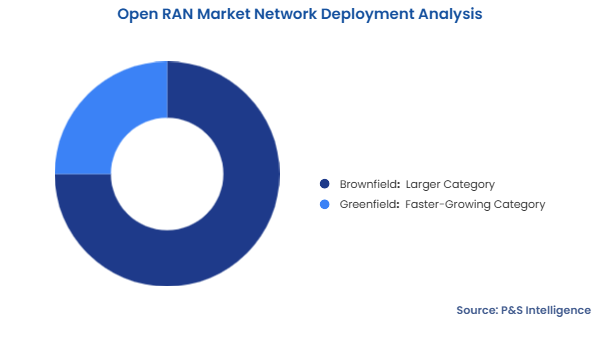
Brownfield is the larger segment, holding a market share of 75%, due to operator preference for upgrading existing telecom infrastructure gradually
Greenfield is the faster-growing segment, registering a CAGR of approximately 30.9%, as new networks adopt Open RAN without legacy system limitations
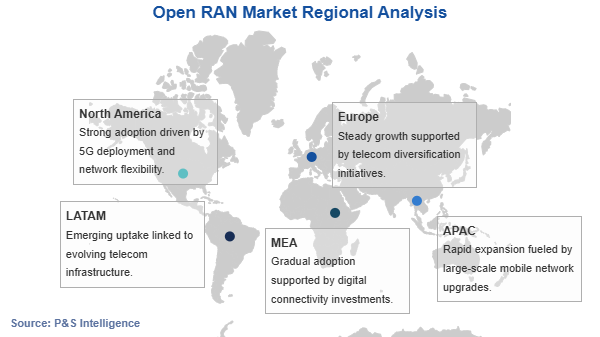
North America is the largest region, holding a market share of 40%, and APAC is the fastest-growing, registering a CAGR of approximately 31.6%.
Open RAN Market Future Outlook
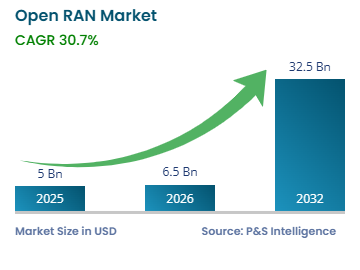
The open RAN market size was USD 5.0 billion for 2025, and it will grow by 30.7% during 2026–2032, to reach USD 32.5 billion by 2032.
The market is expanding as telecom operators increasingly adopt Open RAN to build flexible and cost-efficient network architectures that eliminate vendor lock-in. The growing demand for high-speed data and cloud-based services further accelerates the need for scalable network infrastructure. Telecom providers deploy open interfaces to accelerate innovation and optimise network costs. In addition, government initiatives supporting telecom supply chain diversification and Open RAN deployment are further driving market growth. For instance, the National Telecommunications and Information Administration launched a USD 1.5 billion Public Wireless Supply Chain Innovation Fund to support Open RAN development and deployment.
Open RAN Market Emerging Trends and Growth Drivers
Shift Towards Cloud-Native and Multi-Vendor Deployments Is Major Trend
The industry is shifting toward software-driven, cloud-based network architectures that separate hardware from software functions. Telecom operators deploy Open RAN solutions on general-purpose servers to improve scalability and reduce dependence on proprietary systems. This transition is driven by the rapid expansion of digital connectivity and increasing network capacity requirements. According to the International Telecommunication Union, 5.5 billion people used the internet globally in 2024, increasing demand for scalable network infrastructure. Furthermore, according to Ericsson, global 5G subscriptions surpassed 1.7 billion in 2024, accelerating the need for flexible and high-capacity network architectures.
Need to Reduce Network Costs and Avoid Vendor Lock-in Drives Market
Telecom operators increasingly adopt Open RAN to reduce infrastructure costs and eliminate dependence on single-vendor ecosystems. Traditional network architectures remain expensive and difficult to scale under rising data demands. According to the International Telecommunication Union, approximately 6 billion people used the internet globally in 2025, increasing the need for continuous network expansion. Furthermore, according to Ericsson, total global mobile network data traffic reached 200 Exabytes per month in 2025, creating significant capacity and cost pressures for operators. Telecom providers deploy interoperable Open RAN solutions to optimise capital expenditure and enable flexible, scalable network architectures.
Integration Challenges and Performance Uncertainty Are Key Restraints
The market faces limitations because integrating equipment from multiple vendors remains highly complex. Diverse hardware and software systems often struggle to interoperate, causing performance issues and deployment delays. Operators question whether Open RAN can match the reliability of established single-vendor infrastructures at scale. These integrations require highly specialised technical expertise to ensure stable network performance. Many operators continue to rely on proven legacy systems to maintain operational stability.
Rural and Private Network Deployments Offer Market Opportunities
The market offers growth opportunities as telecom operators expand network coverage in rural and underserved regions. Open RAN enables cost-efficient deployments in these areas by reducing infrastructure costs and allowing flexible network configurations. This expansion directly addresses the global connectivity gap. According to the International Telecommunication Union, 2.6 billion people remained offline globally in 2024, highlighting significant unmet demand for network access. Enterprises are also deploying private networks for industrial automation across the manufacturing and logistics sectors. Vendors can enter underserved markets and deliver customised, scalable connectivity solutions.
Open RAN Market Segmentation Analysis
Component Analysis
Solutions represent the larger category, holding a market share of 70%, as operators invest heavily in core network components such as radios, software platforms, and controllers. These elements are essential for deploying and operating functional Open RAN systems at scale. The need for such infrastructure continues to grow with rising data consumption.
Services are the Faster-Growing Category, registering a CAGR of approximately 31.0%, as operators need support for integration, testing, and maintenance of multi-vendor networks. Managing Open RAN systems is complex; so, companies rely on external expertise. This growing need for smooth operations is driving demand for professional and managed services.
The components analysed in this report are:
Solutions (Larger Category)
Radio Unit (RU)
Distributed Unit (DU)
Centralised Unit (CU)
RAN Intelligent Controller (RIC)
Open Fronthaul & Interface Solutions
Services (Faster-Growing Category)
Network Integration & Deployment
Interoperability Testing & Validation
System Design & Planning
Managed Open RAN Services & Optimisation
Lifecycle Support & Maintenance
Network Deployment Analysis
Brownfield is the larger category, holding a market share of 75%, because most operators already have existing network infrastructure. Instead of building from scratch, they prefer upgrading current systems with Open RAN solutions. This approach reduces risk, saves time, and allows a gradual transition without disrupting ongoing services.
Greenfield represents the faster-growing category during the forecast period. New entrants and regional operators increasingly build telecommunications networks from the ground up using Open RAN technology. These deployments avoid legacy system constraints and enable faster and more flexible infrastructure rollout compared to upgrading existing networks. Operators increasingly adopt greenfield strategies to implement scalable and efficient network architectures.
The network deployments analysed in this report are:
Brownfield (Larger Category)
Greenfield (Faster-Growing Category)
End User Analysis
Mobile network operators (MNOs) represent the largest category, as they build and manage large-scale telecommunications networks. These operators adopt Open RAN to improve efficiency and reduce dependence on single-vendor ecosystems. This approach enables them to handle growing connectivity demands, while optimising capital expenditure. MNOs continuously expand network coverage to ensure widespread access across regions. According to the International Telecommunication Union, 96% of the global population was covered by a mobile broadband network in 2024.
Private network operators/enterprise 5G users are the fastest-growing category, registering a CAGR of approximately 31.3%, as businesses are adopting private networks for better control and security. Industries like manufacturing and logistics need reliable and low-latency connectivity, which is pushing demand for customised Open RAN-based network solutions.
The end users analysed in this report are:
Mobile Network Operators (MNOs) (Largest Category)
Drive strategic growth with comprehensive market analysis
Open RAN Market Regional Outlook
North America Open RAN Market Analysis
North America holds the largest share, of 40%, because telecom operators in this region are early adopters of advanced network technologies and actively test new architectures like Open RAN. Strong presence of leading vendors and cloud providers supports faster innovation and deployment. Operators here also focus on reducing long-term costs and improving network flexibility. Government-backed initiatives and industry collaborations further support open network development. The region benefits from well-established infrastructure, which allows smoother integration of Open RAN solutions compared to regions still building basic telecom networks.
U.S. Open RAN Market Analysis
The U.S. leads North America due to early large-scale Open RAN deployments by major telecom operators. These companies collaborate with software providers to develop flexible and scalable network architectures. The country’s large subscriber base and high data consumption drive continuous infrastructure upgrades. Additionally, according to the CTIA, wireless data usage reached 132 trillion Megabytes in 2024, reflecting extremely high network demand. Operators accelerate Open RAN adoption to enhance capacity, improve efficiency, and support next-generation connectivity.
Canada Open RAN Market Analysis
Canada is the faster-growing market in the region as operators expand network coverage across remote and underserved areas. According to Ericsson, approximately 4 million Canadian smartphone users planned to upgrade to 5G services, reflecting rising demand for advanced connectivity in both urban and rural regions. Telecom providers deploy Open RAN to build cost-efficient and scalable infrastructure across geographically dispersed locations. Operators accelerate the deployment of flexible network architectures to support future capacity requirements.
Asia-Pacific Open RAN Market Analysis
Asia-Pacific has the highest CAGR, of approximately 31.6%, because many countries are expanding telecom coverage while also upgrading to modern network systems. Operators in this region are more open to adopting new technologies at scale, especially in emerging markets. Local governments are encouraging domestic telecom ecosystems, which support Open RAN adoption. There is also strong demand from industries building private networks for manufacturing and logistics. The mix of new deployments and growing digital usage is pushing faster adoption compared to more mature regions.
China Open RAN Market Analysis
China leads the Asia-Pacific region due to its large-scale telecommunications infrastructure and rapid 5G deployment. According to the China Internet Network Information Center, China’s internet user base exceeded 1.1 billion in 2024, supporting the expansion of high-capacity telecom networks and digital infrastructure. Operators and domestic vendors collaborate to develop and test Open RAN solutions within a highly coordinated ecosystem. Government support for local technology development further accelerates the adoption of flexible network architectures.
India Open RAN Market Analysis
India experiences rapid growth due to large-scale telecommunications expansion and rising demand for cost-efficient networking solutions. Operators seek flexible infrastructure to serve a vast and diverse population at lower costs. Open RAN supports these requirements by enabling scalable and affordable network deployments. Government initiatives promoting domestic telecom equipment further accelerate adoption. According to the International Telecommunication Union, India recorded 1.15 billion mobile-cellular subscriptions in 2024, creating significant pressure on operators to expand network capacity efficiently. Telecom providers increasingly deploy flexible architectures to support growing connectivity demand.
Europe Open RAN Market Analysis
Europe shows steady growth in the Open RAN market due to strong regulatory support for open and interoperable network systems. Telecom operators are focusing on reducing dependency on a limited number of suppliers, which aligns with Open RAN goals. Regional initiatives and collaborations between operators and vendors are helping in testing and deployment. Countries across Europe are gradually integrating Open RAN into existing networks, while ensuring performance and security standards are met.
The regions and countries analysed in this report are:
North America (Largest Regional Market)
U.S. (Larger Country)
Canada (Faster-Growing Country)
Europe
Germany (Largest Country)
U.K. (Fastest-Growing Country)
France
Italy
Spain
Rest of Europe
Asia-Pacific (Fastest-Growing Regional Market)
China (Largest Country)
India (Fastest-Growing Country)
Japan
South Korea
Australia
Rest of APAC
Latin America
Brazil (Largest Country)
Mexico (Fastest-Growing Country)
Rest of LATAM
Middle East and Africa
Saudi Arabia (Largest Country)
U.A.E. (Fastest-Growing Country)
South Africa
Rest of MEA
Open RAN Market Competitive Landscape
The market is fragmented because it includes a wide mix of telecom vendors, software providers, and new technology firms entering the space. Open RAN encourages participation from multiple players by allowing different components to work together, which increases competition. Large telecom companies, cloud providers, and smaller specialised firms are all contributing solutions. No single company controls the market, as operators prefer sourcing from different vendors. This open structure creates room for innovation but also leads to a scattered competitive landscape where many players focus on specific parts of the network rather than offering complete end-to-end solutions.
Key Players in the Open RAN Market:
Telefonaktiebolaget LM Ericsson
Nokia Corporation
Huawei Technologies Co., Ltd.
ZTE Corporation
Samsung Electronics Co., Ltd.
NEC Corporation
Fujitsu Limited
Cisco Systems, Inc.
Qualcomm Incorporated
Intel Corporation
Mavenir Systems, Inc.
Parallel Wireless, Inc.
Altiostar Networks, Inc.
Radisys Corporation
Juniper Networks, Inc.
Open RAN Market Developments
In March 2026, Nokia Corporation launched Doksuri Remote Radio Heads and a marketplace for Service Management and Orchestration applications. The release added new radio hardware and an application channel for RAN automation within open, multivendor environments. Nokia also said the radios support Open RAN fronthaul standards, placing the update in its AirScale and AI RAN portfolio.
In February 2026, Airspan Networks launched the AirUnity small cell portfolio for indoor and outdoor radio coverage. The company described the line as software-defined and able to support LTE and NR modes through split and all-in-one deployment designs. AirUnity sits alongside Airspan’s Open RAN radio and small cell portfolio for carrier and enterprise networks.
In February 2026, Telefonaktiebolaget LM Ericsson launched new AI-ready radio products and RAN software for mobile networks. The release covered radio hardware, antennas, and software intended for RAN application management through open interfaces. The company framed the update as part of its portfolio for open, cloud-based, and software-driven radio access network operations.
In September 2025, Samsung Electronics announced the deployment of its AI-powered RAN Intelligent Controller (RIC) in TELUS’ commercial virtualized and Open RAN network in Canada. Samsung provided the RIC solution, including software applications within its CognitiV Network Operations Suite (NOS). The deployment supported TELUS’ transition toward software-based and AI-driven radio access network operations, with Samsung serving as the network solutions provider.
Frequently Asked Questions About This Report
What is Open RAN in simple telecom network terms+
Open RAN is a disaggregated radio access network architecture with open interfaces that lets operators mix hardware and software from different vendors.
How does Open RAN differ from traditional telecom RAN systems+
Traditional RAN uses proprietary equipment from one vendor, while Open RAN uses modular components with open interfaces for flexibility and interoperability.
Why are telecom operators adopting Open RAN technology globally+
Operators adopt Open RAN to avoid vendor lock-in, reduce costs, and enable multi-vendor interoperability and innovation in network deployment.
What are the primary components of an Open RAN architecture+
Open RAN consists of radio units (RU), distributed units (DU), centralized units (CU), and a RAN Intelligent Controller (RIC).
How does Open RAN support multi-vendor network interoperability+
Open RAN uses standardised open interfaces that allow equipment from different suppliers to work together seamlessly.
Want a report tailored exactly to your business need?
Leading companies across industries trust us to deliver data-driven insights and innovative solutions for their most critical decisions. From data-driven strategies to actionable insights, we empower the decision-makers who shape industries and define the future. From Fortune 500 companies to innovative startups, we are proud to partner with organisations that drive progress in their industries.
Client Testimonials
Working with P&S Intelligence and their team was an absolute pleasure – their awareness of timelines and commitment to value greatly contributed to our project's success. Eagerly anticipating future collaborations.
McKinsey & Company
India
Unmatched Standards
Our insights into the minutest levels of the markets, including the latest trends and competitive landscape, give you all the answers you need to take your business to new heights
Complete Data Security
We take a cautious approach to protecting your personal and confidential information. Trust is the strongest bond that connects us and our clients, and trust we build by complying with all international and domestic data protection and privacy laws