This Report Provides In-Depth Analysis of the Online Gambling Market Report Prepared by P&S Intelligence, Segmented by Game Type (Sports Betting, Casino, Lottery, Bingo), Device Type (Desktops & Laptops, Mobiles & Tablets), Age Group (18, 25, 41, 55+ Years), Gender (Male, Female), and Geographical Outlook for the Period of 2021 to 2032
Explore the market potential with our data-driven report
Online Gambling Market Key Insights
Sports betting commanded the largest share in 2025, of 40%.
Mobiles & tablets have the highest CAGR through 2026–2032, of approximately 10.7%.
The 25–40 years category held the largest share in 2025, of 40%.
Females are projected to register the highest growth rate through 2026–2032, of approximately 10.9%.
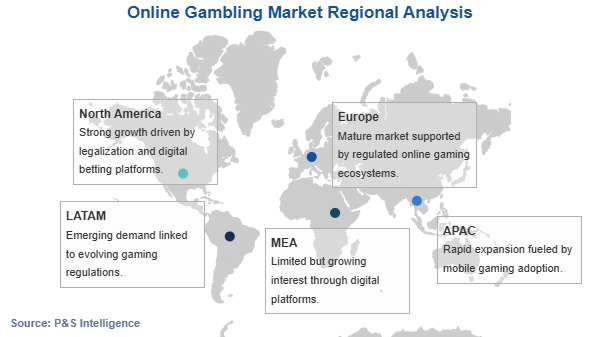
Europe is the world's largest regional market, with 40% share.
North America is the fastest-growing region, at a CAGR of approximately 11.5%, through 2032.
Online Gambling Market Future Outlook
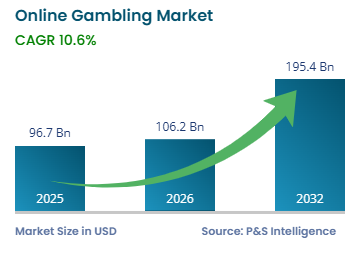
The global online gambling market valued USD 96.7 billion in 2025, and it is projected to reach approximately USD 195.4 billion by 2032, expanding at a CAGR of 10.6% during 2026–2032. This is due to the progressive liberalization of gambling regulation across North America, Asia-Pacific, and Latin America, accelerating adoption of mobile-first platforms enabled by mass-market smartphone penetration, and systematic integration of advanced technologies including artificial intelligence, blockchain-based payment systems, and live-dealer streaming infrastructure. These technologies collectively elevate the digital gambling experience beyond what land-based alternatives can offer at scale.
The global online gambling market continues to grow strongly, driven by rising smartphone penetration, affordable mobile data, and expanding digital payment ecosystems that make real-money gaming more accessible. Improved broadband infrastructure and 5G rollout enhance user experience through live betting and real-time casino streaming. Product innovation in in-play sports betting, esports wagering, fantasy sports, and live-dealer casinos has broadened demographic reach, while secure digital wallets and personalized promotions improve retention. Regulatory liberalization in parts of North America, Latin America, and Europe has created licensed markets and attracted institutional investment.
However, restrictive laws limit growth in several large potential markets. In the United States, online gambling legality varies by state, restricting nationwide expansion. In China, most forms of gambling are illegal, eliminating one of the world’s largest potential markets. In India, federal restrictions and uneven state-level regulations create legal uncertainty and limit scale. In many Middle Eastern countries, gambling is broadly prohibited under national laws. These legal constraints dampen growth in otherwise large potential markets and drive players toward unregulated offshore platforms, tempering global expansion despite strong underlying demand.
Online Gambling Market Emerging Trends and Growth Drivers
Mobile-First Attitude of Players Is Major Market Trend
The most-consequential structural shift in online gambling over the past five years has been the decisive migration from desktop-centric to mobile-first delivery. This transition is not merely a change in device preference—it has fundamentally altered how operators create platforms, design product experiences, and monetize user behavior.
Operators have abandoned web-adapted interfaces in favor of native app experiences engineered around gesture navigation, push notification triggers, biometric authentication, and frictionless in-session deposit flows. Live in-play betting, which requires real-time responsiveness and persistent connectivity, has proven particularly dependent on mobile infrastructure. The sustained momentum toward mobile-first platforms is expected to intensify through the forecast period as 5G network coverage expands across under-penetrated markets. This would reduce latency barriers, which have historically limited live-product adoption outside mature economies.
Regulatory Liberalization and State-Level Legalization Drive Market Expansion
Regulatory change has emerged as the most-powerful driver for the market, converting previously inaccessible consumer segments into licensed, tax-generating markets. The 2018 U.S. Supreme Court ruling overturned the Professional and Amateur Sports Protection Act, which transferred sports betting regulation to individual states and triggered a wave of legislative adoption across North America. The American Gaming Association's State of the States 2025 documented that U.S. iGaming revenue reached USD 8.41 billion in 2024, a 28.7% year-over-year increase, while commercial sports betting revenue climbed 24.8% to USD 13.78 billion. Americans wagered USD 149.90 billion on sports during the year.
Beyond North America, Brazil's enactment of Law 14,790/2023 and the launch of its SPA licensing framework in January 2025 opened one of the world's largest untapped consumer markets. The trajectory points toward continued expansion, several U.S. states remain in active legislative stages, and comparable liberalization cycles are underway across Southeast Asia and parts of Africa, collectively sustaining regulatory tailwinds well into the 2030s.
Responsible Gambling Mandates and Public Health Act As Restraints
While regulatory liberalization accelerates market access, operating conditions within established markets are tightening, creating a countervailing restraint on operator margin and strategic freedom. The World Health Organization (December 2024) states that about 1.2% of the world’s adult population has a gambling disorder, and industry estimates suggest global gambling revenue could reach USD 700 billion by 2028. These findings have elevated gambling harm to a recognized public health priority, prompting regulators in the UK, Netherlands, Germany, India, and Australia to introduce or strengthen mandatory stake limits, advertising restrictions, affordability checks, and enhanced self-exclusion mechanisms.
Therefore, compliance infrastructure costs have risen, high-value player acquisition strategies are being curtailed, and advertising expenditure in several European markets faces binding constraints. The WHO's formal recognition of gambling disorder within the ICD-11 framework signals that operators should anticipate progressively stricter requirements across mature markets through the forecast period.
In April 2025, the UK Gambling Commission implemented the Gambling Levy Regulations 2025, introducing a statutory gambling levy payable as a percentage of gross gambling yields. The levy creates a mandatory, ring-fenced funding stream for gambling harm research, treatment, and prevention, raising compliance costs for all remote operators licensed in the United Kingdom. In February 2025, the UK Gambling Commission enacted mandatory financial vulnerability checks, requiring all remote gambling operators to conduct frictionless affordability assessments when a customer's net spend exceeds GBP 150 within 30 days. The measure, implementing a key provision of the government's 2023 Gambling White Paper, marks a structural shift in UK operator compliance obligations toward proactive harm identification.
Expanding Digital Infrastructure Could Offer Market Opportunities
The most-significant unrealized commercial opportunity in online gambling lies in markets with rising internet penetration, expanding middle-class, and evolving regulatory frameworks. The International Telecommunication Union (ITU) reported 5.5 billion internet users globally in 2024, but connectivity in South and Southeast Asia, Sub-Saharan Africa, and Latin America remains materially lower than in developed markets. This means each percentage point of incremental penetration represents millions of newly accessible consumers. India's online fantasy sports segment has grown from a niche category to a mass-market product adopted across income tiers, driven by cricket's cultural centrality and cost-effective smartphone availability.
Brazil's formalized licensing structure transforms one of the hemisphere's largest consumer economies from an unregulated gray zone into a structured commercial market. As digital infrastructure investment accelerates across these regions, operators with established mobile-native products and localized payment integrations could capture first-mover advantages in markets that collectively represent hundreds of millions of prospective users.
Online Gambling Market Segmentation Analysis
Game Type Analysis
Sports betting commanded the largest share of the global online gambling market in 2025, of 40%. This is due to the progressive legalization of wagering across North America and the structural integration of sportsbooks with major media and broadcast ecosystems. The expansion of in-play wagering products enables bet placement at any point during a live event and dramatically increases per-session bet frequency. Similarly, the mainstream integration of sportsbook advertising within NFL, NBA, and Premier League broadcasts has normalized the behavior among previously inactive demographics. Moreover, the relatively lower technological barrier to entry for mobile sportsbooks compared to live casino products accelerates adoption in emerging regulatory markets.
The casino category has the highest growth rate during the 2026–2032 forecast period, of 11.0%, as immersive technologies, cryptocurrency payment rails, and live-dealer studio expansion elevate the online casino experience. Live dealer products, in which real dealers conduct table games streamed from production studios, have proven particularly effective at replicating the social and atmospheric elements of physical casinos. This helps retain users who previously found purely digital casino games insufficiently engaging.
The market segments into the following game types:
Sports Betting (Largest Category)
Casino (Fastest-Growing Category)
Lottery
Bingo
Others
Device Type Analysis
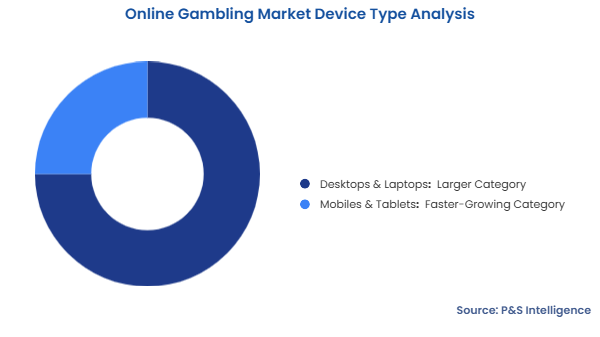
Desktops & laptops held the largest share of global online gambling revenue in 2025, of 75%, underpinned by their superior processing power and screen real estate. These systems are also compatible with high-fidelity gaming formats including VR-enabled casino platforms, multi-screen live dealer interfaces, and complex in-play sportsbook dashboards with simultaneous market displays. These platforms are preferred by high-frequency and high-stakes players, who require stable connectivity, enhanced audiovisual performance, and ergonomic consistency for extended sessions.
Mobiles & tablets are projected to demonstrate the highest CAGR through 2026–2032, of approximately 10.7%, reflecting the shift in the way new players first access online gambling platforms. In markets entering the regulated phase, mobile devices constitute the primary, and often exclusive, point of digital access for the majority of adult consumers. This category will also grow as operators invest in native app experiences engineered around biometric authentication, push-notification-triggered engagement, and single-tap bet-slip functionality.
The market segments into the following device types:
Desktops & Laptops (Larger Category)
Mobiles & Tablets (Faster-Growing Category)
Age Group Analysis
The 25–40 years category held the largest global online gambling market share in 2025, as it accounts for the majority of active platform users and total wagering volume. This demographic entered adulthood during the mainstream emergence of smartphone platforms, giving them both the digital fluency and transactional comfort required for seamless app-based gambling. They also have higher disposable incomes than younger people, enabling sustained participation in real-money products, including live casino tables, same-game parlay sportsbooks, and subscription-style loyalty programs.
The 18–25 years category is anticipated to exhibit the highest CAGR during 2026–2032, propelled by their mobile-native behavior, social betting mechanics, and global expansion of legal online platforms into emerging markets with predominantly young populations. This cohort has grown up in a media environment, where gambling brands are deeply embedded in sports broadcasting, influencer content, and digital advertising, normalizing participation at a younger age.
The market segments into the following age groups:
18–25 Years (Fastest-Growing Category)
25–40 Years (Largest Category)
41–54 Years
55+ Years
Gender Analysis
Males dominated the global online gambling market in 2025 with 75% share, reflecting a participation pattern historically shaped by the structural overlap between sports fandom and sports betting. The World Health Organization December 2024 gambling fact sheet reports that 11.9% of men globally experience harm from gambling compared to 5.5% of women, reflecting trends observed in online gambling. This participation gap is rooted in the sports engagement culture, product design conventions historically oriented toward male behavioral preferences, and lower proportional exposure to gambling advertising among women. Males also demonstrate higher average wagering per session, particularly in high-frequency in-play sports betting and competitive poker formats.
Females are projected to register the higher growth rate through 2026–2032, as operators are systematically redesigning their acquisition strategies and product portfolios to address a previously underleveraged demographic. According to industry reports, female participation in U.S. sports betting reached around 46% in 2024, up from approximately 38% in 2020. This is attributable to the growing integration of sports betting within mainstream entertainment media and the expansion of casino and live-dealer products, which carry lower barriers to entry than sports-knowledge-intensive wagering. Additionally, targeted brand campaigns by operators, including dedicated female ambassador programs, drive this category. The lowering of participation friction with mobile-first product designs and broader social normalization of online gambling across developed and emerging markets also encourage online gambling by women.
The market segments into the following genders:
Male (Larger Category)
Female (Faster-Growing Category)
Drive strategic growth with comprehensive market analysis
Online Gambling Market Regional Outlook
Europe Online Gambling Market Share
Europe is the world's largest regional market, with 40% share, owing to the depth of its regulatory infrastructure, high internet penetration rates, and established consumer acceptance of online wagering. The region encompasses multiple distinct national licensing regimes—the UK, Germany, Italy, France, Spain, Sweden, Netherlands, and Malta among them—creating a complex but commercially mature operating environment. The UK Gambling Commission's industry statistics for April 2024–March 2025 reported GBP 16.8 billion in total gross gambling yield for the period, a 7.3% year-over-year increase, with remote gambling now accounting for more than half of total UK gambling revenue.
United Kingdom Online Gambling Market Scenario
The United Kingdom is the largest individual country market in Europe, accounting for 35% share, supported by the longest-standing and most-comprehensively regulated online gambling framework globally. The UK Gambling Commission oversees all licensed remote gambling operators, and the market operates under the Gambling Act 2005, which is currently undergoing its most significant reform since enactment.
The UK Gambling Commission reported GBP 7.8 billion in remote gross gambling yield for April 2024–March 2025 period, a 13.1% year-over-year increase. Regulatory milestones implemented in 2025 include mandatory affordability checks, online slot stake limits capped between GBP 2 and 5, the introduction of a statutory gambling levy, replacing voluntary industry contributions; and enhanced self-exclusion enforcement. This collectively represents the most substantive overhaul of UK online gambling regulation in two decades.
North America Online Gambling Market Future
North America is the fastest-growing region, at a CAGR of approximately 11.5%, through 2032. Growth is driven by the legalization of online sports betting in 38 U.S. states and Washington D.C., expanding mobile access, and widespread broadband and smartphone use. All these factors make betting more convenient and accessible, especially for women. Sports betting remains highly popular, with the Super Bowl, World Series, NBA, and NFL seasons boosting participation. Online casino games, poker, and live dealer formats also attract significant player interest.
Mobile devices account for the majority of user engagement, particularly among younger demographics, while in-play and micro-betting options enhance real-time engagement. Player sentiment is largely positive regarding convenience and technology, though there are concerns about gambling risks and responsible play. Canada’s provincial regulation and growing acceptance further contribute to regional expansion.
United States Online Gambling Market Forecast
The United States dominates North American online gambling market with 70% share. Mobile sports wagering is legally available in 30 of the 38 jurisdictions with sports betting operations, enabling ubiquitous access through licensed operator apps. The 2018 Supreme Court ruling that overturned the Professional and Amateur Sports Protection Act and transferred regulatory authority to individual states. According to the American Gaming Association State of the States 2025 report, by year-end 2024, legal sports betting was operational in 38 jurisdictions including the District of Columbia, while iGaming was active in eight states. Online gaming now accounts for approximately 30% of total U.S. commercial gaming revenue, compared to just 13% in 2021, demonstrating the rapid structural shift toward digital channels.
The American Gaming Association's State of the States 2025 confirmed U.S. commercial sports betting revenue of USD 13.78 billion in 2024, with North Carolina and Vermont both launching regulated mobile sportsbooks during the year. Missouri legalized sports betting in November 2024 with planned launch in 2025, representing one of the largest remaining untapped consumer populations in the country.
The report covers the following regions and countries:
North America (Fastest-Growing Region)
United States (Larger Country)
Canada (Faster-Growing Country)
Europe (Largest Region)
United Kingdom (Largest Country)
Germany
France
Italy (Fastest-Growing Country)
Spain
Rest of Europe
Asia-Pacific
China
India
Japan
South Korea
Australia (Largest and Fastest-Growing Country)
Rest of APAC
Latin America
Brazil (Largest Country)
Mexico (Fastest-Growing Country)
Rest of LATAM
Middle East & Africa
Saudi Arabia
South Africa (Largest and Fastest-Growing Country)
U.A.E.
Rest of MEA
Online Gambling Market Share Analysis
The global online gambling market exhibits moderate fragmentation, shaped by geographical licensing barriers, technology investment requirements, and regulatory complexity of operating across multiple jurisdictions. No single operator commands a decisive majority of global revenue; however, a few large, publicly listed multinationals hold disproportionate competitive weight relative to the broader field of regional and niche players. They have prospered through successive acquisitions, cross-border licensing strategies, and technology platform consolidation. The top operators benefits from their established brand recognition in regulated markets, proprietary technology stacks, scale-driven marketing efficiencies, and financial capacity to absorb the compliance costs of entering new countries.
The competitive landscape is continuing to consolidate as larger operators deploy capital to acquire technology capabilities, expand into newly licensed markets, and neutralize regional competitors before they can scale. Using licensed market entry moments can help simultaneously gain customer bases and eliminate potential rivals. Barriers to success include licensing fees across dozens of jurisdictions, responsible gambling compliance infrastructure, payment processing arrangements, and high capital requirement to maintain competitive mobile product quality in a rapidly evolving technology environment.
Competitive Landscape of the Online Gambling Market:
Flutter Entertainment plc
Entain plc
Bet365 Group Ltd.
888 Holdings plc
Kindred Group plc
Betsson AB
DraftKings Inc.
William Hill plc
BetMGM LLC
Super Group (SGHC Limited)
Evolution AB
Caesars Entertainment Inc.
Online Gambling Market Developments
In July 2025, Flutter Entertainment plc acquired Boyd Gaming Corporation's remaining 5% stake in FanDuel Group for USD 1.755 billion, securing 100% ownership of this U.S. sports betting and iGaming platform, which was valued at approximately USD 31 billion. The transaction consolidates Flutter's full strategic and financial control over FanDuel and is expected to deliver approximately USD 65 million in annual cost savings through more favorable market access arrangements in Boyd-operated states.
In May 2025, Flutter Entertainment plc acquired a 56% majority stake in NSX Group—operator of the Betnacional brand—for USD 350 million. ahead of Brazil's January 2025 regulated market launch. The acquisition integrates Flutter's FanDuel technology stack with a locally recognized sports betting brand, establishing an immediate licensed position in an emerging online gambling market.
In September 2024, Flutter Entertainment plc announced the acquisition of Snaitech S.p.A.—an Italian regulated gambling operator—from Playtech plc for EUR 2.3 billion (USD 2.6 billion), adding the Snai and Wincity brands to Flutter's European portfolio.
In August 2024, BetMGM LLC—the joint venture of Entain plc and MGM Resorts International—launched a Single Account Single Wallet feature, enabling online sports bettors in Nevada to maintain a single, seamless digital wallet usable across all states where BetMGM is licensed. The capability removes the friction of maintaining separate state accounts and is designed to increase cross-state player retention and wallet consolidation.
Frequently Asked Questions About This Report
What will be the online gambling market 2032 size?+
In 2032, the market for online gambling will value USD 195.4 billion.
Which game type is the most popular in the online gambling industry?+
Sports betting dominates the online gambling industry with 40% revenue.
Which is the most-productive region in the online gambling market?+
Europe is the largest market for online gambling, with 40% share.
What are the key online gambling industry drivers?+
The online gambling industry is driven by progressive liberalization of gambling regulations, accelerating adoption of mobile-first platforms, and integration of AI, blockchain-based payment systems, and live-dealer streaming infrastructure.
What is the online gambling market nature?+
The market for online gambling is moderately fragmented.
Want a report tailored exactly to your business need?
Leading companies across industries trust us to deliver data-driven insights and innovative solutions for their most critical decisions. From data-driven strategies to actionable insights, we empower the decision-makers who shape industries and define the future. From Fortune 500 companies to innovative startups, we are proud to partner with organisations that drive progress in their industries.
Client Testimonials
Working with P&S Intelligence and their team was an absolute pleasure – their awareness of timelines and commitment to value greatly contributed to our project's success. Eagerly anticipating future collaborations.
McKinsey & Company
India
Unmatched Standards
Our insights into the minutest levels of the markets, including the latest trends and competitive landscape, give you all the answers you need to take your business to new heights
Complete Data Security
We take a cautious approach to protecting your personal and confidential information. Trust is the strongest bond that connects us and our clients, and trust we build by complying with all international and domestic data protection and privacy laws