This Report Provides In-Depth Analysis of the Online Fitness Market Report Prepared by P&S Intelligence, Segmented by Streaming Type (Live, On-Demand), Session Type (Group, Solo), Revenue Model (Subscription, Hybrid, Advertisement), Device Type (Smartphones, Smart TVs, Laptops, Desktops, & Tablets), and Geographical Outlook for the Period of 2021 to 2032
Explore the market potential with our data-driven report
Online Fitness Market Future Outlook
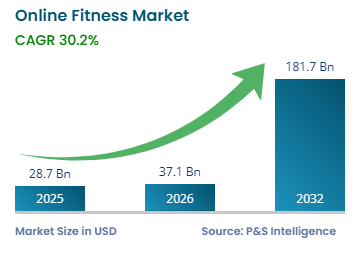
The online fitness market size was USD 28.7 billion for 2025, and it will grow by 30.2% during 2026–2032, to reach USD 181.7 billion by 2032.
This growth reflects the structural migration of exercise from physical facilities to internet-delivered formats. These include live-streamed classes, on-demand workout libraries, virtual personal training, and app-based fitness programs accessed through smartphones, smart televisions, laptops, tablets, and connected wearables. The market has evolved into a mainstream fitness delivery model. Advances in artificial intelligence, low-latency streaming, and biometric integration enable more personalized, interactive, and data-driven workout experiences, which deepen user engagement and long-term participation.
A persistent global physical inactivity trend underpins demand, and digital fitness platforms are well positioned to address it, with the World Health Organization (WHO) reporting that approximately 31% of adults worldwide, around 1.8 billion people, did not meet recommended physical activity levels in 2022, highlighting the growing need for accessible digital fitness solutions. This public health challenge, alongside rising healthcare costs and expanding corporate wellness initiatives, is encouraging employers and healthcare organizations to support access to digital fitness solutions. Such support broadens the market beyond individual consumers.
Key Market Insights
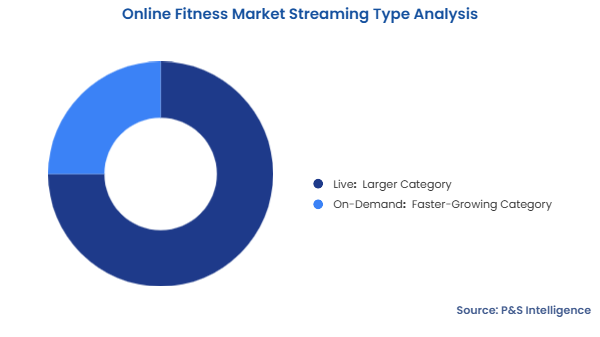
The live category holds the larger market share, of 75%, in 2025, driven by its interactive, instructor-led workout experience.
The hybrid category will have the highest CAGR, of approximately 30.5%, driven by increasing demand for flexible pricing options and the need to attract first-time and price-sensitive users.
The smartphones category holds the largest market share, of 45%, in 2025, and will have the highest CAGR, of approximately 30.8%, driven by widespread ownership, portability, and easy access to fitness applications and online workouts.
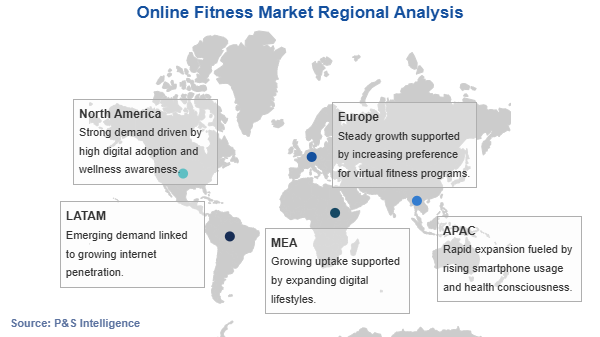
North America holds the largest market share, of 40%, in 2025, driven by high disposable incomes, widespread broadband connectivity, and high smartphone penetration.
Asia-Pacific will have the highest CAGR, of approximately 31.1%, driven by rising smartphone penetration, increasing disposable incomes, and rapid digital transformation.
Online Fitness Market Trends and Drivers
Artificial Intelligence Personalization Is Key Trend
The integration of artificial intelligence (AI) is transforming the online fitness market from a traditional content-delivery model into a personalized, data-driven coaching experience. This transformation is reshaping how platforms engage and retain users. Rather than providing identical workout libraries to all subscribers, AI-powered platforms analyze user preferences, fitness goals, historical workout performance, and data from connected wearable devices to recommend personalized exercise programs, adjust workout intensity in real time, and deliver immediate feedback. These capabilities improve user engagement, encourage long-term participation, and help strengthen long-term subscriber retention through more individualized fitness experiences, including computer vision-based exercise form analysis and adaptive coaching.
The market continues to witness increasing investment in AI-enabled fitness technologies. In 2025, iFIT Health & Fitness expanded its AI Coach capability across 19 international markets, demonstrating the growing importance of intelligent personalization as a competitive differentiator. As AI technologies advance, online fitness providers are increasingly competing on the quality of personalized coaching and long-term user retention rather than solely on the size of their content libraries.
Smartphone Ubiquity and Rising Healthcare Costs Are Biggest Drivers
The proliferation of smartphones and mobile broadband is a foundational force propelling online fitness adoption. It removes the hardware and location barriers that once confined structured exercise to gyms and studios. As high-speed connectivity reaches near-universal levels in developed markets and expands across emerging economies, online fitness platforms are able to deliver live and on-demand workouts to an increasingly broad global audience through scalable digital infrastructure. The International Telecommunication Union (ITU) estimates that 5.5 billion people, representing 68% of the global population, were using the Internet in 2024, providing a digital foundation for the adoption of online fitness platforms and mobile health applications.
The expansion of digital connectivity coincides with growing global emphasis on preventive healthcare. According to the World Health Organization (WHO), the growing focus on reducing healthcare expenditure associated with physical inactivity is encouraging greater adoption of accessible digital fitness solutions that support healthier lifestyles and preventive healthcare. This convergence of widespread digital access and rising healthcare costs is encouraging consumers, employers, and healthcare organizations to adopt online fitness as a scalable preventive health solution, and the trend is expected to strengthen as wearable device integration and AI-powered personalization continue to advance.
User Churn and Rising Content Costs Are Key Restraints
Persistent subscriber churn and rising content-related costs continue to constrain profitability in the online fitness market despite healthy revenue growth, with many platforms facing challenges in retaining subscribers over the long term. This retention gap requires continuous investment in customer acquisition, personalized engagement strategies, and premium content to sustain recurring subscription revenue. Increasing expenditures on content creation, instructor compensation, music licensing, and platform development place ongoing pressure on operating margins, an effect felt most acutely by providers offering extensive live and on-demand workout libraries.
These combined challenges require online fitness companies to continuously invest in user retention through AI-powered personalization, gamification, community engagement, and hybrid fitness experiences, although balancing user acquisition costs with long-term profitability is expected to remain a challenge throughout the forecast period despite improvements in customer engagement and subscription retention.
Corporate Wellness Expansion and Preventive Healthcare Are Biggest Opportunities
A sizeable and underserved opportunity is emerging beyond the traditional individual subscriber base, particularly across enterprise and institutional channels, as employers increasingly invest in digital wellness programs to improve employee health, enhance productivity, promote workforce engagement, and support preventive healthcare. This shift is expanding demand for subscription-based online fitness platforms through employer-sponsored access, creating a scalable, recurring revenue opportunity for market participants.
The World Health Organization (WHO) recommends that adults engage in at least 150–300 minutes of moderate-intensity physical activity each week, supporting demand for accessible online fitness platforms that enable users to incorporate structured exercise into their daily routines through personalized, flexible, on-demand digital fitness programs. The growing adoption of connected wearable devices is creating additional opportunities for online fitness platforms to deliver real-time activity tracking, personalized coaching, and performance analytics. Integration with smartwatches, fitness bands, and health monitoring devices enables continuous user engagement, supports goal-based fitness programs, and strengthens long-term subscriber retention through data-driven fitness experiences. Platforms that strengthen employer partnerships while offering AI-powered coaching, gamified experiences, and personalized wellness programs are well positioned to expand their addressable market and unlock new long-term growth opportunities.
Online Fitness Market Segmentation Analysis
Streaming Type Analysis
The live category holds the larger market share, of 75%, in 2025, driven by its ability to replicate the interactive experience, accountability, and motivation of instructor-led fitness classes. Real-time coaching and scheduled sessions encourage greater workout consistency, and live participant engagement improves user retention compared with self-paced formats. The widespread availability of high-speed broadband and smartphone connectivity has strengthened adoption, and connected devices enable users to participate in live fitness sessions from virtually any location. Live streaming also supports community engagement through virtual group workouts and instructor interaction, making it attractive for users seeking structured and immersive fitness experiences.
The on-demand category will have the higher CAGR, of approximately 30.4%, driven by increasing demand for flexible workout schedules, personalized fitness experiences, anytime access to extensive digital workout libraries, AI-powered content recommendations, multilingual programming, and compatibility across smartphones, smart televisions, tablets, and connected wearable devices. The convenience of accessing workouts on demand, combined with the continuous expansion of premium fitness content and personalized coaching features, is expected to accelerate adoption among users with diverse lifestyles and fitness goals throughout the forecast period.
The streaming types analyzed in this report are:
Live (Larger Category)
On-Demand (Faster-Growing Category)
Session Type Analysis
The group category holds the larger market share, in 2025, driven by strong social accountability, community engagement, and instructor-led motivation that closely replicate the experience of in-person fitness classes. Live interaction, group challenges, and shared fitness goals encourage higher participation and strengthen user retention, making group-based programs a preferred format across leading online fitness platforms. Community-focused features such as leaderboards, live competitions, and virtual group workouts further enhance engagement and long-term subscription retention.
The solo category will have the higher CAGR, of approximately 30.6%, driven by increasing demand for personalized fitness experiences, flexible workout schedules, AI-powered coaching tailored to individual fitness goals, and integration with wearable devices that enables real-time performance tracking, adaptive workout recommendations, and personalized progress monitoring. The convenience of exercising independently, combined with advances in AI-driven personalization and connected fitness technologies, is expected to accelerate adoption among users with diverse lifestyles and fitness goals. Continued platform innovation supports this segment, with Apple Fitness+ introducing a Progressive Strength program and expanding personalized training content in 2025 to support individualized workout experiences.
The session types analyzed in this report are:
Group (Larger Category)
Solo (Faster-Growing Category)
Revenue Model Analysis
The subscription category holds the largest market share, of 60%, in 2025, driven by the recurring and habit-based nature of fitness consumption. Subscription plans provide online fitness platforms with predictable revenue streams to support continuous investment in content creation, instructor-led classes, platform development, and AI-powered personalization, while offering users unlimited access to live and on-demand workout libraries. This recurring revenue model strengthens customer retention and enables providers to continuously expand premium fitness content and digital services.
The hybrid category will have the highest CAGR, driven by increasing demand for flexible pricing options and the need to attract first-time and price-sensitive users. By providing free access to selected fitness content while offering premium subscriptions for advanced features, personalized coaching, and exclusive workout programs, these models enable providers to expand their user base and improve conversion into paid memberships. According to the Organisation for Economic Co-operation and Development (OECD), 93% of adults aged 16–74 across OECD countries used the Internet at least once during the previous 12 months, while 87% used it daily or almost every day. This high level of digital engagement supports the continued adoption of online subscription services and creates a favorable environment for hybrid and freemium online fitness platforms to expand their user base and convert free users into paid subscribers.
The revenue models analyzed in this report are:
Subscription (Largest Category)
Hybrid (Fastest-Growing Category)
Advertisement
Device Type Analysis
The smartphones category holds the largest market share, of 45%, in 2025, and it will have the highest CAGR. Their dominance is driven by widespread ownership, portability, and the ability to provide convenient access to live-streamed classes, on-demand workouts, and AI-powered fitness applications. Built-in cameras, motion sensors, and seamless integration with wearable devices enable real-time activity tracking, computer vision-based exercise form analysis, and personalized coaching experiences. According to the U.S. Office of the National Coordinator for Health Information Technology (ONC), 50% of U.S. adults reported having a mobile health app in 2020, and 85% of those users accessed the app at least once during the previous year, demonstrating strong engagement with smartphone-based digital health applications that support the adoption of mobile-first online fitness platforms. Continued advancements in mobile connectivity, artificial intelligence, and wearable device integration are expected to reinforce smartphone leadership throughout the forecast period.
The device types analyzed in this report are:
Smartphones (Largest and Fastest-Growing Category)
Smart TVs
Laptops, Desktops, & Tablets
Others
Drive strategic growth with comprehensive market analysis
Online Fitness Market Regional Outlook
North America Online Fitness Market Size
North America holds the largest market share, of 40%, in 2025, driven by high household disposable incomes, widespread broadband connectivity, and high smartphone penetration, along with the widespread adoption of digital health and wellness technologies across the region. The region also benefits from a well-established corporate wellness ecosystem, where many employers incorporate digital fitness platforms into employee wellness initiatives to promote healthier lifestyles and improve workforce productivity. Adoption of connected devices, including smartwatches and fitness trackers, has strengthened user engagement with online fitness platforms through personalized activity tracking and performance monitoring.
Demand is further supported by the growing emphasis on increasing physical activity and healthier lifestyles across the region. According to the U.S. Centers for Disease Control and Prevention (CDC), 47.2% of U.S. adults met the federal aerobic physical activity guidelines in 2024. This increasing focus on healthier lifestyles supports sustained demand for subscription-based and hybrid digital fitness services. Regional growth is expected to draw on continued innovation in AI-powered coaching, personalized workout programs, and wearable device integration, while the expansion of digital wellness offerings through employer-sponsored initiatives and collaborations with healthcare organizations provides an additional growth channel.
U.S. Online Fitness Market Size
The U.S. is the largest and fastest-growing country market within North America, supported by high consumer spending on digital health and fitness services, widespread smartphone and broadband adoption, and the presence of many leading online fitness platform providers. The country's well-established digital ecosystem, alongside adoption of corporate wellness programs and connected wearable devices, continues to drive demand for subscription-based and personalized online fitness solutions. Continuous investment in artificial intelligence and digital health technologies is enhancing platform capabilities through personalized coaching, adaptive workout recommendations, and real-time performance tracking.
According to the U.S. Centers for Disease Control and Prevention (CDC), 47.2% of U.S. adults met the federal aerobic physical activity guidelines in 2024, highlighting substantial opportunities for digital fitness platforms to engage individuals seeking more accessible and flexible exercise solutions. Market growth is expected to draw on continued innovation in AI-powered personalization, hybrid home-and-gym fitness models, and deeper integration with wearable devices and corporate wellness initiatives.
Asia-Pacific Online Fitness Market Size
Asia-Pacific will have the highest CAGR, of approximately 31.1%, driven by rising smartphone penetration, increasing urbanization, expanding disposable incomes, ongoing digital transformation, and government support for digital health initiatives. The emergence of local fitness platforms offering culturally relevant content in regional languages, together with flexible subscription and micro-payment models, is broadening access beyond major metropolitan areas, accelerating user adoption across diverse consumer segments. The China Internet Network Information Center (CNNIC) reports that China's internet population reached approximately 1.108 billion by December 2024. Mobile devices accounted for 99.7% of internet access among internet users, providing a strong foundation for mobile-first online fitness services. In addition, Japan's Ministry of Internal Affairs and Communications (MIC) reported that 90.5% of Japanese households owned a smartphone in 2024, while individual smartphone ownership exceeded 80%, further strengthening the region's mobile-first ecosystem for online fitness applications and digital wellness services.
Moreover, China is the largest country market within Asia-Pacific, supported by the world's largest internet population and a mature digital ecosystem of domestic online fitness platforms delivering localized content, vernacular coaching, and seamless digital payment integration. Extensive 5G deployment and widespread broadband connectivity provide the infrastructure for high-quality live and on-demand fitness streaming, and high smartphone penetration extends that reach across urban and rural markets. China's Ministry of Industry and Information Technology (MIIT) reports that the country had built 4.19 million 5G base stations as of November 2024, strengthening nationwide low-latency connectivity for digital services, including online fitness platforms.
India Online Fitness Market Size
India is the fastest-growing country in the Asia-Pacific online fitness market, supported by rapid internet subscriber growth, affordable mobile data, a young and digitally connected population, and increasing demand for regional-language fitness content. Expanding rural connectivity, widespread smartphone adoption, and the growing popularity of digital payment platforms are extending access to online fitness services beyond metropolitan areas, creating significant opportunities for market expansion.
The Telecom Regulatory Authority of India (TRAI) reports that India's internet subscriber base reached 969.10 million by March 2025, expanding the addressable market for digital fitness platforms. The Ministry of Statistics and Programme Implementation (MoSPI) reports that 85.5% of Indian households possessed at least one smartphone and 86.3% had internet access within their household premises in 2025, providing a digital foundation for online fitness applications and live-streaming services.
The regions and countries analysed in this report are:
North America (Largest Regional Market)
U.S. (Larger and Faster-Growing Country)
Canada
Europe
Germany (Largest Country)
U.K. (Fastest-Growing Country)
France
Italy
Spain
Rest of Europe
Asia-Pacific (Fastest-Growing Regional Market)
China (Largest Country)
India (Fastest-Growing Country)
Japan
South Korea
Australia
Rest of APAC
Latin America
Brazil (Largest Country)
Mexico (Fastest-Growing Country)
Rest of LATAM
Middle East and Africa
Saudi Arabia (Largest Country)
South Africa
U.A.E. (Fastest-Growing Country)
Rest of MEA
Online Fitness Market Share Analysis
The market is fragmented, characterized by the presence of numerous international, regional, and niche providers competing across live-streaming classes, on-demand workout platforms, virtual personal training, AI-powered coaching, and connected fitness ecosystems. No single company holds a dominant market share, as competition is driven by content quality, personalization, pricing, community engagement, technological innovation, and strategic partnerships rather than scale alone. Leading companies, including Peloton Interactive, Inc., iFIT Health & Fitness Inc., Apple Inc., Google LLC, and Les Mills International Ltd. compete alongside numerous regional platforms and emerging AI-focused startups. Market participants increasingly differentiate themselves through multilingual content, wearable device integration, corporate wellness partnerships, gamified experiences, and flexible subscription models. Additionally, sustained investment in AI-powered personalization, content innovation, and strategic collaborations is expected to remain central to strengthening user engagement, improving retention, and expanding market presence.
Leading Companies in the Online Fitness Market:
Peloton Interactive, Inc.
Apple Inc.
iFIT Health & Fitness Inc.
Nike, Inc.
Google LLC
Strava, Inc.
Les Mills International Limited
ClassPass, Inc.
Freeletics GmbH
Centr Pty Ltd.
Zwift, Inc.
Curefit Healthcare Private Limited
Fiit Limited
The Beachbody Company, Inc.
Wexer Holding AS
Technogym S.p.A.
EGYM GmbH
WHOOP, Inc.
Online Fitness Market News
In June 2026, Les Mills International Ltd. partnered with Hyperhuman to make its flagship programs, including BODYPUMP, BODYCOMBAT, and BODYBALANCE, available through Hyperhuman's AI-powered content infrastructure for eligible paid teams globally. The partnership gives fitness apps, wellness platforms, and connected-fitness companies a faster path to embed premium, science-backed content into their own digital products via app, web, and API.
In April 2026, Peloton Interactive, Inc. entered into a strategic content partnership with Spotify, making Peloton workout content available to Spotify Premium members across multiple markets, expanding the reach of its on-demand fitness library beyond its own platform ecosystem.
In December 2025, Apple Inc. expanded Apple Fitness+ to 28 new markets, including India, Singapore, Chile, Hong Kong, and the Netherlands, in the service's largest expansion since launch, adding AI-generated voice dubbing in Spanish, German, and Japanese. The expansion targets high-growth Asia-Pacific and Latin American markets and leverages localized content to broaden its global subscriber base.
In April 2025, Strava, Inc. entered into an agreement to acquire Runna, a U.K.-based developer of personalized running training plans, uniting Strava's community of over 150 million registered users with a leading running-coaching app. The acquisition strengthened Strava's structured-training offering and deepened its vertical integration amid growing demand for AI-driven training plans.
Frequently Asked Questions About This Report
What factors are driving the growth of the online fitness market?+
Growth is driven by increasing smartphone and internet penetration, rising health awareness, expanding adoption of wearable devices, AI-powered personalized training, and the growing preference for convenient home and hybrid fitness solutions.
What are the key trends in the online fitness market?+
Major trends include AI-enabled virtual coaching, connected fitness equipment, wearable integration, on-demand and live-streamed workouts, personalized fitness programs, and corporate wellness platforms.
What are the major challenges in the online fitness market?+
The market faces challenges such as subscriber churn, intense competition, rising content production and licensing costs, maintaining long-term user engagement, and data privacy concerns.
Which region is expected to witness the fastest growth in the online fitness market?+
Asia-Pacific is projected to record the fastest growth due to increasing smartphone penetration, expanding internet access, rising disposable incomes, and growing awareness of health and fitness across emerging economies.
How is artificial intelligence transforming the online fitness market?+
Artificial intelligence is enabling personalized workout plans, real-time performance feedback, virtual coaching, adaptive training programs, predictive health insights, and enhanced user engagement through data-driven recommendations.
Want a report tailored exactly to your business need?
Leading companies across industries trust us to deliver data-driven insights and innovative solutions for their most critical decisions. From data-driven strategies to actionable insights, we empower the decision-makers who shape industries and define the future. From Fortune 500 companies to innovative startups, we are proud to partner with organisations that drive progress in their industries.
Client Testimonials
Working with P&S Intelligence and their team was an absolute pleasure – their awareness of timelines and commitment to value greatly contributed to our project's success. Eagerly anticipating future collaborations.
McKinsey & Company
India
Unmatched Standards
Our insights into the minutest levels of the markets, including the latest trends and competitive landscape, give you all the answers you need to take your business to new heights
Complete Data Security
We take a cautious approach to protecting your personal and confidential information. Trust is the strongest bond that connects us and our clients, and trust we build by complying with all international and domestic data protection and privacy laws