Online Advertising Market Size Estimation
Key Highlights
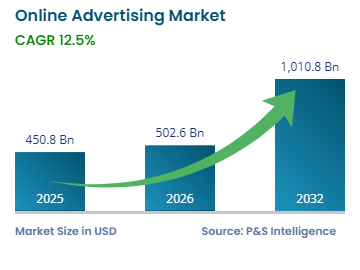
| Study Period | 2021 - 2032 |
| Market Size in 2025 | USD 450.8 Billion |
| Market Size in 2026 | USD 502.6 Billion |
| Market Size by 2032 | USD 1010.8 Billion |
| Projected CAGR | 12.5% |
| Largest Region | North America |
| Fastest-Growing Region | Asia-Pacific |
| Market Structure | Consolidated |
Market Size
Explore the market potential with our data-driven report
Online Advertising Market Key Insights
- Inorganic advertising accounted for the larger share, of 85%, in 2025.
- Social media is the fastest-growing category during 2026–2032, at a CAGR of 12.7%.
- Mobile phones accounted for the largest share, of 65%, in 2025.
- The CPC category is the fastest-growing during 2026–2032, at a CAGR of 13.1%.
- The retail & e-commerce category accounted for the largest share, of 30%, in 2025.
- North America accounted for the largest share, of 40%, in 2025.
- Asia-Pacific is the fastest-growing region, at a CAGR of 13.5% during 2026–2032.
Online Advertising Market Future Outlook
The global online advertising market stood at USD 450.8 billion in 2025 and is projected to reach USD 1010.8 billion by 2032, expanding at a compound annual growth rate of 12.5% over 2026–2032. Online advertising has become the dominant engine of global marketing expenditure as businesses across verticals redirect investment from broadcast and print toward data-driven digital channels. The deepening integration of artificial intelligence and machine learning into programmatic ad targeting, dynamic creative optimization, and real-time bidding infrastructure enables brands to achieve measurable conversion outcomes at a scale and precision that traditional media channels cannot replicate.
The structural expansion of internet access is continuously enlarging the addressable audience available to online advertisers. The International Telecommunication Union (ITU) reports that 6 billion people — three-quarters of the global population — are now connected to the internet in 2025, an increase of more than 240 million compared to 2024, with 5G networks estimated to cover 55% of the world's population. Search engines, social media networks, connected TV services, and retail media networks are evolving rapidly as AI-powered personalization raises campaign effectiveness and ROI expectations. Retail, BFSI, and healthcare represent the most significant verticals driving this shift.
Online Advertising Market Trends & Drivers
Programmatic Advertising and AI-Driven Targeting Are Key Trends
The global online advertising market is undergoing a structural transformation as programmatic buying and artificial intelligence displace manual campaign management across the industry. Programmatic real-time bidding enables advertisers to execute audience-matched placements at millisecond speed across millions of publisher endpoints. This precision and scale fundamentally alters the economics of campaign execution. AI-powered tools including dynamic creative optimization, predictive audience segmentation, and automated bidding algorithms are compressing the gap between ad spend and measurable conversion outcomes.
The shift from cookie-based to first-party data environments is reshaping targeting infrastructure and compelling advertisers to invest in clean-room technologies and contextual ad placement. Apple's App Tracking Transparency framework and the broader movement toward privacy-compliant identity solutions are driving this transition. As AI capabilities mature and data governance frameworks standardize, programmatic adoption is expected to deepen further across emerging markets in Asia-Pacific and Latin America, where mobile-first infrastructure creates native compatibility with automated buying systems.
Surging Mobile Penetration and E-Commerce Expansion Fuel Market Growth
The convergence of smartphone proliferation and e-commerce growth is the most consequential structural driver of online advertising demand globally. Global smartphone subscriptions are estimated to exceed 6.5 billion by 2025, with approximately 5.7 billion smartphone users worldwide. Individuals spend around 3.5 to 4 hours per day on mobile devices, prompting advertisers to increasingly follow consumer attention toward in-app, social media, and mobile search environments. E-commerce expansion enlarges the commercial rationale for digital advertising investment in parallel. As online retail scales across markets, brands face intensifying pressure to capture high-intent purchase moments through retail media networks, search advertising, and shoppable video formats.
Retail Media Networks and Connected TV Advertising Create Opportunities
Significant market potential is emerging from retail media networks and connected TV, two rapidly scaling advertising channels capturing budgets flowing out of traditional media. Retail media offers advertisers the ability to link on-site impressions directly to confirmed purchase transactions, achieving two-to-five times higher return on ad spend relative to open-web display. Closed-loop platforms operated by Amazon Ads, Walmart Connect, and Instacart Ads are the primary commercial expressions of this model.
Connected TV is also gaining traction as an advertising platform as linear television viewership declines structurally. The European Commission's Regulation (EU) 2024/900 introduces harmonized transparency requirements for political advertising across all EU member states. This regulatory momentum pushes advertisers toward accountable, data-governed channels, which retail media and CTV platforms already operate as by design.
An estimated 5.54 billion people worldwide are expected to use OTT streaming services by 2025, up from 4.95 billion in 2023. Connected TV adoption is rising in parallel, with India reporting approximately 129.2 million active CTV users in 2025, reflecting 87% year-over-year growth.
Among major OTT platforms, Netflix leads with approximately 301 million paid subscribers, followed by Amazon Prime Video with approximately 200 million users, Disney+ with approximately 128 million subscribers, Tencent Video with approximately 110 million users, iQIYI with approximately 101 million users, Paramount+ with approximately 79 million subscribers, and Hulu with approximately 64 million subscribers. In India, the merged JioHotstar platform has emerged as a dominant player with an estimated 300 million users, reflecting its strong position in the OTT market.
Data Privacy Regulations and Cookie Deprecation Constrain Market Growth
Data privacy regulations create compliance complexity and targeting friction that disproportionately affects mid-tier advertisers reliant on third-party data infrastructure. The EU's General Data Protection Regulation, the California Consumer Privacy Act, and equivalent legislation across Brazil, India, and Southeast Asia are progressively restricting the collection, processing, and cross-site transfer of user behavioral data — the foundational inputs for programmatic targeting and retargeting campaigns. Regulatory fragmentation across jurisdictions increases compliance costs for global campaigns and creates asymmetric competitive conditions between large platforms with proprietary first-party data ecosystems and smaller publishers without equivalent data assets. Market adaptation is accelerating through investment in consent management platforms, contextual advertising tools, and privacy-enhancing technologies, though the transition introduces cost pressures that moderate growth rates in data-intensive campaign categories.
Online Advertising Market Segmentation Analysis
Advertising Type Analysis
Inorganic (paid) advertising accounted for the larger share, of 85%, in the global online advertising market in 2025. Precise audience targeting, immediate reach, guaranteed placement, and measurable ROI make paid advertising the preferred channel for performance-oriented campaigns across search, social, display, and retail media environments.
The scalability of paid advertising infrastructure enables advertisers to enter, scale, and exit campaigns with minimal friction, sustaining structural dominance across the forecast period. Self-serve platforms operated by Alphabet Inc., Meta Platforms Inc., and Amazon.com Inc. are the primary vehicles through which this scalability is delivered. The OECD Broadband Portal reports that fixed broadband subscriptions across OECD nations exceeded 500 million in 2024. This high-speed connectivity backbone directly underpins the delivery of paid digital advertising inventory at scale.
The organic category is the faster-growing bifurcation during 2026–2032. Rising investment in content marketing, search engine optimization, influencer partnerships, and community-driven social media strategies is driving this growth as brands seek sustainable, cost-efficient alternatives to escalating paid media costs. The proliferation of AI-powered content generation tools is lowering the production costs associated with organic content at scale, enabling SMEs to compete through owned-channel strategies previously available only to large advertisers. As data privacy regulations tighten globally and third-party targeting signals erode, organic strategies that build first-party audience relationships are gaining strategic importance.
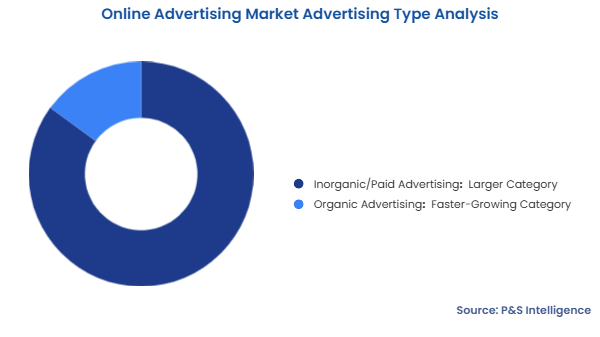
The market segments into the following advertising types:
- Inorganic/Paid Advertising (Larger Category)
- Organic Advertising (Faster-Growing Category)
Ad Format Analysis
Search engine advertising/PPC accounted for the largest share, of 35%, in the global online advertising market in 2025. Search ads intercept users at the precise moment of active information-seeking or purchase consideration, generating conversion rates two to three times higher than interruptive display formats. Alphabet Inc.'s Performance Max and Google Shopping integrations enable automated keyword bidding, audience expansion, and creative optimization within a single campaign framework. The format's scalability across businesses of all sizes, supported by self-serve auction infrastructure, ensures search advertising retains its structural leadership. According to UNCTAD, global e-commerce sales exceeded approximately USD 27 trillion, while retail e-commerce accounted for around USD 6 trillion and nearly 20% of total retail sales globally, highlighting the rapid expansion of digital commerce ecosystems. This scale of commercial intent is what search advertising is structurally positioned to capture.
Social media advertising is the fastest-growing format during 2026–2032. The explosive reach of short-form video platforms including TikTok, Instagram Reels, and YouTube Shorts, is the primary demand accelerant. The deepening integration of social commerce features collapses the consumer journey from content discovery to purchase completion. AI-driven targeting refined through behavioral, interest, and demographic signals enables hyper-personalized campaign delivery at scale. Global internet adoption reached approximately 5.5 billion users in 2024, with annual growth of around 3–4%, reflecting steady but uneven expansion across developing economies. This expanding connectivity base is directly enlarging the social media advertising audience across emerging markets where platform adoption is accelerating.
The market segments into the following ad formats:
- Search Engine Advertising/PPC (Largest Category)
- Social Media Advertising (Fastest-Growing Category)
- Display Advertising
- Video Advertising
- Native Advertising
- Others
Platform Analysis
Mobile phones accounted for the largest share, of 65%, in the global online advertising market in 2025. Location-based targeting, in-app advertising, real-time engagement, and seamless integration with social commerce make mobile the preferred medium for both performance and brand campaigns, underpinned by users averaging 4.8 hours per day on handheld devices globally. The China Internet Network Information Center (CNNIC) confirms that over 99% of China's 1.1 billion internet users access the web via mobile phones, with 4.19 million 5G base stations operational nationally.
Connected TV (CTV)/OTT is the fastest-growing category during 2026–2032. Streaming platforms scaling their ad-supported inventory and household-level audience segmentation are attracting budget reallocation from traditional broadcast. Amazon's entry into ad-supported streaming instantly added 200 million viewers globally to its CTV inventory, while Roku and Samsung Ads continue expanding smart TV advertising reach. The U.S. Federal Communications Commission (FCC) indicates that broadband internet subscriptions in the U.S. exceeded 130 million fixed connections by 2024. This high-bandwidth household infrastructure directly underpins CTV ad delivery and audience engagement at scale.
The market segments into the following platforms:
- Mobile Advertising (Largest Category)
- Web/Desktop Advertising
- Connected TV (CTV)/OTT (Fastest-Growing Category)
Pricing Model Analysis
The cost per mille (CPM) category accounted for the largest share, of 45%, in the global online advertising market in 2025. Strong demand from brand awareness campaigns prioritizing visibility and reach over direct conversion underpins this position. The surge in programmatic display, video, and CTV advertising — where impression-based buying is the structural norm — has reinforced CPM's dominance across high-traffic environments. Advertisers using CPM gain access to platforms including YouTube, streaming services, and premium publisher networks, where audience scale and content adjacency drive brand recall. The integration of AI-driven audience segmentation within CPM campaigns has elevated targeting precision, enabling advertisers to optimize impressions for quality rather than volume alone. This structural entrenchment of impression-based monetization reflects CPM's foundational role across the internet ecosystem.
The cost per click (CPC) category is the fastest-growing category during 2026–2032. The performance-based nature of the model resonates with small and medium-sized enterprises seeking measurable, budget-efficient advertising. The expansion of self-serve ad platforms across search, social, and retail media channels lowers entry barriers and enables precise budget control. As AI-powered bid optimization reduces wasted spend and improves click quality, CPC's ROI proposition strengthens for advertisers across all verticals.
The market segments into the following pricing models:
- Cost Per Mille/CPM (Largest Category)
- Cost Per Click/CPC (Fastest-Growing Category)
- Cost Per Action/CPA
- Programmatic/Real-Time Bidding
Vertical Analysis
The retail & e-commerce category accounted for the largest share, of 30%, in the global online advertising market in 2025. Closed-loop attribution across search, social, display, and retail media channels directly links ad investment to purchase outcomes, making digital advertising structurally indispensable to the sector. The rapid expansion of retail media networks has created dedicated advertising ecosystems where brands pay to reach consumers at the point of active shopping intent. Global retail e-commerce sales were estimated at approximately USD 5.8 trillion in 2023. Digital platforms are increasingly the primary channel through which retail brands compete for consumer attention and purchase decisions.
Banking, financial services & insurance (BFSI) is the fastest-growing category during 2026–2032. Financial institutions are accelerating digital-first customer acquisition strategies through mobile banking app promotion, fintech product launches, and AI-personalized financial services advertising. The proliferation of mobile payment platforms, neobanks, and digital investment products creates sustained demand for performance-oriented digital advertising capable of driving app downloads, account registrations, and transaction activations at scale. The World Bank reports that global financial inclusion reached 76% of adults in 2023, up from 51% in 2011. Mobile-led banking adoption is expanding the financially active digital population that BFSI advertisers seek to engage.
The market segments into the following verticals:
- Retail & E-Commerce (Largest Category)
- BFSI (Fastest-Growing Category)
- Healthcare & Medical
- Automotive
- Education
- Telecom
- Others
Drive strategic growth with comprehensive market analysis
Online Advertising Market Geographical Analysis
North America Online Advertising Market Analysis
North America accounted for the largest share, of 40%, in the global online advertising market in 2025. Decades of investment in digital infrastructure, a highly mature programmatic advertising ecosystem, and concentrated demand from technology-intensive industries including retail, BFSI, and media and entertainment underpin this position. The United States accounts for the majority of regional advertising revenue, with per-capita ad expenditure exceeding USD 1,300 in 2025, reflecting its position as the world’s most mature and highest-spending advertising market. Alphabet Inc., Meta, and Amazon collectively account for approximately 55–56% of global advertising spend (excluding China) in 2025, with their share projected to exceed 60% by 2030.
Programmatic buying commands over 80% of display transactions, enabling real-time audience segmentation at scale. Linear TV advertising in the United States is projected to decline by approximately 7% year-over-year in 2025, while advertising budgets are increasingly being reallocated toward streaming and connected TV platforms. The Federal Communications Commission reports that approximately 94% of U.S. locations have access to broadband internet as of 2024, indicating widespread digital connectivity. North America's leadership is reinforced by continued innovation in privacy-compliant targeting, AI-driven campaign automation, and the rapid scaling of retail media networks.
United States Online Advertising Market Outlook
The U.S. is the largest country market within North America. The country's advertising ecosystem is defined by its depth of first-party data assets, high CTV penetration, and the commanding scale of walled-garden platforms. Brands are aggressively reallocating linear TV budgets toward streaming and programmatic video environments offering household-level targeting. Retail media closed-loop attribution has become a defining competitive differentiator, with U.S. retail media networks collectively attracting over USD 62 billion in annual spend in 2025. This direct linkage between ad impressions and confirmed purchase transactions is what separates retail media from open-web display as a performance channel.
Europe Online Advertising Market Trends
Europe is the second-largest regional market for online advertising, with Germany holding the largest country position within the region. Germany's concentration of export-oriented brands with substantial digital marketing budgets, anchored by its position as the continent's largest economy, drives this standing. The UK is the fastest-growing country market in Europe. A highly developed programmatic ecosystem, leadership in CTV advertising, and the growth of performance-based social media campaigns are driving its expansion. Regulatory complexity under the GDPR and the Digital Services Act has accelerated the transition toward first-party data strategies and contextual advertising across the region. European advertisers are investing progressively in clean-room technologies and consent-based personalization to maintain targeting efficacy within a tightening regulatory environment.
Asia-Pacific Online Advertising Market Growth
Asia-Pacific is the fastest-growing region in the global online advertising market, registering a CAGR of 13.5% during 2026–2032, driven by rapid digitalization, expanding mobile internet penetration, and increasing adoption of programmatic advertising across key markets.
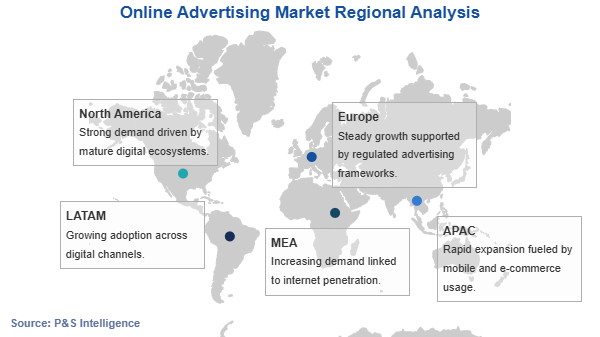
China is the largest country market within Asia-Pacific, anchored by a massive e-commerce ecosystem and a domestic digital advertising landscape shaped by ByteDance, Tencent, Alibaba, and Baidu. India is the fastest-growing country market, with digital ad spending rising 21.4% in 2024 and a rapidly expanding smartphone user base enabling mobile-first advertising at scale.
China Online Advertising Market Outlook
China's online advertising ecosystem is defined by the dominance of short-form video platforms, with over 1 billion users accessing Douyin and Kuaishou monthly. Live-stream commerce has created a seamless advertising-to-conversion funnel in China, with short video platforms significantly influencing consumer purchase decisions. The continued monetization of AI-driven targeting tools, the expansion of programmatic buying, and the growing sophistication of retail media networks anchored by Alibaba, JD.com, and Pinduoduo are collectively shaping China's online advertising trajectory.
India Online Advertising Market Prospects
India is the fastest-growing country market within Asia-Pacific. The convergence of rising smartphone penetration, accelerating 4G and 5G rollout, and an expanding e-commerce industry is driving this position. Display ad spending in India rose 22% in 2024, reaching USD 3.15 billion, and is expected to reach USD 6.22 billion by 2028 as major platforms deepen their regional investments. The Advertising Standards Council of India (ASCI) has introduced stricter regulations for online advertising conduct, reinforcing advertiser trust and platform accountability. The Telecom Regulatory Authority of India (TRAI) reports that India had over 900 million broadband subscribers as of 2024, establishing one of the world's largest mobile internet user bases.
The regions and countries analyzed in this report include:
- North America (Largest Region)
- U.S. (Largest Country Market)
- Canada (Fastest-Growing Country Market)
- Europe
- Germany (Largest Country Market)
- U.K. (Fastest-Growing Country Market)
- France
- Italy
- Spain
- Rest of Europe
- Asia-Pacific (Fastest-Growing Region)
- China (Largest Country Market)
- India (Fastest-Growing Country Market)
- Japan
- South Korea
- Australia
- Rest of Asia-Pacific
- Latin America
- Brazil (Largest Country Market)
- Mexico (Fastest-Growing Country Market)
- Rest of Latin America
- Middle East & Africa
- Saudi Arabia (Largest Country Market)
- U.A.E. (Fastest-Growing Country Market)
- South Africa
- Rest of Middle East & Africa
Online Advertising Market Share Analysis
The global online advertising market exhibits a highly concentrated competitive structure. Commanding data network effects, platform scale, and advertising technology capabilities among a small number of digital ecosystem operators define this structure. Owning high-traffic consumer platforms, proprietary audience datasets, and self-serve advertising infrastructure that serves millions of small and medium-sized businesses directly is the source of this concentration. The economics of digital advertising strongly favor platforms with scale: larger audience pools generate richer behavioral signals, which improve targeting precision, attract higher advertiser spend, and fund further platform development.
This creates compounding moats that are difficult for new entrants to overcome. Within this concentrated landscape, leading players compete through distinct strategic approaches. Agency holding groups aggregate multi-platform media buying at scale, provide brand strategy and creative services, and increasingly compete on proprietary data and AI-driven planning capabilities.
Top Companies in the Online Advertising Market:
- Alphabet Inc.
- Meta Platforms Inc.
- Amazon.com Inc.
- ByteDance Ltd.
- Microsoft Corporation
- Baidu Inc.
- Tencent Holdings Limited
- The Trade Desk Inc.
- Adobe Inc.
- Criteo S.A.
- Publicis Groupe S.A.
- WPP plc
- Snap Inc.
- Pinterest Inc.
- Verizon Media Inc.
Online Advertising Market News
- In November 2025, Omnicom Group Inc. completed its USD 13.3-billion all-stock acquisition of The Interpublic Group of Companies Inc., following regulatory approvals from the U.S. Federal Trade Commission and the European Union. The merger consolidates complementary data, AI, and media buying capabilities to build scale against walled-garden platforms.
- In October 2025, Meta Platforms Inc. announced that from December 16, 2025, it would use interactions from over 1 billion monthly Meta AI users to personalize advertising across Facebook, Instagram, WhatsApp, and Messenger. This marks the company's most direct integration of generative AI behavioral data into its targeting infrastructure. The move expands Meta's first-party data depth and is expected to improve ad relevance and conversion outcomes for the company's 10 million active advertisers.
- In June 2025, Meta Platforms Inc. introduced 11 new AI advertising tools at Cannes Lions 2025, including image-to-video conversion enabling advertisers to transform up to 20 product photos into multi-scene video ads, expanded Advantage+ automation for lead generation campaigns, and AI-generated brand consistency controls. The product suite is designed to reduce creative production costs and accelerate campaign deployment for businesses of all sizes on its platforms.
- In June 2025, WhatsApp — owned by Meta Platforms Inc. — announced the introduction of advertising within its Updates tab, marking the platform's first move into paid advertising since its founding. The development opens a new inventory channel for advertisers seeking to reach global audiences through the world's most widely used messaging platform.
- In January 2025, Amazon.com Inc. launched its Retail Ad Service in beta, enabling third-party retailers to access and deploy Amazon's advertising technology and machine learning infrastructure to serve contextually relevant ads within their own e-commerce platforms.
- In December 2024, Omnicom Group Inc. and The Interpublic Group of Companies Inc. announced their definitive merger agreement in a stock-for-stock transaction.
- In January 2024, Amazon.com Inc. introduced advertising on Prime Video across the U.S., U.K., Germany, Canada, and France through an ad-supported tier. This instantly added a major new CTV inventory source to the global digital advertising market.