On-Device AI Market Size Estimation
Key Highlights
| Study Period | 2021 - 2032 |
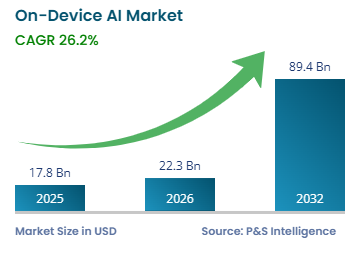
| Market Size in 2025 | USD 17.8 Billion |
| Market Size in 2026 | USD 22.3 Billion |
| Market Size by 2032 | USD 89.4 Billion |
| Projected CAGR | 26.2% |
| Largest Region | North America |
| Fastest-Growing Region | Asia-Pacific |
| Market Structure | Moderately Consolidated |
Market Size
Explore the market potential with our data-driven report
On-Device AI Market Key Insights
- Hardware commanded the larger share, of 80%, in 2025.
- Wearable devices are the fastest-growing category over 2026–2032, at 26.8% CAGR.
- Machine learning accounted for the largest share, of 45%, in 2025.
- Healthcare is the fastest-growing category over 2026–2032, at 26.5% CAGR.
- North America held the largest share, of 45%, in 2025.
- Asia-Pacific is the fastest-growing region, at a CAGR of 27.0% over 2026–2032.
On-Device AI Market Analysis
The global on-device AI market stood at USD 17.8 billion in 2025 and is projected to reach USD 89.4 billion by 2032, expanding at a compound annual growth rate of 26.2% over 2026–2032. On-device AI represents a fundamental architectural shift in how artificial intelligence is deployed. By executing AI models locally on the device, enterprises and consumers gain measurable advantages in latency reduction, data privacy, and operational continuity in low-connectivity environments.
Neural processing units (NPUs), machine learning frameworks, and computer vision capabilities are being integrated directly into smartphones, wearables, automotive systems, and industrial IoT devices. This hardware-level integration enables real-time inference without reliance on cloud infrastructure. AI-enabled smartphones and edge AI chips optimized for energy efficiency have expanded use cases across consumer electronics, healthcare monitoring, autonomous navigation, and industrial automation. The International Telecommunication Union (ITU) confirms that over 5.4 billion people globally used the internet in 2023. This scale of connected device penetration is accelerating demand for localized, low-latency AI processing on personal and enterprise devices.
On-Device AI Market Emerging Trends & Growth Drivers
NPU Integration and AI-Enabled Devices Are Key Trends in Market
The mainstream integration of dedicated NPUs into consumer and industrial hardware is the most consequential structural shift in the on-device AI market. Historically confined to flagship smartphones, NPU architectures have migrated rapidly into mid-range devices, wearables, automotive SoCs, and industrial microcontrollers. Advances in chip miniaturization, model compression techniques including quantization and pruning, and the emergence of TinyML frameworks allow complex inference workloads to execute on memory-constrained hardware. This transition is fundamentally redefining the boundary between AI-capable and standard devices.
By 2025, AI PCs are projected to account for 31% of total PC shipments, with global shipments reaching approximately 77 million units, reflecting the rapid integration of AI capabilities into mainstream computing devices. As NPUs become commoditized in mid-range tiers, competition is shifting from hardware availability to software optimization, model efficiency, and ecosystem integration. Chipmakers and device OEMs that develop proprietary AI frameworks — including Apple's Core ML, Qualcomm's AI Engine, and Google's TensorFlow Lite — are building platform lock-in that sustains competitive positioning beyond individual device cycles.
Data Privacy Regulations and Cloud Dependence Concerns Drive Market
Stringent data privacy regulation is compelling enterprises and device manufacturers to shift AI inference from cloud infrastructure to device-level processing. The European Union's General Data Protection Regulation (GDPR) and the EU Artificial Intelligence Act establish legal frameworks that impose significant liability on organizations transmitting sensitive personal data to cloud servers for AI processing. This regulatory pressure is acute in healthcare, financial services, and public administration, where biometric, financial, and behavioral data processed by AI systems carry the highest compliance risk.
Enterprise adoption is accelerating as organizations recognize that cloud-dependent AI introduces latency, bandwidth costs, and single points of failure that on-device processing eliminates. Rising internet penetration has created a large installed base of connected devices where local AI processing reduces network congestion while improving responsiveness.
Expanding Mid-Tier Smartphone Penetration Creates Market Opportunities
AI-enabled hardware is penetrating mid-range and budget smartphones in high-volume markets, opening a structurally significant opportunity. Advancements in efficient AI models, combined with competitive chipset pricing from MediaTek and Qualcomm, are enabling the integration of AI features into devices priced below USD 300.
India’s smartphone user base surpassed approximately 938 million in 2024, reflecting strong growth in mobile connectivity. This large installed base presents a significant opportunity for on-device AI feature adoption over the forecast period. Locally optimized on-device AI applications for vernacular language processing, agricultural analytics, and financial inclusion tools are being developed against this infrastructure base.
Power Consumption and Thermal Management Constraints Limit Market Growth
High power consumption and heat generation in AI-integrated, battery-operated edge devices are the principal restraints on on-device AI market expansion. Running large AI models locally demands substantially higher processing resources than conventional smartphone applications, draining battery life and generating heat that affects device longevity and requires hardware compromises, reducing model complexity relative to cloud-based equivalents. Wearable devices and industrial IoT sensors face particularly acute constraints, as their ultra-compact form factors limit both battery capacity and heat dissipation architecture.
Model compression, quantization, and hardware-software co-design approaches are progressively narrowing this gap. Devices below a certain thermal threshold remain incapable of executing computationally intensive on-device AI workloads, restricting the addressable market for full on-device inference to higher-tier hardware segments. Next-generation NPU architectures are expected to achieve higher TOPS-per-Watt efficiency ratios, moderating this constraint gradually. The restraint will persist as a ceiling on feature complexity in budget and ultra-compact device categories.
On-Device AI Market Segmentation and Category Analysis
Component Analysis
Hardware commanded the larger share, of 80%, in the global on-device AI market in 2025. The category's dominance is anchored by sustained enterprise and consumer demand for neural processing units, system-on-chip architectures integrating dedicated AI accelerators, AI memory modules, and edge GPUs optimized for low-latency inference. On-device AI by definition must execute on physical silicon, making hardware the irreducible foundation for every software framework, AI model, and edge application that performs inference without cloud connectivity. This dependence creates a durable revenue concentration in hardware that software licensing alone cannot displace. The U.S. CHIPS and Science Act allocated USD 52.7 billion toward domestic semiconductor manufacturing and R&D, validating the strategic importance governments assign to AI hardware supply chain resilience.
Software is the faster-growing segment over 2026–2032. Enterprise demand for AI development frameworks, model optimization toolchains, and on-device inference runtime environments is accelerating as organizations seek to reduce the complexity of deploying AI across heterogeneous hardware. As NPUs proliferate across devices, frameworks including TensorFlow Lite, Core ML, ONNX Runtime, and proprietary OEM AI SDKs become the critical differentiation surface for device manufacturers seeking to retain developer ecosystems. The European Commission's AI Act requires documented, auditable AI systems. This obligation is driving adoption of compliant inference frameworks and governance tooling deployable at the device level.
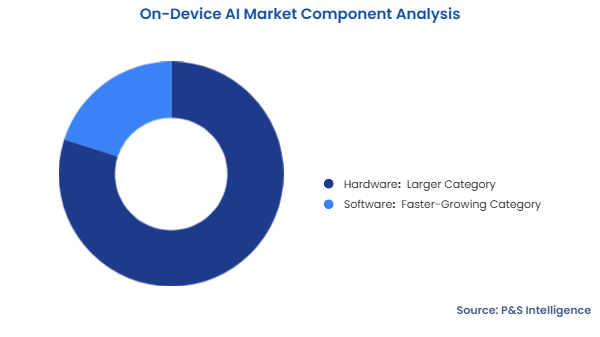
The market segments into the following components:
- Hardware (Larger Category)
- Software (Faster-Growing Category)
Device Type Analysis
Smartphones and tablets held the largest share, of 30%, in the global on-device AI market in 2025. The category's position is anchored by the largest installed base of any AI-capable hardware category globally, exceeding 6 billion active smartphones, and by the deepest integration of NPU architectures within mobile SoCs across all price tiers. Consumer-facing AI applications including computational photography, voice assistants, biometric authentication, and real-time translation generate continuous, high-frequency inference demand.
Smartphone OEMs have institutionalized NPU investment as a competitive differentiator, with every major chipmaker embedding dedicated AI engines in flagship and mid-range processors. According to the International Telecommunication Union (ITU), global mobile broadband penetration reached 87 subscriptions per 100 inhabitants in 2023. This scale of addressable device base defines the primary distribution channel through which on-device AI is reaching end users.
Wearable devices are the fastest-growing device segment over 2026–2032. Continuous health monitoring capabilities require local, privacy-preserving AI inference—heart rhythm analysis, blood oxygen monitoring, sleep pattern classification, and fall detection cannot tolerate the latency or connectivity dependence of cloud-based processing. Approximately 30% of consumer wearable devices integrated on-device AI capabilities in 2024, reflecting the growing adoption of local intelligence for real-time health monitoring.
This penetration rate is expected to deepen as miniaturized NPU architectures achieve the ultra-low power envelopes required for always-on inference on battery-constrained smartwatches and fitness bands. The World Health Organization (WHO) reports that the global population aged 60 and above will reach 2.1 billion by 2050. This demographic trajectory establishes a long-term structural demand base for wearable health AI extending well beyond the forecast period. The global wearable medical devices market value is projected to reach USD 67.2 billion by 2030, growing at a CAGR of 18.3%.
The market segments into the following device types:
- Smartphones & Tablets (Largest Category)
- Wearable Devices (Fastest-Growing Category)
- Automotive Systems
- Smart Home Devices
- Industrial IoT & Automation
- Healthcare Devices
- Others
Technology Analysis
Machine learning accounted for the largest share, of 45%, in the global on-device AI market in 2025. ML frameworks spanning supervised learning for image classification, reinforcement learning for adaptive personalization, and federated learning for privacy-preserving model updates constitute the algorithmic core from which specialized AI capabilities are derived. The category's dominance reflects both the maturity of ML model optimization for edge hardware and the breadth of its deployment across smartphones, automotive ADAS systems, industrial predictive maintenance, and consumer electronics.
OECD data on digital economy investment confirms that enterprise AI adoption, predominantly built on ML architectures, has expanded consistently across member economies. This sustained expansion underpins demand for ML inference capabilities at the device level.
Computer vision is the fastest-growing technology segment over 2026–2032. Deployment is expanding across surveillance, autonomous vehicle perception, augmented reality, industrial quality inspection, and retail analytics. In each of these applications, real-time visual data processing at the device level eliminates the prohibitive latency and bandwidth costs of transmitting video streams to cloud infrastructure.
Advances in lightweight convolutional neural networks and vision transformers optimized for NPU execution are enabling high-accuracy object detection and scene understanding on memory-constrained devices. The U.S. National Institute of Standards and Technology (NIST) has published AI evaluation frameworks specifically addressing computer vision system accuracy and robustness requirements. These frameworks are accelerating enterprise confidence in deploying vision AI at the edge.
The market segments into the following technologies:
- Machine Learning (Largest Category)
- Computer Vision (Fastest-Growing Category)
- Natural Language Processing
- Speech Recognition
Vertical Analysis
Consumer electronics accounted for the largest share, of 35%, in the global on-device AI market in 2025. High sales volumes across AI-capable smartphones, smart TVs, wearables, smart speakers, and connected home appliances generate the high-frequency inference demand that underpins the category's position. Consumer electronics manufacturers have systematically embedded on-device AI as a product differentiation mechanism, offering adaptive display calibration, noise cancellation, personalized content recommendation, and gesture recognition as standard across mid-range and premium products. Rapid product refresh cycles accelerate NPU generation transitions and sustain hardware revenue at scale.
Healthcare is the fastest-growing end-use segment over 2026–2032. Patient data privacy requirements, intermittent connectivity in clinical environments, and real-time response demands favor local processing over cloud-dependent architectures. AI-enabled wearable health monitors, point-of-care diagnostic devices, and surgical assistance systems are driving adoption. The U.S. Food and Drug Administration has authorized more than 1,000 AI-enabled medical devices through established premarket pathways, reflecting the growing clinical adoption of AI technologies. This regulatory milestone validates on-device AI's clinical readiness and is accelerating procurement across hospital systems and outpatient care settings globally.
The market segments into the following verticals:
- Consumer Electronics (Largest Category)
- Healthcare (Fastest-Growing Category)
- Automotive
- Manufacturing
- Retail
- Others
Drive strategic growth with comprehensive market analysis
On-Device AI Market Geographical Analysis
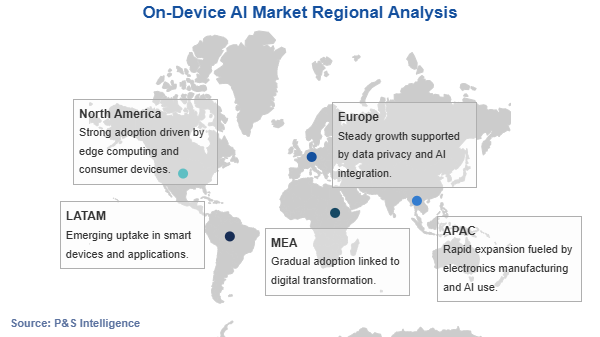
North America On-Device AI Market Outlook
North America held the largest share, of 45%, in the global on-device AI market in 2025. Qualcomm, Apple, Intel, and NVIDIA anchor the region through multi-generational investment in dedicated AI accelerators and neural engine architectures embedded within consumer and enterprise hardware. Sustained enterprise adoption in healthcare diagnostics, autonomous vehicle development, and industrial edge computing reinforces regional demand trajectories.
CHIPS and Science Act funding directed at domestic semiconductor fabrication has strengthened the region's structural advantages in AI chip supply chains. High consumer electronics penetration, with smartphones and AI-enabled PCs achieving near-saturation in the U.S., sustains consistent demand for on-device inference capabilities across productivity, health, and communications applications. According to the U.S. National Science Foundation (NSF), total R&D spending in the United States reached USD 892 billion in 2022, reflecting sustained growth in research investment. The U.S. Department of Commerce confirms that the CHIPS and Science Act allocated USD 52.7 billion for domestic semiconductor manufacturing and research, directly strengthening the on-device AI hardware supply chain.
U.S. On-Device AI Market Growth
The U.S. is the largest market within North America and globally. Leading-edge chip design, robust venture capital investment in edge AI startups, and deep enterprise integration of AI across healthcare, defense, and financial services define its structural position. Apple's Neural Engine — embedded across iPhone, iPad, and Mac product lines — and Qualcomm's Snapdragon series have established the U.S. as the primary innovation center for on-device AI architectures. Federal procurement of AI-enabled edge devices for defense and national security applications adds a structurally stable demand layer not present in other markets.
This economic depth supports sustained AI hardware and software development across the chipmaker and enterprise mobility ecosystem. Continued chipmaker R&D investment and expanding AI integration into smart home ecosystems and wearable health monitoring platforms will extend the U.S. market's lead over the forecast period.
Europe On-Device AI Market Analysis
The European on-device AI market is shaped by a regulatory environment that structurally favors on-device processing. The EU's General Data Protection Regulation (GDPR) and the EU Artificial Intelligence Act have created strong institutional incentives for enterprises to process sensitive data locally rather than transmitting it to cloud servers. The EU Artificial Intelligence Act introduced the world’s first comprehensive AI legal framework, with initial provisions, including bans on prohibited AI practices, entering into force in February 2025. Germany's advanced industrial manufacturing sector drives significant demand for embedded AI in Industry 4.0 applications, including predictive maintenance, quality inspection, and autonomous robotics.
Eurostat reports that approximately 45% of EU enterprises used cloud computing services in 2023. This installed base creates consistent demand for hybrid on-device/cloud AI architectures that balance performance with regulatory compliance. The EU AI Act's compliance requirements will continue accelerating enterprise transitions to on-device processing, particularly in healthcare, financial services, and public sector applications across Germany, France, and the U.K.
Asia-Pacific On-Device AI Market Forecast
Asia-Pacific is the fastest-growing region in the global on-device AI market, registering a CAGR of 27.0% over 2026–2032. China's designation of on-device AI as a national strategic priority, combined with state-backed investment in domestic chip design through HiSilicon Kirin and Cambricon NPU architectures, has created a self-reinforcing ecosystem of device manufacturers and AI software developers. China's National Development and Reform Commission (NDRC) has designated artificial intelligence as a core component of China's 14th Five-Year Plan, directing state investment toward domestic AI chip development and large-scale deployment across consumer and industrial devices.
Samsung Electronics produces both Exynos SoCs and flagship Galaxy devices, driving supply-side chip innovation and demand-side device adoption across South Korea. India's rapidly expanding smartphone installed base represents the region's most significant volume growth opportunity for on-device AI feature penetration. MeitY confirms that the India AI Mission will allocate INR 10,371.92 crore (USD 1.24 billion) over five years toward AI compute infrastructure, datasets, and semiconductor skilling programs.
Asia-Pacific's growth trajectory is expected to strengthen as India's manufacturing ecosystem matures under the Production Linked Incentive (PLI) scheme for electronics and as regional 5G rollout accelerates hybrid edge-cloud AI deployments across Southeast Asia and Australia.
China On-Device AI Market Trends
China held the largest country market share within Asia-Pacific for on-device AI in 2025. A uniquely integrated ecosystem of domestic chip designers, device manufacturers, and government-mandated AI adoption programs underpins this position. Huawei's HiSilicon division produces the Kirin series of NPU-integrated SoCs, and Cambricon's edge AI accelerators have established a domestic supply chain that reduces dependence on foreign semiconductor inputs a strategic imperative reinforced by U.S. export restrictions. The Chinese government's AI Plus initiative has accelerated the deployment of on-device AI across smartphones, AI computers, and wearable devices.
Geopolitical headwinds including semiconductor export controls limiting access to advanced fabrication nodes may moderate hardware performance gains relative to U.S. and South Korean competitors. Domestic NPU innovation and vertical integration between chip designers and device OEMs will sustain China's leadership within Asia-Pacific.
India On-Device AI Market Growth
India is the fastest-growing country market within Asia-Pacific for on-device AI. Policy-driven investment, explosive smartphone adoption, and a rapidly deepening digital infrastructure underpin this position. The India AI Mission has established a foundational compute and data infrastructure that directly accelerates on-device AI development and deployment at scale. Indian startups are leveraging TinyML and model quantization techniques to deploy on-device inference capabilities on mid-range and budget devices, extending AI functionality to the price-sensitive segments that dominate India's volume market.
The Press Information Bureau (PIB), Government of India confirms that the India AI Mission has surpassed the initial target of 10,000 GPUs, providing affordable AI compute access to startups, researchers, and enterprises building on-device AI solutions. India's Digital India and Make in India programs are incentivizing domestic electronics manufacturing, with AI-integrated device production increasingly anchored in Indian facilities as global supply chain diversification accelerates. PLI scheme incentives attracting global semiconductor and electronics manufacturers, a 416,000-strong AI talent pool, and government commitments to deploying AI across agriculture, healthcare, and financial inclusion collectively reinforce India's growth trajectory. In each of these sectors, on-device, low-connectivity AI processing provides decisive operational advantages.
The regions and countries analyzed in this report include:
- North America (Largest Region)
- U.S. (Largest Country Market)
- Canada (Fastest-Growing Country Market)
- Europe
- Germany (Largest Country Market)
- U.K. (Fastest-Growing Country Market)
- France
- Italy
- Spain
- Rest of Europe
- Asia-Pacific (Fastest-Growing Region)
- China (Largest Country Market)
- India (Fastest-Growing Country Market)
- Japan
- South Korea
- Australia
- Rest of APAC
- Latin America
- Brazil (Largest Country Market)
- Mexico (Fastest-Growing Country Market)
- Rest of LATAM
- Middle East & Africa
- Saudi Arabia (Largest Country Market)
- South Africa
- U.A.E. (Fastest-Growing Country Market)
- Rest of MEA
On-Device AI Market Competitive Landscape
The global on-device AI market exhibits a moderately consolidated competitive structure at the semiconductor and platform layer. A small number of vertically integrated technology companies control the critical hardware architectures that underpin on-device inference across all device categories. This concentration reflects the extraordinary capital requirements of custom silicon development — designing and fabricating a competitive NPU requires multi-billion-dollar investment cycles spanning three to five years — compounded by proprietary software ecosystems that bind AI model developers to specific hardware platforms.
High switching costs reinforce this structure, as optimization frameworks, toolchains, and model architectures are tightly coupled with underlying hardware instructions, making platform migration resource-intensive. Access to advanced manufacturing nodes and long-term supplier relationships raises barriers to entry for new participants. Growing demand for low-latency, privacy-preserving, and energy-efficient AI processing is intensifying competition around performance-per-watt and edge optimization capabilities, sustaining continuous innovation while preserving the positional advantages of established players.
Key Players in the On-Device AI Market:
- Qualcomm Technologies Inc.
- Apple Inc.
- Samsung Electronics Co. Ltd.
- NVIDIA Corporation
- Intel Corporation
- MediaTek Inc.
- Google LLC
- Microsoft Corporation
- Huawei Technologies Co. Ltd.
- Arm Holdings plc
- Amazon.com Inc.
- Baidu Inc.
On-Device AI Market News
- In June 2025, Apple Inc. unveiled new on-device AI capabilities at WWDC 2025, including live translation, enhanced visual intelligence, and privacy-preserving, device-level processing as part of its Apple Intelligence framework.
- In April 2025, Samsung Electronics Co. Ltd. and Google LLC expanded their strategic partnership to integrate the Gemini AI model into Ballie, Samsung's home AI companion robot, embedding on-device generative AI capabilities into a consumer robotics platform and extending the competitive reach of both companies into the smart home AI segment.
- In March 2025, Intel Corporation unveiled its Edge AI Suites and Open Edge Platform, enabling low-power, real-time AI integration across existing industrial infrastructure without requiring hardware replacement. The platform targets enterprise and manufacturing segments where edge inference adoption has been constrained by integration complexity and infrastructure cost.
- In March 2025, Qualcomm Technologies Inc. partnered with FYI.AI to integrate on-device AI into Snapdragon-powered devices, enhancing personalization, processing speed, and privacy for creative AI tools across smartphones, XR devices, automotive systems, and robotics. This partnership signals Qualcomm's strategy to expand Snapdragon's on-device AI ecosystem beyond mobile into multi-category edge applications.
- In March 2025, Arm Holdings plc collaborated with Stability AI to optimize the Stable Audio Open model for Arm CPUs using KleidiAI technology, achieving a 30-fold increase in audio generation speed and reducing processing time from 240 seconds to under 8 seconds on Armv9 CPUs. This enables fully offline, high-quality audio AI generation on smartphones.
- In November 2024, Fujitsu Limited partnered with Advanced Micro Devices, Inc. to jointly develop next-generation computing platforms targeting AI inference and high-performance computing at the edge, combining Fujitsu's enterprise systems expertise with AMD's GPU and accelerator portfolio to address growing demand for sustainable, high-throughput on-device AI infrastructure.
- In June 2024, Apple Inc. launched Apple Intelligence at WWDC 2024, a personal AI system integrated into iOS 18, iPadOS 18, and macOS Sequoia, built on a hybrid architecture combining on-device processing with privacy-preserving server-based generative models.