North America Cold Chain Market Size & Share Analysis - Trends, Drivers, Competitive Landscape, and Forecasts (2026 - 2032)
This Report Provides In-Depth Analysis of the North America Cold Chain Market Report Prepared by P&S Intelligence, Segmented by Offering (Hardware, Packaging, Software, Services), Temperature Range (Chilled, Sub-Chilled, Blast-Frozen, Frozen, Deep-Frozen), Application (Fish Meat & Seafood, Dairy Products, Fruits & Vegetables, Processed Food, Pharmaceuticals, Bakery & Confectionery), and Geographical Outlook for the Period of 2021 to 2032
Explore the market potential with our data-driven report
North America Cold Chain Market Key Insights
Hardware accounted for the largest share, of 45%.
The frozen (−18°C to −25°C) category has the highest CAGR, of approximately 13.5%.
Fish, meat, & seafood applications held the largest share, of 35%.
U.S. commands the largest share, of 75%, driven by stringent food and drug safety regulations and sustained government infrastructure investment programs.
Canada is the fastest-growing country market, at approximately 14.2% CAGR, propelled by cold-chain infrastructure funding, rising protein consumption, and e-commerce expansion.
North America Cold Chain Market Future Outlook
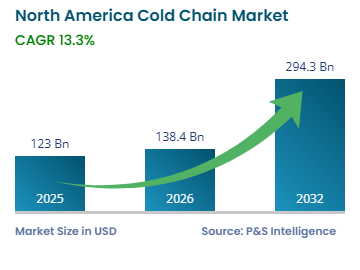
The North America cold chain market stood at USD 123.0 billion in 2025 and is projected to reach approximately USD 294.3 billion by 2032, expanding at a compound annual growth rate of 13.3% over 2026–2032. Escalating demand for temperature-controlled storage and transportation across food and pharmaceutical supply chains is the primary structural driver. Tightening federal regulatory standards governing product integrity from production through delivery are reinforcing this demand at the infrastructure level.
The U.S. Food and Drug Administration's (FDA) Food Safety Modernization Act (FSMA) Section 204 mandates comprehensive digital traceability for high-risk food categories. These compliance requirements have compelled cold chain operators to invest heavily in IoT-enabled monitoring infrastructure and automated logistics platforms. The U.S. Department of Agriculture (USDA) reported that frozen poultry stocks in the United States reached 1.03 billion pounds in February 2024, reflecting inventory held in cold storage facilities. The breadth of these figures reflects how deeply temperature-controlled infrastructure is embedded across the region's food supply chain.
North America Cold Chain Market Trends and Drivers
IoT-Enabled Monitoring and Software Integration Are Key Market Trends
The North America cold chain market is undergoing a technological transition as IoT-based temperature monitoring and cloud-connected visibility platforms move from early adoption into mainstream deployment. AI-driven warehouse management systems are accelerating this shift, replacing periodic manual logging with continuous, automated oversight across refrigerated storage and transport assets. Real-time sensor networks now enable tracking of temperature excursions, humidity deviations, and location data across the full asset footprint. A fundamental shift in how operators design and manage temperature-controlled assets is underway. According to the U.S. Food and Drug Administration, pharmaceutical cold chain logistics increasingly require continuous temperature monitoring and data logging to ensure compliance with regulatory standards, reinforcing the adoption of real-time IoT-enabled tracking systems.
Digital visibility is restructuring competitive positioning across the cold chain, not merely improving operational efficiency. Operators with real-time monitoring capability command premium contracts from pharmaceutical and e-commerce clients, while those dependent on manual monitoring or periodic logging face growing pressure on contract renewal and regulatory compliance. The operational and financial case for accelerated technology adoption through the forecast period is compelling.
Food Safety and Pharmaceutical Cold Chain Mandates Drive Market
Regulatory frameworks at the federal level represent the most powerful structural driver of cold chain investment across North America. The U.S. Food and Drug Administration's Food Safety Modernization Act (FSMA), specifically its Section 204 Food Traceability Rule, mandates that all entities manufacturing, processing, packing, or holding high-risk foods on the FDA's Food Traceability List maintain digital records of Critical Tracking Events and Key Data Elements. Records must be submitted to the FDA within 24 hours upon request. The compliance deadline, now extended to July 20, 2028, has prompted increased focus on digital traceability infrastructure across the food cold chain. Industry participants now recognize that the rule's technical and operational requirements demand multi-year implementation timelines.
The FDA has noted that over 50% of newly approved drugs in 2022 required cold chain storage and transportation. Biologics, monoclonal antibodies, and mRNA-based therapies require validated 2°C to 8°C temperatures for storage and transportation. The Drug Supply Chain Security Act (DSCSA) enforces end-to-end traceability for pharmaceutical products through serialization and electronic tracking across all dispensing and distribution nodes. These regulatory frameworks are compelling operators to invest in validated cold chain infrastructure and compliant documentation workflows that span the entire product journey. Qualified monitoring systems have become a baseline procurement requirement rather than a differentiating capability.
E-Commerce and Last-Mile Reefer Logistics Expansion Create Opportunities
The rapid expansion of online grocery and direct-to-consumer food delivery across the United States is generating a demand shift that the existing cold chain infrastructure was not designed for. By mid-2025, an estimated 81 million U.S. households purchased groceries online, with online grocery shoppers numbering approximately 148.4 million individuals. Last-mile temperature-controlled delivery requirements have reached a scale for which conventional bulk distribution infrastructure has no ready answer. The U.S. Census Bureau recorded U.S. e-commerce retail sales growth of 9.4% year-over-year, reaching USD 308.9 billion in Q4 2024.
A structural gap has opened between conventional cold chain infrastructure optimized for bulk pallet-based distribution to retail and the urban micro-fulfillment model required for e-commerce perishable delivery. Operators are deploying modular, multi-temperature micro-fulfillment centers within 10 miles of densely populated urban centers to capture high-margin last-mile cold logistics contracts. In 2024, five speculative cold storage projects were completed in the U.S., adding 1.1 million square feet of new refrigerated space, with an additional 2.2 million square feet expected in 2025.
High Capital Costs and Energy Intensity Constrain Market Expansion
Cold chain infrastructure development is capital-intensive, with refrigerated storage construction costs typically ranging from USD 130 to 350 per square foot, depending on temperature zone requirements, insulation, and refrigeration system complexity. Refrigeration systems alone account for nearly 60% of total cold storage operating costs. The continuous energy demands of maintaining precise low-temperature environments across large-footprint facilities are the primary cost driver. Significant barriers to entry for small and mid-sized operators follow from this cost structure, concentrating market share among well-capitalized providers with access to long-term financing.
Energy price volatility compounds this constraint. Rising electricity costs across the U.S. and Canada directly erode margins in refrigerated warehousing, particularly for operators running older, energy-inefficient facilities that lack the capital budget for refrigeration system modernization. The transition to eco-friendly refrigerants and IoT-based energy management can reduce consumption, but the upfront conversion cost remains prohibitive for a substantial portion of the mid-market operator base. Smaller operators unable to sustain compliance and modernization costs are exiting or partnering with large integrated cold chain providers, accelerating consolidation across the sector.
North America Cold Chain Market Segmentation Analysis
Offering Analysis
Hardware accounted for the largest revenue share, of 45%, in 2025. Temperature sensors, RFID tracking devices, telematics units, and networked monitoring hardware embedded in refrigerated warehouses and reefer transport vehicles form the essential data-collection layer upon which cold chain compliance and visibility depend. Hardware deployment across established food and pharmaceutical supply chains is broad and deeply embedded. A continual replacement cycle, sustained by regulatory validation requirements and facility modernization programs, reinforces category demand independently of new build activity.
The FDA's Drug Supply Chain Security Act (DSCSA) mandates serialization and end-to-end electronic tracking of pharmaceutical products at every distribution node. Sustained hardware demand across the pharmaceutical cold chain follows directly from these obligations. The FDA confirms that DSCSA interoperability requirements have compelled distributors and dispensers to implement hardware-based unit-level tracing at scale.
Software is projected to register the fastest-growing CAGR over the forecast period. The transition from passive monitoring to active, AI-driven cold chain management platforms is the primary growth mechanism. Cloud-connected visibility solutions, predictive analytics tools, temperature excursion management systems, and compliance automation platforms are being embedded into warehouse management and transportation management systems, enabling real-time intervention before product integrity is compromised. The FDA's FSMA Section 204 Food Traceability Rule requires digital Key Data Element records at every Critical Tracking Event; manual recordkeeping cannot feasibly satisfy 24-hour data retrieval mandates at supply chain scale. FDA Food Traceability Rule compliance timelines are compelling end users to deploy integrated software platforms.
The market segments into the following offerings:
Hardware (Largest Category)
Storage Equipment
Transport Refrigeration Equipment
Monitoring Devices
Packaging
Passive Packaging
Active Packaging
Pallet Shippers & Thermal Covers
Software (Fastest-Growing Category)
Cold Chain Monitoring & Visibility
Temperature Excursion Management
Analytics & Compliance
Services
Installation & Commissioning
Calibration & Validation
Maintenance & Support
System Integration & Consulting
Temperature Range Analysis
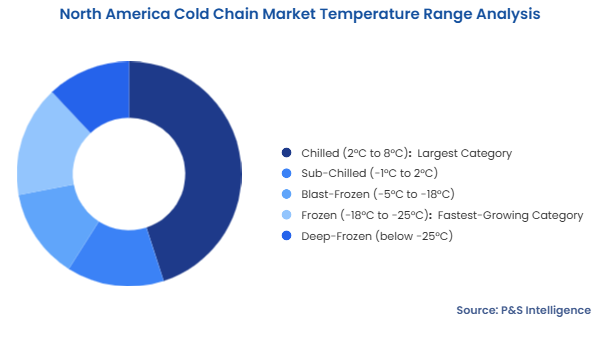
The chilled (2°C to 8°C) category held the largest share, of 45%, in 2025. Fresh produce, dairy products, beverages, meat and seafood in transit, and the majority of pharmaceutical biologics require continuous chilled environments throughout storage and distribution. Vaccines and monoclonal antibodies sit within this biologics group, making the pharmaceutical sector a structurally reliable contributor to chilled demand alongside food. The volume of products demanding chilled conditioning and the extensive refrigerated storage infrastructure already optimized for this temperature range together cement the category's position. The U.S. Department of Agriculture (USDA) confirms that refrigerated food product stocks held in commercial cold storage, including dairy, eggs, and fresh produce, are maintained at chilled rather than frozen temperatures.
The frozen (−18°C to −25°C) segment is anticipated to register the fastest-growing CAGR over the forecast period, at approximately 13.5%. The expansion of e-commerce grocery and direct-to-consumer frozen food delivery is compelling cold chain operators to invest in frozen-specific micro-fulfillment and last-mile logistics infrastructure. The global biologics pipeline is generating demand for deep-freeze cold chain pharmaceutical capabilities, where ultra-low temperature storage is a validated requirement rather than an operational preference. The USDA has reported that 96% of frozen red meat and 100% of frozen poultry produced in the U.S. pass through commercial frozen cold storage.
The market segments into the following temperature ranges:
Chilled (2°C to 8°C) (Largest Category)
Sub-Chilled (−1°C to 2°C)
Blast-Frozen (−5°C to −18°C)
Frozen (−18°C to −25°C) (Fastest-Growing Category)
Deep-Frozen (below −25°C)
Application Analysis
Fish, meat & seafood commanded the largest share in 2025. The perishable nature of animal protein products and strict USDA and FDA food safety requirements for continuous temperature control from processing through retail distribution drive this category. The USDA confirms that meat and poultry are the dominant commodities held in U.S. commercial refrigerated warehouses.
Processed food is projected to register the fastest-growing CAGR over the forecast period, at approximately 13.7%. Consumer demand for convenience foods and ready-to-eat meals is expanding the requirement for temperature-controlled processed food logistics. Frozen prepared products are compounding this demand, pulling volume into cold chain channels that previously handled ambient distribution. Urbanization and shifting lifestyle patterns are the structural forces behind this trajectory.
The trend is pronounced in North America, where e-commerce grocery penetration continues to deepen across major urban markets. Three-temperature last-mile routing — where insulated compartments for ambient, chilled, and frozen products are consolidated within a single vehicle or container — is driving investment in cold chain infrastructure calibrated for the processed food distribution model.
The market segments into the following applications:
Fish, Meat & Seafood (Largest Category)
Dairy Products
Fruits & Vegetables
Processed Food (Fastest-Growing Category)
Pharmaceuticals
Bakery & Confectionery
Others
Drive strategic growth with comprehensive market analysis
North America Cold Chain Market Geographical Analysis
United States Cold Chain Market Outlook
The United States holds the largest share, of 75%, in the North America cold chain market. Decades of regulatory-driven infrastructure investment have built a distribution network of considerable scale and technical depth. A sophisticated pharmaceutical manufacturing and logistics base reinforces this position, operating validated cold chain corridors across the country's major production and distribution hubs. Consumer demand for fresh and frozen food products sustains continuous temperature management requirements across retail, foodservice, and direct-to-consumer channels.
The FDA’s FSMA framework requires risk-based monitoring and control of temperature conditions across food supply chains, with documentation and verification of preventive controls to ensure product safety. Sustained capital investment in compliant infrastructure follows directly from these obligations. The U.S. pharmaceutical sector relies on validated 2°C–8°C cold chains for maintaining the integrity of biologics and vaccines across production and distribution. The rapid expansion of e-commerce grocery and meal-kit delivery platforms is driving investment in urban micro-cold-storage hubs and last-mile refrigerated transport fleets.
The reach of temperature-controlled infrastructure across the domestic food supply chain is extensive and structurally embedded. Pharmaceutical pipeline growth and FSMA traceability compliance investments are positioning the U.S. cold chain market for continued expansion through the forecast period. Ongoing consolidation among large-scale refrigerated warehouse operators is compressing the competitive field around well-capitalized providers. Americold and Lineage are expanding automated storage and retrieval capacity across strategic logistics corridors, accelerating throughput in refrigerated fulfillment centers.
Canada Cold Chain Market Analysis
Canada is the fastest-growing country market within North America, registering a CAGR of 14.2% over 2026–2032. Public investment in healthcare infrastructure and a growing number of international clinical trials conducted in Canada are expanding demand for pharmaceutical-grade cold chain capacity. Activity across pharmaceutical logistics, food distribution, and biotechnology supply chains is broadening the country's cold chain base beyond traditional protein storage.
Health Canada's regulatory alignment with FDA standards for temperature-controlled pharmaceutical distribution has elevated compliance requirements for cold chain operators serving the biotech and vaccine distribution sectors. The country's agricultural output, spanning grain, dairy, meat, and seafood, generates substantial demand for long-haul refrigerated storage and transport infrastructure between production and consumption centers. Statistics Canada reported that the combined stock of frozen and chilled meats in Q1 and Q2 of 2024 amounted to 128,080 and 131,778 units respectively. This reflects consistent and sustained cold chain utilization across Canada's protein supply chain.
The growing presence of pharmaceutical and biotechnology companies in the greater Toronto and Vancouver metropolitan areas is intensifying demand for validated cold chain solutions for both domestic and cross-border distribution. UPS acquired Andlauer Healthcare Group, a Canadian pharmaceutical cold chain specialist, for CAD 2.2 billion in November 2025. The transaction signals the strategic importance of the Canadian cold chain corridor to global logistics operators seeking validated pharmaceutical distribution infrastructure in North America.
The countries analyzed in this report include:
U.S. (Larger Country Market)
Canada (Faster-Growing Country Market)
North America Cold Chain Market Share Analysis
The North America cold chain market exhibits a moderately consolidated structure. Capital barriers are significant, and economies of scale in refrigerated warehousing give established operators a structural cost advantage that new entrants cannot replicate without long-term financing commitments. The regulatory complexity of operating validated temperature-controlled networks across food and pharmaceutical supply chains adds a further layer of competitive insulation for incumbents. A small number of large-scale integrated operators control substantial shares of regional refrigerated storage capacity, concentrating the top tier of the market around well-capitalised providers. The transportation equipment, packaging, and software segments accommodate a broader range of specialised competitors, where capital requirements are lower and technical differentiation carries more weight than network scale.
Consolidation has intensified in recent years. Rising compliance costs and energy modernisation requirements have raised the threshold for competitive participation across refrigerated warehousing. E-commerce infrastructure demands are compounding this pressure, accelerating the exit or absorption of smaller operators unable to sustain the investment cycles that large integrated providers can absorb.
Top Companies in the North America Cold Chain Market:
North America Cold Chain Market News
In November 2025, United Parcel Service Inc. completed the acquisition of Andlauer Healthcare Group Inc., a Canadian healthcare logistics specialist offering cold chain transportation and third-party logistics solutions for pharmaceutical manufacturers, for CAD 2.2 billion (USD 1.6 billion). The acquisition integrates Andlauer's coast-to-coast Canadian pharmaceutical cold chain network into UPS Healthcare's 17 million square feet of compliant healthcare distribution space. Andlauer's network spans air freight forwarding, ground transportation, and last-mile services across Canada's major pharmaceutical distribution corridors.
In August 2025, Americold Realty Trust opened its new USD 100-million import–export hub in Kansas City, Missouri, in partnership with Canadian Pacific Kansas City (CPKC). The 335,000-square-foot facility is designed to handle refrigerated containers exceeding 50,000 pounds. On-site USDA inspections are embedded within the facility's operating model, removing the border delay friction that conventional import–export cold chain handling generates. The hub also anchors CPKC's Mexico Midwest Express, North America's only single-line rail service for refrigerated freight between the U.S. Midwest and Mexico.
In May 2025, Lineage, Inc. announced a definitive agreement to acquire four cold storage warehouses from Tyson Foods, Inc. for USD 247 million, covering approximately 49 million cubic feet, in Pottsville, Pennsylvania; Olathe, Kansas; Rochelle, Illinois; and Tolleson, Arizona. Lineage also committed USD 740 million to build and operate two next-generation, fully automated cold storage warehouses for Tyson, part of a broader USD 1 billion investment program. Automated protein logistics capacity across major U.S. distribution corridors expands materially under this combined commitment.
In March 2025, Carrier Global Corporation, through its Sensitech subsidiary, launched Lynx FacTOR, a SaaS platform designed to automate end-to-end product release evaluations for the pharmaceutical cold chain. The device-agnostic, 21 CFR Part 11-compliant solution consolidates temperature excursion data, batch stability records, and compliance documentation. Batch release timelines that previously required days are reduced to minutes for pharmaceutical cold chain compliance workflows.
Frequently Asked Questions About This Report
What will be North America cold chain market size in 2032?+
In 2032, the cold chain market in North America size will be USD 294.3 billion.
Which offering has largest North America cold chain industry share?+
Hardware has the largest North America cold chain industry share, of 45%.
Which country has largest North America cold chain market share?+
U.S. is the largest cold chain market in North America, with 75% share.
What are the key North America cold chain industry drivers?+
The North America cold chain market is primarily driven by rising demand for fresh and frozen food, expanding pharmaceutical and biotech industries, increasing e-commerce and organized retail, government investments in cold storage infrastructure, and growing consumer awareness of food safety and quality.
What is the North America cold chain market nature?+
The cold chain market in North America is moderately consolidated.
Want a report tailored exactly to your business need?
Leading companies across industries trust us to deliver data-driven insights and innovative solutions for their most critical decisions. From data-driven strategies to actionable insights, we empower the decision-makers who shape industries and define the future. From Fortune 500 companies to innovative startups, we are proud to partner with organisations that drive progress in their industries.
Client Testimonials
Working with P&S Intelligence and their team was an absolute pleasure – their awareness of timelines and commitment to value greatly contributed to our project's success. Eagerly anticipating future collaborations.
McKinsey & Company
India
Unmatched Standards
Our insights into the minutest levels of the markets, including the latest trends and competitive landscape, give you all the answers you need to take your business to new heights
Complete Data Security
We take a cautious approach to protecting your personal and confidential information. Trust is the strongest bond that connects us and our clients, and trust we build by complying with all international and domestic data protection and privacy laws