NDT and Inspection Market Size & Share Analysis - Trends, Drivers, Competitive Landscape, and Forecasts (2026 - 2032)
This Report Provides In-Depth Analysis of the NDT and Inspection Market Report Prepared by P&S Intelligence, Segmented by Offering (Services, Equipment), Method (Visual Testing, Magnetic Particle Testing, Liquid Penetrant Testing, Eddy Current Testing, Ultrasonic Testing, Radiographic Testing), Industry (Oil & Gas, Manufacturing, Aerospace & Defense, Construction, Automotive), and Geographical Outlook for the Period of 2021 to 2032
Explore the market potential with our data-driven report
NDT and Inspection Market Future Outlook
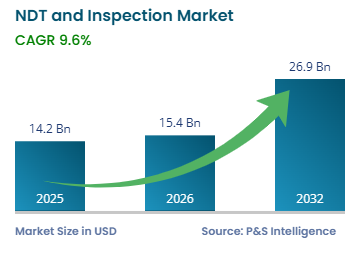
The NDT and inspection market size was USD 14.2 billion for 2025, and it will grow by 9.6% during 2026–2032, to reach USD 26.9 billion by 2032.
The market is driven by tightening asset-integrity mandates across the oil & gas, aerospace & defense, and manufacturing industries, along with an industry-wide shift from schedule-based inspections toward condition-based maintenance and AI-enabled defect detection. Ultrasonic testing, radiographic testing, eddy current testing, magnetic particle testing, visual testing, and liquid penetrant testing remain the core non-destructive inspection techniques supporting the integrity, reliability, and safety of ageing industrial infrastructure worldwide.
Persistently high capital investment in energy infrastructure continues to reinforce demand for non-destructive testing and inspection services. According to the International Energy Agency (IEA), global energy investment is projected to reach approximately USD 3.3 trillion in 2025. This investment is supporting continued development and maintenance of pipelines, refineries, power facilities, and offshore assets that rely extensively on ultrasonic and radiographic testing for asset integrity management. Parallel growth in precision manufacturing is expanding demand for advanced inspection technologies. According to the National Bureau of Statistics of China, China's equipment manufacturing value-added increased by 9.2% year over year in 2025. This growth is accelerating the adoption of eddy current testing and phased-array ultrasonic testing (PAUT) across electronics, automotive, and aerospace component inspection and quality assurance.
Key Market Insights
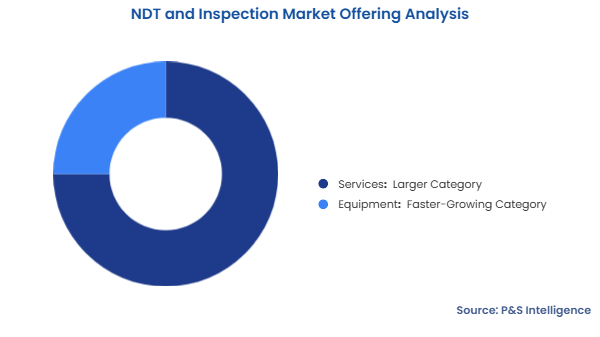
The services category holds the larger market share of 75%, in 2025, driven by strong demand for outsourced specialized inspection services.
The eddy current testing category will have the highest CAGR, of approximately 10.2%, driven by its high sensitivity in detecting surface and near-surface defects in conductive materials.
The oil & gas category holds the largest market share of 35%, in 2025, driven by the need for continuous integrity inspection of pipelines, refineries, and offshore assets.
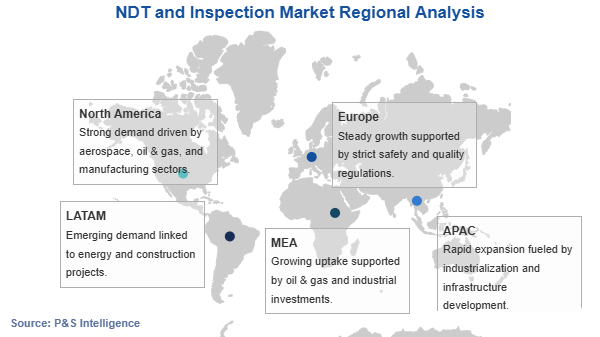
North America holds the largest market share of 40% in 2025, driven by extensive energy infrastructure and stringent asset integrity regulations.
Asia-Pacific will have the highest CAGR of approximately 10.5%, driven by rapid industrialization, expanding manufacturing, and growing energy infrastructure investments.
NDT and Inspection Market Trends and Drivers
AI-Enabled Defect Classification and Robotic Platforms Are Key Trends
Inspection delivery is shifting from manual, schedule-based fieldwork toward automated, data-centric workflows. NDT service providers are integrating artificial intelligence (AI)-based defect classification, drone-enabled visual inspection, and robotic inspection platforms into ultrasonic, radiographic, and visual testing programs. This integration is enabling larger asset coverage with fewer on-site labor hours, and it is generating comprehensive digital inspection records. This transformation is particularly evident in confined and hazardous environments, including offshore platforms, nuclear facilities, storage tanks, and pipelines, where robotic systems reduce personnel exposure while improving the consistency and repeatability of ultrasonic and eddy current inspections.
As cloud-based asset integrity managementv platforms become more widely adopted, inspection data is increasingly integrated with predictive maintenance and digital asset management systems. This integration is enabling operators to move from periodic inspections to condition-based maintenance strategies. In July 2025, Waygate Technologies introduced the Krautkramer WheelStar RPS, a fully automated robotic ultrasonic testing system utilizing phased-array matrix technology for railway wheel inspection. The system automates the inspection process, generates standardized digital inspection reports, and reduces inspection cycle time to approximately six minutes per wheelset. This performance demonstrates the industry's shift toward intelligent, AI-enabled, and robotic NDT solutions. This evolution is strengthening long-term service relationships between asset owners and inspection providers through continuous monitoring, analytics, and lifecycle asset management. This trend is expected to continue as industries accelerate digital transformation and expand the use of electronic inspection documentation.
Asset Integrity Mandates and Aging Pressure Equipment Are Biggest Drivers
Decades-old refineries, pipelines, and pressure vessels across mature industrial economies require recurring structural verification to remain within design safety margins. This structural verification requirement is driving demand for ultrasonic, radiographic, and magnetic particle testing. Codes such as the ASME Boiler and Pressure Vessel Code (BPVC) mandate periodic nondestructive examination for covered equipment, and compliance with these design and inspection requirements has become a baseline cost of operation rather than a discretionary expense. According to the ASME Boiler and Pressure Vessel (BPV) Certification Program, more than 7,000 organizations across 95 countries hold BPV certification.
This widespread adoption reflects standardized pressure equipment manufacturing, inspection, and quality assurance requirements that sustain baseline demand for non-destructive testing services. As aging fleets of pressure equipment continue operating beyond their original design life in North America and Europe, operators are shifting from calendar-based inspection intervals toward risk-based inspection programs that combine more frequent NDT assessments with predictive analytics. This trend is expected to reinforce steady demand for NDT inspection services through 2032.
Certified Technician Shortage Is Key Restraint
A persistent shortage of technicians holding ASNT- or ISO 9712-certified qualifications is constraining the growth of the NDT and Inspection market by limiting service capacity and slowing the execution of inspection projects. Level II and Level III certification requires extensive training, qualification examinations, and documented supervised work experience that cannot be rapidly expanded to meet short-term demand. The American Society for Nondestructive Testing (ASNT) certification framework requires candidates seeking Level II and Level III certification to demonstrate both practical experience and technical competency before independent inspection responsibilities can be undertaken.
The lengthy certification pathway, combined with increasing demand from the oil & gas, aerospace & defense, power generation, manufacturing, and renewable energy sectors, continues to limit the availability of qualified inspection personnel. NDT service providers are increasingly investing in automation, artificial intelligence, remote visual inspection, and robotic inspection platforms to improve productivity and reduce dependence on on-site certified technicians. Nevertheless, the shortage of experienced personnel is expected to remain a key constraint on inspection capacity expansion as demand for asset integrity management and regulatory compliance continues to grow.
Renewable Energy Expansion Is Creating New Inspection Opportunities
The rapid global buildout of renewable energy capacity is creating a fast-growing inspection niche beyond traditional oil & gas and manufacturing end uses. Wind turbine blades, towers, and solar photovoltaic (PV) installations require specialized ultrasonic, thermographic, and visual inspection techniques to detect delamination, corrosion, fatigue damage, and micro-cracking that conventional maintenance practices may not readily identify. According to the International Renewable Energy Agency (IRENA), global wind power capacity grew by 14% in 2025, with record additions of 158.7 GW, while total renewable power capacity additions reached 692 GW. The expanding installed base of utility-scale wind assets is increasing demand for recurring blade, tower, and structural integrity inspections throughout their multi-decade operating lifecycles.
In response, NDT providers are developing drone-based thermographic imaging, robotic inspection platforms, and advanced ultrasonic testing solutions purpose-built for wind turbine blade inspection. This is positioning specialized inspection service providers and equipment manufacturers to benefit from continued renewable energy deployment through 2032.
NDT and Inspection Market Segmentation Analysis
Offering Analysis
The services category holds the larger market share of 75%, in 2025, driven by the need for certified inspection expertise and compliance with stringent industry regulations. The extensive training, qualification examinations, and documented supervised work experience required for ASNT and ISO 9712 certification make it more cost-effective for industries such as oil & gas, aerospace & defense, manufacturing, and power generation to engage certified third-party inspection providers. The American Society for Nondestructive Testing (ASNT) administers personnel qualification and certification programs that require candidates to demonstrate technical competency before achieving Level II or Level III certification, reinforcing the continued reliance on specialized NDT service providers.
The equipment category will have the higher CAGR of approximately 9.8%, driven by increasing adoption of portable digital NDT instruments, phased-array ultrasonic testing (PAUT) systems, digital radiography, eddy current testing equipment, AI-enabled inspection software, and robotic inspection technologies that improve inspection accuracy, productivity, and asset integrity management across industrial sectors.
The offerings analysed in this report are:
Services (Larger Category)
Equipment (Faster-Growing Category)
Method Analysis
The Ultrasonic testing category holds the largest market share of 35%, in 2025, driven by the technique's ability to detect internal defects and measure material thickness across welds, pipelines, pressure vessels, forgings, and composite structures without exposing personnel to ionizing radiation or requiring component disassembly. The American Petroleum Institute's API 570 Piping Inspection Code requires periodic thickness assessment of in-service piping systems to evaluate corrosion rates and remaining service life. This code has made ultrasonic thickness testing the most widely adopted inspection technique across the petroleum, petrochemical, and chemical processing industries.
The eddy current testing category will have the highest CAGR, driven by its high sensitivity in detecting surface and near-surface defects in conductive materials used in aerospace, nuclear power, rail, and electric vehicle manufacturing. The U.S. Nuclear Regulatory Commission (NRC) requires periodic inspection of steam generator tubing in pressurized water reactors to ensure structural integrity. This requirement has established eddy current testing as the industry-standard method for these inspections, sustaining demand for advanced eddy current inspection systems across nuclear power infrastructure.
The methods analysed in this report are:
Visual Testing
General visual inspection
Aided visual inspection
Magnetic Particle Testing
Liquid Penetrant Testing
Eddy Current Testing (Fastest-Growing Category)
Ultrasonic Testing (Largest Category)
Straight-beam testing
Angle-beam testing
Immersion ultrasound testing
Others
Radiographic Testing
Industry Analysis
The oil & gas category holds the largest market share in 2025, driven by the sector's extensive network of pipelines, refineries, offshore platforms, storage terminals, and processing facilities that require continuous integrity assessment to ensure safe and reliable operations. According to the International Energy Agency (IEA), approximately USD 1.1 trillion of global energy investment in 2025 is directed toward fossil fuel supply, including oil, natural gas, and coal. This investment level sustains demand for inspection and asset integrity management across upstream, midstream, and downstream infrastructure.
The aerospace & defense category will have the highest CAGR of approximately 10.0%, driven by expanding aircraft production, increasing maintenance, repair, and overhaul (MRO) activity, and stringent structural inspection requirements for aging fleets. The Federal Aviation Administration (FAA), through Advisory Circular 120-84, provides guidance for aging aircraft inspection and maintenance programs. This guidance reinforces the need for recurring non-destructive testing to evaluate structural integrity and support continued airworthiness of commercial aircraft.
The industries analysed in this report are:
Oil & Gas (Largest Category)
Manufacturing
Aerospace & Defense (Fastest-Growing Category)
Construction
Automotive
Others
Drive strategic growth with comprehensive market analysis
NDT and Inspection Market Regional Outlook
North America NDT and Inspection Market Size
North America holds the largest market share of 40% in 2025, driven by one of the world's largest energy pipeline networks and stringent regulatory requirements for asset integrity. A well-established ecosystem of ISO- and ASNT-certified inspection service providers, combined with the high capital investment required for advanced NDT equipment, software, and personnel certification, continues to encourage asset owners to outsource inspection activities to specialized service providers.
According to the U.S. Department of Transportation's Pipeline and Hazardous Materials Safety Administration (PHMSA), the U.S. energy pipeline network spans more than 2.6 million miles. This network requires continuous integrity assessments using techniques such as ultrasonic and radiographic testing to comply with federal pipeline safety regulations. Enforcement records reviewed by the Congressional Research Service indicate that PHMSA initiated 1,081 enforcement actions against pipeline operators between 2020 and 2024. These enforcement actions are reinforcing ongoing compliance-driven investment in NDT and inspection services.
U.S. NDT and Inspection Market Size
The U.S. is the largest country market within North America, driven by an extensive refining, petrochemical, and pipeline network, one of the world's largest commercial and defense aerospace manufacturing and maintenance industries, and continued regulatory oversight following pipeline safety incidents, which is reinforcing investment in asset integrity management and non-destructive testing across the country. Federal Aviation Administration (FAA) airworthiness directives require recurring non-destructive inspections of aging aircraft fleets using techniques such as ultrasonic, eddy current, and radiographic testing. Expanding electric vehicle battery manufacturing is generating additional demand for weld, cell, and component inspection.
A Congressional Research Service review of Pipeline and Hazardous Materials Safety Administration (PHMSA) data indicates that 25 serious pipeline incidents were reported in 2024. This finding is maintaining regulatory emphasis on integrity management programs and driving continued demand for inspection and assessment of high-consequence pipeline segments.
Asia-Pacific NDT and Inspection Market Size
Asia-Pacific will have the highest CAGR of approximately 10.5%, driven by rapid industrialization, expanding manufacturing capacity, and continued investment in energy infrastructure. The construction of new pipeline networks, refineries, petrochemical complexes, and power facilities across China, India, Indonesia, and Australia is generating sustained demand for ultrasonic and radiographic inspection services. Government-backed manufacturing initiatives and the expansion of aerospace maintenance, repair, and overhaul (MRO) capabilities are accelerating the adoption of phased-array ultrasonic testing (PAUT) and eddy current testing across the automotive, electronics, and aerospace industries.
According to the China Association of Automobile Manufacturers (CAAM), China's automobile production reached 34.531 million units in 2025, an increase of 10.4% year over year, while vehicle sales grew 9.4% to 34.4 million units, both reaching record highs. The sustained expansion of automotive and new energy vehicle manufacturing is increasing demand for non-destructive testing technologies, including ultrasonic, eddy current, and radiographic testing. These technologies support weld inspection, battery manufacturing, component validation, and production quality assurance across the region's largest manufacturing base.
India NDT and Inspection Market Size
India is the fastest-growing country market for NDT and Inspection in Asia-Pacific through 2032, driven by the rapid expansion of aerospace maintenance, defense manufacturing, energy infrastructure, and industrial production. Government initiatives such as Make in India and Atmanirbhar Bharat are accelerating domestic manufacturing of aircraft, defense equipment, and high-value industrial components, increasing the need for advanced non-destructive testing technologies to ensure product quality, structural integrity, and regulatory compliance. Continued investments in refinery modernization, pipeline infrastructure, and power generation are sustaining demand for ultrasonic, radiographic, eddy current, and magnetic particle testing.
According to the Ministry of Civil Aviation, the number of Maintenance, Repair, and Overhaul (MRO) facilities in India increased from 96 in 2014 to 166 in 2025. Policy reforms aimed at establishing India as a global aviation MRO hub have supported this expansion. The country's expanding aircraft fleet and growing domestic MRO capabilities are driving higher demand for non-destructive inspection during aircraft manufacturing and maintenance activities. The Government of India reported that defence production reached INR 1.78 lakh crore in FY 2025–26, representing 15.6% growth over the previous fiscal year. This growth is strengthening demand for ultrasonic, eddy current, radiographic, and other advanced inspection technologies used in the manufacture and maintenance of aerospace and defense systems.
The regions and countries analysed in this report are:
North America (Largest Regional Market)
U.S. (Larger and Faster-Growing Country)
Canada
Europe
Germany (Largest and Fastest-Growing Country)
U.K.
France
Italy
Spain
Rest of Europe
Asia-Pacific (Fastest-Growing Regional Market)
China (Largest Country)
India (Fastest-Growing Country)
Japan
South Korea
Australia
Rest of APAC
Latin America
Brazil (Largest and Fastest-Growing Country)
Mexico
Rest of LATAM
Middle East and Africa
Saudi Arabia (Largest and Fastest-Growing Country)
South Africa
U.A.E.
Rest of MEA
NDT and Inspection Market Share Analysis
The market is fragmented due to the presence of numerous global, regional, and local inspection service providers serving diverse end-use industries, including oil & gas, manufacturing, aerospace & defense, construction, automotive, and power generation. Market competition is driven by technical expertise, industry certifications, service quality, geographic coverage, and turnaround time rather than by a few dominant players. While leading companies offer advanced inspection equipment and digital NDT solutions, a significant share of inspection services is delivered by specialized regional firms that maintain long-term customer relationships and meet local regulatory and certification requirements. The growing adoption of AI-enabled inspection, robotics, drones, and predictive maintenance platforms is intensifying competition, encouraging companies to expand service portfolios, strengthen technological capabilities, and pursue strategic partnerships and acquisitions.
Top Companies in the NDT and Inspection Market:
SGS SA
Bureau Veritas SA
Intertek Group plc
Applus+ Services, S.A.
MISTRAS Group, Inc.
Acuren Corporation
DEKRA SE
Evident Corporation
TUV SUD AG
Element Materials Technology Group
Waygate Technologies
ESAB Corporation
NDT and Inspection Market News
In June 2026, ESAB Corporation completed its acquisition of Eddyfi Technologies Inc. for approximatelyUSD 1.45 billion, strengthening its portfolio with advanced non-destructive testing (NDT), inspection, sensing, and monitoring technologies.
In October 2025,MISTRAS Group, Inc. partnered with Villari to integrate wireless structural health monitoringv and crack-detection sensor technology into its inspection services, expanding its capabilities in continuous asset integrity monitoring for critical steel infrastructure.
In August 2025, Acuren Corporation completed its USD 1.7 billion merger with NV5 Global, Inc., creating a diversified testing, inspection, certification (TIC), and engineering services company with more than USD 2 billion in annual revenue.
Frequently Asked Questions About This Report
What are the major factors driving the growth of the NDT and Inspection market?+
Growth is driven by stricter industrial safety regulations, aging infrastructure requiring periodic inspections, expansion of oil & gas, aerospace, power generation, manufacturing, and renewable energy assets, and increasing adoption of predictive maintenance and digital inspection technologies.
What are the most widely used non-destructive testing methods?+
The major testing methods include ultrasonic testing (UT), radiographic testing (RT), visual testing (VT), magnetic particle testing (MPT), liquid penetrant testing (LPT), and eddy current testing (ECT).
How is artificial intelligence transforming the NDT and Inspection market?+
AI improves automated defect detection, image interpretation, predictive maintenance, inspection reporting, and data analytics. When combined with robotics, drones, and digital twins, AI enhances inspection accuracy, reduces inspection time, and lowers operating costs.
What challenges are limiting the adoption of NDT and Inspection solutions?+
The challenges include shortages of certified inspectors, high equipment costs, complex certification requirements, and integration with legacy systems.
Which regulations and standards are most important in the NDT and Inspection market?+
The key standards include ASME BPVC, ISO 9712, ASNT certification programs, ASTM standards, and API inspection codes.
Want a report tailored exactly to your business need?
Leading companies across industries trust us to deliver data-driven insights and innovative solutions for their most critical decisions. From data-driven strategies to actionable insights, we empower the decision-makers who shape industries and define the future. From Fortune 500 companies to innovative startups, we are proud to partner with organisations that drive progress in their industries.
Client Testimonials
Working with P&S Intelligence and their team was an absolute pleasure – their awareness of timelines and commitment to value greatly contributed to our project's success. Eagerly anticipating future collaborations.
McKinsey & Company
India
Unmatched Standards
Our insights into the minutest levels of the markets, including the latest trends and competitive landscape, give you all the answers you need to take your business to new heights
Complete Data Security
We take a cautious approach to protecting your personal and confidential information. Trust is the strongest bond that connects us and our clients, and trust we build by complying with all international and domestic data protection and privacy laws