Key Highlights
| Study Period | 2019 - 2032 |
| Market Size in 2024 | USD 56.6 Billion |
| Market Size in 2025 | USD 59.3 Billion |
| Market Size by 2032 | USD 87.8 Billion |
| Projected CAGR | 5.8% |
| Largest Region | APAC |
| Fastest Growing Region | Europe |
| Market Structure | Fragmented |

| Study Period | 2019 - 2032 |
| Market Size in 2024 | USD 56.6 Billion |
| Market Size in 2025 | USD 59.3 Billion |
| Market Size by 2032 | USD 87.8 Billion |
| Projected CAGR | 5.8% |
| Largest Region | APAC |
| Fastest Growing Region | Europe |
| Market Structure | Fragmented |
Explore the market potential with our data-driven report
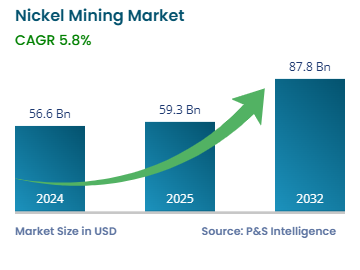
The nickel mining market size was USD 56.6 billion in 2024, which is predicted to reach USD 87.8 billion by 2032, growing at a CAGR of 5.8% during 2025–2032.
The market's robust growth trajectory is primarily driven by the accelerating global transition to electric vehicles, which has fundamentally transformed nickel from a traditional stainless-steel input to a critical battery mineral essential for the clean energy revolution.
The exponential growth in electric vehicle production has created unprecedented demand for high-grade nickel, particularly Class 1 nickel with purity levels above 99.8%, which is essential for manufacturing nickel-rich cathode materials in lithium-ion batteries. The shift towards higher nickel content in battery chemistries, such as NCM 811 (80% nickel, 10% cobalt, 10% manganese), has intensified the competition for nickel resources globally. This technological evolution in battery chemistry is fundamentally reshaping the nickel mining industry's operational priorities and investment strategies.
The strategic importance of nickel has been amplified by geopolitical considerations, as nations recognize nickel as a critical mineral for energy security and technological sovereignty.
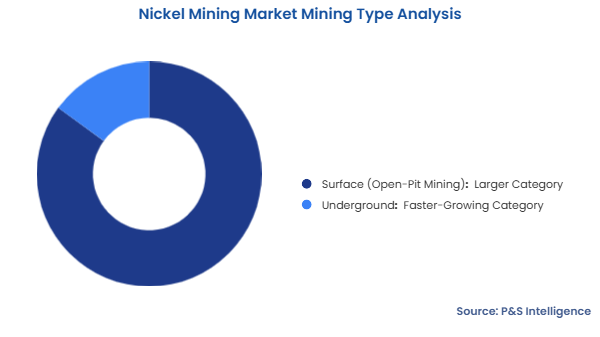
The surface category held the larger share in the global nickel mining market in 2024, of approximately 85%, and it is expected to maintain its dominance throughout the forecast period. This is primarily due to the geological characteristics of laterite nickel deposits, which typically occur as extensive near-surface ore bodies in tropical regions, making open-pit extraction the most economically viable method. The accessibility of laterite ores, combined with lower initial capital requirements compared to underground operations and the ability to achieve higher production volumes, has driven the preference for surface mining operations, particularly in Indonesia and the Philippines, where laterite deposits dominate the resource base.
Underground mining will witness the higher CAGR, during the forecast period, driven by the depletion of easily accessible surface deposits, technological advancements in underground extraction methods, and the higher-grade characteristics of sulfide ores typically found at depth. The development of automated mining systems, improved ventilation technologies, and enhanced safety protocols has reduced operational costs and improved the economic viability of underground nickel mining projects. Additionally, the premium pricing for high-grade nickel sulfide concentrates, which are more efficiently processed into Class 1 nickel for battery applications, provides strong economic incentives for underground mining development.
These mining types are covered:
The laterite category dominated the nickel mining market in 2024 with a share of approximately 70%, reflecting the abundance of laterite deposits in major producing regions and the massive expansion of laterite processing capacity in Southeast Asia. The concentration of global nickel resources in laterite formations, which account for over 70% of known nickel reserves, combined with technological improvements in laterite processing through HPAL and pyrometallurgical methods, has enabled the economic extraction of nickel from these lower-grade but more abundant ore types. The rapid development of integrated laterite-to-battery material supply chains in Indonesia has further strengthened this category's market position.
The sulfide bifurcation is projected to experience the faster growth, during 2025–2032, driven by their superior processing characteristics for battery-grade nickel production and the lower carbon intensity of sulfide processing compared to laterite routes. The direct production of high-purity nickel from sulfide ores through conventional flotation and smelting processes, without the need for complex intermediate steps required for laterites, provides significant operational advantages. Furthermore, the byproduct credits from copper, cobalt, and platinum group metals commonly associated with sulfide deposits enhance project economics and attract investment in sulfide exploration and development.
These ore types are covered:
The stainless-steel production category maintained its dominance in 2024 with approximately 40% market share, driven by the continued industrial expansion, infrastructure development, and the widespread adoption of stainless steel in construction, automotive, and consumer goods applications. According to the World Stainless Association, global stainless-steel production increased by 4.6% in 2023, reaching 58.4 million metric tonnes. Moreover, as per the Nickel Institute, nickel-containing stainless-steel grades accounted for approximately 80% of the total production. The superior corrosion resistance, formability, and high-temperature performance characteristics imparted by nickel make it indispensable for austenitic stainless-steel grades, particularly Type 304 and Type 316, which remain the industry workhorses.
Battery manufacturing represents the fastest-growing application, during 2025–2032, driven by the exponential growth in electric vehicle production and stationary energy storage deployment. The transition toward high-nickel battery chemistries, including NCM 811 and NCA formulations, has intensified nickel demand from the battery sector, which now accounts for approximately 17% of total nickel consumption and is projected to exceed 30% by 2032. The superior energy density and cost-performance characteristics of nickel-rich batteries, combined with ongoing improvements in battery technology and manufacturing scale, position this category for sustained hypergrowth throughout the forecast period.
These applications are covered:
The construction industry held the largest share of the nickel mining market demand in 2024, of 35%, primarily through its consumption of stainless steel for structural applications, architectural facades, and infrastructure components. The durability, aesthetic appeal, and low maintenance requirements of nickel-containing stainless steel have made it the material of choice for modern construction projects, particularly in corrosive environments and high-profile architectural applications. The ongoing global urbanization trend, infrastructure modernization programs, and the increasing emphasis on sustainable, long-lasting building materials continue to drive nickel demand from the construction sector.
The automotive industry is experiencing the highest growth rate, during the forecast period, propelled by the dual drivers of electric vehicle adoption and continued use of nickel in conventional vehicle manufacturing. Beyond battery applications, nickel remains critical for automotive exhaust systems, engine components, and decorative trim, where its corrosion resistance and aesthetic properties are valued. The transformation of the automotive industry toward electrification, combined with the increasing nickel intensity per vehicle as battery sizes grow, positions this sector as the primary growth driver for nickel demand through 2032.
These end-use industries are covered:
Drive strategic growth with comprehensive market analysis
Asia-Pacific held the largest share in the nickel mining market in 2024, of 40%, and it is expected to maintain its dominance throughout the forecast period, primarily due to its rich resource base, strong industrial demand, and government-driven investments. This is primarily attributed to Indonesia's emergence as the global nickel mining powerhouse, producing an estimated 1.8 million metric tons in 2023, representing nearly 50% of global production.
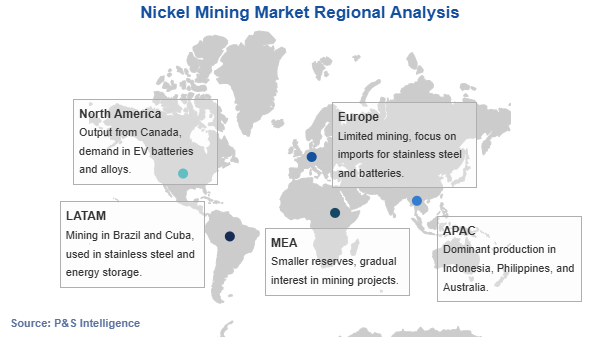
The region's dominance has been further reinforced by the Philippines' contribution of 400,000 metric tons annually, making it the world's second-largest producer, and the rapid development of integrated nickel processing facilities across Southeast Asia. The concentration of both laterite nickel resources and downstream processing capacity in the region, combined with proximity to major consumption markets in China and growing battery manufacturing hubs, solidifies Asia-Pacific's position as the epicenter of global nickel mining activity.
China’s nickel mining sector plays a vital role in supporting the country’s stainless steel and electric vehicle industries. Though it relies heavily on imported ore, China has developed extensive refining and smelting capabilities, making it a dominant force in processed nickel supply. The sector is backed by strategic investments and state-supported initiatives aimed at securing upstream resources abroad. Environmental concerns and resource depletion within China have also accelerated the shift toward overseas partnerships and integrated supply chain control
Indonesia has transformed its nickel industry through strategic policy interventions, particularly the ore export ban implemented in 2020, which has attracted massive foreign investment in domestic processing facilities. The country's nickel production capacity has expanded dramatically, with multiple HPAL plants and pyrometallurgical facilities coming online to process the abundant laterite resources. The development of integrated industrial parks, such as the Indonesia Morowali Industrial Park (IMIP), has created vertically integrated nickel-to-stainless steel and nickel-to-battery material supply chains, positioning Indonesia not just as a raw material supplier but as a critical processing hub for the global nickel industry.
Europe is experiencing the fastest regional growth, with a projected CAGR of approx. 6.0% during 2025–2032, driven by the European Union's critical minerals strategy and efforts to reduce dependence on imports for battery materials. The region's nickel mining activities are concentrated in Finland, Russia, and Norway, with significant investments in sustainable mining practices and processing technologies. The EU's Green Deal and battery regulations have created strong policy support for domestic nickel production and processing, attracting investment in both traditional mining operations and innovative recycling initiatives. The development of battery gigafactories across Europe and the automotive industry's rapid electrification are creating substantial regional demand for nickel, incentivizing exploration and development of European nickel resources.
The regions and countries analyzed in this report are:
The global nickel mining market exhibits a fragmented structure due to the presence of numerous regional and international players operating across different geographical markets and ore types. While several major mining conglomerates control significant production volumes, no single group of companies dominates the market sufficiently to create a highly consolidated environment. This fragmentation is further accentuated by the geographical dispersion of nickel resources and the varying scales of operations, from large-scale integrated complexes to smaller specialty producers.
The competitive landscape has been significantly influenced by Indonesia's emergence as the dominant producing nation, with numerous Indonesian companies, often in partnership with Chinese firms, rapidly expanding production capacity through new smelter developments. The market has witnessed increasing vertical integration, with mining companies expanding into downstream processing and battery material production to capture greater value from the battery supply chain.
Want a report tailored exactly to your business need?
Request CustomizationLeading companies across industries trust us to deliver data-driven insights and innovative solutions for their most critical decisions. From data-driven strategies to actionable insights, we empower the decision-makers who shape industries and define the future. From Fortune 500 companies to innovative startups, we are proud to partner with organisations that drive progress in their industries.

Working with P&S Intelligence and their team was an absolute pleasure – their awareness of timelines and commitment to value greatly contributed to our project's success. Eagerly anticipating future collaborations.
McKinsey & Company
India
Our insights into the minutest levels of the markets, including the latest trends and competitive landscape, give you all the answers you need to take your business to new heights

We take a cautious approach to protecting your personal and confidential information. Trust is the strongest bond that connects us and our clients, and trust we build by complying with all international and domestic data protection and privacy laws


Customize the Report to Align with Your Business Objectives

Request the Free Sample Pages