Network Detection and Response Market Size & Share Analysis - Trends, Drivers, Competitive Landscape, and Forecasts (2026 - 2032)
This Report Provides In-Depth Analysis of the Network Detection and Response Market Report Prepared by P&S Intelligence, Segmented by Component (Solutions, Services), Deployment Mode (On-Premises / Data Center Networks, Cloud Networks, Hybrid Network Environments, Edge / Distributed Networks, Industrial / Operational Technology Networks), Organization Size (Large Enterprises, Small & Medium Enterprises), Application (Network threat detection and monitoring, Cloud and hybrid network security monitoring, Incident investigation and response management, Regulatory compliance and risk monitoring, Protection of critical and operational infrastructure), End-User (Banking, Financial Services, and Insurance, Healthcare and Life Sciences, IT and Telecommunications, Government and Defense, Energy and Utilities, Manufacturing, Retail and E-commerce), and Geographical Outlook for the Period of 2021 to 2032
Network Detection and Response Market Size Estimation
Key Highlights
Study Period
2021 - 2032
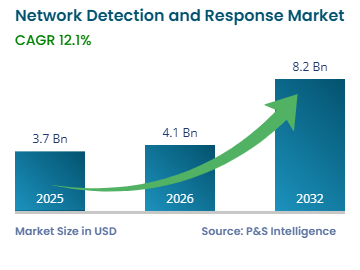
Market Size in 2025
USD 3.7 Billion
Market Size in 2026
USD 4.1 Billion
Market Size by 2032
USD 8.2 Billion
Projected CAGR
12.1%
Largest Region
North America
Fastest-Growing Region
Asia-Pacific
Market Structure
Moderately Fragmented
Market Size
Explore the market potential with our data-driven report
Network Detection and Response Market Future Outlook
The network detection and response market size was USD 3.7 billion for 2025, and it will grow by 12.1% during 2026-2032, to reach USD 8.2 billion by 2032.
The market is expanding because organizations across industries are becoming increasingly dependent on digital networks to support business operations, customer engagement, cloud applications, and connected technologies. As enterprise environments grow more distributed, security teams face greater challenges in monitoring network activity and identifying threats that move across users, devices, applications, and data environments. Traditional security tools often provide limited visibility into complex network behavior, particularly in hybrid infrastructure where workloads operate across on-premises and cloud environments. Organizations are therefore placing greater emphasis on solutions that can continuously analyze network traffic, detect suspicious activity, and improve threat response capabilities without disrupting business operations.
Additionally, the rapid expansion of digital infrastructure, cloud connectivity, and high-speed communications networks is increasing the volume and complexity of network traffic that organizations must secure. According to the International Telecommunication Union, global 5G network coverage reached about 51% of the world’s population in 2024. Wider network availability is supporting greater adoption of connected devices, cloud-based services, and real-time digital applications across enterprise environments. This shift is increasing the need for advanced monitoring technologies capable of providing deeper network visibility and faster identification of abnormal behavior. Enterprises are responding by investing in network detection and response platforms that strengthen security operations, improve incident investigation capabilities, and help security teams manage evolving threats across increasingly interconnected digital ecosystems.
Key Market Insights
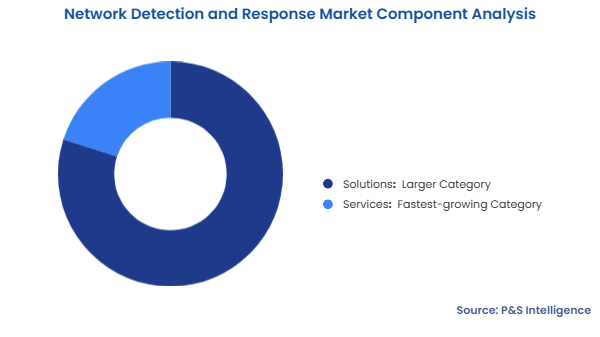
Solutions is the largest component, holding a market share of 80%, due to enterprise demand for integrated platforms delivering network visibility, detection, and response.
Cloud networks are the fastest-growing network type, registering a CAGR of approximately 12.5%, driven by rapid migration of enterprise workloads toward multi-cloud infrastructure.
Large enterprises are the largest organisation size segment, holding a market share of 75%, due to complex digital infrastructure and higher cybersecurity investment capacity.
North America holds the largest share of 40%, due to strong enterprise cybersecurity investment and widespread adoption of advanced network monitoring platforms.
Asia-Pacific is the fastest-growing region, registering a CAGR of approximately 13.0%, driven by rapid digital expansion and increasing enterprise network traffic across emerging economies.
Network Detection and Response Market Trends and Drivers
Shift Toward AI-Driven and Cloud-Native NDR Platforms Is Major Trend
The network detection and response market is increasingly shifting toward AI-powered and cloud-native security platforms. Organizations are deploying advanced analytics technologies that can process large volumes of network telemetry, identify abnormal behavior, and improve threat visibility across complex digital environments with reduced manual effort. Vendors are also expanding support for hybrid and multi-cloud infrastructure while integrating network detection capabilities with broader security operations platforms. According to Cisco's Cybersecurity Readiness Index 2024, 55% of organizations planned to invest in AI-driven technologies in 2024. Moreover, Palo Alto Networks reported that the fastest cyber intrusions reached data exfiltration within 72 minutes in 2025, highlighting increasingly compressed attack timelines. These conditions are encouraging organizations to adopt automated network detection and response platforms that accelerate threat identification, investigation, and response across distributed environments.
Rising Complexity and Frequency of Network-Based Cyberattacks Drive Market
The network detection and response market is growing as cyberattacks targeting enterprise networks become more frequent, sophisticated, and difficult to identify through traditional security controls. Organizations are managing encrypted traffic, remote access connections, cloud workloads, and interconnected digital environments that generate large volumes of network activity and create visibility challenges across infrastructure. According to Microsoft, organizations worldwide faced more than 600 million cybercriminal and nation-state attacks every day in 2024, illustrating the intensity of modern threat activity. Furthermore, Check Point Software Technologies reported that organizations experienced an average of 1,925 weekly cyberattacks during 2025, representing a 47% annual increase. The growing attack burden is encouraging enterprises to strengthen network visibility, improve threat hunting capabilities, accelerate incident investigation processes, and deploy advanced network detection and response platforms that support continuous monitoring across complex digital environments.
High Implementation Complexity and Shortage of Skilled Security Professionals
The network detection and response market faces operational challenges linked to deployment complexity and specialized expertise requirements. Organizations must integrate these platforms with existing network infrastructure, security tools, and monitoring frameworks while continuously tuning detection policies and investigating alerts across diverse environments. Many enterprises struggle to recruit and retain personnel with the skills required to manage advanced threat detection technologies and security operations workflows. According to ISC2, an estimated 4.8 million additional cybersecurity professionals were needed globally in 2024 to effectively secure organizations. Limited access to experienced cybersecurity talent can delay platform deployment, reduce monitoring effectiveness, and constrain the adoption of advanced network detection and response solutions, particularly among mid-sized organizations with restricted security resources and smaller operational teams.
Expansion of NDR Adoption Across Cloud, IoT, and Underserved Mid-Market Segments
The network detection and response market is creating new opportunities as organizations expand connected infrastructures and digital operations across enterprise, industrial, and cloud environments. Growing dependence on connected devices, operational technology systems, and distributed business networks is increasing the need for continuous network visibility and advanced monitoring capabilities. According to GSMA, enterprise IoT connections worldwide reached 10.7 billion in 2024, exceeding consumer connections and highlighting the scale of connected infrastructure growth. The expansion of connected assets is increasing network traffic, communication pathways, and potential attack surfaces across organizations. This environment is encouraging investment in network detection and response platforms that can identify anomalous behavior, monitor east-west traffic movement, support faster threat investigations, and strengthen security oversight across increasingly complex digital ecosystems and connected enterprise infrastructures.
Network Detection and Response Market Segmentation Analysis
Component Analysis
Solutions is the largest category, holding a market share of 80%, because organizations prefer integrated platforms that combine network visibility, threat detection, investigation, and response capabilities within a centralized security framework. Large enterprise networks generate substantial volumes of traffic across cloud environments, data centers, remote users, and connected business systems, creating a need for continuous monitoring and threat analysis. According to Cloudflare Radar's Year in Review 2024, global internet traffic increased by 17.2% in 2024. Higher traffic volumes increase the complexity of identifying malicious activity within normal network operations, encouraging organizations to deploy comprehensive network detection and response solutions that improve visibility, accelerate threat investigation, and strengthen security operations across distributed enterprise environments.
Services are the fastest-growing category, as many companies lack the skilled teams needed to manage advanced security tools. Businesses are turning to managed and professional services to handle monitoring, threat analysis, and response activities. This reduces operational burden and ensures better use of NDR platforms. Growing reliance on outsourced security operations is further accelerating demand.
The components analysed in this report are:
Solutions (Largest Category)
Network traffic analysis and visibility platforms
Behavioural analytics and anomaly detection systems
AI-driven threat detection engines
Integrated response orchestration platforms
Threat intelligence and forensic analysis tools
Services (Fastest-growing Category)
Managed detection and response (MDR) services
Security monitoring and threat hunting services
Incident response and remediation services
Consulting, integration, and deployment services
Training and support services
Deployment Mode Analysis
On-Premises / Data Centre Networks is the largest category, holding a market share of 40%, because many enterprises still operate critical workloads within internal infrastructure. These environments require strong internal network monitoring to detect threats that bypass perimeter defences. Organisations prefer keeping sensitive data within controlled systems, which supports continued use of on-premises deployments.
Cloud Networks is the fastest-growing category, registering a CAGR of approximately 12.5%, as enterprises increasingly migrate applications, workloads, and business operations to cloud-based environments. The growing use of public cloud, private cloud, and hybrid infrastructure is making network traffic more distributed, creating visibility challenges that traditional security tools often struggle to address. According to Eurostat, 65.5% of European Union enterprises using paid cloud computing services purchased security software applications as a cloud service in 2025. The widespread adoption of cloud-based security tools reflects the increasing importance of protecting cloud environments. Moreover, organizations are deploying specialized network detection and response platforms to monitor east-west traffic, identify suspicious activity, and improve threat visibility across complex cloud networks.
The deployment modes analysed in this report are:
On-Premises / Data Centre Networks (Largest Category)
Cloud Networks (Fastest-growing Category)
Hybrid Network Environments
Edge / Distributed Networks
Industrial / Operational Technology (OT) Networks
Organisation Size Analysis
Large Enterprises is the largest category, because these organizations operate complex network environments spanning multiple locations, cloud platforms, data centers, and business applications that require continuous visibility and threat detection. They also maintain dedicated security operations teams, larger cybersecurity budgets, and structured risk management programs that support investment in advanced monitoring technologies. According to the World Economic Forum, 88.3% of medium- and high-revenue organizations reported having the skills needed to achieve their cybersecurity objectives in 2024. Stronger cybersecurity capabilities enable large enterprises to deploy network detection and response platforms that support real-time threat identification, network analytics, incident investigation, and coordinated response across extensive enterprise infrastructures.
Small & Medium Enterprises (SMEs) are the fastest-growing category, registering a CAGR of approximately 12.3%, as these businesses are becoming more aware of network security risks. They are gradually adopting NDR solutions, especially through managed service models that reduce cost and complexity. Easier deployment options and growing digital operations are supporting adoption among SMEs.
The organization sizes analysed in this report are:
Large Enterprises (Larger Category)
Small & Medium Enterprises (SMEs) (Faster-growing Category)
Application Analysis
Network threat detection and monitoring is the largest category, because it is the core function of NDR systems. Organisations primarily adopt these tools to continuously monitor network traffic and identify suspicious behaviour. This use case is essential for maintaining visibility and detecting threats early across all network environments.
Cloud and hybrid network security monitoring is the fastest-growing category, registering a CAGR of approximately 12.7%, as enterprises increasingly operate applications, workloads, and data across public cloud, private cloud, and on-premises environments. These distributed architectures create visibility gaps that traditional monitoring tools often struggle to address, increasing the need for continuous network analysis across interconnected systems. According to Eurostat, 52.7% of European Union enterprises used paid cloud computing services in 2025. The expanding use of cloud infrastructure is encouraging organizations to adopt network detection and response platforms that provide centralized visibility, monitor east-west traffic movement, and detect suspicious activity across hybrid environments where threats can move between multiple network layers.
The applications analysed in this report are:
Network threat detection and monitoring (Largest Category)
Cloud and hybrid network security monitoring (Fastest-growing Category)
Incident investigation and response management
Regulatory compliance and risk monitoring
Protection of critical and operational infrastructure
End-User Analysis
Banking, Financial Services, and Insurance (BFSI) is the largest category, holding a market share of 30%, because financial institutions manage highly sensitive transaction data and remain frequent targets of cyberattacks. These organisations require continuous network monitoring to detect fraud attempts, unauthorised access, and data breaches across digital banking platforms. According to the International Monetary Fund, nearly one-fifth of reported cyber incidents over the past two decades have targeted the financial sector. Moreover, strict regulatory frameworks and growing cyber risk are encouraging financial institutions to invest in advanced network detection and response systems.
Healthcare and Life Sciences is the fastest-growing category, as this sector is rapidly digitising patient records and connected medical systems. The increase in sensitive health data and connected devices raises security risks. Organisations are adopting NDR solutions to monitor network activity and protect critical systems from disruptions and unauthorised access.
The end-users analysed in this report are:
Banking, Financial Services, and Insurance (BFSI) (Largest Category)
Healthcare and Life Sciences (Fastest-growing Category)
IT and Telecommunications
Government and Defence
Energy and Utilities
Manufacturing
Retail and E-commerce
Others
Drive strategic growth with comprehensive market analysis
Network Detection and Response Market Geographical Analysis
North America Network Detection and Response Market Analysis
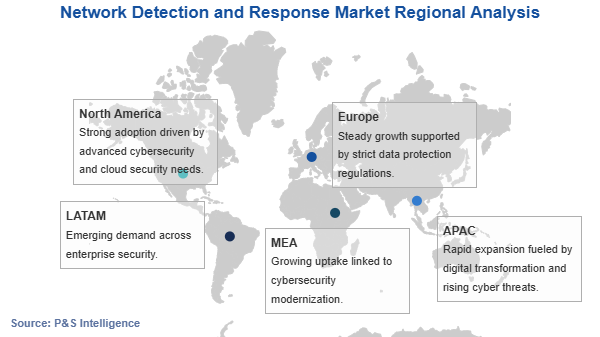
North America holds the largest share, of 40%, because enterprises in this region have highly mature cybersecurity frameworks and strong investment capacity. Organisations here actively deploy advanced threat detection systems as part of broader security operations. There is also early adoption of integrated platforms that combine network visibility with response capabilities. Strict data protection expectations and high exposure to targeted cyberattacks further push demand. In addition, large enterprises prefer continuous monitoring and proactive threat hunting, which supports sustained use of advanced NDR solutions across industries.
U.S. Network Detection and Response Market Analysis
The U.S. network detection and response market is expanding due to strong awareness of advanced cyber threats and increasing enterprise investment in proactive security strategies. Organisations across sectors deploy integrated security platforms that combine network monitoring, threat detection, and automated response capabilities to strengthen digital resilience. According to the Federal Bureau of Investigation, suspected internet crime complaints reached 859,532 in 2024, with reported financial losses exceeding $16 billion. Moreover, the growing financial impact of cybercrime is encouraging enterprises and critical infrastructure operators to strengthen network monitoring and incident response capabilities.
Canada Network Detection and Response Market Analysis
The Canadian network detection and response market is developing steadily as organizations strengthen cyber defense capabilities across critical infrastructure, government systems, financial services, and essential public networks. Security teams are placing greater emphasis on continuous network monitoring because sophisticated threat actors increasingly target operational environments that support national services and economic activity. According to Communications Security Establishment Canada, 1,406 cybersecurity incidents affecting critical infrastructure were responded to during the 2024–2025 reporting period. The growing volume of incidents is encouraging organizations to expand network visibility, improve threat detection capabilities, and adopt network detection and response platforms that help security teams investigate suspicious activity, reduce response times, and strengthen resilience across distributed enterprise environments.
Asia-Pacific Network Detection and Response Market Analysis
Asia-Pacific has the highest CAGR, of approximately 13.0%, because enterprises and public agencies are moving from perimeter-focused security tools toward network-level visibility across cloud, telecom, industrial, and connected-device environments. China’s large enterprise base and expanding digital infrastructure are increasing demand for continuous traffic analysis across data centers, manufacturing networks, and public-sector systems. India is adding a different growth layer through banking digitization, cloud migration, technology services, and cybersecurity capability development. Japan, South Korea, Australia, and Singapore are strengthening adoption through regulated industries, critical infrastructure protection, and stricter security governance. These conditions make NDR more relevant in Asia-Pacific because regional buyers need tools that detect lateral movement, abnormal traffic behavior, encrypted traffic risks, and threats moving across hybrid networks before they disrupt operations.
China Network Detection and Response Market Analysis
The China network detection and response market is expanding due to the country’s large digital ecosystem and rapidly increasing network activity across industries. Organisations are strengthening internal network monitoring to manage high data volumes and protect expanding digital infrastructure. According to the State Council of the People's Republic of China, China recorded 1.125 billion internet users in 2025, with internet penetration reaching 80.1%. Furthermore, the scale of connected users and enterprise data traffic is encouraging organisations to deploy advanced network detection and response platforms to improve visibility and threat monitoring across complex network environments.
India Network Detection and Response Market Analysis
The Indian network detection and response market is growing rapidly as organisations expand digital operations and increase dependence on connected platforms. Enterprises are seeking stronger monitoring capabilities to manage rising network activity across cloud environments, remote work systems, and distributed IT infrastructure. According to the Press Information Bureau, India recorded approximately 970 million internet connections in 2024, while average monthly data consumption per user reached 21.52 gigabytes. Moreover, increasing internet usage and higher network traffic volumes are encouraging organisations to adopt advanced NDR platforms to strengthen cybersecurity monitoring.
Europe Network Detection and Response Market Analysis
Europe shows steady growth as organisations focus on strengthening data protection and network security practices. Enterprises in this region are placing strong emphasis on compliance-driven monitoring and risk management. Many companies are modernising their existing security systems to improve detection capabilities within complex network environments. There is also a growing focus on securing cross-border data flows and enterprise networks. This creates consistent demand for solutions that offer better visibility and control without disrupting existing operations.
The regions and countries analysed in this report are:
North America (Largest Regional Market)
U.S. (Larger Country)
Canada (Faster-Growing Country)
Europe
Germany (Largest Country)
U.K. (Fastest-Growing Country)
France
Italy
Spain
Rest of Europe
Asia-Pacific (Fastest-Growing Regional Market)
China (Largest Country)
India (Fastest-Growing Country)
Japan
South Korea
Australia
Rest of APAC
Latin America
Brazil (Largest Country)
Mexico (Fastest-Growing Country)
Rest of LATAM
Middle East and Africa
Saudi Arabia (Largest Country)
U.A.E. (Fastest-Growing Country)
South Africa
Rest of MEA
Network Detection and Response Market Share Analysis
The market is moderately fragmented, with competition spread across established cybersecurity vendors, network security specialists, and emerging providers focused on advanced threat detection technologies. Vendors differentiate themselves through artificial intelligence capabilities, behavioral analytics, cloud-native architectures, threat intelligence integration, and network visibility features tailored to different enterprise requirements. Customer demand varies significantly across industries, network environments, and security maturity levels, creating opportunities for multiple companies to compete effectively without a single vendor controlling a dominant position. The market also continues to attract innovation from newer participants developing specialized detection and response capabilities for hybrid, cloud, and distributed networks. This competitive environment encourages continuous product enhancement, platform expansion, and technology partnerships as vendors seek to strengthen their market presence and address evolving enterprise security needs.
Leading Companies in the Network Detection and Response Market:
Cisco Systems Incorporated
ExtraHop Networks Incorporated
Palo Alto Networks Incorporated
Fortinet Incorporated
Arista Networks Incorporated
Vectra AI Incorporated
Darktrace Holdings Limited
Corelight Incorporated
Stamus Networks Incorporated
Rapid7 Incorporated
Trend Micro Incorporated
Stellar Cyber Incorporated
Sangfor Technologies Incorporated
CrowdStrike Holdings Incorporated
Progress Software Corporation
Network Detection and Response Market News
In June 2026, Gigamon launched a Splunk integration for the Gigamon Deep Observability Pipeline that works with Splunk Federated Search. The release lets joint customers query distributed telemetry while keeping data in existing repositories. Gigamon said the app includes processing pipelines, federated search templates, and dashboards, and that the solution was available to joint customers in June 2026.
In March 2026, Corelight released Agentic Triage for its Open NDR platform, alongside new machine-learning models and SOC integrations. The release uses Corelight network evidence to create entity-centered investigations and adds integrations with identity and endpoint tools. Corelight also added detections for encrypted tunneling behavior, unauthorized VPN activity, and credential-theft patterns across network traffic.
In February 2026, ExtraHop added identity and Kubernetes visibility updates to its RevealX NDR platform. The company connected Entra ID, Active Directory, and Okta attributes with network telemetry and added native inspection of Kubernetes traffic and metadata. ExtraHop also introduced query and API paths for AI agents to retrieve network context during investigations.
In October 2025, Corelight announced enhancements to its NDR platform, introducing integrated threat intelligence, including CrowdStrike IOC feeds and expanded AI-driven detection capabilities to identify evasive and advanced threats across enterprise environments.
Frequently Asked Questions About This Report
What is driving the network detection and response market?+
The market is growing as organizations need deeper network visibility, faster threat detection, and stronger response across cloud, hybrid, and distributed environments.
Why do organizations need network detection and response solutions?+
Organizations use these solutions to monitor network traffic continuously, detect abnormal behavior, and identify threats that traditional security tools may miss.
How does network detection and response improve cybersecurity operations?+
It supports security teams by analyzing network behavior, prioritizing suspicious activity, and helping investigators respond faster to hidden or lateral threats.
Which component leads the network detection and response market?+
Solutions lead the market because enterprises prefer platforms that combine visibility, behavioral analytics, automated detection, and incident response capabilities.
Why are cloud networks important for this market?+
Cloud networks are important because workloads are moving across distributed environments, creating visibility gaps that require specialized monitoring and detection tools.
Want a report tailored exactly to your business need?
Leading companies across industries trust us to deliver data-driven insights and innovative solutions for their most critical decisions. From data-driven strategies to actionable insights, we empower the decision-makers who shape industries and define the future. From Fortune 500 companies to innovative startups, we are proud to partner with organisations that drive progress in their industries.
Client Testimonials
Working with P&S Intelligence and their team was an absolute pleasure – their awareness of timelines and commitment to value greatly contributed to our project's success. Eagerly anticipating future collaborations.
McKinsey & Company
India
Unmatched Standards
Our insights into the minutest levels of the markets, including the latest trends and competitive landscape, give you all the answers you need to take your business to new heights
Complete Data Security
We take a cautious approach to protecting your personal and confidential information. Trust is the strongest bond that connects us and our clients, and trust we build by complying with all international and domestic data protection and privacy laws