This Report Provides In-Depth Analysis of the Near-Infrared Imaging Market Report Prepared by P&S Intelligence, Segmented by Product (Reagents, Imaging Systems, Software and Services), Indication (Oncology, Cardiovascular Disorders, Gastrointestinal Disorders, Neurological Disorders, Plastic and Reconstructive Surgeries), End User (Hospitals and Clinics, Pharmaceutical & Biotechnology Companies, Research Laboratories and Academic Institutes, Ambulatory Surgical Centers), and Geographical Outlook for the Period of 2021 to 2032
Explore the market potential with our data-driven report
Near-Infrared Imaging Market Future Outlook
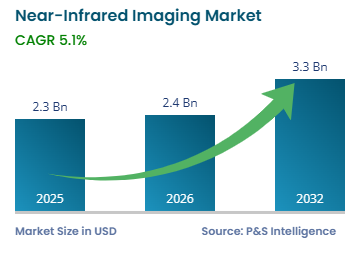
The near-infrared imaging market size was USD 2.3 billion for 2025, and it will grow by 5.1% during 2026-2032, to reach USD 3.3 billion by 2032.
The near-infrared imaging market is expanding as healthcare systems move towards less invasive diagnostic and surgical techniques that can provide real-time visual guidance. The technology helps clinicians view tissues, blood vessels, perfusion patterns, and lymphatic structures more clearly during procedures, which improves visibility without relying only on conventional imaging methods. Its use is becoming more important in oncology, cardiovascular care, reconstructive surgery, and image-guided interventions, where accurate tissue assessment and blood flow evaluation can influence clinical decisions. Compared with many traditional techniques, near-infrared imaging offers practical value during live procedures because it allows doctors to assess anatomical structures while treatment is being planned or performed. This makes it useful in hospitals and specialised surgical centres where precision, faster decision-making, and reduced procedural uncertainty are becoming key priorities.
According to the Institute for Health Metrics and Evaluation, cardiovascular disease deaths reached 19.2 million globally in 2023, showing the large clinical burden linked with conditions where vascular assessment and blood flow monitoring are important. This creates steady demand for imaging tools that can help clinicians evaluate perfusion, vessel visibility, and tissue viability during cardiovascular and related procedures. The market is also benefiting from improvements in imaging sensors, fluorescent agents, software processing, and portable device designs, which are making near-infrared systems easier to integrate into operating rooms and diagnostic workflows. Wider use across research laboratories, hospitals, and emerging healthcare settings is helping the technology move beyond specialised applications into broader clinical practice. These developments are strengthening adoption across diagnostic, surgical, and image-guided surgery applications.
Key Market Insights
Reagents are the largest and fastest-growing product category, holding a market share of 60% and registering a CAGR of approximately 5.3%, due to repeated use in imaging workflows and increasing cancer-related diagnostic demand.
Oncology is the largest and fastest-growing indication, holding a market share of 35% and registering a CAGR of approximately 5.7%, driven by rising cancer incidence and increasing need for precise tumour detection during surgical procedures.
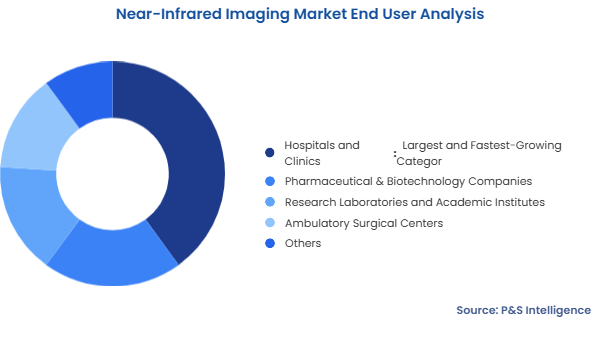
Hospitals and clinics are the largest and fastest-growing end-user segment, holding a market share of 40% and registering a CAGR of approximately 5.5%, due to high procedure volumes and availability of advanced imaging infrastructure.
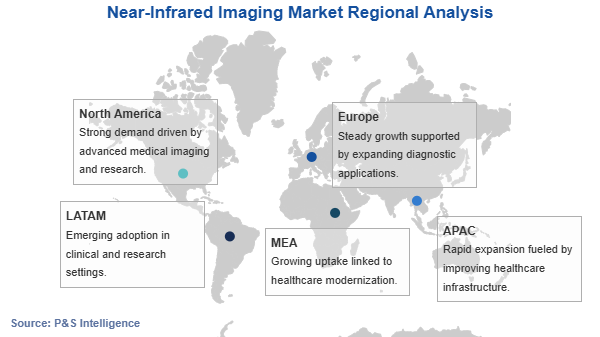
North America is the largest region, holding a market share of 40%, due to early adoption of advanced imaging technologies and strong healthcare system integration.
Asia-Pacific is the fastest-growing region, registering a CAGR of approximately 6.0%, driven by expanding healthcare infrastructure and increasing access to advanced imaging technologies.
The industry is shifting toward integrating near-infrared imaging with advanced surgical platforms across modern healthcare environments. This trend is driven by the growing use of real-time visualization during procedures, allowing surgeons to evaluate tissue perfusion, vascular structures, and anatomical boundaries with greater precision while supporting more informed intraoperative decisions. According to the International Federation of Robotics, sales of medical robots increased by 91% to around 16,700 units globally in 2024, while demand for surgical robots rose by 41%, reflecting broader adoption of advanced technologies in operating rooms. Furthermore, Leica Microsystems introduced the Viventis SCAPE light sheet microscope in 2026 at Focus on Microscopy 2026, making the system available globally through Leica Microsystems and authorized partners. These developments are expanding the use of advanced imaging technologies within modern surgical and research environments while supporting more precise visualization across specialized clinical workflows.
Rising Demand for Minimally Invasive Procedures Drives Market
The market is expanding as healthcare providers increasingly adopt procedures that reduce recovery time while supporting greater precision across clinical settings. This shift is driven by the growing preference for minimally invasive interventions, where near-infrared imaging improves visualization of tissue structures, vascular anatomy, and blood flow during surgery without extensive incisions. Surgeons increasingly rely on these systems to strengthen intraoperative guidance across transplant, oncologic, cardiovascular, and reconstructive procedures. According to the Global Observatory on Donation and Transplantation, 173,727 organ transplants were performed globally in 2024. Furthermore, according to the International Society of Aesthetic Plastic Surgery, 19.1 million non-surgical aesthetic procedures were performed globally in 2023. These expanding procedural volumes are encouraging broader integration of near-infrared imaging across operating rooms and interventional settings, supporting more accurate tissue visualization and helping clinicians perform increasingly complex procedures with greater confidence and precision.
High Cost and Limited Accessibility of Advanced Imaging Systems Restrains the Market
The market faces constraints as near-infrared imaging systems require high equipment spending, recurring reagent purchases, maintenance support, and trained operators. This issue is stronger in smaller hospitals, diagnostic centers, and rural care facilities, where capital budgets are usually directed toward essential imaging and treatment infrastructure first. Interpreting fluorescence signals also requires clinical and technical familiarity, which can slow routine use in resource-constrained settings. According to the World Bank, 3,455,100,410 people lived in rural areas globally in 2024. This large rural population base shows why affordability, service access, and installation readiness remain important for technology suppliers. Wider adoption depends on compact systems, lower operating expenses, simpler workflows, and training models that help providers add near-infrared imaging without heavy infrastructure changes.
Expansion of Imaging Use in Drug Development and Research Settings Creates Opportunity
The market presents growth opportunities as near-infrared imaging is becoming more closely integrated with surgical visualization platforms. Hospitals are adopting these systems to support minimally invasive procedures, where real-time fluorescence guidance helps surgeons assess perfusion, tissue boundaries, and resection areas during live procedures. According to Olympus Corporation, the VISERA ELITE III surgical imaging platform was launched in 2026 with Fluorescence-Guided Surgery IR ICG in full 4K White Light and high-contrast Magenta Mode, and it is available in all global regions, including the United States. This directly relevant launch strengthens the market case because it shows near-infrared imaging moving into multispecialty operating rooms, including colorectal, gynecological, urological, hepatopancreatobiliary transplant, and general surgery workflows.
Reagents are the largest and fastest-growing category, holding a market share of 60% and registering a CAGR of approximately 5.3%, because near-infrared imaging depends on contrast agents for clear visualization. These reagents, especially indocyanine green, are repeatedly used during surgical mapping, perfusion assessment, tumor localization, and diagnostic imaging, which keeps demand tied to procedure volume. According to the American Association for Cancer Research, an estimated 20 million new cancer cases and over 10.3 million cancer deaths occurred globally in 2025. This clinical volume supports steady reagent consumption across hospitals, oncology centers, and research laboratories using fluorescence-guided imaging workflows.
The products analysed in this report are:
Reagents (Largest and Fastest-Growing Category)
Indocyanine Green (ICG)
Other Fluorescent Contrast Agents
Imaging Systems
Near Infrared Fluorescence Imaging Systems
Near Infrared Fluorescence & Bioluminescence Imaging Systems
Software and Services
Imaging Software
Maintenance & Support Services
Indication Analysis
Oncology is the largest and fastest-growing category, registering a CAGR of approximately 5.7%, because near-infrared imaging is widely used for tumor detection, surgical guidance, and treatment precision. The technology helps clinicians distinguish malignant tissue, assess margins, and support fluorescence-guided procedures, while research teams use it in targeted therapy and precision medicine studies. According to the Institute for Health Metrics and Evaluation, global cancer incidence reached 18.5 million new cases in 2023, excluding non-melanoma skin cancers. This disease burden is increasing demand for imaging systems across oncology surgery, diagnostics, translational research, and treatment-planning workflows.
The indications analysed in this report are:
Oncology (Largest and Fastest-Growing Category)
Cardiovascular Disorders
Gastrointestinal Disorders
Neurological Disorders
Plastic and Reconstructive Surgeries
Others
End User Analysis
Hospitals and Clinics are the largest and fastest-growing category, holding a market share of 40%, because most imaging procedures are performed in these settings where advanced surgical and diagnostic equipment is available. These facilities handle a high volume of patients and require accurate imaging for treatment decisions. Adoption is also supported by the presence of trained professionals and infrastructure. As healthcare services expand and procedures increase, hospitals and clinics continue to be the primary users of near-infrared imaging systems.
The end users analysed in this report are:
Hospitals and Clinics (Largest and Fastest-Growing Category)
Pharmaceutical & Biotechnology Companies
Research Laboratories and Academic Institutes
Ambulatory Surgical Centers
Others
Drive strategic growth with comprehensive market analysis
North America Near-Infrared Imaging Market Analysis
North America holds the largest share of 40% because hospitals and surgical centres in the region adopt advanced imaging systems early and use them across complex clinical workflows. Near-infrared imaging is used during cancer surgery, vascular assessment, reconstructive procedures, and lymphatic mapping, where real-time visual guidance helps clinicians see tissue perfusion and margins more clearly. The region also benefits from strong reimbursement systems, trained specialists, and a dense network of academic hospitals that test imaging technologies before wider use.
Product availability is stronger because many global device companies operate in the United States and Canada, while regulatory pathways encourage clinically validated systems. Demand is especially high in procedures where surgeons need accurate visual feedback without relying only on conventional imaging. This makes North America a mature market, where adoption is driven by hospital readiness, advanced surgical practice, and regular integration of fluorescence-guided imaging into operating rooms.
U.S. Near-Infrared Imaging Market Analysis
The U.S. market shows strong adoption of near-infrared imaging due to the widespread use of advanced surgical technologies across hospitals and specialised care centres. This is driven by high procedure volumes, strong clinical research activity, and continuous integration of imaging tools in complex surgeries. Regulatory approvals for imaging agents also support the introduction of new technologies into practice. According to the American Cancer Society, over 2.0 million new cancer cases were diagnosed in the United States in 2024, sustaining a continuous, high-volume requirement for advanced diagnostic imaging in complex surgical procedures. This high disease burden is supporting consistent adoption of imaging systems across healthcare settings.
Canada Near-Infrared Imaging Market Analysis
Canada is experiencing gradual adoption of near-infrared imaging as hospitals continue modernizing surgical infrastructure and expanding access to advanced clinical services. This trend is supported by a strong concentration of tertiary care hospitals, academic medical centers, and research institutions that regularly evaluate and implement advanced imaging technologies. According to Statistics Canada, 30,893,239 people lived in Canada's 41 census metropolitan areas on July 1, 2024. This concentration of population and healthcare services supports greater utilization of advanced surgical technologies within large hospital networks, while creating favorable conditions for wider integration of near-infrared imaging across specialized surgical, oncology, and diagnostic care programs.
Asia-Pacific has the highest CAGR of approximately 6.0% because hospitals across the region are expanding access to advanced diagnostic and surgical technologies. Demand is rising in oncology, cardiovascular care, reconstructive surgery, and minimally invasive procedures, where near-infrared imaging helps clinicians assess blood flow, lymphatic drainage, and tissue condition during treatment. Large patient volumes are pushing hospitals to improve procedural accuracy and reduce repeat interventions. Private hospital chains are also investing in modern operating rooms, while public healthcare systems are improving access to specialist care.
China, India, Japan, South Korea, and Southeast Asian countries are seeing stronger use of medical imaging tools as healthcare spending and clinical training improve. Local distribution partnerships are making imaging systems more accessible to hospitals outside major cities. The region is still developing compared with North America and Europe, so adoption is rising from a lower base, creating faster growth across surgical, diagnostic, and research applications.
Japan Near-Infrared Imaging Market Analysis
Japan holds a strong position in near-infrared imaging due to its advanced medical technology environment and early adoption of precision healthcare tools. This is driven by the need for accurate imaging in complex surgical procedures and a strong base of medical device innovation. The country also focuses on improving healthcare outcomes for its ageing population through advanced technologies. Japan's population aged 65 and older reached 36.19 million in 2024, supporting the need for precision imaging tools in managing complex, age-related surgical conditions. This demographic trend is driving the continued integration of imaging systems across hospitals and specialised care facilities.
India Near-Infrared Imaging Market Analysis
India is witnessing increasing adoption of near-infrared imaging as private hospitals expand advanced surgical and diagnostic capabilities across major healthcare centers. Growing demand for minimally invasive procedures, oncology care, and specialty surgeries is encouraging providers to invest in fluorescence-guided imaging technologies that improve procedural precision. According to the Ministry of Tourism, Government of India, based on Bureau of Immigration data, 644,387 foreign tourists visited India for medical treatment in 2024. This sustained medical tourism activity is supporting investment in internationally accredited hospitals, advanced operating rooms, and specialized surgical services, creating broader opportunities for near-infrared imaging systems across high-complexity clinical applications.
Europe Near-Infrared Imaging Market Analysis
Europe is an established region for near-infrared imaging because hospitals place strong emphasis on clinical evidence, patient safety, and regulated use of medical devices. The technology is increasingly used in fluorescence-guided surgery, oncology procedures, vascular assessment, and reconstructive care, where surgeons need better visibility of perfusion and tissue boundaries. Western European hospitals are more advanced in adoption because they have stronger surgical infrastructure, research funding, and access to specialised imaging systems. Academic medical centres also contribute through clinical studies that evaluate new imaging agents, camera systems, and surgical applications. Regulatory controls make adoption more structured, as hospitals usually prefer devices with proven safety and clinical performance. Countries in Eastern Europe are adopting the technology more gradually because of budget limits and uneven access to advanced surgical equipment. Overall, Europe shows steady demand, led by clinical research, hospital-based use, and the need for safer image-guided procedures.
The regions and countries analysed in this report are:
The market is fragmented, with companies participating across imaging systems, fluorescence imaging platforms, reagents, contrast agents, software, and integrated visualization solutions for surgical and research applications. Product portfolios are highly specialized, enabling manufacturers to address distinct clinical requirements in oncology, cardiovascular surgery, gastrointestinal procedures, plastic and reconstructive surgery, and preclinical research. Additionally, companies are strengthening their positions through product launches, technology upgrades, strategic collaborations, and regulatory approvals that broaden their clinical reach and application coverage. Furthermore, innovation continues to focus on higher image quality, real-time fluorescence visualization, workflow integration, artificial intelligence-enabled image analysis, and compatibility with minimally invasive and robotic-assisted surgical platforms. These developments encourage broad participation from established medical technology companies and specialized imaging providers, creating a competitive landscape where technological differentiation, clinical performance, and application expertise shape market positioning across diverse healthcare and research environments.
Leading Companies in the Near-Infrared Imaging Market:
Stryker Corporation
Olympus Corporation
Medtronic Public Limited Company
KARL STORZ SE and Company KG
Carl Zeiss AG
Danaher Corporation
Shimadzu Corporation
Hamamatsu Photonics K K
Revvity Incorporated
LI COR Biosciences Incorporated
Merck KGaA
Bracco Imaging SpA
Fluoptics SAS
MediBeacon Incorporated
Lumicell Incorporated
Near-Infrared Imaging Market News
In March 2026, Olympus Corporation launched the VISERA ELITE III surgical imaging platform, integrating Fluorescence-Guided Surgery (IR/ICG), 4K, and 3D imaging capabilities. The platform enhances near-infrared fluorescence visualization for real-time tissue perfusion and anatomical imaging across colorectal, gynecological, urological, hepatopancreatobiliary, and general surgical procedures.
In February 2026, Specim, Spectral Imaging Ltd. introduced the Specim FX19 hyperspectral camera. The line-scan camera operates in the near and shortwave infrared range and extends the company’s FX camera series. Specim, Spectral Imaging Ltd. positioned the product for industrial machine vision and research use, with the launch published on the company’s product news page online.
In September 2023, Stryker Corporation launched the 1788 Platform, its next-generation surgical imaging system featuring enhanced fluorescence imaging capabilities for improved visualization of tissue perfusion and critical anatomy during minimally invasive surgery.
In December 2025, GE HealthCare Technologies Inc. launched Imaging 360 powered by AI. The cloud-based software was presented as an operational tool for radiology teams, using AI to analyse imaging operations and surface workflow information. The company published the launch as a new version of its Imaging 360 solution, not as a funding or revenue update.
Frequently Asked Questions About This Report
What is near infrared imaging mainly used for in healthcare?+
It is used to visualize blood flow, tissue perfusion, lymph nodes, tumors, and surgical anatomy in real time, helping clinicians make clearer procedure decisions.
How does near infrared fluorescence imaging help during surgical procedures?+
It highlights perfusion, bile ducts, lymphatic pathways, and lesion margins during operations, giving surgeons visual guidance beyond normal white light and palpation.
Why is indocyanine green commonly used in near infrared imaging?+
Indocyanine green absorbs near infrared light and emits fluorescence, allowing compatible cameras to show vascular, perfusion, and lymphatic information during medical procedures.
Which clinical areas commonly use near infrared imaging systems today?+
Common areas include oncology, cardiovascular surgery, gastrointestinal surgery, reconstructive surgery, ophthalmology, and lymphatic mapping, where real time visualization improves clinical confidence.
What factors are driving demand for near infrared imaging solutions?+
Demand is rising because hospitals need minimally invasive visualization, better surgical guidance, improved perfusion assessment, and technologies that support faster intraoperative decision making.
Want a report tailored exactly to your business need?
Leading companies across industries trust us to deliver data-driven insights and innovative solutions for their most critical decisions. From data-driven strategies to actionable insights, we empower the decision-makers who shape industries and define the future. From Fortune 500 companies to innovative startups, we are proud to partner with organisations that drive progress in their industries.
Client Testimonials
Working with P&S Intelligence and their team was an absolute pleasure – their awareness of timelines and commitment to value greatly contributed to our project's success. Eagerly anticipating future collaborations.
McKinsey & Company
India
Unmatched Standards
Our insights into the minutest levels of the markets, including the latest trends and competitive landscape, give you all the answers you need to take your business to new heights
Complete Data Security
We take a cautious approach to protecting your personal and confidential information. Trust is the strongest bond that connects us and our clients, and trust we build by complying with all international and domestic data protection and privacy laws