This Report Provides In-Depth Analysis of the Natural Refrigerants Market Report Prepared by P&S Intelligence, Segmented by Type (Hydrocarbons, Carbon Dioxide (R-744), Ammonia (R-717), Other Types), Application (Air Conditioning, Cold Storage, Freezers, Food Processing, Other Applications), End User (Commercial, Industrial, Residential), and Geographical Outlook for the Period of 2022 to 2033
Explore the market potential with our data-driven report
Natural Refrigerants Market Overview
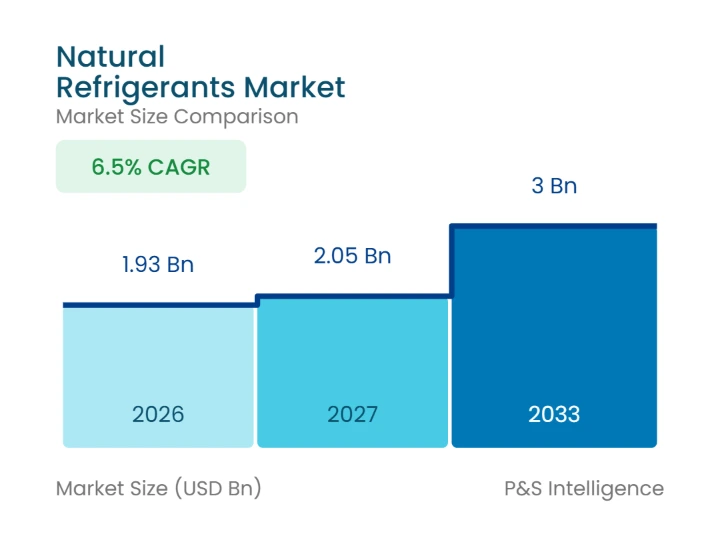
The global natural refrigerants market size is estimated at USD 1.93 Billion in 2026 and is projected to reach USD 2.05 Billion in 2027. Revenue is expected to climb to USD 3.00 Billion by 2033, advancing at a 6.5% CAGR during 2027-2033. Appliance, heat pump, and commercial refrigeration manufacturers are the main buyers, because fixed regulatory dates are removing high-GWP HFCs from the equipment they build and sell. Each redesigned product range turns into recurring orders for refrigerant-grade propane, isobutane, CO2, and ammonia, first for factory charging and later for servicing installed systems.
Refrigeration and air conditioning OEMs are moving product lines to propane, isobutane, and CO2 because HFC supply is shrinking on an international timetable. As per the UNEP Ozone Secretariat, 175 parties had ratified the Kigali Amendment to the Montreal Protocol as of October 5, 2026, committing them to stepwise cuts in HFC production and consumption. Natural refrigerant gases fall outside those quotas, so their relative cost position tends to improve each time a reduction step tightens HFC availability. For gas suppliers, volume expands as OEM redesign cycles reach each equipment class.
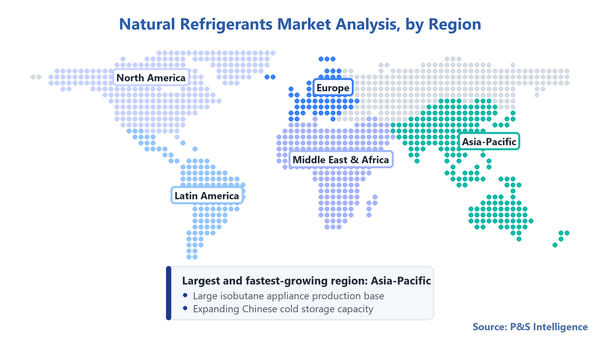
Asia-Pacific leads natural refrigerants market revenue with 38% of the 2026 total and is also projected to post the fastest growth, at a 7.6% CAGR during 2027-2033. China anchors the region through high-volume refrigerator and freezer production charged with isobutane, while India adds a fast-expanding cooling base in homes and food cold chains. Europe follows a different path, with Germany, Italy, and France converting supermarket estates to CO2 and moving new heat pump ranges to propane. Asian demand depends largely on new factory output and warehouse construction, whereas European demand comes mainly from replacing and converting systems already in service.
Key market insights
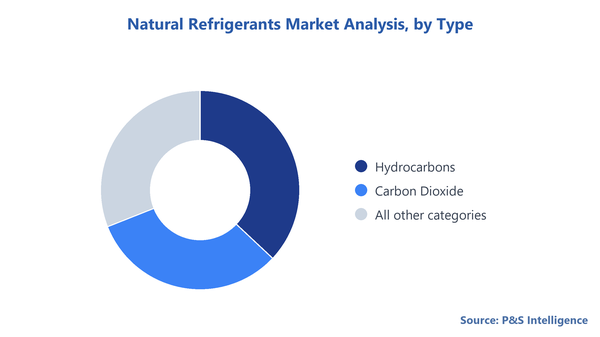
By type, hydrocarbons account for 37% of revenue in 2026, while carbon dioxide (R-744) is projected to expand at a 7.8% CAGR during 2027-2033.
By application, air conditioning accounts for 39% of revenue in 2026, while cold storage is projected to expand at a 7.5% CAGR during 2027-2033.
By end user, industrial users account for 45% of revenue in 2026, while commercial users are projected to expand at a 9.0% CAGR during 2027-2033.
By geography, Asia-Pacific accounts for 38% of revenue in 2026 and is also projected to expand at the fastest rate, a 7.6% CAGR during 2027-2033.
Natural Refrigerants Market Trends & Drivers
Larger permitted propane charges are redefining self-contained commercial refrigeration
Makers of plug-in display cases, beverage coolers, and ice machines are extending propane into larger self-contained models because safety standards now permit bigger charges in each refrigerant circuit. Under the earlier limit, manufacturers either split cooling duty across several small propane circuits or kept HFCs in their larger cabinets. A higher per-circuit allowance lets one propane circuit handle more cooling load, which cuts component count and brings more of a product range within reach of HFC-free designs. The shift moves supermarket and convenience store cabinet purchases toward hydrocarbon-charged units.
ASERCOM confirms that the 2022 edition of EN IEC 60335-2-89, published in the Official Journal of the European Union on August 2, 2023, allows self-contained commercial refrigeration equipment to carry up to about 500 grams of R-290. Because the standard is harmonized, cabinet makers selling CE-marked units at this charge gain a presumption of conformity under EU product rules. Each redesigned cabinet line adds factory-charging volume for refrigerant-grade propane, which benefits hydrocarbon refiners already qualified with European cabinet manufacturers. Convenience store and supermarket operators buying these cabinets also avoid the site refrigerant work that remote HFC systems require.
Equipment-level bans on high-GWP gases are accelerating propane use in small cooling and heating units
Manufacturers selling small air conditioners and heat pumps into Europe face fixed cut-off dates for high-GWP fluorinated gases, which pushes many self-contained designs toward propane. A quota-based phase-down raises HFC prices gradually, but a placing-on-market ban removes the HFC option from a whole product category on a known date. OEMs therefore redesign entire model ranges ahead of each deadline, and their refrigerant purchasing for factory charging switches to propane once the new ranges enter production. Demand from this channel arrives in steps tied to regulatory dates.
According to the European Commission, plug-in room air conditioners, monoblock units, and other self-contained air conditioning equipment and heat pumps up to 12 kW using fluorinated gases with a GWP of 150 or more are prohibited from January 1, 2027, unless safety requirements demand them. From January 1, 2032, the same equipment classes may not contain any fluorinated gas, subject to the same safety exception. The 2032 step leaves natural refrigerant options as the main route for these products in the EU, which favors hydrocarbon suppliers with European filling capacity and delivery to OEM plants.
Growing heat pump sales are opening a factory-charging channel for propane
Monobloc air-to-water heat pumps for homes are a growing use for propane, because the sealed outdoor unit keeps the flammable charge outside living space. Every unit is charged at the factory, so propane purchases rise with heat pump production volume and with the share of models designed around R-290. Demand in this channel follows household heating equipment sales, a different buying cycle from retail refrigeration, which gives refrigerant suppliers a second and less correlated source of volume.
European Heat Pump Association data show heat pump sales across 21 European countries rose 13% in 2025 to 2.9 million units, bringing the installed stock to 29.3 million. Those figures size the equipment base and do not measure propane adoption, since a large part of recent sales still used synthetic refrigerants such as R-32. The opening lies in converting that sales volume as the 2027 limit on small self-contained units takes effect. Hydrocarbon producers already qualified with heat pump OEMs could take the added charging volume, and the stability of national subsidy schemes is likely to set the pace.
Process safety obligations on large ammonia charges are constraining system design
Ammonia is widely used in large cold stores and food plants, but its toxicity brings compliance costs that rise with charge size, and those costs weigh most on mid-sized facilities. Owners comparing ammonia with CO2 or synthetic systems must budget for hazard analysis, operator training, mechanical integrity programs, and emergency planning once a charge passes regulatory thresholds. Some operators respond by choosing CO2 or packaged low-charge ammonia units, which shifts volume between refrigerant types and lowers the ammonia bought per site.
Under the Occupational Safety and Health Administration's Process Safety Management standard, anhydrous ammonia has a threshold quantity of 10,000 pounds, above which a U.S. refrigeration system becomes a covered process with full program obligations. Designers often keep charges below that line by splitting plants into several smaller systems or pairing ammonia with CO2 in cascade arrangements. For ammonia suppliers, the threshold limits initial fill volume per project, while equipment makers offering factory-built low-charge packages gain an edge with operators that want ammonia efficiency without covered-process paperwork.
Segmentation Analysis
Type
Hydrocarbons account for 37% of 2026 revenue, the largest share by type, led by isobutane in household refrigerators and freezers and propane in plug-in commercial cabinets, small heat pumps, and some room air conditioners. Appliance plants charge every unit on the production line, so hydrocarbon volume rises with refrigerator and display case output in China, Europe, and Latin America. Charges per unit are small, but annual unit counts run into the millions, which keeps purchasing steady. Refiners able to ship dry, high-purity grades in bulk to appliance plants hold an advantage.
Carbon dioxide (R-744) is set to post the quickest growth by type, at a 7.8% CAGR during 2027-2033, as supermarket chains standardize on transcritical CO2 racks for new and refitted stores. CO2 carries an A1 safety classification, so retailers can run large central systems serving whole sales floors without the charge limits that apply to propane. Figures from ATMOsphere put European transcritical CO2 installations at 111,650 sites at the end of 2025, up 16% in a year, including 106,000 food retail stores. Each rack holds a large charge and needs periodic top-ups, giving CO2 suppliers repeat volume per site.
Copyright P&S Intelligence. Reuse requires attribution under CC BY 4.0.
Application
Air conditioning accounts for 39% of 2026 revenue, the largest application share, because it covers propane chillers and monobloc units, ammonia chillers for large buildings, and CO2 circuits in vehicle climate systems. Chiller charges are large, and building owners replacing HFC chillers increasingly specify natural refrigerant models. The China Household Electrical Appliances Association notes that HFC-32 remains the dominant refrigerant in China's residential air conditioning, so revenue in this category is likely to derive more from chillers, monobloc units, and vehicles than from room units. A wider shift of Chinese room units to propane would add volume.
Cold storage is expected to grow fastest among applications, at a 7.5% CAGR during 2027-2033, as warehouse operators add refrigerated space for frozen food, fresh produce, and pharmaceuticals. New cold stores are frequently built around ammonia, CO2, or ammonia-CO2 cascade systems, which carry some of the largest charges in refrigeration. China's cold storage capacity reached 267 million cubic meters in 2025, up 5.53% on 2024, according to the China Federation of Logistics & Purchasing. Capacity counts measure buildings and not refrigerant choice, yet each new site that specifies ammonia or CO2 needs a first fill at commissioning.
End User
Industrial users account for 45% of 2026 revenue, the largest end-user share, because food processing plants, dairies, breweries, and chemical sites run ammonia and CO2 systems with charges far larger than those in shops or homes. Ammonia's high efficiency and low cost per kilogram keep it the standard choice for these plants, and sites with trained ammonia operators tend to stay with it. Large systems also lose refrigerant through maintenance and leaks over decades of service, which keeps top-up orders flowing between new projects. Suppliers with tanker delivery and local bulk storage are better positioned to serve these accounts.
Commercial users are projected to expand at a 9.0% CAGR during 2027-2033, the fastest pace among end users, as supermarkets, convenience stores, restaurants, and hotels replace HFC equipment with CO2 racks and propane plug-in cabinets. Retail chains operate hundreds or thousands of sites, so a refrigerant policy set at head office turns into repeat equipment orders across an entire estate. Plug-in propane cabinets arrive factory-charged and sealed, which spares store staff any on-site refrigerant handling. Distributors serving refrigeration contractors are exposed mainly to the CO2 side, since central racks are charged on site and topped up later.
The following segments are analysed in this report.
Type
Hydrocarbons
Carbon Dioxide (R-744)
Ammonia (R-717)
Other Types
Application
Air Conditioning
Cold Storage
Freezers
Food Processing
Other Applications
End User
Commercial
Industrial
Residential
Geographical Outlook
Asia-Pacific natural refrigerants market outlook
Asia-Pacific accounts for 38% of the natural refrigerants market in 2026 and is also projected to post the fastest regional expansion, at a 7.6% CAGR during 2027-2033. China, the region's largest market and its fastest-growing country, supplies a large share of the world's refrigerators and freezers, and much of that output is charged with isobutane or propane from domestic refiners. Japan adds a mature commercial base, where convenience store and supermarket chains have adopted CO2 condensing units widely. The region's position depends mainly on factory charging volume, so demand moves with appliance output and new cold-chain construction.
India is the region's second growth engine, because household air conditioning, food cold chains, and commercial buildings are adding cooling capacity from a low base. The India Cooling Action Plan, issued by the Ministry of Environment, Forest and Climate Change, projects a five- to eightfold rise in aggregate refrigerant demand by 2037-38. That projection covers all refrigerants, yet it indicates how much new equipment will be bought while India's HFC freeze under the Kigali schedule approaches. Suppliers with filling plants and distribution inside India are better positioned to serve OEMs choosing propane or CO2 than importers.
Copyright P&S Intelligence. Reuse requires attribution under CC BY 4.0.
Europe market analysis
Europe trails Asia-Pacific in revenue, and its demand depends more on converting systems already in service than on new factory output. Supermarket groups in Germany, Italy, and France have moved large parts of their estates to transcritical CO2, while heat pump makers are shifting monobloc ranges to propane ahead of equipment bans. Contractors in these markets have years of experience installing CO2 racks, which lowers project risk for retailers converting additional stores. The U.K. follows a similar path under its own F-gas regime.
Data reported to the European Environment Agency show HFCs placed on the EU market fell 37% in 2024 from 2023, ending the year 1% below the quota. A shrinking HFC supply tends to raise the cost of keeping older plant running, so store owners and building operators bring forward replacements that would otherwise wait for equipment failure. For refrigerant suppliers, this favors CO2 and propane volume tied to conversion projects across the region's larger retail markets. The region is likely to hold its position as conversion continues through the forecast period.
Latin America market analysis
Latin America keeps pace with the global market mainly through appliance manufacturing, with Brazil and Mexico producing refrigerators and freezers for domestic sale and export, much of it charged with isobutane. Factory demand in the region follows production plans at multinational appliance plants, which often set refrigerant specifications centrally and apply them across their Latin American lines. Supermarket chains in Brazil have begun installing CO2 and propane systems in new stores, although HFC equipment still dominates the installed base.
Argentina, Brazil, and Mexico follow the Kigali timetable for developing economies, under which HFC consumption is first frozen and then reduced in later steps, giving OEMs time to convert product lines gradually. Currency swings and import duties raise the landed cost of refrigerant-grade gases, so local filling and distribution carry more weight than in Europe. Suppliers with cylinder filling inside Brazil or Mexico are better positioned to serve appliance plants and the service trade at stable prices, and the region's growth is likely to track the pace of appliance export programs.
Middle East & Africa market analysis
The Middle East & Africa contributes a modest share of global revenue, and high ambient temperatures shape which refrigerant types buyers choose. Transcritical CO2 loses efficiency in hot climates, so Gulf retailers and cold store developers often favor ammonia, hydrocarbons, or CO2 systems fitted with ejectors and parallel compression. Saudi Arabia and the U.A.E. import much of their food, which supports investment in cold storage near ports and distribution hubs. South Africa adds an established ammonia base in food processing and a growing number of CO2 supermarket installations.
Demand in the Gulf arrives mainly as project-based first fills for new cold stores, food plants, and retail developments, which makes volumes uneven from year to year. South African demand includes a steadier service trade from an older installed base. Distributors with hazardous-goods licensing and local cylinder stocks are better positioned across the region, because shipping flammable or toxic gases over long distances adds lead time and cost. Wider adoption of CO2 in the Gulf is likely to depend on equipment designs that hold efficiency at high outdoor temperatures.
North America market analysis
North America contributes a smaller share than the two leading regions, with demand split between ammonia in food processing and cold storage, CO2 in a rising number of supermarkets, and propane in self-contained commercial cabinets. U.S. grocers set refrigerant strategy chain by chain, so adoption advances through new builds and major remodels, one store at a time. Canadian retailers, particularly in Quebec, adopted CO2 early, which gives suppliers there an established service network and contractors familiar with high-pressure systems.
The U.S. Environmental Protection Agency finalized a rule on May 21, 2026 that allows new supermarket systems and remote condensing units to use refrigerants with a GWP of up to 1,400 until January 1, 2032, after which the original 150 and 300 limits apply. The revision removes much of the near-term regulatory pressure on U.S. retailers, so CO2 orders before 2032 depend more on corporate climate targets and lifecycle cost. Refrigerant suppliers in the region are likely to see slower retail conversion in the meantime and a sharper wave of specification changes as the 2032 date nears.
The following geographies are analysed in this report.
Asia-Pacific
China
Japan
India
South Korea
Australia
Rest of Asia-Pacific
Europe
Germany
U.K.
France
Italy
Spain
Rest of Europe
Latin America
Brazil
Mexico
Argentina
Rest of Latin America
Middle East & Africa
Saudi Arabia
U.A.E.
South Africa
Rest of Middle East & Africa
North America
U.S.
Canada
Natural Refrigerants Market Competitive Landscape
Supply in the natural refrigerants market is moderately fragmented, because each refrigerant type comes from a different production chain and buyers tend to source regionally. Refrigerant-grade CO2 and ammonia are purified from industrial gas and chemical streams, while propane and isobutane are refined from liquefied petroleum gas, and flammable or toxic cargo is costly to move over long distances. Regional refiners and distributors therefore hold firm positions close to appliance clusters and food industries. The structure is fairly stable, although refrigerant distributors have grown through acquisitions that widen their reach among service contractors.
Three groups compete. Industrial gas companies such as Linde plc and L'Air Liquide S.A. supply refrigerant-grade CO2 and ammonia, with hydrocarbons in some countries, through cylinder and bulk networks serving supermarket contractors and food plants. Hydrocarbon specialists, including GTS S.p.A., Puyang Zhongwei Fine Chemical Co. Ltd., Shandong Yuean Chemical Industry Co. Ltd., and HyChill Australia Pty Ltd., compete on purity, moisture control, and bulk delivery to appliance and cabinet plants. Refrigerant distributors such as A-Gas International Limited, Tazzetti S.p.A., and Harp International Ltd sell hydrocarbon grades beside synthetic products to service contractors.
Entry barriers are moderate. A new hydrocarbon refiner needs distillation capacity, hazardous-area filling lines, and approval from appliance makers, which test each refrigerant grade before it enters a production line. Requalifying a grade takes time, which can keep an approved supplier in place for the life of a product platform and favors incumbents when new propane models launch. For buyers, the regional structure means price and lead time vary more with location than with brand, and supply security depends on how many qualified refiners operate within trucking distance.
Major Companies in Natural Refrigerants Market:
Linde plc
L'Air Liquide S.A.
A-Gas International Limited
Harp International Ltd
Tazzetti S.p.A.
GTS S.p.A.
Puyang Zhongwei Fine Chemical Co. Ltd.
Shandong Yuean Chemical Industry Co. Ltd.
HyChill Australia Pty Ltd
Engas Pty Ltd
Last Updated: October 2026
Frequently Asked Questions About This Report
How big is the natural refrigerants market?+
The global natural refrigerants market size is estimated at USD 1.93 Billion in 2026 and is projected to reach USD 2.05 Billion in 2027.
What is driving the shift to natural refrigerants?+
Refrigeration and air conditioning OEMs are moving product lines to propane, isobutane, and CO2 because HFC supply is shrinking on an international timetable.
Which region is growing fastest in the natural refrigerants market?+
Asia-Pacific leads natural refrigerants market revenue with 38% of the 2026 total and is also projected to post the fastest growth, at a 7.6% CAGR during 2027-2033.
Which natural refrigerant type is growing fastest?+
Carbon dioxide (R-744) is set to post the quickest growth by type, at a 7.8% CAGR during 2027-2033, as supermarket chains standardize on transcritical CO2 racks for new and refitted stores.
How many CO2 refrigeration systems are installed in Europe?+
Figures from ATMOsphere put European transcritical CO2 installations at 111,650 sites at the end of 2025, up 16% in a year, including 106,000 food retail stores.
Why are heat pump manufacturers switching to propane?+
Monobloc air-to-water heat pumps for homes are a growing use for propane, because the sealed outdoor unit keeps the flammable charge outside living space.
Who are the major companies in the natural refrigerants market?+
Industrial gas companies such as Linde plc and L'Air Liquide S.A. supply refrigerant-grade CO2 and ammonia, with hydrocarbons in some countries, through cylinder and bulk networks serving supermarket contractors and food plants.
Want a report tailored exactly to your business need?
Leading companies across industries trust us to deliver data-driven insights and innovative solutions for their most critical decisions. From data-driven strategies to actionable insights, we empower the decision-makers who shape industries and define the future. From Fortune 500 companies to innovative startups, we are proud to partner with organisations that drive progress in their industries.
Client Testimonials
Working with P&S Intelligence and their team was an absolute pleasure – their awareness of timelines and commitment to value greatly contributed to our project's success. Eagerly anticipating future collaborations.
McKinsey & Company
India
Unmatched Standards
Our insights into the minutest levels of the markets, including the latest trends and competitive landscape, give you all the answers you need to take your business to new heights
Complete Data Security
We take a cautious approach to protecting your personal and confidential information. Trust is the strongest bond that connects us and our clients, and trust we build by complying with all international and domestic data protection and privacy laws