This Report Provides In-Depth Analysis of the Natural Dyes Market Report Prepared by P&S Intelligence, Segmented by Source (Plant-Based, Animal-Based, Mineral-Based), Form (Powder, Liquid, Paste), Application (Dyeing & Coloring, Tanning, Printing Inks, Paints & Coatings), End-Use (Food & Beverages, Textiles & Leather, Cosmetics & Personal Care, Pharmaceuticals, Packaging), and Geographical Outlook for the Period of 2021 to 2032
Explore the market potential with our data-driven report
Natural Dyes Market Overview
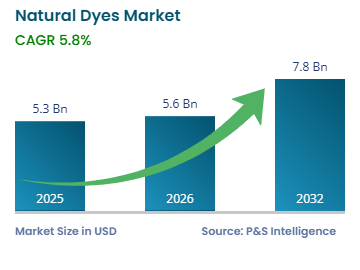
The natural dyes market size was USD 5.3 billion for 2025, and it will grow by 5.8% during 2026–2032, to reach USD 7.8 billion by 2032.
This growth is supported by escalating consumer demand for eco-friendly and sustainable colorants across textiles, food and beverages, and cosmetics applications, reinforced by stringent regulatory frameworks restricting synthetic dye usage in multiple industries. Plant-based sources including indigo, turmeric, and madder dominate the market, offering biodegradable alternatives that align with circular economy principles and clean-label product formulations. The transition toward natural colorants is accelerating as manufacturers respond to environmental concerns associated with synthetic dye production. Regulatory and policy signals from major economies, including the European Union’s ban on titanium dioxide (E171), are structurally accelerating demand for natural colorants across food, textile, and cosmetic value chains.
Industrial adoption is further reinforced by advancements in extraction technologies, mordanting techniques, and fermentation-based production methods that enhance colorfastness and scalability. The World Bank estimates that textile dyeing and treatment contribute approximately 20% of industrial water pollution globally, intensifying demand for environmentally responsible dyeing solutions.
Natural Dyes Market Emerging Trends
Clean-Label Consumer Preferences Are Key Trends
Shifting consumer preferences toward clean-label products containing recognizable, natural ingredients are reshaping formulation strategies across food and beverages, cosmetics, and personal care sectors. The food and beverages sector increasingly utilizes natural colorants to meet clean-label requirements, while cosmetics and personal care manufacturers integrate plant-derived pigments to address consumer preferences for non-toxic formulations. According to the survey data, over 60% of consumers in North America and Europe report higher trust in brands offering transparent, clean-label ingredient declarations. In Asia-Pacific, clean-label food and beverage launches incorporating natural colors have grown at significant annual rates since 2022, driven by rising middle-class consumption and regulatory scrutiny of artificial additives.
Walmart announced plans to eliminate synthetic dyes and artificial additives from its store-brand products by early 2027, reflecting growing retailer-driven pressure on manufacturers to transition toward healthier, naturally derived ingredients, including natural colorants. PepsiCo has announced plans to reduce the use of synthetic dyes across selected product lines, including beverages and snacks such as Gatorade and Cheetos, with greater adoption of naturally derived colorants, reinforcing the broader industry shift toward natural alternatives. Large multinational food companies, including Kraft Heinz, have publicly announced timelines to remove artificial dyes from major product portfolios, reinforcing clean-label demand at commercial scale. This preference shift creates structural demand growth for natural dyes derived from sources including annatto, turmeric, spirulina, beetroot, paprika, chlorophyll, and carmine, which are among the most widely approved and commercially deployed natural colorants globally, offering regulatory acceptance across major food safety jurisdictions while meeting color intensity, stability, and shelf-life performance requirements.
Regulatory Restrictions on Synthetic Dyes Is Biggest Driver
Government regulatory actions targeting petroleum-based synthetic dyes are compelling manufacturers across food, textile, and cosmetic industries to transition toward natural alternatives. In the United States, regulatory pressure has intensified through federal safety petitions and binding state-level legislation, most notably California’s Food Safety Act, which prohibits the use of Red Dye No. 3 and other synthetic additives in food products sold in the state, prompting nationwide reformulation by manufacturers serving multi-state markets. The U.S. FDA maintains a comprehensive list of color additives exempt from batch certification under 21 CFR Part 73, many of which are derived from plant, animal, or mineral sources and approved for use in foods, drugs, and cosmetics.
In 2025, the U.S. Food and Drug Administration approved three natural color additives, galdieria extract blue, butterfly pea flower extract, and calcium phosphate, expanding the approved palette of natural colors for food manufacturing and directly supporting large-scale replacement of synthetic dyes in beverages, confectionery, cereals, and dairy products. UNESCO and UN-Water report that approximately 80% of global municipal and industrial wastewater is discharged into the environment without adequate treatment, particularly in developing and emerging economies. Assessments by the United Nations Environment Programme and the World Bank identify textile dyeing and finishing operations as among the most significant industrial contributors to water pollution due to high volumes of chemically contaminated effluent, reinforcing regulatory pressure and industry interest in cleaner dyeing alternatives, including natural dyes.
This regulatory pressure extends beyond the United States. The European Food Safety Authority has formally concluded that Titanium dioxide (E171) can no longer be considered safe as a food additive, resulting in a legally binding European Union-wide ban that has forced widespread substitution with natural colorants across confectionery, bakery, and beverage applications. State-level legislation in multiple U.S. jurisdictions, combined with European Union precautionary approaches and ongoing safety re-evaluations of artificial dyes, creates compounding regulatory pressure that increasingly favors natural dye adoption.
Government Policy and Regulatory Support Is Biggest Opportunity
A key opportunity in the natural dyes market arises from government initiatives, regulatory frameworks, and sustainability mandates aimed at reducing reliance on synthetic dyes and promoting eco-friendly alternatives. Across major markets, regulatory bodies are increasingly tightening standards on synthetic colorants due to environmental and health concerns, which indirectly drive the adoption of natural dyes by creating compliance incentives for manufacturers. For example, stringent regulations targeting hazardous waste streams from synthetic dye effluents have prompted industries to explore biodegradable and less toxic natural dyes to meet environmental compliance requirements, particularly in textile and food applications. In 2025, GNT Group B.V. showcased its expanding EXBERRY® plant-based natural color portfolio at SupplySide Global, highlighting new vegetable- and spice-derived color solutions for clean-label food and beverage applications.
Regulatory developments in food color additive approvals, such as the U.S. Food and Drug Administration’s authorization of new natural-source color additives made from algae and flower petals, expand the palette of legally approved natural colorants for food use. In parallel, industry players are aligning with these regulatory shifts; for instance, Archroma has commercialized its EarthColors® range, which derives textile dyes from agricultural waste streams, supporting compliance with stricter environmental and wastewater regulations. These actions, combined with an overall increase in sustainability-oriented regulations in Europe and North America, are creating a policy-enabled growth environment that lowers barriers for natural dyes adoption and encourages market expansion through 2032 and beyond.
Natural Dyes Market Segmentation Analysis
Source Analysis
The plant category holds the largest market share, of 65%, in 2025, and it will have the highest CAGR, establishing dominance across the natural dyes industry. This leadership position stems from the extensive availability of botanical sources, including indigo, turmeric, madder root, annatto, and beetroot, that provide diverse color palettes suitable for multiple end-use applications. The U.S. Department of Agriculture's National Organic Program supports plant-based dyes through certification frameworks that enable organic labeling for products utilizing plant-derived colorants, reinforcing consumer preference for traceable botanical ingredients.
The agricultural scalability, regulatory support for botanical alternatives, and consumer alignment with clean-label preferences further contributes this category. The FDA classifies color additives derived from plant sources as exempt from certification requirements, simplifying regulatory pathways compared to synthetic alternatives and accelerating adoption across food, cosmetics, and textile industries.
The sources analyzed in this report are:
Plant-Based (Largest and Fastest Growing Category)
Animal-Based
Mineral-Based
Form Analysis
The powder category holds the largest market share, of 70%, in 2025. This leadership reflects superior shelf stability, ease of transportation, and storage advantages that powder formulations offer compared to liquid alternatives. Powder dyes demonstrate extended usability without requiring preservatives, making them particularly suitable for export markets and industrial-scale applications where consistent dosing and controlled solubility are essential. Textile manufacturers prefer powdered indigo for denim production, while food processors utilize powdered turmeric and spirulina for standardized color intensity across batch production cycles.
The liquid category will have the highest CAGR, of 6.0%, as manufacturers increasingly demand ready-to-use formats that reduce processing steps and enable direct application in continuous production environments. According to the United States Department of Agriculture National Organic Program, color additives derived from organic agricultural sources may be used in certified organic products when the final formulation meets the applicable organic content thresholds, supporting use of liquid natural colorants in organic-positioned food and beverage products.
The forms analyzed in this report are:
Powder (Largest Category)
Liquid (Fastest Growing Category)
Paste
Application Analysis
The dyeing & coloring category holds the largest market share, of 70%, in 2025, and it will have the highest CAGR, driven by extensive utilization across textile processing, food manufacturing, and cosmetics formulation. This application dominance reflects natural dyes' core functionality as colorants that replace synthetic alternatives in response to regulatory pressure and consumer sustainability preferences. The World Bank estimates that textile dyeing contributes 17-20% of industrial water pollution globally, creating substantial demand for natural dye alternatives that reduce environmental impact while meeting color performance requirements.
The applications analyzed in this report are:
Dyeing & Coloring (Largest and Fastest Growing Category)
Tanning
Printing Inks
Paints & Coatings
End User Analysis
The textiles & leather category holds the largest market share, of 45%, in 2025, reflecting the sector's substantial colorant consumption for fabric dyeing, garment finishing, and leather processing operations. This dominance stems from the fashion industry's sustainability transformation, where major apparel brands including Patagonia, Eileen Fisher, and H&M have incorporated natural dyes into product lines to meet corporate environmental commitments and consumer expectations for eco-friendly fashion. Certification requirements play a growing role in buyer decisions. Standards such as Global Organic Textile Standard (GOTS) and OEKO-TEX® increasingly influence sourcing choices, particularly for European apparel brands, favoring dye systems that comply with natural and low-toxicity criteria.
The cosmetics & personal care category will have the highest CAGR, of 5.9%, as clean-beauty trends accelerate demand for plant-derived pigments in lipsticks, foundations, hair colorants, and skincare formulations. The European Commission's cosmetics regulation (EC 1223/2009) restricts certain synthetic colorants including benzidine-based azo dyes, compelling cosmetics manufacturers to reformulate with natural alternatives and driving sustained market expansion in personal care applications.
The end users analyzed in this report are:
Food & Beverages
Textiles & Leather (Largest Category)
Cosmetics & Personal Care (Fastest Growing Category)
Pharmaceuticals
Packaging
Others
Drive strategic growth with comprehensive market analysis
Natural Dyes Market Geographical Analysis
Asia-Pacific Natural Dyes Market Size
Asia-Pacific holds the largest market share, of 40%, in 2025, and it will have the highest CAGR, of 6.1%. This dominance stems from the region's extensive textile manufacturing infrastructure, abundant agricultural resources for dye-yielding plants, and centuries-old traditional expertise in natural dyeing techniques. Countries including China, India, Japan, and Indonesia maintain robust production capabilities for plant-based colorants such as indigo, turmeric, and henna, supporting both domestic consumption and international exports.
The China Dyestuff Industry Association reported that China consumed approximately 1.1 million tons of textile dyes in 2020, representing around 45% of global dye demand, underscoring the nation's critical role in global colorant consumption patterns.
Government initiatives promoting sustainable manufacturing practices and environmental regulations restricting hazardous chemical discharges are accelerating the adoption of natural alternatives. Across Asia Pacific, stricter wastewater discharge norms for textile processing and chemical use restrictions are indirectly encouraging the substitution of synthetic dyes with lower-impact and natural colorants. The region’s outlook remains positive as growth in organic food, sustainable textiles, and clean-label cosmetics continues across emerging Asia-Pacific economies.
China Natural Dyes Market Size
China represents the largest country market within Asia Pacific, accounting for substantial natural dyes consumption driven by its position as the world's largest textile manufacturer and exporter. The nation's extensive supply chain infrastructure, from raw material cultivation to finished product manufacturing, enables cost-effective natural dye production at scale. Traditional dyeing heritage, particularly in provinces such as Yunnan and Zhejiang, provides foundational expertise that modern manufacturers are integrating with advanced extraction technologies.
The Ministry of Ecology and Environment of China has identified textile dyeing wastewater as a major source of hazardous industrial effluent, prompting stringent discharge regulations that encourage manufacturers to adopt eco-friendly dye solutions.
The government's 14th Five-Year Plan emphasizes development of high-end dyes and environmentally friendly dyeing processes, creating favorable conditions for natural colorant market expansion. Policy emphasis on green manufacturing and pollution reduction indirectly supports adoption of natural and bio-based dyeing alternatives.
India Natural Dyes Market Size
India emerges as the fastest-growing country market within Asia Pacific, driven by expanding textile exports, government sustainability initiatives, and traditional knowledge of plant-based dyeing techniques. The nation possesses favorable climatic conditions for cultivating dye-yielding plants, including indigo and turmeric, combined with established infrastructure spanning small-scale artisanal operations to large manufacturing facilities.
India's Ministry of Textiles data indicates that the country's textile sector employs over 45 million people and exported textile items worth USD 34.4 billion in FY 2023–24, representing significant opportunities for natural dye integration across the value chain.
Government programs, including PM MITRA Parks and Production Linked Incentive schemes, are promoting sustainable textile manufacturing, while collaborations between UNEP and the Ministry of Textiles through the InTex India programme support SME clusters in adopting circular practices. Indian natural dye manufacturers increasingly target export markets, supported by certifications such as the Global Organic Textile Standard (GOTS).
The region and countries of the market are as follows:
North America
U.S. (Larger and Faster-Growing Country Market)
Canada
Europe
Germany (Largest Country Market)
U.K.
France (Fastest-Growing Country Market)
Italy
Spain
Rest of Europe
Asia-Pacific (Largest and Fastest-Growing Region)
China (Largest Country Market)
India (Fastest-Growing Country Market)
Japan
South Korea
Australia
Rest of Asia-Pacific
Latin America
Brazil (Largest Country Market)
Mexico (Fastest-Growing Country Market)
Rest of Latin America
Middle East & Africa
Saudi Arabia (Largest Country Market)
South Africa (Fastest-Growing Country Market)
U.A.E.
Rest of MEA
Natural Dyes Market Share
The market is fragmented, with a competitive structure characterized by the presence of numerous specialized producers alongside diversified chemical companies maintaining natural colorant portfolios. This fragmentation stems from several structural factors: relatively low barriers to entry for small-scale production, geographic dispersion of raw material sources enabling regional specialization, and diverse end-use applications requiring differentiated product formulations across food, textile, and cosmetics sectors. Market concentration remains limited as no single company controls dominant share across all application segments and geographic regions. The competitive landscape continues evolving as regulatory pressure on synthetic dyes accelerates demand growth, attracting new entrants and prompting established chemical companies to expand natural colorant offerings through organic development and strategic acquisitions.
Key Natural Dyes Companies:
Abbey Color
AMA Herbal
Pylam Products Company Inc.
Archroma
GNT Group B.V.
Stony Creek Colors
NIG GmbH
Givaudan
D
Couleurs DE Plantes
Aura Herbal Textiles
Sun Food Tech
Natural Dyes Market News
In November 2025, Denmark-based Chromologics raised approximately €7 million in venture funding to scale precision-fermentation production of natural pigments, bringing total funding close to EURO 20 million and highlighting rising investor interest in bio-manufactured natural dyes.
In November 2024, GNT Group B.V. announced the launch of GNT Ventures, an investment arm designed to fund early-stage companies developing technologies relevant to natural color solutions. One of its initial collaborations is with Plume Biotechnology to enhance EXBERRY® color technologies through fermentation-based innovation, focusing on raw material sourcing, processing methods, and sustainable ingredient development.
In April 2024, AMA Herbal Group commercially launched Bio Indigo PReR, a biochemically modified pre-reduced natural indigo in liquid form developed at its facility in Lucknow, India. The product offers a more sustainable alternative to synthetic indigo, with claims of reduced energy consumption, simplified logistics (no airtight packing), and lower environmental impact while maintaining compatibility with existing textile dyeing systems.
In February 2023, Archroma completed the acquisition of the Textile Effects business from Huntsman Corporation. Huntsman Textile Effects was the textile chemicals division of Huntsman Corporation, supplying dyes, textile chemicals, and digital inks to the global textile industry, strengthening Archroma’s position in sustainable textile colorants and specialty chemicals.
Frequently Asked Questions About This Report
What are natural dyes used for?+
Natural dyes are used in textiles, leather, food & beverages, cosmetics & personal care, pharmaceuticals, packaging, and printing applications.
Why is the natural dyes market growing?+
The market is growing due to rising demand for eco-friendly, non-toxic, and clean-label products, along with regulatory pressure on synthetic dyes.
Which industry uses the most natural dyes?+
The textiles and leather industry is the largest consumer of natural dyes.
Which region dominates the natural dyes market?+
Asia-Pacific dominates the natural dyes market.
What is the market nature of the natural dyes market?+
The natural dyes market is fragmented.
Want a report tailored exactly to your business need?
Leading companies across industries trust us to deliver data-driven insights and innovative solutions for their most critical decisions. From data-driven strategies to actionable insights, we empower the decision-makers who shape industries and define the future. From Fortune 500 companies to innovative startups, we are proud to partner with organisations that drive progress in their industries.
Client Testimonials
Working with P&S Intelligence and their team was an absolute pleasure – their awareness of timelines and commitment to value greatly contributed to our project's success. Eagerly anticipating future collaborations.
McKinsey & Company
India
Unmatched Standards
Our insights into the minutest levels of the markets, including the latest trends and competitive landscape, give you all the answers you need to take your business to new heights
Complete Data Security
We take a cautious approach to protecting your personal and confidential information. Trust is the strongest bond that connects us and our clients, and trust we build by complying with all international and domestic data protection and privacy laws