Explore the market potential with our data-driven report
Global MXene Market Overview
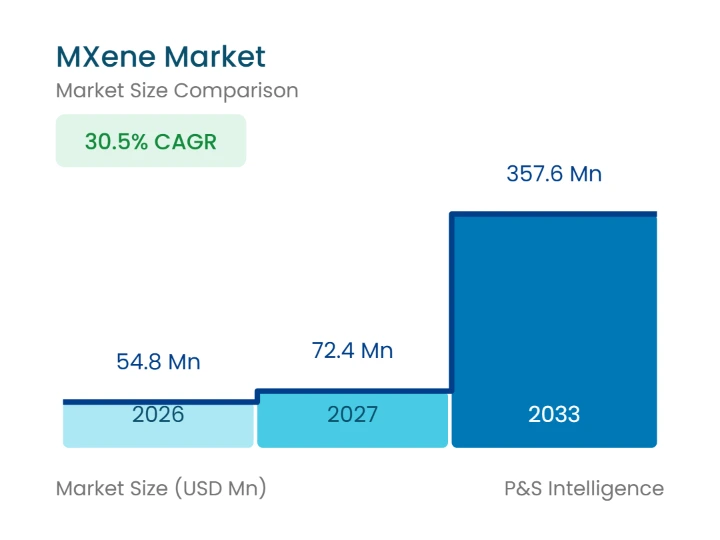
The global MXene market is estimated at USD 54.80 Million in 2026, with USD 72.40 Million projected for 2027. Revenue is set to reach USD 357.60 Million by 2033, a 30.5% CAGR over 2027-2033. Energy storage developers form the largest buyer group, and electronic component makers and research laboratories also buy titanium carbide powders, dispersions, and MAX phase precursors to move prototypes toward qualified products. Producers that can hold flake quality steady from gram samples to kilogram lots are better positioned to convert that interest into repeat business.
Cell developers and shielding designers that have proven MXene in prototypes now need volume at a price few producers can yet offer. According to Drexel University, where the material was discovered in 2011, a USD 5 Million, three-year production program launched in July 2025 with partners in the U.A.E., Italy, and Ukraine aims to clear the manufacturing bottleneck by 2028, and its lead researcher noted that no company sells inexpensive, high-quality MXenes for water and healthcare uses. Lower cost per kilogram would widen global MXene market demand from sample orders into recurring supply contracts.
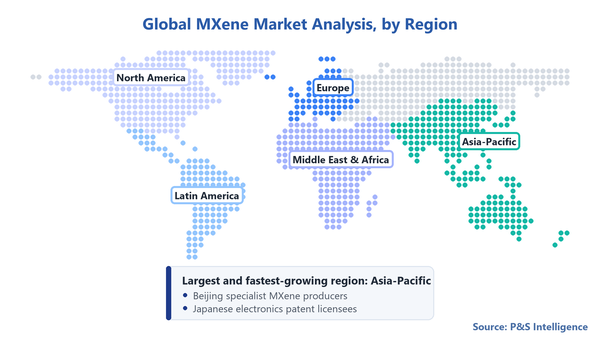
Asia-Pacific accounts for 38.0% of 2026 revenue and is also the fastest-growing region, with a 32.6% CAGR during 2027-2033. China anchors regional supply through Beijing-based specialists that ship powders, dispersions, and MAX phase precursors, while Japanese electronic component makers license MXene technology and fund synthesis research aimed at conducting films. North America ranks second, with growth that depends more on patent licensing, defense programs, and national laboratory work than on new production volume.
Key market insights
By material type, titanium-based MXenes (Ti3C2Tx, Ti2CTx) hold 73.5% of 2026 revenue, while vanadium-based MXenes (V2CTx, V4C3Tx) are projected to grow at a 34.2% CAGR during 2027-2033.
By physical form, powders (multilayer and lyophilized) account for 55.5% in 2026, and pastes, inks, and free-standing films are expected to expand at a 33.8% CAGR over 2027-2033.
By synthesis method, hydrofluoric acid (HF) chemical etching represents 48.0% of 2026 revenue, whereas electrochemical etching is set to advance at a 36.5% CAGR during 2027-2033.
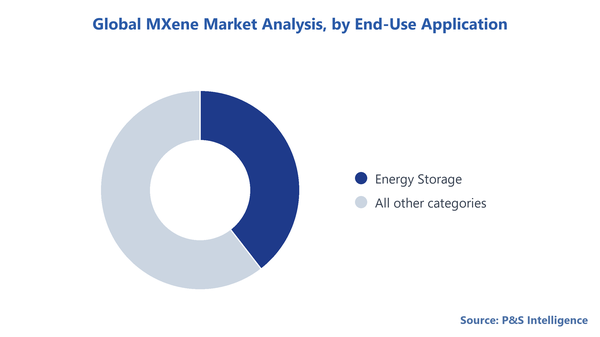
By end-use application, energy storage (batteries and supercapacitors) holds 39.5% in 2026, while sensors and actuators are projected to grow at a 34.8% CAGR during 2027-2033.
By geography, Asia-Pacific accounts for 38.0% of 2026 revenue and is projected to post the fastest growth, at a 32.6% CAGR during 2027-2033.
Global MXene Market Trends & Drivers
Bottom-up and etch-free synthesis routes are redefining MXene production economics
MXene producers and the battery and electronics developers that buy from them are tracking a shift from acid etching of MAX phase powder toward molten-salt, electrochemical, vapor-phase, and bottom-up routes. The etching step shapes much of a plant's cost, waste treatment, and permitting work, so a route that avoids it changes who can afford to enter production. Routes that skip the MAX phase altogether would also remove one purchase from the bill of materials and put precursor sellers under price pressure.
The European Research Council funds MXClean, a proof-of-concept project at the Universitat Politecnica de Valencia that began on March 1, 2026 and assembles MXenes directly from molecular precursors, aiming to show scalability to multi-gram batches before it ends in August 2027. Multi-gram output is far below what a battery line would consume, so acid-etched material is likely to carry most volume through the forecast period. Producers holding know-how on a cheaper route could, however, undercut etched powder on price once those processes clear pilot trials.
Demand for thinner electromagnetic shielding is driving MXene film and coating purchases
Designers of handsets, wearables, small satellites, and electric vehicle electronics need shielding that fits into tighter spaces, where every micrometer of copper or aluminum foil adds thickness and weight. MXene films and sprayable inks can shield at a fraction of that thickness, which gives these designers a reason to order evaluation lots of films and coatings. This application also shifts purchasing toward dispersions and inks, because component makers apply the material as a coating rather than blending dry powder.
Researchers writing in Science measured 92 dB of electromagnetic interference shielding from a 45-micrometer titanium carbide film and more than 50 dB from a film only 2.5 micrometers thick. The authors described the thicker result as the highest among synthetic materials of comparable thickness. With performance established, the commercial test for producers has moved to consistency. A shielding film qualified into a handset or radar module typically cannot change material without requalification, which favors suppliers able to hold flake size and conductivity steady from batch to batch.
Unmet fast-charging electrode needs are opening a high-volume pathway in energy storage
Battery and supercapacitor developers designing for fast charging trade power, which needs open and conductive electrodes, against volumetric energy, which needs dense ones. MXene addresses both in one material, so cell developers test it as an active electrode material, as a conductive additive in place of carbon black, and as a current-collector coating. Electrode roles typically consume more material per device than a sensor or a thin shielding layer, so a single qualified electrode program could move a producer's orders from kilogram lots to much larger contracts.
A team publishing in Nature Energy recorded capacitance of up to 210 F/g at a scan rate of 10 V/s from macroporous titanium carbide films, exceeding the best carbon supercapacitors, and about 1,500 F/cm3 from MXene hydrogels. Results of that kind give cell developers reason to buy evaluation lots. Turning those orders into recurring volume depends on price per kilogram and on supply agreements that guarantee consistent surface chemistry, which favors producers already running multi-kilogram batches.
Hazardous fluoride etching and short shelf life are constraining production scale-up
The largest share of commercial MXene still comes from etching MAX phase powder in hydrofluoric acid, and every added kilogram means larger acid volumes, fume control, and fluoride waste treatment. That burden weighs most on small specialist producers trying to move from laboratory batches toward tonne-scale plants. Aqueous dispersions also oxidize in storage, so distributors must ship them quickly or steer buyers toward dry powder, which adds a redispersion step for the user and limits sales of ready-to-use formats.
The National Institute for Occupational Safety and Health sets a recommended exposure limit for hydrogen fluoride of 3 ppm over a work shift, with 30 ppm classed as immediately dangerous to life or health. Keeping operators below limits that tight typically means enclosed reactors, gas scrubbing, and trained staff before a plant can add capacity. Some suppliers are working to lighten the process load. Sigma-Aldrich lists a multilayer titanium carbide powder made from recycled TiO2 with fewer processing steps in its greener-alternative range, although fluoride handling at each producer is likely to remain part of supplier qualification for large-volume buyers.
Segmentation Outlook
Material Type
Titanium-based MXenes (Ti3C2Tx, Ti2CTx) account for 73.5% of global MXene market revenue in 2026. Titanium carbide was the first MXene isolated, so most published application data covers it. Developers qualifying a new product start where the data is deepest, and the Ti3AlC2 precursor has the widest availability of any MAX phase, which typically keeps input costs below those of niobium or molybdenum grades. American Elements' catalog offers Ti2C titanium carbide MXene in purity grades from 2N to 5N, a range that lets one material serve both laboratory screening and pilot production.
Vanadium-based MXenes (V2CTx, V4C3Tx) are projected to grow fastest, at a 34.2% CAGR during 2027-2033. Developers of zinc-ion batteries and other aqueous multivalent-ion cells value vanadium's several oxidation states, which support higher charge storage in cathodes. In ACS Nano, researchers described a V2CTx cathode for an aqueous zinc hybrid-ion battery that delivered 508 mAh/g, with capacity rising over 18,000 cycles. If zinc-ion batteries move into stationary storage pilots, vanadium MXene would shift from catalog sales into contract supply for cathode developers, a higher-value channel for the few producers already making V2AlC precursor.
Physical Form
Powders (multilayer and lyophilized) hold 55.5% of 2026 revenue. Dry powder stores and travels far better than wet product, because water and dissolved oxygen slowly degrade MXene flakes in suspension, so distributors can keep it in stock and ship it internationally without expedited handling. Battery developers also often prefer powder because they mix it into their own slurries and control solvent and concentration themselves. For producers, powder carries lower logistics cost per kilogram, which keeps it the default format for catalog and export sales.
Pastes, inks, and free-standing films are expected to expand at a 33.8% CAGR during 2027-2033, the quickest pace among product forms. A Trinity College Dublin-led study in Nature Communications showed that additive-free aqueous and organic MXene inks can print conductive tracks, resistors, and micro-supercapacitors on untreated plastic and paper using standard inkjet and extrusion printers. Because these inks need no surfactants or binders, makers of printed electronics and shielding coatings can adopt them without reworking their processes, and ready-to-apply ink typically earns producers more per kilogram than powder.
Synthesis/Production Method
Hydrofluoric acid (HF) chemical etching represents 48.0% of 2026 revenue. HF etching is the original route used since the material's discovery, so it has the largest installed base of reactors, the most documented process windows, and the longest customer qualification history. Battery and electronics developers that have qualified HF-etched flakes face retesting costs if their supplier changes method, which keeps existing etching lines busy. Producers running HF lines keep a qualification advantage as long as they can absorb the safety and waste-handling costs.
Electrochemical etching is set to post the fastest growth, at a 36.5% CAGR during 2027-2033. The route uses an applied voltage in place of concentrated fluoride, which shrinks the hazardous-chemical inventory a plant must permit and store. As per a TU Dresden-led paper in Angewandte Chemie, anodic etching of Ti3AlC2 in a fluoride-free binary aqueous electrolyte gave over 90% yield of mono- and bilayer flakes up to 18.6 micrometers across. Producers that commercialize this route could offer fluoride-free material to medical and water-treatment developers, where residual fluorine can complicate qualification.
End-Use Application
Energy storage (batteries and supercapacitors) accounts for 39.5% of 2026 revenue. Cell and supercapacitor developers tend to buy MXene in larger lots because electrodes, conductive additives, and current-collector coatings all consume material during each prototype build. Energy storage programs also run long evaluation cycles across several cell formats, which turns early sample purchases into repeat orders. For producers, this end use rewards tight control of flake size and surface chemistry, since electrode performance is sensitive to both Copyright P&S Intelligence. Reuse requires attribution under CC BY 4.0.
Sensors and actuators are projected to grow at a 34.8% CAGR during 2027-2033, faster than any other end use. Wearable health monitors, strain sensors, and biosensors need conductive, flexible, and water-compatible films, a combination MXene supplies without a separate binder. A bibliometric review in Advanced Fiber Materials counted nearly 1,000 publications on MXene-functionalized textiles from 2017 through 2024, with uses ranging from strain sensors to wearable biosensors. Sensor makers buy little material per device but favor printable inks and thin films, which typically earn producers more per gram than bulk powder.
The following segments are analysed in this report.
Asia-Pacific holds 38.0% of global MXene market revenue in 2026 and is set to expand faster than any other region, at a 32.6% CAGR during 2027-2033. China is the region's largest market, supported by Beijing-based producers that sell titanium, vanadium, and niobium MXene grades alongside MAX phase precursors, and by a university base that buys research-grade lots year-round. Figures from a bibliometric study in Frontiers in Bioengineering and Biotechnology put China at 1,079 of 1,489 MXene biomedical publications from 2011 to 2022, against 160 from the U.S. and 96 from India.
Japan brings a different kind of demand, led by electronic component makers that license MXene technology and co-fund synthesis work aimed at conducting films. Writing in Graphene and 2D Materials in 2023, Anasori and Gogotsi noted that a Japanese manufacturer, the first company to license MXene synthesis from Drexel University, led MXene patenting with about 30 patents granted and pending. The region's lead is likely to widen because it combines precursor supply, MXene synthesis, and the battery and electronics plants that would consume qualified material in volume.
Copyright P&S Intelligence. Reuse requires attribution under CC BY 4.0.
North America market analysis
North America trails Asia-Pacific, and its demand is shaped more by patent licensing, defense work, and federally funded research than by bulk production. The foundational MXene patents originate in the U.S., so licensing fees, royalties, and custom synthesis contracts add to regional revenue alongside material sales. Catalog distributors also ship research-grade powders and dispersions to university and national laboratory buyers across the U.S. and Canada, a steady but low-volume channel. A Drexel spin-off has also begun scaling MXene production in Philadelphia, which gives defense and electronics buyers a domestic source to qualify.
Lawrence Livermore National Laboratory confirms that its team synthesized Ti3C2Tx with a production yield of about 70%, using a route that outperformed conventional HF synthesis, and developed the material for shielding and antenna components on small satellites. Defense and space programs buy small volumes at high specifications, which favors domestic producers able to document provenance and lot consistency. Regional growth is likely to track how quickly those programs move from laboratory evaluation to purchasing.
Europe market analysis
Europe holds a smaller position than North America, with demand led by publicly funded research consortia, defense-related shielding, and interest in cleaner production methods. Universities in Germany, Spain, and Italy run funded MXene programs, and specialist supply includes a Kyiv-based producer that works with Italian and Belgian research partners. Buyers in the region tend to purchase small, specified lots for consortium work, which favors suppliers with documented synthesis routes and traceable lot records.
A NATO Science for Peace and Security project, ATHENA, coordinated from the Universite libre de Bruxelles, is developing MXene-polymer composites for lightweight electromagnetic shielding on spacecraft, with a Ukrainian MXene producer taking part. The project pairs digital modelling with fabrication and testing, so participating producers supply material for repeated qualification trials. Programs of this kind buy specialized grades in small lots, but the qualification standards they set can carry over to commercial aerospace and telecom buyers. European producers that pass these defense-linked qualifications could use them as references when bidding for industrial shielding work.
Latin America market analysis
Latin America contributes a small share of global revenue, with demand coming mainly from university laboratories and public research institutes. Buyers in the region largely rely on imported research-grade powders and precursors from catalog distributors, so they pay freight and duties and face longer lead times. That cost structure keeps purchases to small, project-based lots, and it limits how quickly local developers can move from bench tests to pilot devices.
Records from FAPESP, the Sao Paulo Research Foundation, show funded work on MXene electrodes for capacitive deionization of brackish water at the Institute of Aeronautics and Space in Sao Jose dos Campos, and a postdoctoral project on a new MXene synthesis route at the University of Campinas. Water desalination and energy storage appear the likeliest first commercial uses in Brazil. Suppliers that offer regional distribution and technical support stand to gain as these projects move toward pilot scale.
Middle East & Africa market analysis
The Middle East & Africa holds the smallest regional share, but water scarcity gives MXene a specific role there in desalination and water treatment. Abu Dhabi funds university research that links two-dimensional materials work to national water and energy priorities, which creates a channel for pilot-scale membrane and capacitive deionization purchases. Elsewhere in the region, demand is limited to university laboratories buying imported research-grade material in small lots.
Khalifa University established its Research and Innovation Center for Graphene and 2D Materials in 2022 with Abu Dhabi government backing, directing work toward water purification, lightweight composites, aerospace, energy, and healthcare. Its international MXene production partnership gives the U.A.E. a route to locally tested MXene membranes. Regional purchasing is likely to stay at pilot scale until a desalination plant operator commits to a commercial MXene system, at which point membrane-grade suppliers would gain a first reference customer.
The following geographies are analysed in this report.
Asia-Pacific
Japan
South Korea
Taiwan
China
India
Rest of Asia-Pacific
Europe
Germany
U.K.
France
Italy
Netherlands
Spain
Rest of Europe
Latin America
Brazil
Mexico
Rest of Latin America
Middle East & Africa
Saudi Arabia
U.A.E.
Rest of Middle East & Africa
North America
U.S.
Canada
Global MXene Market Competitive Landscape
The global MXene market is fragmented, with supply spread across many small specialist producers, catalog chemical distributors, and university spin-offs, and no producer yet operates at industrial scale. Three conditions keep the structure open. Production know-how still resides largely in university laboratories, much of the volume is sold in gram-to-kilogram lots that do not reward large plants, and foundational patents are licensed to several companies instead of being held by one manufacturer. The structure is likely to tighten once a battery or electronics program qualifies a supplier for volume contracts.
Companies fall into three groups. Specialist producers such as Beijing Beike New Material Technology Co., Ltd., Carbon-Ukraine (Y-Carbon LLC), and Forsman Scientific (Beijing) Co., Ltd. compete on grade breadth across MXene chemistries and MAX phase precursors, and on custom synthesis. Catalog distributors including Merck KGaA (Sigma-Aldrich), American Elements, and ACS Material LLC compete on global logistics, documentation, and purity grading for laboratory buyers. Licensees and spin-offs such as Murata Manufacturing Co., Ltd. and MXene, Inc. concentrate on scaling processes and building applications under university licenses.
For buyers, the main switching cost is requalification. A battery or shielding developer that has tuned its process around one supplier's flake size, surface terminations, and oxidation behavior faces repeated testing to change source, which makes established supply relationships hard to displace even in a field with many sellers. New entrants with cheaper synthesis routes therefore need a qualification win with a named developer before price alone can move share. Catalog distributors face a lower barrier, since laboratory buyers switch catalogs more readily than production programs switch suppliers.
Major Companies in MXene Market:
Beijing Beike New Material Technology Co., Ltd. (Beike 2D Materials)
American Elements
Merck KGaA (Sigma-Aldrich)
Carbon-Ukraine (Y-Carbon LLC)
Murata Manufacturing Co. Ltd.
ACS Material LLC
Nanochemazone
MXene, Inc.
Nephria Bio, Inc.
Japan Material Technologies Corporation (JMTC)
Forsman Scientific (Beijing) Co. Ltd.
Recent Developments in the Market
In September 2026, Murata Manufacturing Co. Ltd. co-funded and co-authored Drexel University research on a vapor-phase route that grows MXene flakes tens of micrometers across from titanium, methane, and titanium tetrachloride, a method on which Murata has filed a patent application. Skipping MAX phase synthesis and acid etching could cut Murata's conducting-film costs.
In September 2026, MXene Inc. granted Xenica Inc. a sublicense to produce, use, and sell MXenes for military and defense applications under its exclusive Drexel University military-use license, for an initial five-year term with royalties on future sales. Revenue depends on Xenica scaling output and qualifying shielding and radar-absorbing material.
Last Updated: October 2026
Frequently Asked Questions About This Report
How big is the MXene market?+
The global MXene market is estimated at USD 54.80 Million in 2026, with USD 72.40 Million projected for 2027. Revenue is set to reach USD 357.60 Million by 2033, a 30.5% CAGR over 2027-2033.
Which MXene type is most widely used?+
Titanium-based MXenes (Ti3C2Tx, Ti2CTx) account for 73.5% of global MXene market revenue in 2026. Titanium carbide was the first MXene isolated, so most published application data covers it.
How effective is MXene for EMI shielding?+
Researchers writing in Science measured 92 dB of electromagnetic interference shielding from a 45-micrometer titanium carbide film and more than 50 dB from a film only 2.5 micrometers thick.
Why is MXene production difficult to scale up?+
The largest share of commercial MXene still comes from etching MAX phase powder in hydrofluoric acid, and every added kilogram means larger acid volumes, fume control, and fluoride waste treatment.
Which region leads the MXene market?+
Asia-Pacific holds 38.0% of global MXene market revenue in 2026 and is set to expand faster than any other region, at a 32.6% CAGR during 2027-2033.
Which companies make MXene?+
Specialist producers such as Beijing Beike New Material Technology Co. Ltd., Carbon-Ukraine (Y-Carbon LLC), and Forsman Scientific (Beijing) Co. Ltd. compete on grade breadth across MXene chemistries and MAX phase precursors, and on custom synthesis.
Want a report tailored exactly to your business need?
Leading companies across industries trust us to deliver data-driven insights and innovative solutions for their most critical decisions. From data-driven strategies to actionable insights, we empower the decision-makers who shape industries and define the future. From Fortune 500 companies to innovative startups, we are proud to partner with organisations that drive progress in their industries.
Client Testimonials
Working with P&S Intelligence and their team was an absolute pleasure – their awareness of timelines and commitment to value greatly contributed to our project's success. Eagerly anticipating future collaborations.
McKinsey & Company
India
Unmatched Standards
Our insights into the minutest levels of the markets, including the latest trends and competitive landscape, give you all the answers you need to take your business to new heights
Complete Data Security
We take a cautious approach to protecting your personal and confidential information. Trust is the strongest bond that connects us and our clients, and trust we build by complying with all international and domestic data protection and privacy laws