Multimodal Transport Market Size & Share Analysis - Key Trends, Future Opportunities, Growth Strategies, and Forecasts (2026 - 2032)
This Report Provides In-Depth Analysis of the Multimodal Transport Market Report Prepared by P&S Intelligence, Segmented by Configuration (Two-Mode, Three-Mode), Transportation Destination (International, Domestic), Individual Mode (Road, Rail, Air, Marine (Sea/River)), Service Type (Freight Transportation, Freight Forwarding, Warehousing & Distribution, Supply Chain Management, Value-Added Services), End-Use Industry (Manufacturing, Retail & E-commerce, Chemicals, Pharmaceutical & Healthcare, Food & Beverages, Oil & Gas, Aerospace & Defense), and Geographical Outlook for the Period of 2021 to 2032
Explore the market potential with our data-driven report
Multimodal Transport Market Outlook
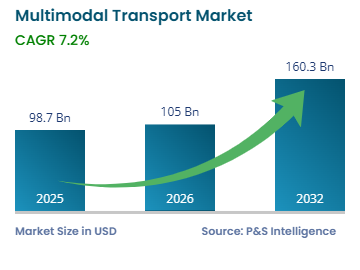
The multimodal transport market size was USD 98.7 billion for 2025, and it will grow by 7.2% during 2026–2032, to reach USD 160.3 billion by 2032.
This growth is driven by an accelerating transition from single-mode freight movement to integrated road, rail, sea, and air logistics operations, as globally dispersed supply chains demand higher transit reliability, real-time cargo visibility, and cost efficiency governed under a unified contractual framework. Cross-border e-commerce proliferation, just-in-time manufacturing imperatives, and sustained government infrastructure investment are reinforcing multimodal adoption across developed and emerging economies alike. The Bureau of Transportation Statistics reports that transportation and warehousing services contributed approximately USD 1.8 trillion, representing around 6% of U.S. GDP in 2024, illustrating the foundational economic significance of integrated freight logistics.
Digital platforms incorporating AI-based route optimization, IoT-enabled cargo tracking, and automated customs documentation are simultaneously reducing transit variability and expanding the addressable market for coordinated multimodal operators. In June 2024, the U.S. Department of Transportation announced over USD 1.8 billion under the Rebuilding American Infrastructure with Sustainability and Equity (RAISE) discretionary grant program, funding 148 transportation projects nationwide. This funding reflects strong federal commitment to freight network modernization, alongside comparable infrastructure initiatives advancing across Europe and Asia-Pacific.
Key Market Insights
The two-mode category holds the largest market share, of 55%, in 2025, driven by the widespread operational preference for combining two complementary modes, most commonly road-rail and road-sea combinations, under a single transport contract.
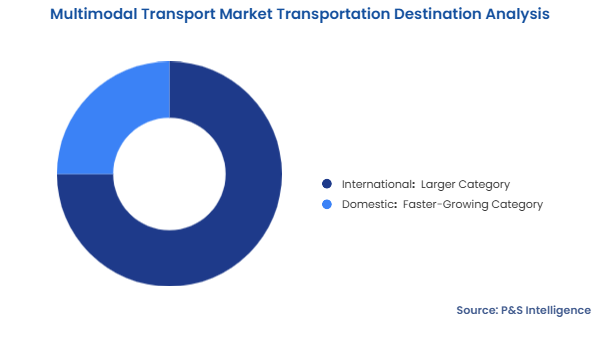
The international category holds the largest share, at 75% in 2025, as multimodal transport is primarily used for cross-border shipments requiring coordinated movement across sea, rail, and road under a single transport contract.
The road category holds the largest market share, of 45%, in 2025, functioning as the essential first-mile and last-mile connector within virtually all multimodal freight chains.
The manufacturing category leads in 2025, holding approximately 30% market share, driven by its high freight volumes requiring integrated multimodal transport.
Asia-Pacific holds the largest market share, of 40%, in 2025, and it will have the highest CAGR, of 7.5%, supported by unparalleled trade volumes, expansive manufacturing networks, and government-backed infrastructure programs at a scale unmatched globally.
Multimodal Transport Market Dynamics
Supply Chain Digitalization and Real-Time Visibility Platforms Are Key Trends
The widespread deployment of AI-driven route optimization, IoT-enabled cargo tracking, and automated digital documentation is fundamentally reshaping how multimodal freight is planned, executed, and monitored across international corridors. The integration of real-time tracking platforms and Transportation Management Systems is eliminating these gaps by providing end-to-end shipment visibility under a single digital interface.
The European Union's Electronic Freight Transport Information (eFTI) Regulation, which mandates that all EU member states accept electronic freight documentation from certified digital platforms, is expected to generate annual savings of approximately EURO 1 billion in operational and administrative costs for the European transport and logistics sector upon full implementation. Meanwhile, the United Nations Centre for Trade Facilitation and Electronic Business (UN/CEFACT) has established data exchange standards critical for multimodal supply chain interoperability, enabling seamless digital communication across modes, borders, and regulatory jurisdictions.
Expanding Global Trade Volumes and Government Infrastructure Investment Are Biggest Drivers
Rising global merchandise trade volumes are the primary external force propelling multimodal transport adoption, as higher freight throughput creates measurable pressure on single-mode infrastructure and compels shippers to leverage integrated routing to maintain delivery commitments. According to the World Trade Organization, global merchandise trade volumes rebounded strongly in Q1 2025, rising 5.3% year-on-year, supported by import frontloading and technology-driven demand. Simultaneously, large-scale government infrastructure investment across North America, Europe, and Asia-Pacific is expanding physical multimodal capacity in ways that directly enable market growth. The U.S. Bipartisan Infrastructure Law authorizes approximately USD 66 billion for passenger and freight rail and invests more than USD 17 billion in port infrastructure and waterways, and the European Commission selected 94 transport projects to receive nearly EURO 2.8 billion in grants under the Connecting Europe Facility in 2025 to modernize railways, inland waterways, maritime routes, and other transport infrastructure.
Additionally, the Government of India has approved the development of 35 Multi-Modal Logistics Parks (MMLPs) at strategic locations under the PM GatiShakti National Master Plan and associated infrastructure schemes, with many parks planned for multimodal connectivity, including road, rail, and freight rail integration to strengthen national freight logistics efficiency.
Nearshoring, Friendshoring, and Supply Chain Reconfiguration Are Biggest Opportunities
Structural reconfiguration of global supply chains, driven by geopolitical tensions, tariff escalation, and corporate risk diversification, is actively generating new multimodal freight corridor opportunities as manufacturing footprints shift from concentrated single-country sourcing toward distributed regional production networks. As companies relocate production capacity from China to Vietnam, Mexico, India, and Eastern Europe, freight flows between these new production hubs and their consumption markets require multimodal solutions capable of integrating inland manufacturing locations with coastal port infrastructure through coordinated road-rail-sea routing. The United Nations Conference on Trade and Development (UNCTAD) reported that global trade reached approximately USD 33 trillion in 2024, reflecting moderate year-on-year growth despite geopolitical and supply chain pressures, with Asia and Latin America identified as key contributors to trade expansion.
In North America, accelerating nearshoring across the U.S.–Mexico corridor is creating structurally durable multimodal route expansion opportunities. Mexico’s Interoceanic Corridor of the Isthmus of Tehuantepec is establishing a strategic Atlantic–Pacific land bridge alternative, while rising cross-border manufacturing investment in Northern Mexico and the U.S. Southwest is increasing demand for integrated rail–truck–port logistics solutions under the USMCA trade framework.
Similarly, India's National Logistics Policy targeting logistics cost reduction from 13% to 8% of GDP by 2030, and Vietnam's expanding port infrastructure collectively exemplify the physical enablers converting nearshoring trends into multimodal freight demand. For logistics operators, this reconfiguration presents a definitive expansion pathway: companies that establish multimodal service networks across newly active manufacturing corridors before route consolidation occurs will secure durable competitive positions in fast-growing, structurally necessary freight lanes through 2032.
Multimodal Transport Market Segmentation and Category Analysis
Configuration Analysis
The two-mode category holds the largest market share, of 55%, in 2025, driven by the widespread operational preference for combining two complementary modes, most commonly road-rail and road-sea combinations, under a single transport contract. Two-mode structures offer shippers a proven balance between cost reduction, transit reliability, and operational simplicity, particularly for continental bulk commodity movements, containerized manufactured goods, and raw material freight that does not require temperature-controlled or time-critical handling. The long-established road-rail intermodal network across North America, encompassing more than 140,000 route miles of Class I railroad and 300+ inland intermodal terminals, exemplifies the infrastructure maturity that sustains two-mode dominance.
The three-mode category will have the highest CAGR, of 7.4%, driven by escalating pharmaceutical cold-chain requirements, cross-border e-commerce time-sensitivity, and the growing complexity of dispersed global manufacturing networks that require synchronized sea-rail-road or air-rail-road sequencing. UNCTAD's Review of Maritime Transport confirms that vessel ton-miles grew 6% in 2024, reflecting extended routing that increasingly necessitates multi-mode connectivity to maintain end-to-end delivery commitments.
The configurations analyzed in this report are:
Two-Mode (Largest Category)
Three-Mode (Fastest-Growing Category)
Others
Transportation Destination Analysis
The international category holds the largest market share, of 75%, in 2025, reflecting the inherent nature of multimodal transport as the preferred freight solution for cross-border shipments requiring coordinated modal transitions across sea, rail, and road infrastructure spanning multiple jurisdictions under a single transport document. Long-distance international freight movements, transoceanic container shipments connecting Asia, Europe, and North America, and overland cross-continental rail corridors such as the China-Europe Railway Express, represent the highest per-shipment revenue opportunity within multimodal networks and are operationally dependent on multi-mode integration by design.
The domestic category will have the highest CAGR, of 7.3%, driven by e-commerce penetration in large emerging economies, including India, Indonesia, Vietnam, and Brazil, where expanding urban consumer markets require coordinated road-rail-inland waterway multimodal networks to overcome infrastructure limitations and reach inland distribution points efficiently.
The transportation destinations analyzed in this report are:
International (Larger Category)
Domestic (Faster-Growing Category)
Individual Mode Analysis
The road category holds the largest market share, of 45%, in 2025, functioning as the essential first-mile and last-mile connector within virtually all multimodal freight chains. Road's dominance stems from its unmatched geographic coverage, door-to-door delivery capability, and scheduling flexibility, characteristics that no other freight mode replicates at scale, positioning it as a mandatory component of all multimodal configurations.
The air category will have the highest CAGR, of 7.6%, driven by surging cross-border e-commerce volumes from Asia, particularly China's export-oriented e-commerce platforms, and growing demand for time-critical pharmaceutical, semiconductor, and high-value electronics freight. IATA reports that air cargo demand rose 11.3% in 2024, marking the strongest annual growth in recent years, driven by elevated e-commerce volumes and sea-to-air modal conversion triggered by Red Sea routing disruptions.
The individual modes analyzed in this report are:
Road (Largest Category)
Rail
Air (Fastest-Growing Category)
Marine (Sea/River)
Service Type Analysis
The freight forwarding category holds the largest market share, of 35%, in 2025, driven by its fundamental role in consolidating smaller shipments into full containers, managing multi-modal routing logistics, and coordinating customs clearance across international jurisdictions under a unified operational framework. The cost efficiency and global market accessibility that freight forwarding provides, particularly for small and mid-sized exporters shipping via LCL (less-than-container-load) sea and rail modes, creates structural demand that is resilient across trade cycle fluctuations. The UN/CEFACT has developed internationally recognized trade facilitation standards that specifically enable digital interoperability between freight forwarders, customs authorities, and multimodal carriers, reinforcing freight forwarding's central role in global trade flows.
The supply chain management category will have the highest CAGR, as shippers progressively outsource end-to-end logistics strategy, encompassing demand forecasting, inventory optimization, carrier management, and multimodal route engineering, to specialized third-party providers.
The manufacturing category holds the largest market share, in 2025, driven by the sector's structurally high freight intensity, encompassing inbound raw material movements, inter-plant work-in-progress transfers, and outbound finished goods shipments, all of which demand coordinated multimodal integration across road, rail, sea, and air corridors at scale. Automotive, chemical, and heavy machinery manufacturers in particular rely on just-in-time delivery schedules across multi-continental supply chains, where multimodal transport's routing flexibility and cost optimization capabilities are operationally non-substitutable.
The retail & e-commerce category will have the highest CAGR, driven by exponential cross-border e-commerce volume expansion requiring multimodal precision delivery networks that integrate sea, air, rail, and last-mile road segments under accelerated transit timelines. UNCTAD reports that global e-commerce sales exceeded USD 1 trillion in recent years, with cross-border digital trade representing a significant and growing component of international retail activity, according to UNCTAD e-commerce updates, creating irreversible structural demand for multimodal freight systems capable of handling high-frequency, geographically dispersed consumer parcel volumes.
The end uses analyzed in this report are:
Manufacturing (Largest Category)
Retail & E-commerce (Fastest-Growing Category)
Chemicals
Pharmaceutical & Healthcare
Food & Beverages
Oil & Gas
Aerospace & Defense
Others
Drive strategic growth with comprehensive market analysis
Multimodal Transport Market Geographical Analysis
Asia-Pacific Multimodal Transport Market Size
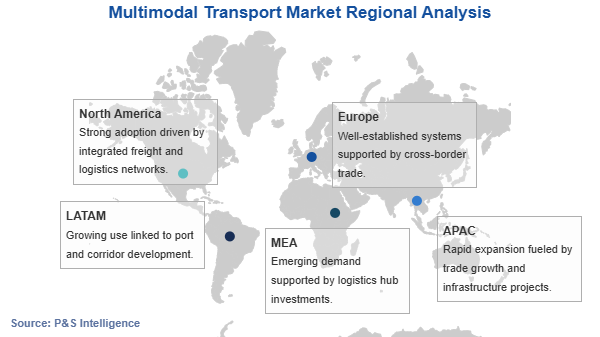
Asia-Pacific holds the largest market share, of 40%, in 2025, and it will have the highest CAGR, of 7.5%, supported by unparalleled trade volumes, expansive manufacturing networks, and government-backed infrastructure programs at a scale unmatched globally. The region's dominance is anchored by coastal megaport complexes, including Shanghai, Ningbo-Zhoushan, Shenzhen, Singapore, and Busan, serving as gateways for sea-rail-road freight corridors extending deep into inland production zones. China's Belt and Road Initiative (BRI), encompassing active engagement across more than 150 countries, has materially expanded cross-border multimodal connectivity through new overland rail routes and intermodal logistics parks. As of early 2026, Asia–Europe ocean freight transit times have extended to approximately 40–45 days due to Red Sea diversions via the Cape of Good Hope, thereby increasing the relative time advantage of overland rail corridors. ASEAN economies, including Vietnam, Thailand, and Indonesia, are simultaneously emerging as significant manufacturing alternatives, accelerating demand for diversified multimodal freight solutions.
The United Nations Economic and Social Commission for Asia and the Pacific states that in 2024, Asia-Pacific’s real merchandise exports grew by approximately 3.4% and imports by 3.6%, both exceeding global averages, while intra-regional trade accounted for nearly 60% of the region’s total exports, underscoring the strength of regional trade integration. The Asian Infrastructure Investment Bank approved approximately USD 8.4 billion in project financing in 2024, covering transport, energy, water, digital and social infrastructure projects across Asia and beyond, with transport forming a significant component of these investments.
China Multimodal Transport Market Size
China holds the largest share within the Asia Pacific multimodal transport market in 2025, anchored by its position as the world's foremost export economy and its extensive intermodal infrastructure network spanning deep-sea ports, inland dry ports, and cross-border rail systems. China's coastal port network, led by Shanghai, which processed approximately 49.2 million TEUs in 2024, is integrated with an expanding inland rail system connecting Sichuan, Chongqing, and Xinjiang production clusters to international freight gateways. The China-Europe Railway Express (CRE), linking approximately 60 Chinese cities to over 50 European destinations, has become a critical multimodal artery reducing cross-continental transit to 12–18 days. According to the National Bureau of Statistics of China, China’s total freight traffic reached 55.7 billion tonnes in 2023, up by about 8.1% over the previous year.
China has launched multiple batches of national multimodal transport demonstration projects and is advancing over 100 national logistics hubs under the 14th Five-Year Plan. Moreover, China's multimodal market trajectory remains strongly positive through 2032, supported by ongoing port expansion at Ningbo-Zhoushan, now the world's largest port by cargo tonnage, and the progressive deployment of AI-driven freight management platforms.
India Multimodal Transport Market Size
India is the fastest-growing individual country market within Asia Pacific for multimodal transport in 2025, driven by transformative government infrastructure investments and a structural shift in national logistics policy toward integrated freight systems. India's Dedicated Freight Corridor network, comprising the 1,506 km Eastern DFC and 1,504 km Western DFC, has enabled segregated high-speed rail freight movement connecting major industrial clusters in Punjab, Haryana, and Rajasthan to the ports of Mumbai and Jawaharlal Nehru Port Trust (JNPT). The National Logistics Policy (NLP) targets reducing India’s logistics cost-to-GDP ratio toward global benchmark levels of around 8–9% through multimodal integration and infrastructure modernization.
Additionally, India’s Dedicated Freight Corridor Corporation of India Limited reported a significant increase in freight operations across the Eastern and Western Dedicated Freight Corridors, with freight train activity rising by approximately 48% in FY 2024–25, reflecting improving corridor utilization and multimodal freight efficiency. The Ministry of Ports, Shipping and Waterways has set a long-term target for India’s port cargo handling capacity to exceed 10,000 million tonnes per annum by 2047 under the Maritime Amrit Kaal Vision 2047 framework, with multimodal connectivity and port-linked industrial integration positioned as core pillars under the Sagarmala Programme and related infrastructure expansion initiatives.
The regions and countries of the market are as follows:
North America
U.S. (Larger and Faster-Growing Country Market)
Canada
Europe
Germany (Largest Country Market)
U.K. (Fastest-Growing Country Market)
France
Italy
Spain
Rest of Europe
Asia-Pacific (Largest and Fastest-Growing Regional Market)
China (Largest Country Market)
India (Fastest-Growing Country Market)
Japan
South Korea
Australia
Rest of APAC
Latin America
Brazil (Largest Country Market)
Mexico (Fastest-Growing Country Market)
Rest of LATAM
Middle East and Africa
Saudi Arabia (Largest Country Market)
South Africa (Fastest-Growing Country Market)
U.A.E.
Rest of MEA
Multimodal Transport Market Share Analysis
The market is fragmented because it operates across multiple transportation modes, road, rail, sea, and air, each with distinct infrastructure ownership, regulatory frameworks, and regional operating constraints. No single operator controls assets across all modes and geographies at scale, leading to corridor-specific competition. Freight flows are often structured around regional trade lanes, favoring local rail operators, port authorities, trucking firms, and specialized freight forwarders. Additionally, diverse end-use requirements, such as cold chain pharmaceuticals, bulk commodities, and project cargo, support niche providers alongside global logistics integrators. This combination of modal specialization, geographic dispersion, and industry-specific service demands prevents dominant global concentration.
Multimodal Transport Market Service Providers:
Kuehne + Nagel International AG
Deutsche Post AG (DHL Group)
C.H. Robinson Worldwide, Inc.
Geodis SA
Yusen Logistics Co., Ltd.
Marubeni Logistics Corporation
BDP International, Inc.
Crowley Maritime Corporation
DSV A/S
Mitsubishi Logistics Corporation
Samskip
Noatum Logistics
DP World
Bison Transport Inc.
Expeditors International of Washington, Inc.
Multimodal Transport Market News & Updates
In April 2025, DSV A/S completed its acquisition of Schenker AG from Deutsche Bahn AG in a transaction valued at approximately EUR 14.3 billion, positioning DSV among the world’s largest freight forwarding and multimodal logistics operators and significantly strengthening its global integrated transport and supply chain management capabilities.
In November 2024, Kuehne + Nagel International AG announced the acquisition of a majority stake in IMC Logistics, a U.S.-based marine drayage and intermodal logistics provider, expanding its inland container and port-rail integration capabilities across North American multimodal corridors.
In February 2024, Danser Group, Swissterminal, and DP World formed a strategic alliance to establish a sustainable inland waterway freight service along the Rhine corridor, enhancing sea–rail–river multimodal connectivity between Central Europe and North Sea ports including Rotterdam and Antwerp.
In January 2024, Bison Transport Inc. announced a strategic intermodal partnership with Canadian Pacific Kansas City (CPKC) to establish integrated transportation services along the north-south corridor connecting Canada, the United States, and Mexico.
Frequently Asked Questions About This Report
Want a report tailored exactly to your business need?
Leading companies across industries trust us to deliver data-driven insights and innovative solutions for their most critical decisions. From data-driven strategies to actionable insights, we empower the decision-makers who shape industries and define the future. From Fortune 500 companies to innovative startups, we are proud to partner with organisations that drive progress in their industries.
Client Testimonials
Working with P&S Intelligence and their team was an absolute pleasure – their awareness of timelines and commitment to value greatly contributed to our project's success. Eagerly anticipating future collaborations.
McKinsey & Company
India
Unmatched Standards
Our insights into the minutest levels of the markets, including the latest trends and competitive landscape, give you all the answers you need to take your business to new heights
Complete Data Security
We take a cautious approach to protecting your personal and confidential information. Trust is the strongest bond that connects us and our clients, and trust we build by complying with all international and domestic data protection and privacy laws