Multimodal AI Market Size & Share Analysis - Trends, Drivers, Competitive Landscape, and Forecasts (2026 - 2032)
This Report Provides In-Depth Analysis of the Multimodal AI Market Report Prepared by P&S Intelligence, Segmented by Offering (Solutions, Services), Data Modality (Text, Image, Audio, Video, Speech & Voice), Technology (Machine Learning, Natural Language Processing, Computer Vision, Context Awareness), Type (Generative, Translative, Explanatory, Interactive), Application (BFSI, Retail & E-commerce, IT & Telecommunication, Manufacturing, Healthcare, Automotive & Transportation, Media & Entertainment, Gaming, Education, Government & Public Sector), Enterprise Size (Large Enterprises, Small & Medium-sized Enterprises), and Geographical Outlook for the Period of 2021 to 2032
Explore the market potential with our data-driven report
Multimodal AI Market Overview
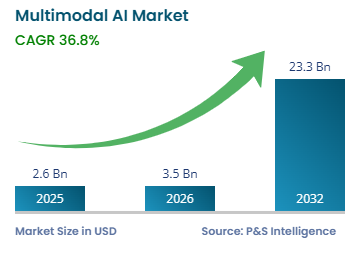
The multimodal AI market size was USD 2.6 billion for 2025, and it will grow by 36.8% during 2026–2032, to reach USD 23.3 billion by 2032.
This growth is driven by enterprise demand for systems that reason jointly across text, image, audio, video, and speech inputs, replacing the fragmented single-modality pipelines that dominated earlier deployments.
The commercial case rests on a measurable shift from pilot projects to production workloads. The Federal Reserve reports that approximately 78% of the U.S. labor force works at firms that have adopted AI, with about 54% employed at firms already running large language models. The Government of China confirms that more than 30% of manufacturing enterprises with annual turnover above 20 million yuan had deployed AI technologies by the end of 2025. The growing adoption of AI is increasing demand for systems that can integrate and interpret diverse data types, including text, images, audio, and video, rather than analyzing each modality separately.
Key Market Insights
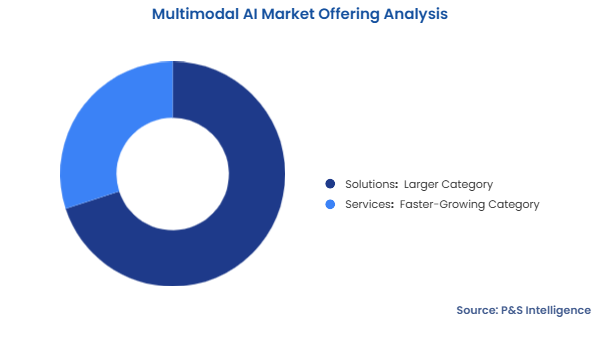
The solutions category holds the larger market share, of 70%, in 2025, driven by demand for ready-to-deploy multimodal AI platforms.
The context awareness category will have the highest CAGR, of approximately 37.2%, driven by demand for AI that understands data relationships, user intent, and real-time interactions.
The media & entertainment category holds the largest market share, of 25%, in 2025, driven by growing multimodal AI adoption in content creation, personalization, localization, and audience engagement.
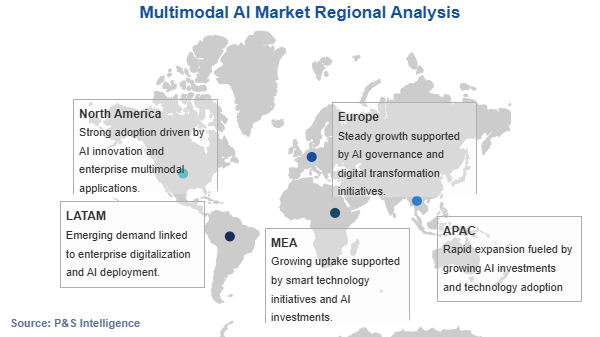
North America holds the largest market share, of 40%, in 2025, supported by strong AI companies, infrastructure, enterprise adoption, and investment.
Asia-Pacific will have the highest CAGR, of approximately 37.7%, driven by state-funded compute programs and rapid industrial deployment.
Multimodal AI Market Trends and Drivers
Infrastructure Specialization Is Key Trend
Enterprise buying is shifting from assembling separate vision, speech, and language contracts toward procuring unified serving capacity from a single provider, and the underlying infrastructure is specializing to match. As multimodal models process increasingly complex and diverse data, they require substantial computational resources, increasing demand for accelerator-based infrastructure. The consequence is a visible bifurcation between general-purpose data centre capacity and accelerator-dense capacity designed to support computationally intensive AI workloads. The 2026 Stanford AI Index reports that global AI compute capacity grew 3.3× annually from 2022 to 2025, reaching 17.1 million H100-equivalents, with NVIDIA accounting for more than 60% of total compute capacity.
For vendors, this trend favours those that can bundle model, serving stack, and capacity together; for buyers, it reduces integration overhead but can increase dependence on fewer providers. The continued expansion of multimodal AI workloads is expected to drive investment in specialized accelerator capacity, while hybrid and on-premises infrastructure will remain important where data residency, security, or latency requirements limit centralized deployment.
Escalating R&D Intensity and Patent Competition Are Key Drivers
Research investment in generative and multimodal systems has moved from exploratory funding to defensive commercial positioning, and the pace of invention is now the clearest leading indicator of near-term product supply. The mechanism is direct; as capability improvements compress the accuracy gap between fused-modality reasoning and specialist single-modality tools, buyers stop treating multimodal systems as experimental substitutes and begin specifying them in procurement. Vendors respond by filing defensively and shipping faster, which shortens refresh cycles and pulls forward enterprise replacement budgets.
World Intellectual Property Organization analysis shows that published generative AI patent families rose from roughly 14,000 in 2023 to more than 37,000 in 2025, with over 56,000 new families published during 2024 and 2025 alone, exceeding the entire output of the preceding decade, while generative AI grew to 8.7% of all AI patenting from 6.1% in 2023. The widening patent landscape reflects intensifying competition as companies expand generative AI capabilities across models, software, infrastructure, and applications. WIPO reports that patent activity is broadening beyond traditional technology companies to include telecommunications, infrastructure, industrial, and utility companies, increasing R&D activity and supporting the development and commercialization of advanced AI capabilities.
Compute Cost and Power Infrastructure Are Key Restraints
The principal brake on adoption is physical rather than commercial. Multimodal models can require substantially more computational resources than text-only models because processing video, audio, and high-resolution visual inputs increases the volume and complexity of data that must be processed, raising inference costs for compute-intensive workloads. Where computing capacity is constrained, enterprises may prioritize high-return workflows rather than scale multimodal AI deployments across the organization.
The International Energy Agency projects that data centre electricity consumption will more than double to around 945 TWh by 2030, while roughly 20% of planned data centre projects are at risk of delay due to grid connection constraints. These power and infrastructure limitations can restrict the availability of computing capacity required to deploy compute-intensive multimodal AI workloads at scale, increasing infrastructure costs and potentially slowing enterprise deployment. Grid queues, transformer and turbine supply constraints, and local permitting can further contribute to deferred capacity and higher infrastructure costs. This restraint is expected to ease gradually as model efficiency improves and purpose-built AI capacity comes online, but power availability and infrastructure constraints are likely to continue influencing deployment economics and favor vendors with secured long-term power and accelerator supply.
Sensory Access Gaps and Underserved Language Coverage Are Biggest Opportunities
A substantial and quantifiable gap exists between the populations who would benefit from speech-, vision-, and translation-based interfaces and those currently served by them. Multimodal systems address this gap structurally, because a single model that converts between speech, text, and visual representations removes the device-specific hardware dependency that has historically limited reach and cost. The World Health Organization reports that approximately 1.5 billion people live with hearing loss while hearing aid production meets less than 10% of global demand, and that unaddressed hearing loss carries an annual global cost of around USD 980 billion.
The commercial implication is that speech, captioning, and translation functions carry demand well beyond conventional enterprise use cases, extending into education, public services, and consumer devices in markets where text-first interfaces underperform. Realizing this pathway depends on model quality in low-resource languages and dialects, which remains uneven. Vendors that invest in regional acoustic and linguistic data are better positioned to capture demand in low-resource languages and dialects that generic English-centric models may not adequately serve.
Multimodal AI Market Segmentation Analysis
Offering Analysis
The solutions category holds the larger market share, of 70%, in 2025, driven by increasing enterprise demand for ready-to-deploy multimodal AI platforms that integrate text, image, audio, video, and speech capabilities into existing business workflows. The availability of scalable solutions reduces the need for enterprises to develop multimodal AI capabilities entirely in-house, supporting broader adoption across multiple applications and industries.
The services category will have the higher CAGR, of approximately 37.0%, driven by increasing demand for implementation, system integration, customization, model fine-tuning, deployment, and ongoing management of multimodal AI systems. The complexity of integrating multiple data modalities with existing enterprise systems is increasing the need for specialized technical and professional services, supporting faster growth in this category.
The offerings analyzed in this report are:
Solutions (Larger Category)
Services (Faster-Growing Category)
Data Modality Analysis
The text category holds the largest market share, of 40%, in 2025, driven by the widespread use of text as a foundational data format across enterprise documents, emails, customer interactions, business records, and digital content. The extensive availability of structured and unstructured textual data, combined with the maturity of natural language processing technologies and large language models, supports broad enterprise adoption and makes text the dominant modality.
The speech & voice category will have the highest CAGR, driven by the growing adoption of voice-based AI assistants, conversational AI, speech recognition, real-time transcription, and voice-enabled customer service applications. Improvements in speech recognition and multilingual capabilities are expanding voice AI across customer service, healthcare, automotive, education, and consumer applications, supporting faster growth in this category. USAID notes that more than 7,000 languages are spoken worldwide, while only a few are recognized by voice assistants, highlighting significant opportunities for multilingual speech AI and underserved-language applications.
The data modalities analyzed in this report are:
Text (Largest Category)
Image
Audio
Video
Speech & Voice (Fastest-Growing Category)
Technology Analysis
The machine learning category holds the largest market share in 2025, driven by its foundational role in training, inference, prediction, pattern recognition, and decision-making across multimodal AI systems. ML provides the underlying algorithms required to process and learn from multiple data types, while its broad integration across enterprise AI platforms, automation, predictive applications, and intelligent systems supports its dominant market position. The OECD reports that 20.2% of firms across OECD countries used AI in 2025, up from 14.2% in 2024 and 8.7% in 2023, demonstrating the expanding enterprise adoption of AI technologies built on machine-learning capabilities.
The context awareness category will have the highest CAGR, of approximately 37.2%, driven by growing demand for AI systems that can understand relationships between different data modalities, user intent, environmental conditions, and real-time interactions. Improvements in contextual reasoning enable multimodal systems to deliver more relevant responses and decisions by combining information from text, images, audio, video, and surrounding context, supporting rapid adoption across autonomous systems, robotics, healthcare, customer service, and enterprise applications.
The technologies analyzed in this report are:
Machine Learning (ML) (Largest Category)
Natural Language Processing (NLP)
Computer Vision
Context Awareness (Fastest-Growing Category)
Type Analysis
The generative category holds the largest market share, of 45%, in 2025, driven by the growing use of AI systems that can create and combine text, images, audio, video, and other content from multimodal inputs. The rapid adoption of generative AI for content creation, marketing, software development, product design, media production, and enterprise automation supports broad commercial deployment and makes generative applications the dominant type. According to WIPO, more than 56,000 generative-AI patent families were published globally during 2024–2025, highlighting the rapid expansion of technological development and commercialization in generative AI.
The interactive category will have the highest CAGR, driven by increasing demand for AI systems that can understand and respond to users in real time through combinations of text, speech, images, and video. The expansion of conversational AI assistants, voice-enabled interfaces, intelligent customer service, robotics, and interactive digital environments is increasing demand for real-time multimodal interaction, supporting faster growth in this category.
The types analyzed in this report are:
Generative (Largest Category)
Translative
Explanatory
Interactive (Fastest-Growing Category)
Application Analysis
The media & entertainment category holds the largest market share in 2025, driven by the increasing use of multimodal AI for content creation, video generation, content personalization, media localization, visual content analysis, advertising, and audience engagement. The ability to combine text, image, audio, and video inputs enables media and entertainment companies to automate content workflows, improve personalization, and create new forms of interactive and generative content, supporting strong adoption of multimodal AI across the sector.
The retail & e-commerce category will have the highest CAGR, of approximately 37.5%, driven by the increasing adoption of multimodal AI for visual search, personalized product recommendations, virtual shopping assistants, customer-service automation, and product-content generation. The ability to combine product images, descriptions, customer reviews, voice interactions, and behavioral data enables retailers to deliver more personalized and efficient shopping experiences, accelerating the adoption of multimodal AI across the sector.
The applications analyzed in this report are:
BFSI
Retail & E-commerce (Fastest-Growing Category)
IT & Telecommunication
Manufacturing
Healthcare
Automotive & Transportation
Media & Entertainment (Largest Category)
Gaming
Education
Government & Public Sector
Others
Enterprise Size Analysis
The large enterprises category holds the larger market share, of 75%, in 2025, driven by their greater financial capacity, established IT infrastructure, larger data resources, and ability to invest in advanced AI models, computing infrastructure, and specialized talent. Large organizations also have more complex business processes and broader AI use cases across customer service, operations, analytics, and content management, supporting higher multimodal AI adoption and a larger contribution to market revenue. The OECD reports that 52.0% of large firms used AI in 2025, compared with 17.4% of small firms, highlighting the significantly higher AI adoption among larger organizations.
The small & medium-sized enterprises category will have the higher CAGR, driven by increasing access to cloud-based AI platforms, pre-trained multimodal models, and pay-as-you-go AI services that reduce the need for substantial upfront infrastructure investment. Lower deployment barriers are enabling SMEs to adopt multimodal AI for customer engagement, marketing, automation, and business operations, creating substantial room for expansion from their currently lower adoption base. The OECD reports that 31% of surveyed SMEs were already using generative AI, demonstrating the growing accessibility of AI technologies among smaller businesses.
The enterprise sizes analyzed in this report are:
Large Enterprises (Larger Category)
Small & Medium-sized Enterprises (SMEs) (Faster-Growing Category)
Drive strategic growth with comprehensive market analysis
Multimodal AI Market Geographical Analysis
North America Multimodal AI Market Size
North America holds the largest market share, of 40%, in 2025, driven by the strong presence of leading AI companies, hyperscale cloud providers, advanced computing infrastructure, high enterprise AI adoption, and substantial investment in AI development. Leadership rests on the concentration of foundation-model laboratories and hyperscale cloud operators that own both training compute and distribution channels, sustained private capital that funds the multi-year training runs unified vision-language-audio models require, and an enterprise base that has already digitized the document, call-recording, and imaging archives such models consume. The U.S. Census Bureau reports that 19.8% of U.S. businesses used AI in their operations as of May 3, 2026, with the Information sector at 39.7% and Finance and Insurance at 33.9%, both well above the national rate.
U.S. Multimodal AI Market Size
The U.S. represents the largest country market within North America and the single largest national market globally, accounting for the majority of regional revenue in 2025. Concentration of model developers, GPU supply agreements, and enterprise software vendors within one commercial ecosystem shortens the path from research release to production. Federal procurement adds a second buyer class with distinct requirements around on-premises inference and audit trails. The U.S. Census Bureau finds that 57% of AI-using firms deploy the technology in three or fewer business functions, most commonly Sales and Marketing at 52%, Strategy and Business Development at 45%, and IT at 41%. The relatively limited adoption of AI across business functions indicates significant room for further enterprise AI deployment, with broader adoption across operations, quality control, customer service, and other functions expected to support continued demand for multimodal AI solutions through the forecast period.
Asia-Pacific Multimodal AI Market Size
Asia-Pacific will have the highest CAGR, of approximately 37.7%, driven by state-funded compute programs and rapid industrial deployment. Governments treat AI compute as public infrastructure and subsidize access rather than leaving allocation to commercial pricing; manufacturing density creates immediate use cases in visual inspection and voice-directed operations; and mobile-first consumer bases generate video and speech data at volumes that make multimodal training economically rational. Linguistic diversity further raises the value of speech and translation capability.
The Press Information Bureau, Government of India announced that India will add 20,000 GPUs to its existing base of 38,000 GPUs, extending subsidized compute access to startups, researchers, and academic institutions under the IndiaAI Mission. Japan, South Korea, and Australia are expected to contribute significant demand in areas such as robotics, semiconductor manufacturing, enterprise AI, and advanced industrial applications. Continued investment in AI computing infrastructure, industrial automation, and domestic AI capabilities is expected to support Asia Pacific's growth.
China Multimodal AI Market Size
China represents the largest country market within Asia Pacific, supported by an unusually complete domestic stack spanning accelerators, foundation models, cloud platforms, and application vendors. Open-weight model releases from domestic developers have lowered deployment cost for Chinese enterprises and reduced dependence on foreign APIs, while state industrial policy directs adoption into specific verticals rather than leaving diffusion to market timing. The Government of China reports that the country's core AI industry exceeded 1.2 trillion yuan in 2025, with more than 6,200 AI companies operating nationally.
The country's large manufacturing base, extensive digital ecosystem, and growing deployment of AI across industrial and consumer applications are creating substantial demand for systems capable of processing and integrating text, image, audio, and video data. Increasing investment in AI infrastructure and the expansion of AI applications across manufacturing, autonomous driving, content creation, and enterprise services are expected to further support multimodal AI market growth.
These regions and countries are analyzed:
North America (Largest Regional Market)
U.S. (Larger Country)
Canada (Faster-Growing Country)
Europe
Germany (Largest Country)
U.K.
France
Italy (Fastest-Growing Country)
Spain
Rest of Europe
Asia-Pacific (Fastest-Growing Regional Market)
China (Largest Country)
India (Fastest-Growing Country)
Japan
South Korea
Australia
Rest of APAC
Latin America
Brazil (Largest and Fastest-Growing Country)
Mexico
Rest of LATAM
Middle East & Africa
Saudi Arabia (Largest Country)
South Africa
U.A.E. (Fastest-Growing Country)
Rest of MEA
Multimodal AI Market Competitive Landscape
The market is semi-consolidated, as a limited number of large technology companies hold substantial influence across foundation models, cloud infrastructure, AI accelerators, and enterprise AI platforms, while numerous startups and specialized providers compete across applications and industry-specific use cases. Companies such as OpenAI, Google, Microsoft, Meta, Amazon, NVIDIA, Anthropic, and other major technology providers have significant capabilities in model development, computing infrastructure, and AI distribution. These companies benefit from access to large-scale computing resources, extensive datasets, research talent, and established enterprise customer bases, creating high barriers to entry at the foundation-model and infrastructure levels. However, the market remains competitive because startups and specialized vendors continue to develop multimodal solutions for healthcare, manufacturing, media, customer service, robotics, and other verticals. This combination of high concentration among leading infrastructure and model providers and broad competition among specialized application vendors creates a competitive market environment with a mix of dominant players and specialized providers.
Leading Companies in the Multimodal AI Market:
Microsoft Corporation
Alphabet Inc.
OpenAI
Meta Platforms, Inc.
Amazon Web Services, Inc. (AWS)
NVIDIA Corporation
IBM Corporation
Anthropic PBC
Adobe Inc.
Salesforce, Inc.
Baidu, Inc.
Alibaba Group Holding Limited
Tencent Holdings Limited
Twelve Labs, Inc.
Jina AI GmbH
Multimodal AI Market Developments
InDecember 2024, Amazon Web Services, Inc. (AWS) launched Amazon Nova, a family of foundation models including multimodal models capable of processing image, video, and text inputs. The launch highlighted the growing commercialization of multimodal foundation models through cloud platforms and expanded enterprise access to multimodal AI capabilities.
InOctober 2024, Adobe Inc. launched its Firefly Video Model in beta, extending its generative AI capabilities from images and design into video generation. The development highlighted the increasing integration of multiple content modalities within creative workflows and expanded the addressable applications for multimodal generative AI.
InSeptember 2024, Meta Platforms, Inc. introduced multimodal capabilities in Llama 3.2, including image understanding and voice-based interaction with Meta AI. The development highlighted the expansion of multimodal AI into consumer applications and the integration of visual and voice capabilities into widely used AI assistants.
In April 2024,Microsoft Corporation launched Phi-3-Vision, a multimodal model capable of processing both text and images. The launch highlighted the growing availability of smaller, cost-efficient vision-language models, supporting broader enterprise adoption of multimodal AI beyond large-scale foundation models.
Frequently Asked Questions About This Report
What is driving the growth of the multimodal AI market?+
The market is driven by increasing adoption of AI systems that can process text, images, audio, video, and other data types, along with growing demand for AI-powered search, automation, content generation, and personalized customer experiences.
What are the major trends in the multimodal AI market?+
Major trends include the development of multimodal foundation models, integration of vision-language capabilities into enterprise applications, increasing use of generative AI, AI-powered visual and conversational search, and deployment across cloud and edge environments.
What are the major challenges facing the multimodal AI market?+
Major challenges include high computational and infrastructure costs, data privacy and security concerns, limited availability of high-quality multimodal datasets, model complexity, integration with existing IT systems, and concerns related to bias and AI reliability.
What are the security and privacy concerns associated with multimodal AI?+
Key concerns include unauthorized data access, data leakage, misuse of personal information, model vulnerabilities, and compliance with data-protection and AI regulations.
How is multimodal AI transforming business operations?+
Multimodal AI is transforming business operations by enabling organizations to analyze multiple data formats simultaneously, automate complex workflows, improve customer interactions, enhance decision-making, and generate or interpret content more efficiently.
Want a report tailored exactly to your business need?
Leading companies across industries trust us to deliver data-driven insights and innovative solutions for their most critical decisions. From data-driven strategies to actionable insights, we empower the decision-makers who shape industries and define the future. From Fortune 500 companies to innovative startups, we are proud to partner with organisations that drive progress in their industries.
Client Testimonials
Working with P&S Intelligence and their team was an absolute pleasure – their awareness of timelines and commitment to value greatly contributed to our project's success. Eagerly anticipating future collaborations.
McKinsey & Company
India
Unmatched Standards
Our insights into the minutest levels of the markets, including the latest trends and competitive landscape, give you all the answers you need to take your business to new heights
Complete Data Security
We take a cautious approach to protecting your personal and confidential information. Trust is the strongest bond that connects us and our clients, and trust we build by complying with all international and domestic data protection and privacy laws