Multi Cloud Management Market Size & Share Analysis - Trends, Drivers, Competitive Landscape, and Forecasts (2026 - 2032)
This Report Provides In-Depth Analysis of the Multi Cloud Management Market Report Prepared by P&S Intelligence, Segmented by Component (Software, Services), Deployment Model (Public Cloud, Hybrid Cloud, Private Cloud), Organization Size (Large Enterprises, Small & Medium Enterprises), Enterprise Application (Infrastructure & Resource Management, Security & Compliance, Cloud Operations Management, Cost & Billing Management, Automation & Orchestration, Monitoring & Analytics), End User (BFSI, Manufacturing, IT & Telecom, Retail & E-commerce, Healthcare & Life Sciences, Government & Public Sector, Media & Entertainment, Energy & Utilities), and Geographical Outlook for the Period of 2021 to 2032
Explore the market potential with our data-driven report
Multi Cloud Management Market Future Outlook
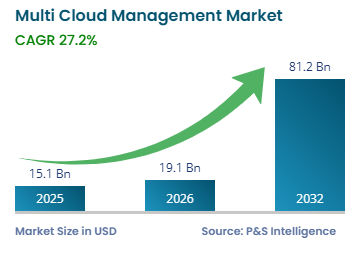
The multi cloud management market size was USD 15.1 billion for 2025, and it will grow by 27.2% during 2026–2032, to reach USD 81.2 billion by 2032.
The market is driven by enterprises facing escalating operational complexity as they distribute workloads across multiple public clouds, private infrastructure, container platforms such as Kubernetes, and distributed edge environments. Multi-cloud management platforms provide unified cloud operations, policy management, workload orchestration, security oversight, and spending optimization across heterogeneous cloud environments through a centralized control plane, while helping organizations avoid vendor lock-in.
The demand is further reinforced by the widespread adoption of hybrid cloud architectures, infrastructure-as-code, container orchestration, and the rapid expansion of artificial intelligence and machine learning workloads, all of which require consistent policy enforcement across cloud providers. Additionally, increasing regulatory requirements for data sovereignty and growing FinOps initiatives to optimize fragmented cloud spending are accelerating platform adoption. Supporting this trend, Eurostat reported that 52.7% of EU enterprises used paid cloud computing services in 2025, representing a 7.4 percentage-point increase from 2023.
Key Market Insights
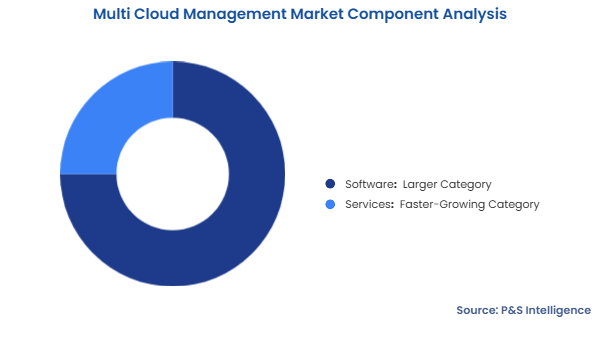
The software category holds the larger market share, of 75%, in 2025, driven by increasing adoption of centralized platforms for multi-cloud management and automation.
The large enterprises category holds the larger market share, of 80%, in 2025, driven by complex IT environments and increasing adoption of multi-cloud management platforms.
The security & compliance category will have the highest CAGR, of approximately 28.9%, driven by rising cyber threats and stricter regulatory requirements across multi-cloud environments.
The BFSI category holds the largest market share, of 25%, in 2025, driven by stringent regulatory requirements and high demand for secure multi-cloud management.
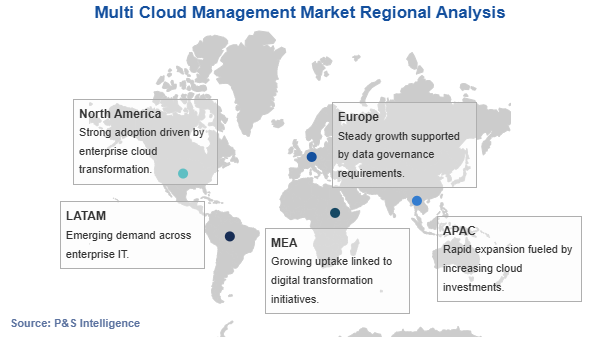
North America holds the largest market share, of 40%, in 2025, driven by advanced cloud infrastructure, high enterprise cloud adoption, and strong demand for multi-cloud governance, security, and automation.
Multi Cloud Management Market Trends and Drivers
AI-Driven Operations and FinOps Discipline Are Key Trends
A defining trend within the multi-cloud management market is the convergence of AI-driven operations (AIOps) and FinOps practices within cloud management platforms. As enterprises scale generative AI, machine learning, and cloud-native workloads, the resulting increase in compute consumption has made cost visibility, resource optimization, and automated governance strategic priorities. Organizations are increasingly adopting multi-cloud management platforms that integrate AI-powered workload placement, predictive analytics, automated policy enforcement, and intelligent resource optimization to reduce operational complexity and improve infrastructure efficiency across distributed cloud environments. According to the Cloud Native Computing Foundation (CNCF), 82% of container users ran Kubernetes in production in 2025, highlighting the widespread adoption of cloud-native orchestration technologies and increasing the need for multi-cloud management platforms that provide unified governance, workload orchestration, automation, and operational visibility across distributed cloud environments.
In addition, Flexera's 2026 State of the Cloud Report reveals that 63% of organizations have established dedicated FinOps teams, up from 59% in the previous year, reflecting the growing institutionalization of cloud financial management. This evolution is shifting the value proposition of multi-cloud management platforms beyond centralized visibility toward intelligent, autonomous optimization that improves performance, governance, and cost efficiency. Reflecting this trend, Broadcom Inc. integrated VMware Private AI Services into VMware Cloud Foundation 9.0 in August 2025, making the platform AI-native and enabling unified governance of AI and traditional workloads across private and hybrid cloud environments. As agentic AI, AIOps, and autonomous cloud operations continue to mature, enterprises are expected to increasingly adopt self-managing multi-cloud platforms capable of dynamically allocating resources and enforcing policies in real time.
Escalating Cloud Complexity and Vendor Lock-In Avoidance Are Biggest Drivers
The primary force behind the multi-cloud management market is the growing operational complexity enterprises face as workloads become distributed across multiple public cloud providers, private infrastructure, container platforms, and edge environments. As organizations deploy applications across Amazon Web Services (AWS), Microsoft Azure, Google Cloud, and on-premises systems to improve resilience, optimize performance, and avoid vendor lock-in, they require centralized platforms capable of providing unified visibility, governance, security, automation, cost optimization, and consistent policy enforcement across heterogeneous cloud environments, driving demand for multi-cloud management solutions that simplify operations.
Flexera's 2026 State of the Cloud Report reveals that 73% of organizations have adopted a hybrid cloud strategy, highlighting the continued expansion of multi-cloud adoption as enterprises seek greater flexibility, resilience, and vendor independence. The strategic importance of unified cloud orchestration was reinforced when IBM completed its USD 6.4 billion acquisition of HashiCorp in February 2025, strengthening its hybrid cloud automation portfolio with infrastructure provisioning and security capabilities across multiple cloud environments. Similarly, Flexera Software LLC strengthened its cloud financial management portfolio in March 2025 through the acquisition of NetApp's Spot FinOps portfolio, enhancing cloud cost optimization and FinOps capabilities across hybrid and multi-cloud environments. As AI workloads, cloud-native applications, Kubernetes deployments, and edge computing continue to expand, demand for centralized multi-cloud management platforms is expected to accelerate through 2032.
Skills Shortages and Integration Complexity Are Key Restraints
Despite rising demand, a persistent shortage of specialized cloud, cybersecurity, and cloud-native expertise continues to constrain the deployment and operation of multi-cloud management platforms. Managing governance, workload orchestration, automation, security, and compliance across heterogeneous cloud environments requires highly skilled cloud architects, DevOps engineers, Kubernetes specialists, and cybersecurity professionals, many of whom remain in short supply. This shortage makes it difficult for organizations to design, integrate, secure, and manage increasingly complex multi-cloud environments, slowing cloud migration initiatives and extending implementation timelines.
Integrating multiple public clouds, private infrastructure, legacy systems, and cloud-native applications requires deep technical expertise and careful coordination to ensure interoperability, consistent governance, and regulatory compliance. Vendors are increasingly incorporating AI-driven automation, low-code capabilities, and intelligent operational tools to simplify cloud management. However, despite these advances, the shortage of skilled professionals and the complexity of integrating heterogeneous cloud environments continue to restrain broader adoption of multi-cloud management platforms, particularly among small and medium-sized enterprises with limited internal IT resources.
Regulatory Compliance and Data Sovereignty Are Biggest Opportunity
Intensifying regulatory pressure around data sovereignty, cross-border data transfers, and cybersecurity is creating growth opportunities for the multi-cloud management market. Frameworks such as the EU Data Act promote cloud switching, interoperability, and data portability. These frameworks, together with increasingly stringent national data protection and sovereignty regulations, are encouraging enterprises in regulated industries to distribute workloads across multiple cloud environments while maintaining consistent governance and policy enforcement, driving demand for multi-cloud management platforms that automate compliance monitoring, policy enforcement, identity governance, and audit reporting across diverse cloud providers. In India, the Ministry of Electronics and Information Technology reported that 2,170 ministries and departments had hosted cloud-based applications on the Government's GI Cloud (MeghRaj) platform as of 2025, reflecting the country's growing emphasis on sovereign cloud infrastructure, centralized governance, and secure cloud adoption.
The rapid growth of Security & Compliance applications is strengthening this opportunity as organizations prioritize unified governance, regulatory adherence, and protection of sensitive data across distributed cloud environments. Vendors that integrate sovereignty-compliant workflows, automated regulatory controls, continuous compliance monitoring, and centralized governance capabilities are well positioned to capitalize on the growing enterprise demand for secure, compliant, and resilient multi-cloud operations across Europe, Asia Pacific, and other global markets.
Multi Cloud Management Market Segmentation Analysis
Component Analysis
The software category holds the larger market share, of 75%, in 2025, driven by enterprises' increasing reliance on centralized software platforms to orchestrate workloads, enforce governance, automate operations, monitor infrastructure, strengthen security, and optimize cloud costs across multiple public, private, and hybrid cloud environments. This widespread adoption of cloud-native orchestration technologies requires centralized software platforms for unified management, automation, governance, workload coordination, and the delivery of unified visibility and operational control across increasingly complex cloud ecosystems as organizations continue to expand their multi-cloud strategies.
The services category will have the higher CAGR, of approximately 27.4%, driven by increasing demand for consulting, migration, integration, implementation, and managed services. Many organizations lack the specialized expertise required to deploy and manage complex multi-cloud environments, leading them to rely on external service providers to accelerate cloud adoption, improve governance, strengthen security, and optimize operational performance.
The components analyzed in this report are:
Software (Larger Category)
Services (Faster-Growing Category)
Deployment Model Analysis
The public cloud category holds the largest market share, of 60%, in 2025, driven by its scalability, flexibility, and cost efficiency, enabling organizations to deploy applications quickly and access advanced computing, storage, analytics, and AI services without heavy capital investment. Multi-cloud management platforms further strengthen this deployment model by enabling enterprises to manage workloads, enforce policies, automate operations, and optimize resource utilization across multiple public cloud providers while enhancing operational visibility, security, and cost control.
The hybrid cloud category will have the highest CAGR, driven by enterprises combining the scalability of public cloud infrastructure with the control, security, and compliance offered by private environments for mission-critical workloads. The Cloud Native Computing Foundation (CNCF) and SlashData report that hybrid cloud usage reached 32% among developers in 2025. This adoption of mixed cloud environments requires unified management, workload orchestration, governance, and security across public and private infrastructure, accelerating demand for multi-cloud management platforms capable of providing centralized visibility, automation, compliance, and operational control across distributed cloud environments. Increasing adoption of hybrid IT strategies across regulated industries such as BFSI, healthcare, government, and manufacturing is further supporting this growth.
The deployment models analyzed in this report are:
Public Cloud (Largest Category)
Hybrid Cloud (Fastest-Growing Category)
Private Cloud
Organization Size Analysis
The large enterprises category holds the larger market share, in 2025, driven by complex IT environments and large-scale cloud deployments that require centralized management of workloads, governance, security, compliance, and cloud costs across multiple public, private, and hybrid cloud environments. Their extensive digital infrastructure and global operations have also made them early adopters of hybrid and multi-cloud strategies. Flexera's 2025 State of the Cloud Report reveals that 62% of enterprises use managed service providers (MSPs) for at least some public cloud management. This reliance on centralized cloud management solutions reflects the growing complexity of enterprise cloud environments.
The SMEs category will have the higher CAGR, of approximately 27.7%, driven by increasing adoption of cloud technologies to improve business agility, reduce infrastructure costs, and access enterprise-grade cloud capabilities without significant capital investment. The growing availability of subscription-based, automated, and easy-to-deploy multi-cloud management platforms is enabling SMEs to manage hybrid and multi-cloud environments more efficiently while reducing operational complexity and administrative overhead.
The organization sizes analyzed in this report are:
Large Enterprises (Larger Category)
Small & Medium Enterprises (SMEs) (Faster-Growing Category)
Application Analysis
The infrastructure & resource management category holds the largest market share, of 35%, in 2025, driven by the growing need to centrally manage compute, storage, networking, and workloads across multiple public, private, and hybrid cloud environments. These capabilities enable enterprises to improve resource utilization, automate provisioning, optimize infrastructure performance, and maintain operational visibility across increasingly complex cloud ecosystems.
The security & compliance category will have the highest CAGR, driven by increasing cyber threats, stricter regulatory requirements, and growing enterprise demand for unified governance across distributed cloud environments. According to IBM's Cost of a Data Breach Report 2024, 40% of all data breaches involved data stored across multiple environments, including public cloud, private cloud, and on-premises infrastructure, highlighting the need for centralized security, compliance, and policy management across heterogeneous cloud ecosystems.
The BFSI category holds the largest market share, in 2025, driven by stringent regulatory requirements and high data security demands that require the management of mission-critical applications across multiple cloud environments while ensuring business continuity, disaster recovery, and regulatory compliance. Financial institutions increasingly adopt multi-cloud management platforms to centralize governance, strengthen cybersecurity, optimize cloud costs, and maintain consistent policy enforcement across distributed infrastructure. Capgemini's World Cloud Report – Financial Services 2025 reveals that 84% of banks and insurers have adopted cloud solutions primarily to improve operational efficiency. This reliance on cloud technologies is driving the need for centralized multi-cloud management.
The manufacturing category will have the highest CAGR, of approximately 27.6%, driven by the rapid adoption of Industry 4.0, Industrial IoT (IIoT), digital twins, edge computing, and AI-enabled smart manufacturing. As manufacturers increasingly operate workloads across factory edge systems, private clouds, and public cloud platforms, demand for multi-cloud management solutions is rising to enable centralized workload orchestration, security, governance, and operational visibility across distributed industrial environments.
The end users analyzed in this report are:
BFSI (Largest Category)
Manufacturing (Fastest-Growing Category)
IT & Telecom
Retail & E-commerce
Healthcare & Life Sciences
Government & Public Sector
Media & Entertainment
Energy & Utilities
Others
Drive strategic growth with comprehensive market analysis
Multi Cloud Management Market Regional Outlook
North America Multi Cloud Management Market Size
North America holds the largest market share, of 40%, in 2025, driven by the world's deepest concentration of hyperscale cloud infrastructure, mature enterprise IT spending, pioneering multi-cloud operating models across industries, major cloud service providers, widespread FinOps and cloud governance practices, sustained investment in AI-ready infrastructure, and the increasing need for unified visibility, security, automation, and policy management across multiple cloud environments. Federal initiatives supporting data center expansion have strengthened regional cloud capacity. In July 2025, the White House issued an executive action to accelerate federal permitting for data center infrastructure. This action supports faster expansion of national compute capacity to meet growing AI and cloud demand.
Canada is experiencing rising adoption of multi-cloud management solutions as enterprises modernize hybrid cloud environments while strengthening compliance with data privacy regulations across banking, healthcare, telecommunications, and the public sector. Statistics Canada reports that 27.0% of Canadian businesses planning to adopt AI expected to purchase cloud services or cloud storage in 2025. This investment in scalable cloud infrastructure is driving demand for centralized multi-cloud management platforms that improve governance, workload visibility, and operational control across distributed cloud environments.
U.S. Multi Cloud Management Market Size
The U.S. is the largest and fastest-growing country market within North America, serving as the primary engine of both regional and global demand for multi-cloud management solutions, driven by its unmatched concentration of hyperscale data centers, leading cloud service providers and multi-cloud platform vendors, and widespread enterprise adoption of multi-cloud strategies. Organizations increasingly operate workloads across multiple public clouds alongside private and hybrid infrastructure. This shift is driving demand for centralized platforms that provide unified governance, security, workload orchestration, automation, and cost optimization across distributed cloud environments. The U.S. Bureau of Economic Analysis (BEA) reports that real GDP increased at an annual rate of 2.1% in the first quarter of 2026. This economic resilience supports enterprise investment in digital transformation and cloud infrastructure.
Asia-Pacific Multi Cloud Management Market Size
Asia-Pacific will have the highest CAGR, of approximately 28.1%, driven by government-led digital transformation initiatives, the expansion of hyperscale data centers, accelerating adoption of cloud-native technologies across enterprises, rising e-commerce and telecommunications activity, and increasing deployment of AI and machine learning workloads. These trends are encouraging organizations to adopt multi-cloud strategies to improve scalability, resilience, and regulatory compliance. The region's diverse data sovereignty and localization requirements are further increasing demand for centralized platforms capable of managing workloads, security, governance, and compliance across multiple cloud environments. Asia-Pacific economies, including India, the Republic of Korea, Thailand, and Malaysia, continue to attract sizeable investments in data center infrastructure, strengthening the region's long-term demand for multi-cloud management solutions. Thailand's Board of Investment (BOI) reported that the country's data center sector attracted investment applications worth THB 521.2 billion across 28 projects during the first half of 2025. This expansion of cloud infrastructure is accelerating enterprise cloud adoption and reinforcing demand for multi-cloud management platforms across the region.
China Multi Cloud Management Market Size
China is the largest country market within Asia Pacific, driven by strong government support for digital transformation, one of the world's largest cloud computing ecosystems, and the continued expansion of national computing infrastructure. The objectives of China's 14th Five-Year Plan to accelerate digital infrastructure, cloud computing, artificial intelligence, and the digital economy continue to encourage enterprise migration toward cloud-based platforms, while stringent data security and personal information protection regulations are prompting organizations to adopt multi-cloud architectures that improve data governance, operational resilience, and regulatory compliance.
The China Academy of Information and Communications Technology (CAICT) reports that China's cloud computing market reached RMB 828.8 billion in 2024. In addition, Xinhua reported that China's East Data, West Computing project had installed more than 1.95 million data center racks by the end of June 2024, supported by over CNY 200 billion in total investment. This expansion, supported by government policy, enterprise digitalization, and growing investment in AI-enabled cloud infrastructure, is strengthening demand for multi-cloud management platforms that provide centralized governance, workload orchestration, security, and cost optimization across increasingly complex cloud environments.
The regions and countries analysed in this report are:
North America (Largest Regional Market)
U.S. (Larger and Faster-Growing Country)
Canada
Europe
Germany (Largest Country)
U.K. (Fastest-Growing Country)
France
Italy
Spain
Rest of Europe
Asia-Pacific (Fastest-Growing Regional Market)
China (Largest Country)
India (Fastest-Growing Country)
Japan
South Korea
Australia
Rest of APAC
Latin America
Brazil (Largest Country)
Mexico (Fastest-Growing Country)
Rest of LATAM
Middle East and Africa
Saudi Arabia (Largest Country)
South Africa
U.A.E. (Fastest-Growing Country)
Rest of MEA
Multi Cloud Management Market Share Analysis
The market is fragmented, with numerous global cloud providers, enterprise software companies, infrastructure vendors, and specialized cloud management platform providers competing across governance, automation, security, orchestration, FinOps, and monitoring capabilities. No single vendor dominates the market because enterprises adopt different platforms based on their cloud environments, industry requirements, and digital transformation strategies. Continuous innovation, partnerships, acquisitions, and AI-driven product enhancements further intensify competition and diversify offerings. Key companies such as IBM Corporation, Microsoft Corporation, Google LLC, Amazon Web Services, Inc., Cisco Systems, Inc., Oracle Corporation, and Flexera Software LLC are driving market growth through investments in AI-enabled automation, hybrid cloud management, security, and cloud cost optimization solutions, strengthening the overall competitive landscape.
Top Companies in the Multi Cloud Management Market:
BMC Software, Inc.
Cloud Software Group, Inc.
CloudBolt Software, Inc.
CoreStack Inc.
Dell Technologies Inc.
Flexera Software LLC
IBM Corporation
Jamcracker, Inc.
Microsoft Corporation
Trianz Holdings Private Limited
Broadcom Inc.
Oracle Corporation
Cisco Systems, Inc.
Salesforce, Inc.
Amazon Web Services, Inc.
Hewlett Packard Enterprise Company
Google LLC
Nutanix, Inc.
Multi Cloud Management Market News
In May 2026, Broadcom Inc. announced the general availability of VMware Cloud Foundation 9.1, launching the AI- and Kubernetes-native private cloud platform with integrated security and mixed compute infrastructure support across AMD, Intel, and NVIDIA.
In January 2026, Flexera Software LLC acquired ProsperOps, an AI-enabled FinOps automation platform, and Chaos Genius, an AI-driven data-cloud cost optimization provider, to expand autonomous FinOps capabilities across Amazon Web Services (AWS), Microsoft Azure, Google Cloud, Snowflake, and Databricks. The acquisitions strengthened Flexera's cloud cost optimization and AI-driven financial governance capabilities for increasingly complex multi-cloud environments.
In November 2025, Apptio, an IBM company, introduced new FinOps capabilities for IBM Cloudability and IBM Kubecost, including Cloudability Governance integration with HashiCorp Cloud Platform (HCP) and Terraform Enterprise in public preview, along with a generally available update to Kubecost for Kubernetes cost visibility and cloud financial management. The enhancements strengthened IBM's multi-cloud governance and FinOps capabilities across hybrid and cloud-native environments.
In May 2025, Hewlett Packard Enterprise Company launched an expanded private cloud portfolio featuring HPE Morpheus Enterprise Software as a standalone offering, enabling unified management across virtualized, Kubernetes-based, on-premises, and public cloud environments.
Frequently Asked Questions About This Report
What does the multi cloud management market include for organizations?+
It includes platforms and services that manage applications, costs, security, compliance, and operations across multiple cloud providers.
What factors are driving demand in the multi cloud management market?+
Demand is driven by provider diversification, workload flexibility, resilience needs, cost control, and avoidance of single vendor dependence.
Why are organizations adopting multi cloud management solutions across operations?+
Organizations adopt multi cloud management to gain visibility, standardize policies, control spending, and coordinate workloads across clouds.
How do multi cloud management solutions improve decision making and efficiency?+
These solutions improve operations by centralizing monitoring, governance, automation, security controls, and cost reporting for cloud teams.
Want a report tailored exactly to your business need?
Leading companies across industries trust us to deliver data-driven insights and innovative solutions for their most critical decisions. From data-driven strategies to actionable insights, we empower the decision-makers who shape industries and define the future. From Fortune 500 companies to innovative startups, we are proud to partner with organisations that drive progress in their industries.
Client Testimonials
Working with P&S Intelligence and their team was an absolute pleasure – their awareness of timelines and commitment to value greatly contributed to our project's success. Eagerly anticipating future collaborations.
McKinsey & Company
India
Unmatched Standards
Our insights into the minutest levels of the markets, including the latest trends and competitive landscape, give you all the answers you need to take your business to new heights
Complete Data Security
We take a cautious approach to protecting your personal and confidential information. Trust is the strongest bond that connects us and our clients, and trust we build by complying with all international and domestic data protection and privacy laws