Key Highlights
| Study Period | 2019 - 2032 |
| Market Size in 2024 | USD 6.3 Billion |
| Market Size in 2025 | USD 6.8 Billion |
| Market Size by 2032 | USD 12.1 Billion |
| Projected CAGR | 8.7% |
| Largest Region | APAC |
| Fastest Growing Region | APAC |
| Market Structure | Fragmented |

| Study Period | 2019 - 2032 |
| Market Size in 2024 | USD 6.3 Billion |
| Market Size in 2025 | USD 6.8 Billion |
| Market Size by 2032 | USD 12.1 Billion |
| Projected CAGR | 8.7% |
| Largest Region | APAC |
| Fastest Growing Region | APAC |
| Market Structure | Fragmented |
|
Explore the market potential with our data-driven report
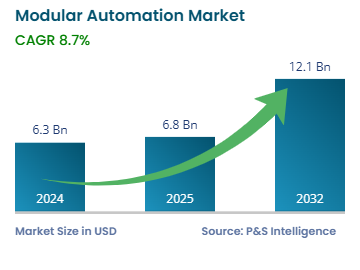
The global modular automation market will generate an estimated revenue of USD 6.3 billion in 2024, which is expected to witness a CAGR of 8.7% during 2025–2032, to reach USD 12.1 billion by 2032.
The major factors responsible for the growth of the market include the rising demand for flexibility in manufacturing processes, the ability to rapidly adapt to changing production needs, and the cost efficiency. Furthermore, the technological advancements as well the drive for Industry 4.0 integration is fueling the progress of the market in the coming years.
As industries face swift shifts in consumer preferences and market dynamics, modular automation systems enable manufacturers to rapidly adjust their production lines. These systems provide easy reconfiguration and scalability, allowing for the efficient production of diverse products without significant downtime or the need for new equipment investments. This flexibility is essential for companies looking to stay competitive in a constantly changing marketplace.
Governments worldwide are accelerating smart manufacturing adoption through high-profile initiatives. Germany’s Industrie 4.0 strategy supports Industry 4.0 transformation, backed by EUR 150 million in federal and EU research funding and close to EUR 100 million through programs like “Autonomics for Industrie 4.0” and “Smart Service World,” alongside around EUR 2 billion annual support via Fraunhofer Institutes.
In the U.S., the CHIPS and Science Act funds advanced manufacturing—including a USD 285 million grant for a digital-twins institute—and NIST allocates USD 37 million annually to Manufacturing USA institutes, with further awards up to USD 70 million for AI resilience efforts. These coordinated investments strengthen the adoption of automation, AI, IoT, and digital twins in production.
The modular distributed control systems category holds the larger market share, of 75%, in 2024. This growth is attributed to the widespread use of modular distributed control systems across various industries such as oil and gas, chemicals, pharmaceuticals, and power generation. DCS are specifically designed to manage complex processes that demand high reliability, scalability, and precision. These systems facilitate centralized control of distributed operations, enabling operators to efficiently monitor and manage multiple tasks.
One of a key advantage of DCS is their capacity for real-time data analytics and process visualization, which significantly improves decision-making and operational efficiency. In addition, as industries increasingly prioritize automation to enhance productivity and minimize human error, the demand for DCS continues to rise.
Modular type packages are the faster-growing category, with approx. 9% CAGR, due to their flexibility, scalability, and faster deployment. They enable manufacturers to customize production lines, reduce downtime, and adapt quickly to market changes. Industries like automotive, electronics, and pharmaceuticals increasingly adopt these solutions to enhance efficiency and cost-effectiveness.
During the study, we have analyzed the following types:
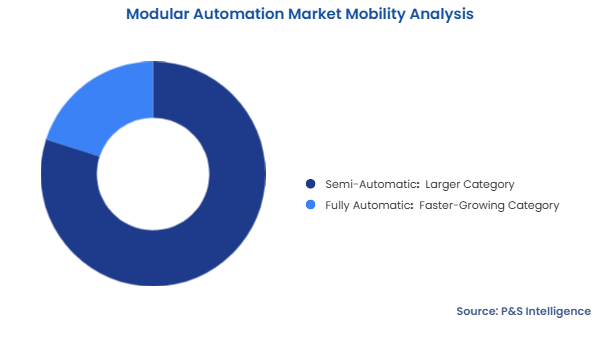
The semi-automatic category holds the larger market share, of 80%, in 2024, due to its versatility and cost-effectiveness. Semi-automatic systems provide a balanced solution, enabling businesses to automate certain processes while retaining a level of manual control. This hybrid model is especially attractive to SMEs that may lack the resources for fully automated systems but are eager to improve their operational efficiency.
The fully automatic category is projected to grow at the higher CAGR, during 2025–2032, due to the growing demand for increased efficiency and productivity across various industries. Fully automated systems eliminate the need for manual intervention, allowing for continuous operation and significantly reducing the potential for human error. This capability is particularly useful in sectors like manufacturing, pharmaceuticals, and food processing, where precision and reliability are paramount.
Below are the mobility types covered in the report:
The pharmaceuticals category accounts for the largest share, of 45%, in 2024. This is primarily due to the industry's stringent regulatory requirements and the critical need for precision and reliability in production processes. Pharmaceutical manufacturing demands adherence to strict quality standards and regulatory compliance, which necessitates the implementation of highly automated systems.
Modular automation systems enable companies to enhance traceability, reduce human error, and ensure consistent product quality, all of which are essential in a sector where even minor discrepancies can have significant consequences.
Additionally, the growing focus on research and development in the pharmaceutical industry has led to an increased demand for flexible manufacturing solutions that can adapt to various production requirements. Furthermore, as the global demand for pharmaceuticals continues to rise, especially in emerging markets, companies are investing in automation to scale their operations efficiently while maintaining compliance with regulatory standards.
Food and beverage are the fastest-growing category, as modular automation boosts production flexibility, ensuring quick adaptation to changing product lines and seasonal demands. It enhances hygiene and safety through precise, repeatable processes while reducing labor costs. This approach supports faster scaling, improved quality control, and compliance with strict food safety regulations.
Modular automation is widely used in beverage bottling plants, dairy processing units, and ready-to-eat meal production facilities. Snack food manufacturers and bakery plants also adopt these systems for efficient packaging and sorting. Breweries and juice producers leverage modular setups to maintain product consistency and rapidly adjust production volumes.
The following end users are included in the report:
The hardware category holds the larger market share, of 70%, in 2024. This is due to its foundational role in automation systems. These include key components such as robotics, I/O modules, drives and motors, sensors, actuators, and safety devices. These physical elements serve as the foundation of automated systems, allowing for precise control, effective feedback mechanisms, and enhanced operational safety.
By incorporating advanced hardware solutions, organizations can improve efficiency, flexibility, and scalability in their automation processes. This strategic integration optimizes production workflows and facilitates the seamless coordination of various manufacturing tasks, contributing to significant growth in hardware components.
Software has the higher CAGR, as industries seek greater flexibility, real-time control, and seamless integration of production modules. Advanced software enables predictive maintenance, data analytics, and remote monitoring, driving efficiency and reducing downtime. This growth is fueled by Industry 4.0 adoption and digital transformation initiatives worldwide.
Below are the components covered in the report:
Drive strategic growth with comprehensive market analysis
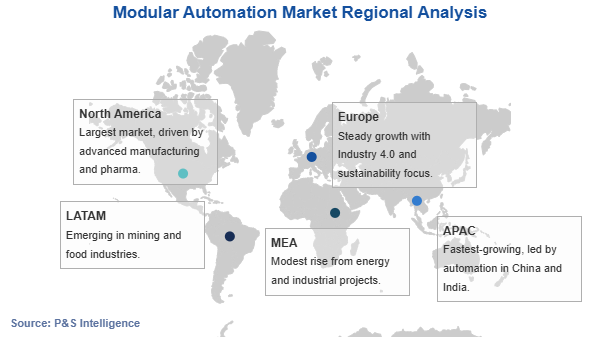
Geographically, APAC is the largest and fastest-growing market, holding a 2024 share of 45% and advancing at a CAGR of approx. 9.5% during 2025–2032. This can be ascribed to several key factors, such as rapid industrialization and urbanization across the region. Countries like China and India are experiencing significant economic expansion, leading to increased manufacturing activities. As industries seek to enhance productivity and efficiency, the adoption of modular automation solutions becomes essential to streamline operations and reduce production costs. Furthermore, the push towards Industry 4.0 is driving automation investments in APAC.
Governments in the region are actively promoting smart manufacturing initiatives and investing in advanced technologies such as robotics, artificial intelligence, and the Internet of Things (IoT). These technologies not only improve operational efficiency but also enable real-time data analytics, predictive maintenance, and enhanced quality control, all of which are crucial for meeting the demands of modern consumers.
Under Made in China 2025 and related national programs, China has allocated fueled funds of approximately USD 2.7 billion (RMB 19.38 million) to its Advanced Manufacturing Fund and over USD 5 billion (RMB 35.91 billion) to the Robot Industry Development Fund, supplemented by more than USD 40 billion (RMB 287.2 billion) in provincial subsidies for industrial digitalization and automation.
India’s Production-Linked Incentive (PLI) schemes span 14–16 strategic sectors, backed by nearly INR 2 lakh crore to boost local manufacturing capacity. Additionally, the National Manufacturing Mission provides structured governance and policy support for Industry 4.0 adoption across MSMEs and electronics production units.
Further, regions and countries analyzed for this report include:
The market is fragmented with the presence of a many players from large multinational corporations to small and medium-sized enterprises (SMEs). This is primarily driven by the varying needs of different industries, which demand tailored solutions that cater to specific operational requirements. As a result, many companies offer specialized products and services, leading to a competitive landscape where numerous vendors coexist.
Further, companies are continually innovating and developing unique modular automation solutions to address specific challenges within their respective industries, such as pharmaceuticals, food and beverage, and logistics. This specialization fosters a competitive environment where firms can differentiate themselves based on their technological capabilities, customization options, and service offerings. Additionally, the entry of new players into the market is facilitated by the growing accessibility of automation technologies, such as cloud computing and IoT.
Want a report tailored exactly to your business need?
Request CustomizationLeading companies across industries trust us to deliver data-driven insights and innovative solutions for their most critical decisions. From data-driven strategies to actionable insights, we empower the decision-makers who shape industries and define the future. From Fortune 500 companies to innovative startups, we are proud to partner with organisations that drive progress in their industries.


Working with P&S Intelligence and their team was an absolute pleasure – their awareness of timelines and commitment to value greatly contributed to our project's success. Eagerly anticipating future collaborations.
McKinsey & Company
India
Our insights into the minutest levels of the markets, including the latest trends and competitive landscape, give you all the answers you need to take your business to new heights

We take a cautious approach to protecting your personal and confidential information. Trust is the strongest bond that connects us and our clients, and trust we build by complying with all international and domestic data protection and privacy laws


Customize the Report to Align with Your Business Objectives

Request the Free Sample Pages