Military Sensors Market Size & Share Analysis - Trends, Drivers, Competitive Landscape, and Forecasts (2026 - 2032)
This Report Provides In-Depth Analysis of the Military Sensors Market Report Prepared by P&S Intelligence, Segmented by Sensor (Imaging/Electro-Optical, Infrared, Radar, Acoustic & Seismic, Magnetic, Position, Pressure & Temperature, Chemical & Biological), Application (Intelligence, Surveillance & Reconnaissance, Electronic Warfare, Communication & Navigation, Combat Operations, Command & Control, Target Recognition & Fire Control, Environmental & Situational Monitoring), End-Use (Airborne, Space-based Systems, Land, Naval, Munitions & Weapon Systems), and Geographical Outlook for the Period of 2021 to 2032
Explore the market potential with our data-driven report
Military Sensors Market Overview
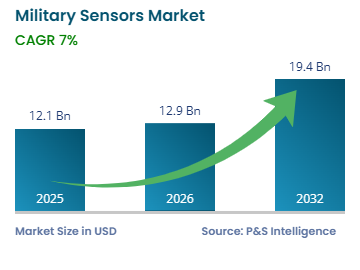
The military sensors market size was USD 12.1 billion for 2025, and it will grow by 7.0% during 2026–2032, to reach USD 19.4 billion by 2032.
The market is expanding as modern defence forces increasingly rely on advanced sensors to enable real-time situational awareness and precision targeting across complex operational environments. Rising defence modernisation programs are accelerating investments in integrated surveillance, tracking, and battlefield monitoring systems. According to the United Nations, global military expenditure reached USD 2.7 trillion in 2024, reflecting substantial investments in upgrading advanced defence technologies. The governments continue prioritising the deployment of reliable sensing technologies to strengthen operational intelligence, enhance threat detection capabilities, and support the modernisation of critical military infrastructure.
Key Market Insights
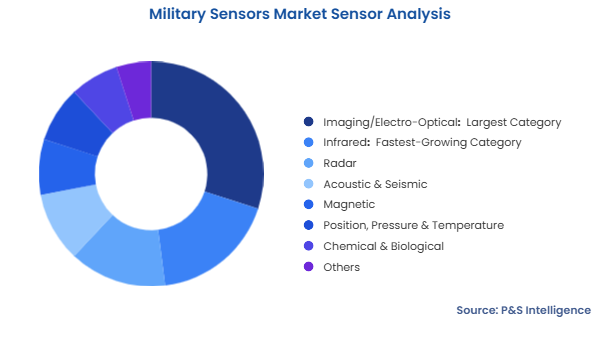
Imaging/electro-optical sensors are the largest sensors, holding a market share of 30%, because defence forces rely on intelligence.
Infrared sensors are the fastest-growing sensors, registering a CAGR of approximately 7.3%, because they enable detection in low-visibility conditions.
Intelligence, surveillance & reconnaissance is the largest application, holding a market share of 30%, because military operations depend on monitoring.
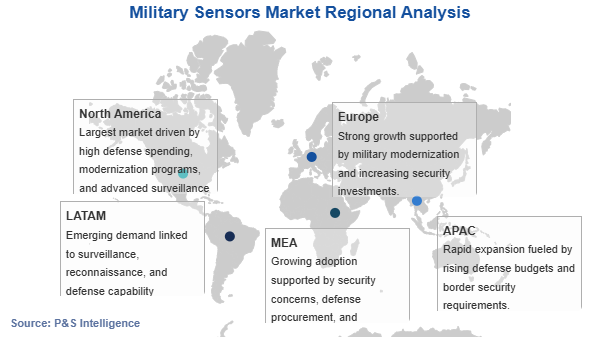
North America holds the largest share, of 40%, because it has a defence ecosystem supported by continuous investment in military technologies.
Asia-Pacific is the fastest-growing region, registering a CAGR of approximately 7.9%, because countries are expanding capabilities and investing in indigenous manufacturing.
Military Sensors Market Dynamics
Integration of AI and Multi-Sensor Fusion in Defence Systems Is Major Trend
The military sensor market is rapidly shifting toward highly connected and network-based sensing systems that support real-time data transmission and coordinated battlefield operations. Modern defence forces increasingly depend on integrated communication and space-based monitoring infrastructure to improve operational efficiency and situational awareness across multiple defence platforms. According to the Union of Concerned Scientists, the number of active satellites in orbit surpassed 10,000 in 2024, while according to the International Telecommunication Union, global 5G coverage reached 51% in 2024. Governments are increasingly prioritising network-enabled sensor architectures over traditional standalone detection systems.
Rising Demand for Advanced Surveillance and Threat Detection Drives Market
The military sensor market is expanding as global defence forces increasingly require advanced monitoring systems to strengthen border security and enable early threat detection. Rising geopolitical instability has intensified the need for continuous surveillance and rapid response capabilities across sensitive national territories. According to the United Nations, 61 active state conflicts were recorded globally in 2024, while UNHCR reported that 123.2 million people were forcibly displaced worldwide. Governments are strengthening their surveillance infrastructure and deploying advanced sensor technologies to improve situational awareness and maintain security across vulnerable borders.
High Development Costs and Complex Integration Hamper Market Growth
The military sensors market is facing growth restraints due to rising financial pressure on governments and increasing costs associated with advanced defence technology development. Modern sensor systems require substantial long-term investments, particularly when integrating new detection technologies with existing legacy military platforms. According to the International Monetary Fund, global public debt exceeded USD 100 trillion in 2024. The budget constraints across several countries are limiting defence procurement spending, which is slowing the adoption of next-generation military sensor technologies.
Unmanned and Autonomous Defence Systems Offer Opportunities
The military sensors market is creating new growth opportunities as defence forces increasingly expand the deployment of autonomous and remotely operated platforms across modern warfare environments. Unmanned aerial vehicles, robotic naval systems, and autonomous ground platforms rely heavily on advanced sensing technologies for navigation, surveillance, and real-time threat detection. The sensor manufacturers are focusing on developing compact, high-performance sensing solutions to support the growing adoption of autonomous defence platforms and next-generation unmanned combat technologies.
Military Sensors Market Segmentation Analysis
Sensor Analysis
Imaging/electro-optical sensors are the largest category, holding a market share of 30%, because defence forces rely heavily on visual intelligence for real-time battlefield monitoring, target identification, and precision strike operations. These systems deliver high-resolution imaging across complex environments and low-visibility conditions, making them essential across modern combat platforms. According to the European Space Agency, the Copernicus program distributed over 200 Petabytes of Earth-observation sensor data in 2024. The increasing dependence on high-volume imaging data continues to support strong demand for electro-optical sensing technologies.
Infrared sensors are the fastest-growing category, registering a CAGR of approximately 7.3%, as they enable detection in low visibility conditions, such as darkness, fog, and smoke. These sensors are critical for night operations and hidden threat identification. With increasing focus on round-the-clock surveillance and border security, their importance is rising. They are also being integrated into advanced defence platforms, which further supports their rapid adoption across multiple military applications.
The sensors analysed in this report are:
Imaging/Electro-Optical (Largest Category)
Infrared (Fastest-Growing Category)
Radar
Acoustic & Seismic
Magnetic
Position, Pressure & Temperature
Chemical & Biological
Others
Application Analysis
Intelligence, surveillance & reconnaissance (ISR) is the largest category, because it forms the backbone of modern military operations. Defence forces rely on ISR systems to gather, process and analyse information before acting. Sensors used in ISR help track movements and monitor large areas continuously. As real-time data becomes more important in decision-making, ISR continues to dominate due to its critical role in maintaining operational awareness.
Electronic warfare is the fastest-growing category, registering a CAGR of approximately 7.5%, because modern military operations increasingly depend on protecting and controlling the electromagnetic spectrum used for communication, navigation, and radar systems. Defence forces are actively investing in capabilities that detect, intercept, and neutralise hostile electronic signals. According to the International Telecommunication Union, 132 governments maintained national cybersecurity and digital defence strategies in 2024. The rising focus on securing critical communication infrastructure continues to accelerate demand for electronic warfare technologies.
Airborne is the largest category, holding a market share of 35%, because military aircraft and unmanned aerial platforms require advanced sensors for navigation, surveillance, reconnaissance, and precision targeting across multiple operational environments. Air-based monitoring remains a critical component of modern defence strategies due to its wide-area coverage and real-time intelligence capabilities. The expanding aerial operations continue supporting strong demand for advanced airborne sensing platforms. According to the FlightGlobal World Air Forces report, the global military aircraft fleet exceeds 50,000 aircraft, reflecting the scale of airborne defence capabilities and ongoing modernization initiatives.
Space-based Systems is the fastest-growing category, as defence strategies increasingly rely on satellites for communication, navigation, and surveillance. Sensors in space systems help monitor large regions and detect activities from long distances. With growing investments in space defence programs, this platform is gaining strong attention. The need for global coverage and early warning capabilities is driving rapid growth in space-based sensor deployment.
The end uses analysed in this report are:
Airborne (Largest Category)
Space-Based Systems (Fastest-Growing Category)
Land
Naval
Munitions & Weapon Systems
Others
Drive strategic growth with comprehensive market analysis
Military Sensors Market Regional Outlook
North America Military Sensors Market Analysis
North America holds the largest share, of 40%, because it has a strong defence ecosystem supported by continuous investment in advanced military technologies. The region focuses heavily on modern warfare systems, including next-generation aircraft, naval platforms, and missile defence, all of which rely on high-performance sensors. There is also a clear emphasis on integrating sensors with digital command systems for better coordination. Close collaboration between defence agencies and private companies further strengthens innovation. Ongoing upgrades to existing military infrastructure keep demand steady across multiple sensor applications.
U.S. Military Sensors Market
The United States dominates the military sensors market due to extensive defence modernisation programs and the large-scale deployment of advanced combat technologies across air, naval, land, and space domains. The country continuously invests in next-generation surveillance, missile defence, and space-based tracking systems to strengthen operational intelligence. According to the United States Space Force, 226 successful space launches were tracked in 2024, while according to the U.S. Department of War (formerly the Department of Defense), 1.32 million active-duty personnel were maintained in 2025. The extensive global military operations sustain a strong demand for advanced sensing technologies.
Canada Military Sensors Market
Canada strengthens its military sensor capabilities to secure vast territorial borders and support continuous Arctic and maritime surveillance operations. The country invests in durable sensing technologies to monitor remote environments and maintain situational awareness across critical northern regions. According to the Government of Canada, the Canadian Armed Forces maintained 63,500 active regular personnel in 2024, while according to the World Directory of Modern Military Aircraft, the Royal Canadian Air Force operated 390 military aircraft. The expanding aerial monitoring operations continue to support demand for advanced military sensors.
Asia-Pacific Military Sensors Market Analysis
Asia-Pacific has the highest CAGR, of approximately 7.9%, because countries in this region are rapidly expanding their defence capabilities in response to evolving security concerns. Governments are actively investing in indigenous defence manufacturing, which is increasing the demand for locally developed sensor technologies. Border monitoring, maritime security, and regional tensions are pushing the need for advanced sensing systems. At the same time, growing defence budgets and modernisation programs are accelerating adoption. The region is also seeing increased deployment of unmanned systems, further boosting sensor demand.
China Military Sensors Market
China is expanding its military sensor capabilities through large-scale defence modernisation and rapid development of aerospace surveillance infrastructure. The country continues investing in advanced tracking, reconnaissance, and electronic warfare systems to strengthen operational monitoring across air, naval, and space platforms. According to Global Times, China successfully launched 311 commercial and observational satellites into orbit in 2025. The rapid expansion of space-based monitoring networks is increasing demand for high-performance sensing technologies across national defence platforms.
India Military Sensors Market
India is strengthening its military sensor deployment through rapid defence modernisation and government initiatives promoting domestic defence manufacturing. The country is expanding advanced surveillance systems, drones, and electronic warfare infrastructure to improve border monitoring and operational intelligence capabilities. According to the Press Information Bureau of India, the government executed 193 military procurement contracts in 2024. The rising defence procurement activity is accelerating the adoption of next-generation sensing technologies across India’s armed forces.
Europe Military Sensors Market Analysis
Europe continues to show steady growth in the military sensors market, supported by its focus on strengthening defence readiness and regional security cooperation. Several countries are upgrading legacy systems and investing in advanced surveillance and detection technologies. The region also emphasises joint defence programs, which require standardised and interoperable sensor solutions. In addition, there is a growing need to monitor airspace and maritime borders more effectively. These factors are encouraging consistent demand for modern sensor technologies across European defence forces.
The regions and countries analysed in this report are:
North America (Largest Regional Market)
U.S. (Larger Country)
Canada (Faster-Growing Country)
Europe
Germany (Largest Country)
U.K. (Fastest-Growing Country)
France
Italy
Spain
Rest of Europe
Asia-Pacific (Fastest-Growing Regional Market)
China (Largest Country)
India (Fastest-Growing Country)
Japan
South Korea
Australia
Rest of APAC
Latin America
Brazil (Largest Country)
Mexico (Fastest-Growing Country)
Rest of LATAM
Middle East and Africa
Saudi Arabia (Largest Country)
U.A.E. (Fastest-Growing Country)
South Africa
Rest of MEA
Military Sensors Market Competitive Landscape
The market is moderately consolidated, as a limited number of large defence companies hold a strong position due to their advanced technology capabilities and long-term government contracts. These players have deep expertise in developing high-performance sensors and often work closely with defence agencies, which makes it difficult for new entrants to compete. At the same time, smaller firms exist but usually focus on niche technologies or act as suppliers. The presence of strict regulations and high entry barriers further supports the dominance of established companies in this market.
Leading Companies in the Military Sensors Market:
Northrop Grumman Corporation
Raytheon Technologies Corporation
Thales Group
BAE Systems plc
Leonardo SpA
Saab AB
Elbit Systems Ltd
Teledyne Technologies Incorporated
Curtiss Wright Corporation
General Dynamics Corporation
Rheinmetall AG
Safran SA
Kongsberg Gruppen ASA
Israel Aerospace Industries Ltd
Mitsubishi Electric Corporation
Military Sensors Market News
In June 2026, OpenWorks Engineering Ltd. reported that Vision Pace had been integrated with a protected mobility vehicle for on-the-move tracking and targeting. The company framed the update as a completed vehicle integration for its autonomous optics product line. The news followed Vision Pace’s earlier launch for kinetic threat targeting and was presented as company product news, not a funding or contract item.
In April 2026, BAE Systems, Inc. entered production and began initial deliveries of the NavGuide GPS receiver from its Electronic Systems business. The company described NavGuide as a field-installable receiver for positioning, navigation and timing use across vehicle, handheld and sensor applications. The item was a production and delivery update for a military navigation product, not a contract award or investment announcement.
In March 2026, VectorNav Technologies LLC added high-dynamic accelerometer and gyroscope ranges across its Tactical Series inertial measurement and inertial navigation products. The company linked the change to defence platform development, including interceptor, air-defence and precision-guidance applications. Engineering units were available for test and evaluation at the time of the announcement, making the update an available product-line change rather than a roadmap item.
In February 2026, MatrixSpace, Inc. launched MatrixSpace Fusion 360 as a multi-sensor counter-drone detection product. The company said the system combines radar, optical and RF/Remote ID sensor data into one view for airspace awareness. The release described Fusion 360 as part of MatrixSpace’s portable drone-detection portfolio and focused on sensor-data fusion, detection and tracking, rather than procurement or funding activity.
Frequently Asked Questions About This Report
What are military sensors and how are they used in defence operations+
Military sensors are devices that detect and measure environmental or operational data, enabling forces to monitor threats, track targets, and support real-time decision-making in complex combat environments.
Why are imaging and electro-optical sensors widely used in military systems+
These sensors provide high-resolution visual data for target identification, surveillance, and reconnaissance, making them essential for accurate situational awareness and precision operations across different military platforms.
How do infrared sensors improve military operations in low-visibility conditions+
Infrared sensors detect heat signatures, allowing forces to identify targets in darkness, fog, or smoke, which enhances night operations and improves threat detection in challenging environments.
What is the role of ISR in modern military sensor applications+
Intelligence, surveillance, and reconnaissance systems collect and analyse real-time data, helping military forces monitor activities, assess threats, and make informed strategic and tactical decisions effectively.
How is artificial intelligence transforming military sensor technologies+
Artificial intelligence enhances sensors by enabling faster data processing, pattern recognition, and automated decision support, improving accuracy and efficiency in threat detection and battlefield monitoring systems.
Want a report tailored exactly to your business need?
Leading companies across industries trust us to deliver data-driven insights and innovative solutions for their most critical decisions. From data-driven strategies to actionable insights, we empower the decision-makers who shape industries and define the future. From Fortune 500 companies to innovative startups, we are proud to partner with organisations that drive progress in their industries.
Client Testimonials
Working with P&S Intelligence and their team was an absolute pleasure – their awareness of timelines and commitment to value greatly contributed to our project's success. Eagerly anticipating future collaborations.
McKinsey & Company
India
Unmatched Standards
Our insights into the minutest levels of the markets, including the latest trends and competitive landscape, give you all the answers you need to take your business to new heights
Complete Data Security
We take a cautious approach to protecting your personal and confidential information. Trust is the strongest bond that connects us and our clients, and trust we build by complying with all international and domestic data protection and privacy laws