Middle East Wind Power Market Size & Share Analysis - Trends, Drivers, Competitive Landscape, and Forecasts (2026 - 2032)
This Report Provides In-Depth Analysis of the Middle East Wind Power Market Report Prepared by P&S Intelligence, Segmented by Type (Onshore, Offshore), Application (Utilities, Commercial, Industrial, Residential), Component (Turbines & Generators, Control & Monitoring Systems, Transmission & Distribution Infrastructure, Support Structures), Turbine Capacity (Large, Medium, Small), and Geographical Outlook for the Period of 2019 to 2032
Explore the market potential with our data-driven report
Middle East Wind Power Market Overview
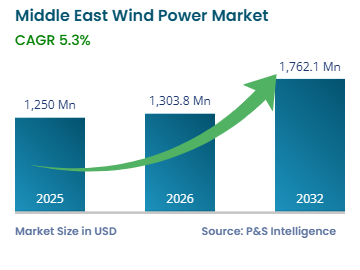
The Middle East wind power market size will be an estimated USD 1,250 million for 2025, and it will grow by 5.3% during 2026–2032, to reach USD 1762.1 million by 2032.
The market growth is driven by ambitious national renewable energy targets, declining wind technology costs, and the region's strategic shift toward energy diversification to reduce dependence on fossil fuels.
The surge in wind power deployment across the Middle East reflects a fundamental transformation in the region's energy landscape. According to the IEA, seven countries including Saudi Arabia, U.A.E., Morocco, Oman, Egypt, Israel, and Jordan are expected to account for over 90% of the region's growth in renewables capacity. Countries such as Saudi Arabia and the U.A.E. are pioneering large-scale wind farms as part of their comprehensive strategies to achieve net-zero emissions targets while maintaining energy security and supporting rapid economic growth.
Middle East Wind Power Market Dynamics
Strategic Integration of Wind Power with Green Hydrogen Production Is Key Trend
The strategic coupling of wind energy infrastructure with green hydrogen production facilities, fundamentally altering the investment rationale and scale of wind farm development across the region, is a key trend for the market.
Green hydrogen production has emerged as a national priority for multiple Middle Eastern countries seeking to maintain their position as global energy exporters in a decarbonizing world.
This transition requires massive renewable energy capacity, with wind power playing a critical role alongside solar.
According to the International Energy Agency (IEA), Oman aims to produce at least 1 mtpa of renewable hydrogen by 2030, 3.75 mtpa by 2040 and 8.5 mtpa by 2050.
Similarly, the U.A.E.'s National Hydrogen Strategy aims to produce 1.4 million tons per annum by 2031, comprising 1 mtpa of green hydrogen and 0.4 mtpa of blue hydrogen, scaling to 7.5 mtpa by 2040 and 15 mtpa by 2050.
Saudi Arabia has equally ambitious targets, with hydrogen production goals of 2.9 mtpa by 2030 and 4 mtpa by 2035.
Saudi Arabia's NEOM green hydrogen project exemplifies this integration, with approximately 4 GW of wind and solar capacity dedicated to producing hydrogen for export markets. This single project requires more wind capacity than the entire current installed base in several Middle Eastern countries.
The economic model for wind power fundamentally changes when integrated with hydrogen production, as variability becomes manageable through electrolyzers that modulate production according to available renewable energy.
This trend is catalyzing development of supporting infrastructure including specialized ports, pipelines, and shipping facilities for hydrogen and ammonia exports.
The integration of wind power with hydrogen production carries significant geopolitical implications and addresses domestic energy security concerns.
By dedicating renewable capacity to hydrogen production for export while natural gas serves domestic power needs, countries can optimize their resource utilization and maximize economic returns from both fossil and renewable assets during the energy transition period.
The scale of announced hydrogen projects suggests that hydrogen-linked wind capacity could exceed utility-scale grid-connected wind capacity within the next decade, representing a fundamental shift in market structure and growth drivers.
Government Renewable Energy Targets Are Biggest Driver
The substantial growth of the Middle East wind power market is primarily driven by ambitious government commitments to wind energy and renewable energy targets, and is a key driver for the market.
Saudi Arabia has established a goal to source at least 50 percent of its power from renewable energy by 2030, expanding its capacity to 130 GW, with 40 GW expected to come from wind.
This represents the most ambitious renewable energy target among Gulf Cooperation Council countries.
Similarly, the U.A.E. is aiming for a 44% clean energy share in its total mix by 2050, while Oman seeks to derive 20% of its power from renewables by 2030.
These national targets are backed by substantial policy frameworks, competitive procurement processes, and streamlined project approvals that significantly reduce development timelines compared to Western markets.
The integration of wind power into national energy strategies reflects recognition that renewable capacity expansion is essential for economic diversification, energy security, and meeting international climate commitments.
The U.A.E. Wind Program, including the 103.5 MW Al Dhafra and Al Sila projects, is expected to power tens of thousands of homes while displacing significant COâ‚‚ emissions.
Innovations in climate technology, such as identification of high nighttime wind patterns, have made utility-scale wind generation viable in regions previously considered unsuitable.
Wind power in the U.A.E. is increasingly integrated into the Energy Strategy 2050 alongside solar and nuclear, and will also support the country’s green hydrogen production, creating additional demand for renewable capacity.
Oman’s 50 MW Dhofar Wind Project demonstrated the viability of large-scale wind in the GCC, with favorable conditions in Dhofar and Duqm supporting both power generation and green hydrogen production.
Government incentives, international developer partnerships, and alignment with Vision 2040 and hydrogen export goals are accelerating wind deployment.
Middle East Wind Power Market Segmentation Analysis
Type Analysis
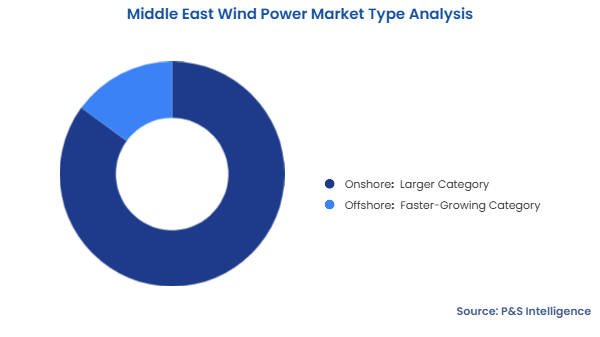
The onshore category holds the larger market share, of 85%, in 2025, supported by lower capital costs, quicker project timelines, and abundant land in regions with strong wind resources. The Gulf of Suez region in Egypt and northwestern desert areas in Saudi Arabia offer particularly strong wind resources suitable for large-scale onshore development.
The offshore category will have the higher CAGR, driven by interest in tapping stronger, more consistent wind resources along the Red Sea, Arabian Gulf, and Eastern Mediterranean coasts. Countries such as Saudi Arabia, the U.A.E., and Oman are increasingly exploring offshore wind to complement their solar and onshore wind portfolios. Declining offshore technology costs, advances in floating turbine platforms suitable for deeper waters, and the potential integration with offshore green hydrogen production facilities are driving renewed interest in this segment.
The types analyzed in this report are:
Onshore (Larger Category)
Offshore (Faster-Growing Category)
Application Analysis
The utilities category holds the largest market share, of 45%, in 2025. This dominance stems from government-led renewable energy procurement programs, the need for utility-scale capacity additions to meet growing electricity demand, and long-term power purchase agreements with national transmission companies. The 650 MW Gulf of Suez Wind Farm II generates enough electricity equivalent to the power consumption of approximately 1,100,000 Egyptian households.
The industrial category will have the highest CAGR, driven by increasing corporate sustainability commitments, the emergence of green hydrogen production facilities requiring dedicated renewable capacity, and industrial clusters seeking to reduce energy costs and carbon footprints. Mining operations, petrochemical complexes, and manufacturing facilities are increasingly investing in captive wind capacity or entering into corporate power purchase agreements.
The applications analyzed in this report are:
Utilities (Largest Category)
Commercial
Industrial (Fastest-Growing Category)
Residential
Component Analysis
The turbines & generators category holds the largest market share, of 40%, in 2025, due tothe high capital intensity of wind turbine procurement, which represents the largest single cost component in wind farm development. The Dumat Al Jandal wind farm comprises 99 wind turbines, each boasting a 4.2 MW capacity.
The control & monitoring systems category will have the highest CAGR, driven by increasing adoption of advanced SCADA systems, predictive maintenance technologies, and digital twin platforms that optimize turbine performance and minimize downtime. The harsh environmental conditions in desert and coastal locations necessitate sophisticated monitoring capabilities to ensure reliable operations and maximize energy production. Remote monitoring solutions and artificial intelligence-driven analytics are becoming standard requirements in new wind farm developments across the region.
The components analyzed in this report are:
Turbines & Generators (Largest Category)
Control & Monitoring Systems (Fastest-Growing Category)
Transmission & Distribution Infrastructure
Support Structures
Others
Turbine Capacity Analysis
The large category holds the largest market share, of 65%, in 2025. This segment includes turbines with capacity ratings above 3 MW, which have become the standard for utility-scale wind farm developments in the Middle East. The Gulf of Suez Wind Farm II features 84 wind turbines with a capacity of 6 MW each and 20 wind turbines with a capacity of 7.5 MW each, the latter being the largest-class onshore wind turbines in the world. Large turbines offer superior economics through higher capacity factors, reduced installation costs per MW, and lower operation and maintenance expenses. The region's focus on gigawatt-scale projects naturally favors larger turbine platforms that can deliver maximum energy output from limited land areas.
The small category will have the highest CAGR, due to rising demand for decentralized and off-grid renewable energy solutions. Supportive government policies, lower installation costs, and suitability for remote areas drive rapid adoption. Businesses and communities increasingly prefer small turbines for localized, sustainable power generation.
The turbine capacities analyzed in this report are:
Large (Largest Category)
Medium
Small (Fastest-Growing Category)
Drive strategic growth with comprehensive market analysis
Middle East Wind Power Market Geographical Analysis
Saudi Arabia Market Size
Saudi Arabia holds the largest market share, of 40%, in 2025, and it will have the highest CAGR, of approx. 5.5%, driven by Vision 2030, which aims for 50% renewable energy in the power mix by 2030. The Dumat Al Jandal wind farm with an installed capacity of 400 MW is Saudi Arabia's first wind farm and the largest in the Middle East, displacing approximately one million tonnes of carbon dioxide each year. The project achieved commercial operation in late 2021 and demonstrated the technical and economic viability of wind power in the kingdom. Saudi Arabia's northwestern desert regions, particularly the Al Jouf area, offer exceptional wind resources with average wind speeds conducive to high-capacity factor operations. The Public Investment Fund, through entities like Badeel, is mobilizing significant capital for wind farm development. International developers and turbine manufacturers are establishing local presence, with several announcing plans for manufacturing facilities within the kingdom. The combination of ambitious targets, streamlined regulatory frameworks, competitive tariffs, and substantial land availability positions Saudi Arabia as the region's wind power leader.
Egypt Market Size
Egypt is emerging as a significant and rapidly expanding player, due to country's strategic location along the Gulf of Suez provides world-class wind resources, with consistently strong wind speeds throughout the year. The Gulf of Suez Wind Farm II with a capacity of 650 MW commenced commercial operation in June 2025 and provides electricity equivalent to the power consumption of approximately 1,100,000 Egyptian households. International development finance institutions including EBRD, AfDB, and JBIC are providing substantial financing support for Egyptian wind projects.
The geographical breakdown of the market is as follows:
Saudi Arabia (Largest and Fastest-Growing Country)
Egypt
U.A.E.
Oman
Jordan
Kuwait
Qatar
Rest of Middle East
Middle East Wind Power Market Share
The market is semi-consolidated due to the active competition from regional developers, strategic partnerships between global and local entities, and ongoing opportunities for new entrants and specialized technology providers. Strategic partnerships between global technology providers and regional entities facilitate knowledge transfer, local capacity building, and risk sharing. At the same time, opportunities for new entrants in specialized areas like advanced control systems, predictive maintenance, and offshore wind technologies indicate that the market remains open and competitive, characteristic of a semi-consolidated structure.
Key Middle East Wind Power Companies:
Abu Dhabi Future Energy Company PJSC
ACWA Power International
EDF Renouvelables SAS
General Electric Company
Siemens Gamesa Renewable Energy S.A.
Vestas Wind Systems A/S
Ørsted A/S
RWE Renewables GmbH
Equinor ASA
Royal Dutch Shell plc
Lamprell plc
AMEA Power FZE
Middle East Wind Power Market News
In March 2025, Siemens Gamesa Renewable Energy, S.A., signed a power purchase agreement with the Egyptian Electricity Transmission Company to develop, finance, and operate a 500 MW wind farm in the Gulf of Suez, highlighting ongoing international investment in Egypt’s wind sector.
In January 2025, OPEC Fund for International Development committed USD 30 million to co-finance the 1.1 GW Suez Wind Farm project in Egypt's Gulf of Suez region, which will power more than 1 million homes and reduce carbon emissions by around 2.5 million tons annually.
In October 2024, Emirates Water and Electricity Company invited expressions of interest for a 140 MW wind farm in Al Sila, Abu Dhabi, set to more than double the U.A.E.’s current wind generation capacity.
Want a report tailored exactly to your business need?
Leading companies across industries trust us to deliver data-driven insights and innovative solutions for their most critical decisions. From data-driven strategies to actionable insights, we empower the decision-makers who shape industries and define the future. From Fortune 500 companies to innovative startups, we are proud to partner with organisations that drive progress in their industries.
Client Testimonials
Working with P&S Intelligence and their team was an absolute pleasure – their awareness of timelines and commitment to value greatly contributed to our project's success. Eagerly anticipating future collaborations.
McKinsey & Company
India
Unmatched Standards
Our insights into the minutest levels of the markets, including the latest trends and competitive landscape, give you all the answers you need to take your business to new heights
Complete Data Security
We take a cautious approach to protecting your personal and confidential information. Trust is the strongest bond that connects us and our clients, and trust we build by complying with all international and domestic data protection and privacy laws