Middle East Media and Entertainment Market Size & Opportunities Analysis - Growth Strategies, Competitiveness, and Forecasts (2026 - 2032)
This Report Provides In-Depth Analysis of the Middle East Media and Entertainment Market Report Prepared by P&S Intelligence, Segmented by Type (Digital Media, Video Games, Television & Radio Broadcasting, Cinema & Live Entertainment, Advertising, Social Media & User-Generated Content), Revenue Model (Subscription-Based, Advertising-Based, Transactional/Pay-Per-View, Freemium & In-App Purchases), Consumer Age Group (Generation Z, Millennials, Generation X, Baby Boomers), Platform (Digital/Online, Traditional/Offline, Hybrid), and Geographical Outlook for the Period of 2019 to 2032
Middle East Media and Entertainment Market Revenue Scope
Key Highlights
Study Period
2019 - 2032
Market Size in 2025
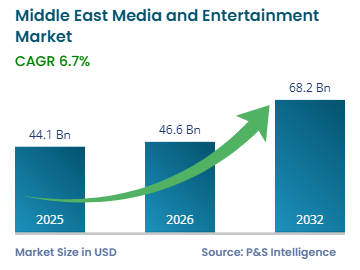
USD 44.1 Billion
Market Size in 2026
USD 46.6 Billion
Market Size by 2032
USD 68.2 Billion
Projected CAGR
6.7%
Largest Country
Saudi Arabia
Fastest Growing Country
U.A.E.
Market Structure
Fragmented
Market Size
Explore the market potential with our data-driven report
Middle East Media and Entertainment Market Future Outlook
The Middle Eastern media and entertainment market value is estimated at USD 44.1 billion in 2025, and it is projected to grow at a CAGR of 6.7% during 2026–2032, to reach USD 68.2 billion by 2032. The phenomenal expansion of the market is primarily driven by extensive government investments through national vision programs, rapid digital transformation initiatives, and an exceptionally young demographic profile with over 65% of the population under 30 years old.
According to the World Bank, 65% of the population in Arab states is under 30, with youth in Saudi Arabia and Egypt representing over 60% of internet users. This young, tech-savvy population exhibits strong preferences for digital content consumption, particularly video-on-demand services, social media content, and gaming, fundamentally reshaping entertainment consumption patterns across the region. The convergence of high smartphone penetration rates exceeding 80% and accelerated 5G network deployments has created an optimal environment for digital entertainment proliferation.
Strategic partnerships between regional broadcasters and global streaming giants are redefining competitive dynamics. Netflix's July 2025 bundle with MBC NOW offers integrated billing, marketing, and set-top hardware, exemplifying the collaborative approach to market penetration. Meanwhile, sovereign wealth funds are actively consolidating media assets, with Public Investment Fund's USD 2-billion acquisition of a 54% stake in MBC in November 2024 demonstrating state-level commitment to building regional media champions.
The proliferation of localized Arabic content has emerged as a critical differentiator, with regional platforms investing heavily in original productions that resonate with local audiences. This cultural renaissance, combined with government-backed entertainment cities and mega-projects, positions the Middle East as an emerging global entertainment hub, attracting international partnerships while nurturing homegrown creative industries.
Middle East Media and Entertainment Market Trends & Drivers
Digital Infrastructure Expansion Is Major Trend
The rapid deployment of advanced digital infrastructure has fundamentally transformed content accessibility and consumption patterns.
This digital momentum is underpinned by substantial telecommunications investments and aggressive 5G rollouts across GCC countries.
Around 92% of the population in GCC countries use the internet, creating an addressable market with sophisticated digital consumption habits.
The proliferation of affordable high-speed internet has democratized access to premium content, enabling streaming platforms to reach previously underserved segments.
Additionally, investments in robust 5G infrastructure have enabled higher streaming quality, with 5G connections in the Gulf states expected to account for 41% of total connections by 2025.
Mobile-first consumption patterns have emerged as the dominant paradigm, with smartphones serving as primary entertainment devices for younger demographics.
This shift has prompted content creators and distributors to optimize for mobile viewing, developing vertical video formats, bite-sized content, and interactive features specifically designed for handheld consumption.
The integration of social features within streaming platforms further enhances engagement, transforming passive viewing into participatory experiences.
Government Vision Programs Are Catalyzing Market Transformation
The implementation of comprehensive national vision programs represents the most significant catalyst for market growth.
These investments extend beyond mere infrastructure development, encompassing regulatory reforms, talent development initiatives, and strategic partnerships with global entertainment companies.
Saudi Arabia issued 34 investment licenses in the entertainment industry in the third quarter of 2024, representing a rise of 13% compared to the previous three months.
The establishment of dedicated entertainment authorities and the relaxation of cultural restrictions have unleashed pent-up domestic demand.
Over USD 2 billion have been invested into the General Authority for Entertainment, facilitating the introduction of previously restricted entertainment forms, including cinema, concerts, and sporting events.
The ripple effects of these investments extend across the value chain. The Cultural Development Fund has already launched a USD 234 million film financing program, while private equity and venture capital are encouraged to support early and mid-stage media startups.
This comprehensive ecosystem approach ensures sustainable industry development beyond government funding cycles.
Gaming and E-Sports Emergence Offers Opportunities
The gaming sector has transcended its entertainment origins to become a significant economic and cultural force.
The average gamer in Saudi Arabia and the UAE spends 6.8 hours per week on mobile games, according to YouGov, reflecting deep behavioral integration.
Government recognition of gaming's economic potential has catalyzed substantial investments in e-sports infrastructure, tournament hosting, and game development capabilities.
The gaming sector of Saudi Arabia is ballooning due to the high disposable incomes of young adults, cultural acceptance of gaming as mainstream entertainment, and the development of local gaming communities.
Professional e-sports leagues have gained significant traction, with major tournaments offering substantial prize pools and attracting international talent.
The convergence of gaming with other entertainment forms has created new hybrid experiences.
Live-streaming platforms dedicated to gaming content have emerged, while traditional media companies are investing in gaming-related programming.
Virtual concerts within gaming environments and gamified social experiences represent the frontier of entertainment innovation, particularly appealing to Generation Z consumers, who seamlessly navigate between digital and physical realms.
Middle East Media and Entertainment Market Segmentation Analysis
Type Analysis
Television & radio broadcasting remains the largest category in the GCC media landscape, with 25% share. Traditional TV channels like MBC still command high viewership, especially for Arabic-language content, news, and Ramadan programming. Despite competition from digital platforms, broadcasting continues to attract major advertising spend and mass audiences across the region.
Video games are the fastest-growing media category in the GCC, through 2032. Saudi Arabia alone accounts for nearly half of that revenue. Growth is driven by mobile gaming, high youth engagement, and government investment—especially Saudi Arabia’s USD 38-billion gaming strategy. The region is also developing esports infrastructure and local studios, rapidly expanding the gaming ecosystem.
These types are covered:
Digital Media
Video-on-Demand (VoD)
Subscription Video on Demand
Transactional Video on Demand
Advertising Video on Demand
Digital Music
Music Streaming
Music Downloads
E-Publishing
Video Games (Fastest-Growing Category)
Mobile Gaming
Console Gaming
PC Gaming
E-Sports
Television & Radio Broadcasting (Largest Category)
Linear TV
Satellite TV
IPTV
Radio Broadcasting
Cinema & Live Entertainment
Cinema/Theatrical
Live Events & Concerts
Theme Parks & Amusement Facilities
Advertising
Digital Advertising
Television Advertising
Out-of-Home (OOH) Advertising
Radio Advertising
Social Media & User-Generated Content
Others
Revenue Model Analysis
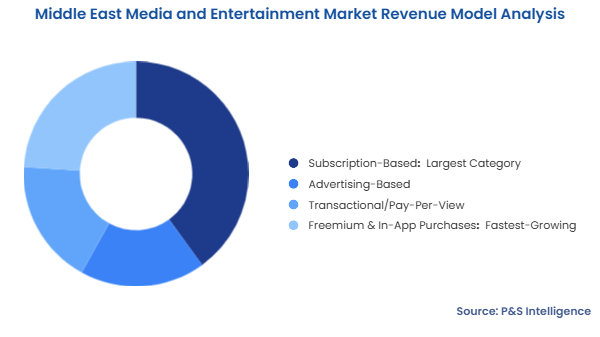
The subscription-based model holds the largest share in 2025, of 40%, primarily due to the widespread adoption of streaming services and the growing willingness of consumers to pay for premium, ad-free content experiences. The popularity of subscriptions is buoyed by household pay-TV upgrades and binge-worthy drama launches. The model's success is attributed to predictable revenue streams, enhanced user experiences, and the ability to invest in original content production.
The freemium & in-app purchases category is expected to register the fastest growth, during the forecast period. This model's appeal lies in its low barrier to entry, allowing users to sample content before committing financially, particularly effective in price-sensitive markets and for younger demographics with limited disposable income.
Millennials command the largest market share in 2025, of 45%, leveraging their established purchasing power and digital fluency. Millennials captured 36.1% revenue share in 2024 thanks to established purchasing power. This generation represents the sweet spot for entertainment providers, combining financial capability with strong digital adoption rates. They demonstrate higher willingness to pay for multiple streaming subscriptions, premium gaming experiences, and exclusive content access. Their consumption patterns favor binge-watching serialized content, participation in online gaming communities, and engagement with nostalgic entertainment properties reimagined for digital platforms.
Social-video challenges, e-sports tournaments, and influencer shopping streams resonate strongly, reshaping the Middle East media and entertainment market's programming grid. The generational divide in content preferences has prompted platforms to develop sophisticated recommendation algorithms and user interface customizations. While younger audiences gravitate toward interactive, social, and gamified experiences, older demographics maintain preferences for traditional long-form content, appointment viewing, and familiar programming formats.
Generation Z has emerged as the fastest-growing category in the Middle East media and entertainment market. This demographic's entertainment consumption is characterized by short-form video preferences, active participation in social media challenges, and seamless navigation between multiple digital platforms simultaneously. Their influence extends beyond consumption patterns, actively shaping content creation trends through user-generated content and viral social media phenomena.
These age groups are covered:
Generation Z (Fastest-Growing Category)
Millennials (Largest Category)
Generation X
Baby Boomers
Platform Analysis
Digital/online platforms dominate the market in 2025 with 65% market share, affirming the region's decisive shift toward internet-based content delivery. This dominance reflects fundamental changes in consumer behavior, with audiences expecting on-demand access, personalized recommendations, and multi-device synchronization as standard features. The digital platform ecosystem encompasses streaming services, mobile applications, web-based content portals, and social media platforms, creating an interconnected entertainment network.
The hybrid platform is experiencing the fastest growth, as it successfully bridges traditional and digital consumption preferences, reflecting consumer appetite for choice without sacrificing live communal viewing. This model's appeal lies in its ability to serve diverse household preferences, combining scheduled programming for live sports and news with extensive on-demand libraries for entertainment content.
MBC's bundling of Netflix inside the MBCNOW TV box illustrates how incumbents protect linear ad pools while upselling global catalogs. These hybrid solutions have proven particularly effective in markets with varying digital literacy levels and infrastructure capabilities. They provide a migration path for traditional television viewers while capturing younger audiences through digital features. The integration of smart TV capabilities, voice control, and recommendation engines within set-top boxes has transformed the living room viewing experience.
These platforms are covered:
Digital/Online (Largest Category)
Traditional/Offline
Hybrid (Fastest-Growing Category)
Drive strategic growth with comprehensive market analysis
Middle East Media and Entertainment Market Geographical Analysis
Saudi Arabia Media & Entertainment Market Size
Saudi Arabia dominates the market in 2025 with 40% revenue, due to the kingdom's Vision 2030 initiative, which has catalyzed unprecedented investments in entertainment infrastructure and content creation. Saudi Arabia's Ministry of Culture announced that cultural infrastructure investments in the Kingdom have exceeded USD 21.6 billion (SAR 81 billion) since the launch of Vision 2030.
The Kingdom's entertainment sector revolution gained momentum with the lifting of the 35-year cinema ban in 2018, followed by rapid expansion of entertainment venues and events. The establishment of mega-entertainment destinations, such as Qiddiya; and the hosting of international events has transformed Saudi Arabia from an entertainment-restricted market to a regional hub.
The report said that the number of inbound tourists in the entertainment industry reached 6.2 million in 2023, representing a rise of 153.3% compared to 2022. This surge in entertainment tourism has created a multiplier effect, driving investments in hospitality, retail, and supporting industries. The localization of international content and the development of Saudi-specific programming have ensured cultural relevance while maintaining global standards.
UAE Media Entertainment Market Share
The United Arab Emirates is experiencing the fastest growth in the region with a CAGR of approx. 7.0%, leveraging its position as a global connectivity hub and its advanced digital infrastructure. The UAE's media and entertainment sector benefits from a cosmopolitan population, world-class infrastructure, and a business-friendly regulatory environment that attracts international media companies. Dubai Media City and Abu Dhabi's twofour54 media zone has established the emirates as production hubs for regional and international content.
The UAE has the second-fastest average mobile internet speed in the world, , providing the technical foundation for high-quality streaming and digital entertainment services. The country's diverse expatriate population, representing over 200 nationalities, creates demand for varied content offerings, from Bollywood productions to Western entertainment and Arabic programming.
The UAE's strategic focus on becoming a global events and entertainment destination has yielded significant results. The thriving film business in the United Arab Emirates is a result of notable government investments in entertainment infrastructure as well as a diversified population. Major events, such as the Dubai Shopping Festival, Abu Dhabi Film Festival, and Expo 2020's legacy venues continue to drive entertainment consumption and attract international talent and investment.
These regions and countries are covered:
Saudi Arabia (Largest Regional Market)
UAE (Fastest-Growing Market)
Qatar
Kuwait
Bahrain
Oman
Egypt
Rest of Middle East
Middle East Media and Entertainment Market Share Analysis
The Middle Eastern media and entertainment market is fragmented, with a diverse mix of regional giants, international players, and specialized local firms operating across various segments. No single company dominates the entire landscape; instead, market power is distributed among broadcasters like MBC Group, streamers like Netflix and Shahid, gaming investors like Savvy Games Group, and music platforms like Anghami and Spotify. Each segment—TV, streaming, gaming, live events, and publishing—features its own set of major players, with limited cross-segment consolidation. This fragmentation reflects varied consumer preferences, localized content demand, and the rapid entry of global platforms targeting specific verticals or countries.
Key Middle East Media and Entertainment Companies:
MBC Group
OSN Network LLC
Abu Dhabi Media Company
Rotana Media Group
Netflix Inc.
The Walt Disney Company
Amazon.com Inc.
Apple Inc.
WatchIt Egypt
Google LLC
Anghami Inc.
Spotify Technology S.A.
Middle East Media and Entertainment Market News
In July 2025, Netflix Inc. announced a groundbreaking partnership with MBC Group to launch bundled streaming services through the MBCNOW Android TV box in Saudi Arabia, combining global and regional content libraries.
In July 2025, South Korean entertainment firm CJ ENM Co. Ltd. established its first Middle Eastern subsidiary in Riyadh to co-produce Arabic adaptations of popular Korean formats.
In May 2025, Qiddiya Investment Company merged with Saudi Entertainment Ventures as part of Saudi Arabia's strategy to accelerate the development of entertainment mega-projects and create an integrated entertainment ecosystem.
In April 2025, Egyptian streaming platform WatchIt expanded its services to the GCC markets, backed by a USD 50 million investment round to fund regional content production and market expansion.
In January 2025, the General Entertainment Authority unveiled 29 new investment opportunities across six entertainment sectors, targeting international and regional investors for partnership in facility development.
In November 2024, Saudi Arabia's Public Investment Fund completed its acquisition of a 54% stake in MBC Group for USD 2 billion.
In September 2024, Anghami Inc. completed its strategic merger with OSN+, creating an integrated music and video streaming platform in MEA with over 70 million registered users.
Want a report tailored exactly to your business need?
Leading companies across industries trust us to deliver data-driven insights and innovative solutions for their most critical decisions. From data-driven strategies to actionable insights, we empower the decision-makers who shape industries and define the future. From Fortune 500 companies to innovative startups, we are proud to partner with organisations that drive progress in their industries.
Client Testimonials
Working with P&S Intelligence and their team was an absolute pleasure – their awareness of timelines and commitment to value greatly contributed to our project's success. Eagerly anticipating future collaborations.
McKinsey & Company
India
Unmatched Standards
Our insights into the minutest levels of the markets, including the latest trends and competitive landscape, give you all the answers you need to take your business to new heights
Complete Data Security
We take a cautious approach to protecting your personal and confidential information. Trust is the strongest bond that connects us and our clients, and trust we build by complying with all international and domestic data protection and privacy laws