Middle East Green Hydrogen Market Size & Share Analysis - Trends, Drivers, Competitive Landscape, and Forecasts (2026 - 2032)
This Report Provides In-Depth Analysis of the Middle East Green Hydrogen Market Report Prepared by P&S Intelligence, Segmented by Technology (Alkaline Electrolyzers, Proton Exchange Membrane (PEM), Solid Oxide Electrolyzer Cells (SOEC)), End User (Power Generation, Chemical & Refining, Mobility/Transportation), Distribution Channel (Pipeline, High-Pressure Tube Trailers, Liquefied Hydrogen Tankers), and Geographical Outlook for the Period of 2019 to 2032
Explore the market potential with our data-driven report
Middle East Green Hydrogen Market Overview
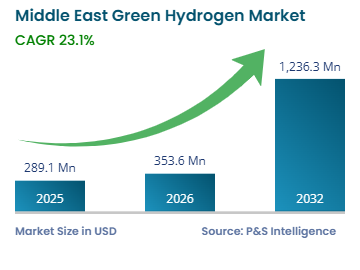
The Middle Eastern green hydrogen market size will be an estimated USD 289.1 million for 2025, and it will grow by 23.1% during 2026–2032, to reach USD 1236.3 million by 2032.
The region's abundant renewable energy resources, particularly solar and wind, combined with strategic government initiatives and massive investments in hydrogen infrastructure, are driving the market's exceptional growth trajectory.
The Middle East is emerging as a key global hub for green hydrogen by capitalizing on its strategic location connecting Europe, Asia, and Africa. Countries across the region are implementing ambitious hydrogen strategies as part of their economic diversification plans. According to the International Energy Agency, the Middle East could produce green hydrogen at USD 1.5–2.0 per kilogram by 2030, making it among the most cost-competitive regions globally.
Major oil and gas companies are partnering with international technology providers to develop large-scale electrolyzer projects. The availability of vast desert lands for solar installations and coastal areas with high wind speeds provides the Middle East with exceptional renewable energy potential for green hydrogen production. Furthermore, existing petrochemical infrastructure and export terminals offer significant advantages for hydrogen production, storage, and international distribution.
Middle East Green Hydrogen Market Growth Factors
Export-Oriented Mega-Projects and International Partnerships Are Key Trends
The Middle Eastern green hydrogen market is experiencing a fundamental transformation with the development of export-oriented mega-projects backed by strategic international partnerships.
These large-scale initiatives, typically exceeding 1 GW in electrolyzer capacity and billions of dollars in investment value, are positioning the region as a future global hydrogen supply hub.
The trend reflects a deliberate strategy by Middle Eastern countries to leverage their renewable energy advantages and existing energy export infrastructure to capture a significant share of the emerging international hydrogen trade.
The scale and ambition of these projects are unprecedented in the global hydrogen landscape.
NEOM Green Hydrogen Company, a joint venture of ACWA Power, Air Products and Chemicals, and NEOM, reached financial close at USD 8.4 billion for the world’s largest green hydrogen/ammonia plant.
According to Air Products and Chemicals Inc., the facility will save the world up to 5 million tonnes of CO2 emissions annually, equivalent to removing over 1 million cars from the road.
International partnerships are fundamental to these mega-projects, bringing together complementary strengths across the value chain.
Japanese companies, including Kawasaki Heavy Industries and Mitsui, have signed memoranda of understanding with multiple Middle Eastern producers for hydrogen imports starting from 2027.
According to Japan's Ministry of Economy, Trade and Industry (METI), the country plans to consume 3 million tonnes of hydrogen annually by 2030 and 20 million tonnes by 2050, with the Middle East expected to supply a significant portion of this volume.
The export focus is driving significant infrastructure development beyond production facilities. Specialized hydrogen and ammonia export terminals are under construction at strategic ports across the region.
The UAE's Khalifa Port is developing dedicated hydrogen handling facilities with a capacity to export 2 million tonnes of ammonia annually.
Saudi Arabia's King Abdullah Port is establishing hydrogen liquefaction and loading infrastructure.
These investments in export infrastructure, totaling over USD 20 billion across the region by 2030, demonstrate the long-term commitment to establishing the Middle East as a reliable hydrogen supplier to global markets.
Furthermore, these mega-projects are catalyzing the development of entire hydrogen ecosystems within their host countries.
The clustering effect around major projects attracts component suppliers, service providers, and downstream industries, creating employment opportunities and economic diversification.
The establishment of dedicated hydrogen valleys and industrial clusters further demonstrates governmental commitment.
These specialized zones offer streamlined permitting processes, infrastructure support, and tax incentives for green hydrogen projects.
Kuwait's Al-Zour green hydrogen complex and Bahrain's renewable energy park exemplify this clustered approach to hydrogen development.
In June 2025, the Oxagon green H2 plant in NEOM reached 80% completion across all sites, including the green hydrogen facility, wind garden, solar farm, and transmission grid.
The project aims to produce 600 tonnes of carbon-free hydrogen daily by 2026.
Additionally, sovereign wealth funds from the region are actively investing in global hydrogen projects, creating international partnerships that facilitate technology transfer and market access.
Abundant Renewable Energy Resources and Declining Production Are Biggest Drivers
The Middle East's exceptional renewable energy resources provide a fundamental competitive advantage for green hydrogen production.
The region receives over 3,000 hours of sunshine annually, with solar irradiation levels reaching 2,400 kWh/m² per year in optimal locations.
According to reports, the Middle East's technical potential for solar power exceeds 5,000 GW, sufficient to produce over 200 million tonnes of green hydrogen annually.
Solar PV electricity costs in the Middle East have fallen to record lows, with recent projects in Saudi Arabia and the UAE achieving tariffs below USD 0.015 per kWh. This positions the region to produce green hydrogen at globally competitive costs.
The Mohammed bin Rashid Al Maktoum Solar Park in Dubai, with its 5 GW capacity by 2030, exemplifies the scale of renewable energy deployment supporting hydrogen production.
Wind resources, particularly in coastal areas of Oman and Saudi Arabia's Red Sea coast, complement solar capacity and enable higher electrolyzer utilization rates.
The combination of solar and wind resources allows for capacity factors exceeding 50% for green hydrogen plants, significantly improving project economics.
Furthermore, the region's existing natural gas infrastructure, including pipelines, storage facilities, and export terminals, can be repurposed for hydrogen transport and distribution, reducing capital requirements for hydrogen infrastructure development.
Saudi Arabia's National Hydrogen Strategy aims to produce 4 million tonnes of clean hydrogen annually by 2035, positioning the kingdom as the world's largest hydrogen exporter.
Abu Dhabi National Oil Company (ADNOC) has allocated USD 15 billion for low-carbon solutions, which encompass carbon capture, electrification, and hydrogen projects, aiming for a 25% reduction in carbon intensity by 2030.
Middle East Green Hydrogen Market Segmentation Analysis
Technology Analysis
The alkaline category holds the largest market share, of 60%, in 2025, due to its proven reliability, lower capital costs, and suitability for large-scale hydrogen production projects. Alkaline electrolyzers have demonstrated operational lifespans exceeding 80,000 hours and offer the lowest cost per MW of installed capacity, making them the preferred choice for gigawatt-scale projects currently under development across the region. Major projects like Saudi Arabia's NEOM green hydrogen facility and Oman's Green Hydrogen Project utilize alkaline technology for their multi-GW installations.
The PEM category will have the highest CAGR, of 23.3%, driven by its superior operational flexibility, faster response times, and compatibility with variable renewable energy sources. The technology's ability to operate at high current densities and produce high-purity hydrogen without additional purification makes it increasingly attractive for mobility applications and industrial processes requiring stringent quality standards.
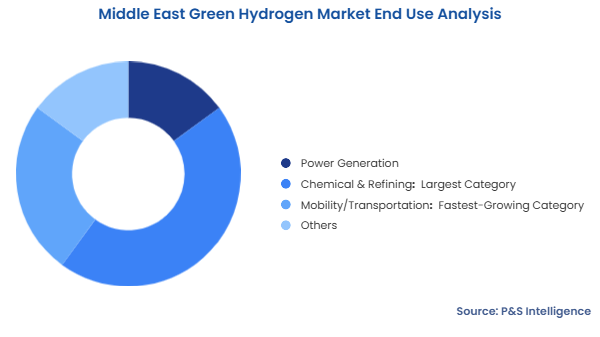
The chemical & refining category holds the largest market share, of 45%, in 2025, driven by the region's extensive petrochemical industry and immediate hydrogen demand for ammonia production, methanol synthesis, and refinery operations. The Middle East accounts for over 15% of global ammonia production capacity, with facilities in Saudi Arabia, Qatar, and the UAE requiring substantial hydrogen volumes. Transitioning from grey to green hydrogen in these applications represents a significant decarbonization opportunity while maintaining industrial competitiveness.
The mobility/transportation category will have the highest CAGR, fueled by ambitious transportation decarbonization targets and strategic investments in hydrogen refueling infrastructure. The development of hydrogen-powered trucks for long-distance freight transport and hydrogen fuel cell trains for planned rail networks further drives segment growth.
The pipeline category holds the largest market share, of 65%, in 2025, leveraging the region's extensive existing natural gas pipeline infrastructure and the economic advantages of pipeline transport for large-volume hydrogen delivery. Major pipeline projects include the planned hydrogen pipeline connecting Saudi Arabia's production centers to export terminals and the UAE's hydrogen backbone linking production sites with industrial consumers.
The liquefied hydrogen tankers category will have the highest CAGR, of 23.4%, due to the region’s strong focus on hydrogen export projects and international partnerships. Countries such as Saudi Arabia, the UAE, and Oman are developing large-scale green hydrogen and ammonia facilities primarily aimed at overseas markets, particularly in Europe and Asia. Ongoing collaborations between Middle Eastern energy companies and global shipping firms, such as those developing hydrogen bunkering and specialized cryogenic vessels, further accelerate adoption.
The distribution channels analyzed in this report are:
Drive strategic growth with comprehensive market analysis
Middle East Green Hydrogen Market Geographical Analysis
Saudi Arabia Green Hydrogen Market Size
Saudi Arabia holds the largest market share, of 45%, in 2025, and it will have the highest CAGR, of 23.2%, due to its unparalleled renewable energy resources, massive investment commitments for green hydrogen projects, and strategic vision to become the world's largest hydrogen exporter. Saudi Arabia’s hydrogen roadmap capitalizes on its expansive land, earmarking more than 35,000 square kilometers for renewable energy projects. According to the Saudi Ministry of Energy, the country aims to achieve a renewable energy capacity of 130 GW by 2030, providing abundant clean electricity for hydrogen production. Saudi Aramco's partnerships with international technology providers and its development of blue and green hydrogen projects position the country at the forefront of the global hydrogen economy. The planned hydrogen industrial clusters in Jubail and Yanbu will integrate production, storage, and export facilities, creating comprehensive hydrogen ecosystems.
UAE Green Hydrogen Market Size
The UAE has a significant market in the Middle East, driven by the emirate's aggressive hydrogen targets, strategic location as a global trade hub, and early-mover advantage in establishing international hydrogen partnerships. According to the UAE Ministry of Energy and Infrastructure, the country targets producing 1.4 million tonnes of hydrogen annually by 2031, with export revenues potentially reaching USD 20 billion. The development of specialized hydrogen ports in Abu Dhabi and Fujairah, equipped with ammonia cracking facilities and hydrogen liquefaction plants, positions the UAE as a crucial hydrogen trading hub connecting producers and consumers globally.
Qatar Green Hydrogen Market Size
Qatar is emerging as a significant player in the Middle Eastern green hydrogen market, leveraging its experience as the world's largest LNG exporter and substantial renewable energy investments. The North Field expansion project includes provisions for green hydrogen production, integrating it with existing LNG infrastructure.
Qatar's strategic advantages include its established international energy trading relationships, world-class port facilities, and expertise in handling cryogenic fuels. The development of the Ras Laffan hydrogen hub, co-located with existing LNG facilities, demonstrates Qatar's integrated approach to clean energy transition while maintaining its position as a global energy supplier.
The countries of the market are as follows:
Saudi Arabia (Largest and Fastest-Growing Country)
UAE
Qatar
Kuwait
Oman
Bahrain
Rest of the Middle East
Middle East Green Hydrogen Market Share
The market is fragmented because it comprises numerous players from different sectors, including national oil companies, renewable energy firms, and international joint ventures. Saudi Arabia, the UAE, and Oman are launching independent large-scale projects, such as NEOM in Saudi Arabia and Masdar initiatives in the UAE, while smaller countries focus on pilot or feasibility studies. Each project has distinct technologies, capacities, and investment strategies. Moreover, the absence of a single dominant player across the region, coupled with varying government policies and incentives, prevents market consolidation and keeps the landscape highly competitive and diverse.
Key Middle East Green Hydrogen Companies:
ACWA Power
Masdar
Air Products and Chemicals, Inc.
Abu Dhabi National Oil Company
Siemens Energy AG
ENGIE SA
Thyssenkrupp AG
BP p.l.c.
TotalEnergies SE
Linde plc
OQ SAOC
Shell plc
Middle East Green Hydrogen Market News
In August 2025, China Petroleum & Chemical Corporation (Sinopec) secured an engineering contract with ACWA Power Company to support the development of a green hydrogen and ammonia project in Yanbu, Saudi Arabia. The facility will use wind and solar energy to produce 400,000 metric tonnes of green hydrogen and 2.8 million tonnes of green ammonia annually, with commercial operations expected to commence in 2030.
In December 2024, OQ Alternative Energy LLC and TotalEnergies SE signed agreements to develop three renewable projects in Oman, including 100-MW solar and 100-MW wind projects, with construction starting in early 2025 and electricity production expected in late 2026.
Want a report tailored exactly to your business need?
Leading companies across industries trust us to deliver data-driven insights and innovative solutions for their most critical decisions. From data-driven strategies to actionable insights, we empower the decision-makers who shape industries and define the future. From Fortune 500 companies to innovative startups, we are proud to partner with organisations that drive progress in their industries.
Client Testimonials
Working with P&S Intelligence and their team was an absolute pleasure – their awareness of timelines and commitment to value greatly contributed to our project's success. Eagerly anticipating future collaborations.
McKinsey & Company
India
Unmatched Standards
Our insights into the minutest levels of the markets, including the latest trends and competitive landscape, give you all the answers you need to take your business to new heights
Complete Data Security
We take a cautious approach to protecting your personal and confidential information. Trust is the strongest bond that connects us and our clients, and trust we build by complying with all international and domestic data protection and privacy laws