Middle East Aviation Market Size & Share Analysis - Trends, Drivers, Competitive Landscape, and Forecasts (2026 - 2032)
This Report Provides In-Depth Analysis of the Middle East Aviation Market Report Prepared by P&S Intelligence, Segmented by Service (Passenger Air Transport, Air Freight and Cargo, Aircraft Maintenance, Repair & Overhaul (MRO), Ground Handling Services & Airport Services, Leasing & Charter Services, Training & Simulation), Application (Commercial Aviation, General Aviation, Military Aviation), Technology (Conventional, Hybrid Electric, Electric, Autonomous/Unmanned), and Geographical Outlook for the Period of 2019 to 2032
Explore the market potential with our data-driven report
Middle East Aviation Market Overview
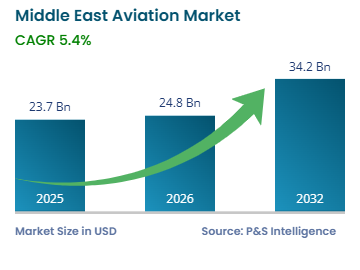
The Middle Eastern aviation market size will be an estimated USD 23.7 billion for 2025, and it will grow by 5.4% during 2026–2032, to reach USD 34.2 billion by 2032.
This robust expansion is driven by the strategic geographical positioning of the region as a global aviation hub, massive infrastructure investments, and the ambitious national aviation strategies of key countries, particularly Saudi Arabia's Vision 2030 and the UAE's comprehensive airport expansion programs. The Middle East's strategic location at the crossroads of Asia, Europe, and Africa enables these carriers to capture significant transit traffic, with approximately 88.4% of the region's aviation capacity dedicated to international routes.
Additionally, the Middle East's ambitious tourism targets and economic diversification strategies are creating substantial demand for aviation services. Saudi Arabia's Vision 2030 plan calls for tourism to account for over 10% of GDP, generating at least one million additional jobs through GIGA projects such as NEOM, Amala, and the Red Sea Project, with plans for over 150,000 new hotel rooms and targeting 100 million tourists among 300 million air passengers by 2030. The kingdom's aviation liberalization plan, including opening domestic routes to international competition, is creating new opportunities, with VistaJet reporting 32% membership growth in the first half of 2025.
Middle East Aviation Market Dynamics
Digital Transformation and Sustainability InitiativesAre Key Trends
The adoption of advanced technologies and sustainable practices is revolutionizing Middle Eastern aviation operations, enhancing efficiency, while addressing environmental concerns.
Kyndryl and Auj's strategic collaboration aims to drive digital innovation in Saudi Arabia's aviation industry, helping airlines, airports, and regulators adopt new technologies and operating models that drive efficiency, resilience, and innovation.
Airlines are implementing artificial intelligence for operational optimization, with Emirates and Qatar Airways leading investments in predictive maintenance systems and automated passenger services.
Sustainability has become a central pillar of regional aviation strategies.
The new concourses D and E at Qatar's Hamad International Airport are designed to meet GSAS 4-star certifications and LEED Gold sustainability standards, incorporating energy-efficient systems, innovative water management solutions, and climate control measures.
They also feature advanced automated boarding systems ensuring smoother boarding processes, greater operational efficiency, and smart technology that facilitates quick travel document verification.
Qatar Airways has committed to using sustainable aviation fuel (SAF) for at least 10% of its combined fuel volumes by 2030 as part of its commitment towards a low-carbon future.
Saudi Arabia's aviation sector is similarly embracing sustainability, with the GACA launching trial air taxi services and granting licenses for innovative aviation technologies, including electric cargo aircraft.
The digital transformation extends to passenger experience enhancement through smart technology implementation.
Dubai's new airport will feature AI and advanced technology to create a "borderless airport" where passengers move through quickly without long queues at customs and immigration checkpoints.
These technological advancements are complemented by investments in workforce development, with training programs producing qualified aviation professionals to support the sector's digital evolution.
The Middle Eastern aviation market is experiencing unprecedented transformation through strategic infrastructure investments that are fundamentally reshaping regional capacity and global connectivity.
Dubai's USD 34.84-billion (AED 128 billion) expansion of Al Maktoum International Airport will create a facility five times the size of Dubai International Airport, with a capacity to handle 260 million passengers annually by 2050.
The project is expected to create thousands of employment opportunities and support up to one million people through employment and housing in Dubai South.
Saudi Arabia's aviation infrastructure development under Vision 2030 represents one of the most ambitious programs globally.
The kingdom plans to invest USD100 billion in aviation infrastructure, including the under-construction King Salman International Airport in Riyadh, which will feature four terminals and six runways with capacity for 120 million passengers by 2030 and 185 million by 2050.
In 2024, Saudi airports handled over 128 million passengers, processed more than 905,000 flights, and managed air cargo volumes exceeding 1.2 million tons.
Government initiatives across the region, including liberalized aviation policies and strategic partnerships, are supporting infrastructure developments and driving economic growth.
Qatar's Hamad International Airport completed its expansion in March 2025, increasing annual capacity to over 65 million passengers.
Saudi Arabia's General Authority of Civil Aviation has reported achieving 100% of Vision 2030's aviation indicators, with the kingdom now ranking 17th globally in the Air Connectivity Index as per IATA, surpassing the 2024 target by two ranks.
These developments, combined with the region's growing tourism sector and economic diversification efforts, position the Middle Eastern aviation market for sustained growth through 2032.
Middle East Aviation Market Segmentation Analysis
Service Analysis
The passenger air transport category holds the largest market share, of 30%, in 2025, driven by the region's strategic position as a global transit hub and increasing demand from both leisure and religious tourism. The category benefits from the presence of world-class carriers operating extensive international networks, with Middle Eastern carriers achieving 9.4% traffic growth in 2024 and major hubs like Dubai, Doha, and Riyadh serving as critical connection points between East and West. The passenger category's dominance is reinforced by massive fleet expansions, premium service offerings, and strategic route development initiatives aligned with national tourism objectives.
The MRO category will have the highest CAGR during the forecast period, driven by fleet expansions from Emirates, Qatar Airways, and Saudia, ensuring a steady schedule of major aircraft inspections for regional providers. The UAE dominates the regional MRO market, commanding 45% of total market share with facilities including Dubai Aerospace Enterprise Engineering, Etihad Engineering, and Emirates Engineering, generating revenue of USD 3.2 billion in 2022. The category's expansion is supported by government initiatives promoting local capabilities and strategic partnerships with global MRO providers.
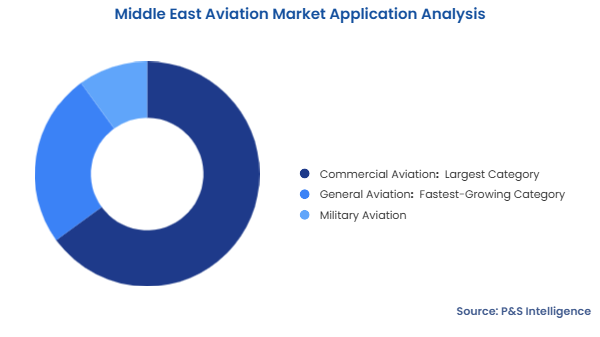
The commercial aviation category holds the largest market share, of 65%, in 2025, highlighting the Middle East’s role as a key hub for both passenger and cargo services. The category encompasses the region's flagship carriers and their extensive route networks, with commercial airlines accounting for approximately 72% market share in 2024 across the combined Middle East and Africa region. Commercial aviation's growth is underpinned by fleet modernization programs, with airlines actively replacing existing aircraft with advanced fuel-efficient models to meet operational demands and environmental objectives.
The general aviation category will have the highest CAGR, of 5.6%, during the forecast period. The region has witnessed substantial growth in its wealthy population base, with the Middle East hosting 754,000 high-net-worth individuals and Africa having 128,000 HNWIs as of 2022. In the private jet charter services market, the large business jet category accounted for 100% of deliveries during 2019-2023 for charter applications, with operators witnessing high demand for large jets throughout the region. The category's expansion is driven by increasing business aviation demand, tourism diversification, and the establishment of dedicated general aviation terminals at major airports.
The applications analyzed in this report are:
Commercial Aviation (Largest Category)
General Aviation (Fastest-Growing Category)
Military Aviation
Technology Analysis
The conventional category holds the largest market share, of 90%, in 2025, encompassing the existing fleet of jet-powered commercial and military aircraft operating throughout the region. This dominance reflects the mature infrastructure supporting conventional aviation, including fuel distribution networks, maintenance facilities, and regulatory frameworks. The region's major carriers operate predominantly conventional fleets, with Emirates Airlines operating 260 aircraft, mostly Airbus A380s and Boeing 777s; Etihad Airways maintaining 100 aircraft, including Boeing 787s, Boeing 777s, and Airbus models; while Air Arabia operates 70 Airbus A320 and A321 aircraft.
The hybrid electric category will have the highest CAGR, of 5.7%, due to increasing investments in sustainable aviation, government initiatives supporting green technologies, rising fuel costs, and airline interest in reducing carbon emissions. Technological advancements in battery and propulsion systems also accelerate adoption, making hybrid aircraft a key focus for future regional fleets.
The technologies analyzed in this report are:
Conventional (Largest Category)
Hybrid Electric (Fastest-Growing Category)
Electric
Autonomous/Unmanned
Drive strategic growth with comprehensive market analysis
Middle East Aviation Market Regional Outlook
UAE Aviation Market Size
UAE holds the largest market share, of 25%, in 2025, establishing itself as the undisputed aviation hub of the Middle East. Capacity across the Middle East reached 38.3 million seats in October 2025, with the UAE accounting for 7.9 million seats. The first phase, slated for completion by 2030, includes construction of Concourse 1 stretching 1.7 miles in length, covering almost 19 million square feet with 100 contact gates. This infrastructure development supports aviation's contribution of AED 43 billion to Dubai's economy in 2023 through tourism facilitated by aviation.
The UAE's aviation ecosystem extends beyond passenger operations to encompass comprehensive MRO capabilities and ground handling services. As per studies, more than 60% of the wide-body aircraft maintenance in the region is performed in the UAE. GE Aerospace operates its support center in Dubai South, providing maintenance and repair solutions for GE and CFM engines serving Emirates, flydubai, Etihad Airways, and Air Arabia. The country's commitment to aviation innovation is demonstrated through regulatory leadership, with the UAE issuing the world's first regulatory framework for hybrid operations, enabling electric vertical takeoff and landing operations.
Saudi Arabia Aviation Market Size
Saudi Arabia will have the highest CAGR, of 5.5%, fueled by Vision 2030’s ambitious plan to accommodate 330 million passengers annually, including 100 million tourists. The kingdom's aviation sector achieved significant milestones in 2024, handling over 128 million passengers through Saudi airports, processing more than 905,000 flights, and managing air cargo volumes exceeding 1.2 million tonnes. The kingdom's aviation transformation encompasses multiple mega-projects reshaping regional connectivity. New airports serving Vision 2030's giga-projects include Red Sea International and Neom Airport, supporting tourism development initiatives.
Saudi Arabia's aviation sector growth extends beyond infrastructure to encompass fleet expansion and route development. The launch of Riyadh Air as a second national carrier alongside Saudia represents a strategic move to capture growing demand, with Riyadh Air planning to connect the capital to over 100 international destinations, potentially creating around 200,000 jobs. Saudia expanded its international network in 2024, with the new Dammam–Beijing route driving a 16.2% increase in passenger traffic and strengthening connections to support pilgrimage tourism. The kingdom's commitment to developing local aviation capabilities is evident through partnerships like Collins Aerospace's MOU with SRB Aerial Systems to support unmanned aerial systems development aligned with Vision 2030.
These countries are analyzed:
Saudi Arabia (Fastest-Growing Country Market)
UAE (Largest Country Market)
Qatar
Kuwait
Oman
Bahrain
Rest of the Middle East
Middle East Aviation Market Share
The market is semi-consolidated, reflecting significant market concentration driven by government-backed national carriers and strategic hub development. The carrier's dominance is reinforced by its extensive network, premium service offerings, and strategic positioning at Dubai International Airport. Qatar Airways follows as the second-largest player, leveraging Hamad International Airport's expansion and its Oneworld alliance membership to capture significant market share. Strategic partnerships and alliances play crucial roles in competitive positioning. Carriers are expanding codeshare agreements, with Saudia establishing partnerships with AEGEAN Airlines, Kenya Airways, Virgin Atlantic, ITA Airways, and Delta Airlines. Government support remains a key competitive factor, with national carriers benefiting from infrastructure investments and favorable regulatory frameworks aligned with economic diversification objectives.
Key Middle East Aviation Companies:
Emirates Group
Qatar Airways Group Q.C.S.C.
Saudi Arabian Airlines Corporation
Airbus SE
The Boeing Company
Lockheed Martin Corporation
Embraer S.A.
Leonardo S.p.A.
Textron Inc.
Flynas Company
Oman Air S.A.O.C.
Gulf Air B.S.C.
Middle East Aviation Market News
In February 2025, Saudia announced network expansion to new destinations and a strengthening of strategic partnerships with global carriers.
In March 2025, Qatar's Hamad International Airport officially unveiled Concourses D and E, completing its comprehensive expansion project that began in 2018, increasing annual capacity to over 65 million passengers.
In February 2023, Collins Aerospace Inc. signed an MOU with SRB Aerial Systems (Unmanned X Inc.) to support research, development, and execution of unmanned aerial systems for use in Saudi Arabia, supporting Vision 2030 objectives.
Want a report tailored exactly to your business need?
Leading companies across industries trust us to deliver data-driven insights and innovative solutions for their most critical decisions. From data-driven strategies to actionable insights, we empower the decision-makers who shape industries and define the future. From Fortune 500 companies to innovative startups, we are proud to partner with organisations that drive progress in their industries.
Client Testimonials
Working with P&S Intelligence and their team was an absolute pleasure – their awareness of timelines and commitment to value greatly contributed to our project's success. Eagerly anticipating future collaborations.
McKinsey & Company
India
Unmatched Standards
Our insights into the minutest levels of the markets, including the latest trends and competitive landscape, give you all the answers you need to take your business to new heights
Complete Data Security
We take a cautious approach to protecting your personal and confidential information. Trust is the strongest bond that connects us and our clients, and trust we build by complying with all international and domestic data protection and privacy laws