Middle East and Africa Smart Water Management Market Size & Share Analysis - Trends, Drivers, Competitive Landscape, and Forecasts (2026 - 2032)
This Report Provides In-Depth Analysis of the Middle East and Africa Smart Water Management Market Report Prepared by P&S Intelligence, Segmented by Component (Hardware/Water Meters, Solutions/Software, Services), Technology (Internet of Things (IoT), Artificial Intelligence (AI) & Machine Learning (ML), Big Data Analytics, Cloud Computing, GIS & Remote Sensing), End User (Industrial, Residential, Commercial), and Geographical Outlook for the Period of 2019 to 2032
Middle East and Africa Smart Water Management Market Valuation
Key Highlights
Study Period
2019 - 2032
Market Size in 2025
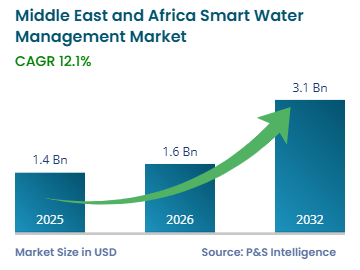
USD 1.4 Billion
Market Size in 2026
USD 1.6 Billion
Market Size by 2032
USD 3.1 Billion
Projected CAGR
12.1%
Largest Region
Saudi Arabia
Fastest Growing Region
UAE
Market Structure
Fragmented
Market Size
Explore the market potential with our data-driven report
Middle East and Africa Smart Water Management Market Overview
The Middle East and Africa smart water management market size will be an estimated USD 1.4 billion for 2025, and it will grow by 12.1% during 2026–2032, to reach USD 3.1 billion by 2032.
The market is propelled by acute water scarcity, expanding urban populations, stringent government regulations, and increasing investments in smart city initiatives across the region.
The Middle East and North Africa is the most water-scarce region of the world. Home to 6.3% of the world's population, the region contains only 1.4 percent of the world's renewable fresh water. This critical water stress has accelerated the adoption of smart water management solutions as governments and utilities seek innovative technologies to optimize water distribution, reduce losses, and ensure sustainable resource utilization.
The proliferation of IoT sensors, artificial intelligence, and real-time monitoring capabilities has transformed traditional water infrastructure into intelligent networks capable of detecting leaks, predicting demand, and optimizing distribution. Major metropolitan areas including Dubai, Riyadh, Cairo, and Johannesburg, are implementing comprehensive smart water programs that integrate hardware meters, software analytics, and professional services to address both water scarcity and aging infrastructure challenges. Nearly 9 out 10 children in the Middle East and North Africa live in areas of high or extremely high-water stress with serious consequences on their health, nutrition, cognitive development and future livelihoods. The integration of smart water technologies presents a viable solution to these pressing challenges, enabling real-time water quality monitoring, automated leak detection, and predictive maintenance that collectively enhance water conservation efforts and service reliability across residential, commercial, and industrial sectors.
Middle East and Africa Smart Water Management Market Emerging Trends
Rapid Expansion of Smart City Initiatives Is Key Trend
Smart city developments across the Middle East and Africa are incorporating water management as a core component of urban infrastructure modernization.
According to report, the United Arab Emirates and Saudi Arabia alone are investing nearly USD 50 billion in smart city projects through 2025.
These investments encompass comprehensive water management systems that integrate with broader urban infrastructure to create interconnected, efficient ecosystems.
Dubai's Smart City project adopts a strategy that calls for the transformation of about 1000 government services which focus on six key sectors, namely, transportation, infrastructure, communications, economic services, urban planning and electricity.
Dubai implemented many initiatives on smart water management including real-time monitoring networks and automated meter reading systems.
Similarly, Abu Dhabi's Masdar City, first announced in 2006, is marketed as a frontrunner for smart city development, built from scratch under the greenfield model.
These flagship projects demonstrate the integration potential of smart water technologies within broader urban development strategies, creating replicable models for implementation across the region.
Extreme Water Scarcity and Climate Change Are Biggest Drivers
The Middle East and Africa region faces unprecedented water stress that serves as the primary driver for smart water management market growth.
With an average water stress level of 820%, the region withdraws eight times more water annually than is naturally available.
This extreme scarcity has prompted governments to prioritize water conservation technologies and implement stringent regulations mandating smart water infrastructure deployment.
The region's arid climate is the primary contributor to its perennial state of water scarcity.
When coupled with the region's limited freshwater supplies and growing demand for water, virtually all MENA countries are facing elevated levels of water stress.
By 2050, two-thirds of countries in the MENA region could have less than 200 cubic meters (m3) of renewable water resources per capita per year (the annual average in other geographical regions is about 7,000 m3 per capita).
Rising temperatures and irregular rainfall patterns have intensified the urgency for intelligent water management systems capable of maximizing efficiency from limited resources.
Smart sensors and IoT devices enable real-time monitoring of water quality, flow rates, and consumption patterns, providing utilities with actionable insights to minimize losses and optimize distribution networks.
Middle East and Africa Smart Water Management Market Segmentation Analysis
Component Analysis
The hardware/water meters category holds the largest market share, of 55%, in 2025, and it will have the highest CAGR during the forecast period. This segment's leadership position stems from the fundamental role of physical infrastructure in enabling smart water management capabilities. Smart water meters provide the essential data collection foundation for comprehensive water management systems, offering real-time consumption monitoring, automated meter reading, and leak detection capabilities that directly address the region's critical water scarcity challenges.
The components analyzed in this report are:
Hardware/Water Meters (Largest and Fastest-Growing Category)
Smart Water Meters
Sensors & Devices
Control Systems
Solutions/Software
Asset Management
Distribution Network Monitoring
SCADA Systems
Meter Data Management (MDM)
Advanced Analytics
Leak Detection Systems
Smart Irrigation Management
Water Quality Monitoring
Demand Forecasting / Predictive Water Management
Services
Professional Services
Managed Services
Training & Support Services
Technology Analysis
The IoT category holds the largest market share, of 40%, in 2025, due to its pivotal role in enabling intelligent water infrastructure across the Middle East and Africa. IoT technology serves as the backbone for connecting disparate water management components into cohesive, intelligent networks capable of real-time data collection, transmission, and analysis. The widespread adoption of IoT in water management stems from its ability to provide continuous monitoring capabilities while minimizing manual intervention requirements in regions facing skilled labor shortages.
The AI & ML category will have the highest CAGR, of 12.3%, as these technologies enable predictive maintenance, demand forecasting, and anomaly detection that transform reactive water management into proactive resource optimization. AI algorithms analyze vast datasets from IoT sensors to identify consumption patterns, predict equipment failures, and optimize distribution schedules, delivering substantial efficiency gains. Cloud computing adoption is accelerating as utilities recognize the scalability and cost advantages of cloud-based water management platforms, particularly for smaller municipalities lacking extensive IT infrastructure.
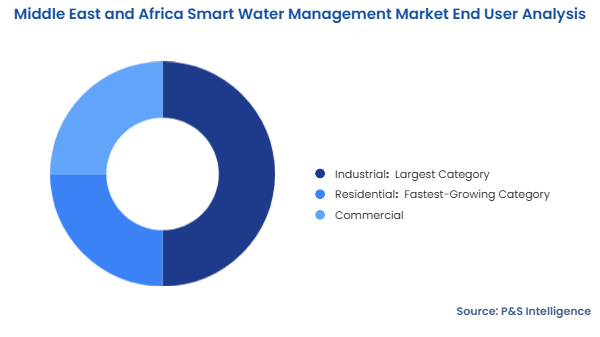
The industrial category holds the largest market share, of 50%, in 2025, driven by stringent regulatory requirements and the critical role of water in industrial processes. Industries including oil and gas, manufacturing, mining, and power generation are implementing comprehensive smart water solutions to optimize consumption, ensure regulatory compliance, and reduce operational costs. The high water intensity of industrial operations combined with increasing environmental regulations has made smart water management systems essential for maintaining competitiveness and operational continuity.
The residential category will have the highest CAGR, of 12.4%, supported by urban expansion and increasing public awareness of water-saving practices. Sigfox SA has been selected as the network to support South Africa's transition to smart water meters. The tender, commonly known as "RT29" awarded to various System Integrators, will see existing meters adapted or replaced to become smart meters to improve revenue collection and service delivery, exemplifying the large-scale residential smart meter deployments occurring across the region. Rising water tariffs and increasing frequency of supply interruptions have motivated residential consumers to adopt smart water devices that enable consumption monitoring and leak detection, driving substantial market growth in this segment.
The end users analyzed in this report are:
Industrial (Largest Category)
Residential (Fastest-Growing Category)
Commercial
Drive strategic growth with comprehensive market analysis
Middle East and Africa Smart Water Management Market Geographical Analysis
Saudi Arabia Smart Water Management Market Size
Saudi Arabia holds the largest market share, of 30%, in 2025, backed by significant investments in water infrastructure modernization under its Vision 2030 programs. Saudi Arabia's desalination capacity is set to increase from 5.6 million cubic meter (m3) per day in 2022 to 8.5 million m3 per day in 2025, and it will have to cover more than 90% of the country's water consumption, necessitating sophisticated management systems to optimize this expanding infrastructure.
The National Water Strategy 2030 which mandates comprehensive water conservation measures and infrastructure upgrades. In 2007, the per capita consumption was 214 L per capita per day (lpcd), surging to 315 lpcd in 2023, marking a 47.2% increase. Major projects including NEOM's smart city development and the expansion of smart irrigation systems across agricultural regions are accelerating technology adoption. The kingdom's focus on reducing per capita water consumption from current levels to global standards by 2030 through smart metering and real-time monitoring systems continues to drive substantial market growth.
UAE Smart Water Management Market Size
UAE will have the highest CAGR, of 12.2%, due to the advanced smart city infrastructure and early adoption of water management technologies, position it as a regional leader in innovation. Approximately 42% of the United Arab Emirates' drinking water comes from desalination plants, creating extensive opportunities for smart management systems to optimize these critical facilities. Dubai demonstrates its commitment to water sustainability through widespread smart meter installations and AI-based leak detection systems across all customer segments. Abu Dhabi's integration of smart water technologies in new developments, particularly in Masdar City and other sustainable urban projects, continues to drive market expansion.
South Africa Smart Water Management Market Size
South Africa is experiencing significant growth in the MEA smart water management market, due to the country's market leadership in Africa, stemming from urgent water scarcity challenges and proactive government initiatives to modernize water infrastructure. South Africa's physical water scarcity will become a reality in 2025, and it's expected to have a water deficit of 17 percent by 2030, driving accelerated adoption of smart water technologies. Smart tech delivers real-time insights to identify inefficiencies and predict future demand. By leveraging Artificial Intelligence and Big Data Analytics, municipalities can transform this data into accurate demand forecasts, optimise available supply, and proactively plan for potential shortages.
The countries of the market are as follows:
Saudi Arabia (Largest Country Market)
UAE (Fastest-Growing Country Market)
Kuwait
Qatar
Bahrain
Egypt
South Africa
Rest of MEA
Middle East and Africa Smart Water Management Market Share
The market is fragmented due to the presence of numerous international technology providers, regional system integrators, and emerging local solution developers. The market fragmentation reflects the diverse technological requirements across different countries and the varying stages of smart water infrastructure development throughout the region. The top 10 players in the Middle East and Africa smart water management market collectively control approximately 45% of the total market share, indicating a slightly fragmented market structure according to the defined criteria. The presence of numerous small and medium-sized enterprises specializing in specific technologies or serving niche markets contributes to the overall fragmentation while driving innovation and competitive pricing. Regional players are gaining traction by offering localized solutions and competitive pricing strategies tailored to specific market needs.
Key Middle East and Africa Smart Water Management Companies:
ABB Ltd.
IBM
Honeywell Elster
Siemens AG
Schneider Electric SE
Suez S.A.
Arada Group
Aquamatrix
Badger Meter
Sensus
Veolia Environnement S.A.
Xylem Inc.
Middle East and Africa Smart Water Management Market News
In October 2024, the Egyptian Ministry of Water Resources and Irrigation signed a comprehensive Memorandum of Understanding with ICARDA (International Center for Agricultural Research in the Dry Areas) to intensify cooperation in agricultural water resources research and smart irrigation technology deployment across Egypt's agricultural regions.
In June 2024, Sigfox S.A. South Africa secured the national contract to provide IoT connectivity for over 15 million smart water meters under the RT29 tender, marking the largest smart water meter deployment in Africa.
Want a report tailored exactly to your business need?
Leading companies across industries trust us to deliver data-driven insights and innovative solutions for their most critical decisions. From data-driven strategies to actionable insights, we empower the decision-makers who shape industries and define the future. From Fortune 500 companies to innovative startups, we are proud to partner with organisations that drive progress in their industries.
Client Testimonials
Working with P&S Intelligence and their team was an absolute pleasure – their awareness of timelines and commitment to value greatly contributed to our project's success. Eagerly anticipating future collaborations.
McKinsey & Company
India
Unmatched Standards
Our insights into the minutest levels of the markets, including the latest trends and competitive landscape, give you all the answers you need to take your business to new heights
Complete Data Security
We take a cautious approach to protecting your personal and confidential information. Trust is the strongest bond that connects us and our clients, and trust we build by complying with all international and domestic data protection and privacy laws