Middle East and Africa Generative AI Market Size & Share Analysis - Trends, Drivers, Competitive Landscape, and Forecasts (2026 - 2032)
This Report Provides In-Depth Analysis of the Middle East and Africa Generative AI Market Report Prepared by P&S Intelligence, Segmented by Component (Software, Services), Application (Computer Vision, Natural Language Processing, Robotics and Automation, Content Generation, Chatbots & Intelligent Virtual Assistants, Predictive Analysis), End User (Media & Entertainment, IT & Telecommunication, BFSI, Healthcare & Life Sciences, Automotive & Transportation, Manufacturing, Construction & Real Estate, Energy & Ytilities, Retail & E-Commerce), Model (Large Language Models, Image and Video Generation Models, Multi-Modal Generative Models), Technology (Generative Adversarial Networks, Tranformers, Variational Auto Encoders, Diffusion Networks), and Geographical Outlook for the Period of 2019 to 2032
Middle East and Africa Generative AI Market Size Forecast
Key Highlights
Study Period
2019 - 2032
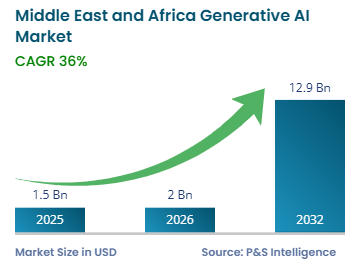
Market Size in 2025
USD 1.5 Billion
Market Size in 2026
USD 2.0 Billion
Market Size by 2032
USD 12.9 Billion
Projected CAGR
36%
Largest Region
Saudi Arabia
Fastest Growing Region
South Africa
Market Structure
Fragmented
Market Size
Explore the market potential with our data-driven report
Middle East and Africa Generative AI Market Overview
The Middle East and Africa generative AI market size will be an estimated USD 1.5 billion for 2025, and it will grow by 36.0% during 2026–2032, to reach USD 12.9 billion by 2032.
This remarkable growth trajectory is driven by accelerating digital transformation initiatives across the region, substantial government investments in AI infrastructure, and the rapid adoption of generative AI solutions to address unique regional challenges while fostering economic diversification.
The region's strategic commitment to AI development is evidenced by ambitious national AI strategies, with Saudi Arabia in discussion with venture capital firms to launch a USD40 billion fund to back AI initiatives, while the U.A.E. is investing heavily in a massive data center cluster as part of the Stargate project, with support from OpenAI, NVIDIA, and other U.S. companies. These investments are creating a robust foundation for generative AI innovation, positioning MEA as an emerging global hub for AI development.
The integration of generative AI across industries is yielding substantial returns. For instance, according to report, GenAI delivers substantial returns, estimated at 3.7 times the investment per dollar spent. This exceptional ROI is particularly pronounced in the financial services, followed by media & telecom, mobility, retail & consumer packaged goods, energy, manufacturing, healthcare, and education sectors.
Middle East and Africa Generative AI Market Dynamics
Infrastructure Development and AI Ecosystem Expansion Are Key Trends
The rapid development of AI infrastructure across the MEA region is creating a strong foundation for generative AI growth.
The investment surge is manifesting in tangible infrastructure developments, with Saudi Arabia, the U.A.E., and Egypt's collective data center capacity predicted to more than double in the next two years.
Major technology partnerships are accelerating this infrastructure development.
Google Cloud and the PIF recently announced the advancement of a USD 10 billion partnership to build and operate a global AI hub in Saudi Arabia.
The establishment of specialized AI zones and innovation hubs is creating ecosystems where startups, enterprises, and research institutions can collaborate effectively.
Notable examples include Hub71+ AI in Abu Dhabi, providing technical resources, AI research access, and industry partnerships; and RAK Innovation City, which leverages AI to streamline business formation and operations, attracting global innovation-driven companies.
National AI Strategies and Government Support Are Biggest Drivers
Government initiatives and national AI strategies across the MEA region are creating an exceptionally supportive environment for generative AI development and deployment.
The alignment with national priorities such as the U.A.E. National Strategy for Artificial Intelligence 2031 and Saudi Arabia's Vision 2030 has positioned AI at the center of economic transformation.
Saudi Arabia's ambitious plans include AWS's commitment to train 100,000 citizens in cloud computing and genAI, focusing on the two newest AWS genAI certifications.
The Saudi Data and Artificial Intelligence Authority has launched initiatives to raise awareness, enhance research, and improve innovation, with plans to train more than 5,000 students in AI-focused courses.
The U.A.E. has taken equally bold steps, with OpenAI reaching an agreement to provide nationwide access to ChatGPT Plus for all residents of the Emirates, making the U.A.E. among the first nations in the world to enable ChatGPT access nationwide.
Generative AI investment in the MEA region is gaining momentum, led by Saudi Arabia and the UAE.
Saudi startup Lucidya has raised USD 30 million in Series B for its Arabic-focused AI CX platform, while Egypt’s Widebot has secured USD 3 million to build “AQL Mind,” a Saudi-backed Arabic generative AI model.
Voice AI startup Sawt has raised USD 1 million in a pre-seed round to develop Arabic-native speech technology, while DEEP.SA has secured USD 1.2 million to build AI tools for government use.
vminds.ai also received a six-figure investment for its AI productivity suite. Additionally, Saudi Arabia launched a USD 1 billion GAIA initiative to accelerate generative AI development in the region.
Middle East and Africa Generative AI Market Segmentation Analysis
Component Analysis
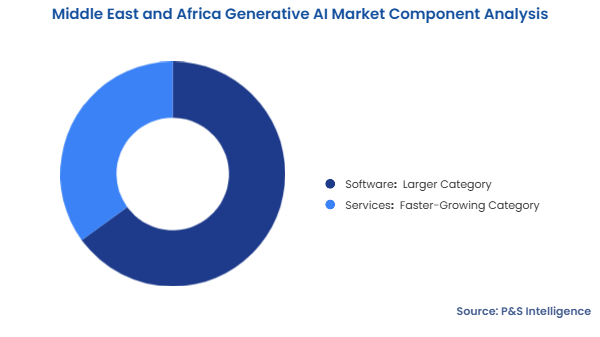
The software category holds the larger market share, of 65%, in 2025, driven by the rapid deployment of large language models, content generation platforms, and specialized AI applications tailored to regional needs. The proliferation of software solutions is fueled by the increasing demand for Arabic language processing capabilities, with companies developing sophisticated models that can handle the linguistic complexity and cultural nuances of the region.
The services category will have the higher CAGR, of 36.4%, owing to the growing need for implementation support, customization, and ongoing management of generative AI solutions. Organizations across MEA are recognizing that successful AI adoption requires more than just technology deployment; it demands comprehensive services, including consulting, integration, training, and continuous optimization. This category is particularly benefiting from the region's focus on building local AI expertise, with consulting firms and system integrators playing crucial roles in helping enterprises navigate their AI transformation journeys.
The components analyzed in this report are:
Software (Larger Category)
Services (Faster-Growing Category)
Application Analysis
The natural language processing category holds the largest market share, of 45%, in 2025, driven by the critical need for Arabic language processing and multilingual communication solutions. MetaDialog built the first LLM to support both Arabic and English, a 7-billion-parameter model trained on one of the world's largest Arabic/English datasets, exemplifying the regional focus on language-specific AI capabilities. The demand for NLP solutions extends beyond translation, encompassing sentiment analysis, document processing, and conversational AI applications that can navigate the linguistic diversity of the MEA region.
The chatbots & intelligent virtual assistants category will have the highest CAGR, of 36.2%, driven by the widespread adoption of conversational AI across customer service, banking, healthcare, and government services. Meta has officially launched Meta AI in the Middle East and North Africa with Arabic capabilities, with millions of users across the region now having unlimited free access to one of the world's most advanced AI assistants. The integration of generative AI into customer-facing applications is transforming how organizations engage with their audiences, providing personalized, culturally relevant interactions at scale.
The BFSI category holds the largest market share in 2025, due to its early adoption of AI technologies for fraud detection, risk management, and customer service automation. Banks and financial institutions are leveraging generative AI to enhance operational efficiency, personalize services, and maintain a competitive edge in a rapidly digitalizing region.
The healthcare & life sciences category will have the highest CAGR during the forecast period, driven by the urgent need to modernize healthcare delivery systems, improve diagnostic accuracy, and enhance patient care across the region. Kinetik (Saudi Arabia) utilizes generative AI to personalize patient care, analyzing health data to provide tailored health plans and recommendations, representing the innovative applications emerging in this sector. The integration of generative AI in drug discovery, medical imaging analysis, and personalized treatment planning is revolutionizing healthcare delivery, particularly in addressing the region's unique health challenges.
The end users analyzed in this report are:
Media & Entertainment
IT & Telecommunication
BFSI (Largest Category)
Healthcare & Life Sciences (Fastest-Growing Category)
Automotive & Transportation
Manufacturing
Construction & Real Estate
Energy & Utilities
Retail & E-Commerce
Others
Model Analysis
The large language models category holds the largest market share, of 50%, in 2025, driven by the critical need for advanced language processing capabilities, particularly for Arabic and other regional languages. These models are essential for understanding, generating, and translating text across multiple dialects, making them highly relevant for both governments and enterprises. Governments in countries such as Saudi Arabia, the UAE, and Qatar are increasingly adopting LLMs for AI-powered public services, chatbots, and automated knowledge management, while enterprises across sectors like banking, healthcare, and education leverage them for customer service automation, content generation, and document processing.
The multi-modal generative models category will have the highest CAGR, of 36.3%, due to the increasing demand for AI systems that can seamlessly process and generate content across text, image, video, and audio modalities. Organizations are recognizing the transformative potential of multi-modal AI in creating more comprehensive and contextually aware solutions. The development of models that can understand Arabic text while generating culturally appropriate visual content is particularly driving adoption in sectors such as media, education, and e-commerce. These advanced models are enabling new use cases such as automated video content creation with Arabic narration, visual product descriptions for e-commerce platforms, and immersive educational content that combines multiple media formats.
The transformers category holds the largest market share, of 55%, in 2025, as this technology's supremacy stems from its revolutionary approach to processing sequential data and its effectiveness in handling the complexities of Arabic and other regional languages. The transformer architecture's ability to capture long-range dependencies and contextual relationships makes it particularly suitable for the linguistic diversity of the MEA region.
The diffusion networks category will have the highest CAGR during the forecast period. This rapid growth is attributed to their superior performance in generating high-quality visual content and their increasing integration with language models for multi-modal applications. The technology's ability to create photorealistic images and videos while maintaining cultural sensitivity and regional aesthetics is driving adoption across creative industries, marketing agencies, and media companies.
The technologies analyzed in this report are:
Generative Adversarial Networks
Transformers (Largest Category)
Variational Auto Encoders
Diffusion Networks (Fastest-Growing Category)
Others
Drive strategic growth with comprehensive market analysis
Middle East and Africa Generative AI Market Regional Outlook
Saudi Arabia Market Size
Saudi Arabia holds the largest market share, of 30%, in 2025. This dominance is primarily attributed to the Kingdom's unprecedented investment in AI infrastructure and strategic commitment to technological advancement. The country's Vision 2030 initiative has positioned AI as a cornerstone of economic diversification, with Saudi Arabia as one of the world's largest investors in generative AI.
Educational programs are being expanded to train more than 5,000 students in AI-focused courses, and plans are underway to enhance the existing workforce's skills and attract new talent. Furthermore, a notable goal is the training of 25,000 women in data and AI over the next five years through the Elevate program, demonstrating Saudi Arabia's inclusive approach to AI development. The establishment of partnerships with global technology leaders, including AWS and HUMAIN’s USD 5 billion investment to build an AI Zone in Saudi Arabia, reinforces the country's position as a regional AI powerhouse.
South Africa Market Size
South Africa will have the highest CAGR, of 36.1%, driven by its relatively advanced technological infrastructure and growing startup ecosystem. The nation's focus on developing local AI solutions that address African-specific challenges, from healthcare delivery to financial inclusion, positions it as a key player in the continent's AI transformation. The country's universities and research institutions are playing crucial roles in developing AI talent and advancing research, while partnerships with international technology companies are facilitating knowledge transfer and capability building.
The geographical breakdown of the market is as follows:
Saudi Arabia (Largest Country Market)
U.A.E.
Kuwait
Qatar
Bahrain
Egypt
South Africa (Fastest-Growing Country Market)
Rest of MEA
Middle East and Africa Generative AI Market Share
The market is fragmented with a dynamic mix of global technology giants, regional champions, and innovative startups competing for market share. The market's nature reflects the early stage of generative AI adoption in the region, where no single player has achieved dominant control, allowing for rapid innovation and market entry opportunities. This fragmentation is driven by the diverse applications of generative AI across industries, the need for localized solutions, particularly in language processing, and the substantial government support for local AI development. The fragmented nature allows innovative startups to capture niche markets, while the growing demand for AI solutions creates space for multiple players to coexist and thrive.
Key Middle East and Africa Generative AI Companies:
G42
Humain
Saudi Data and Artificial Intelligence Authority
IBM Research
InstaDeep Ltd.
Zindi Africa
Aerobotics (Pty) Ltd.
Microsoft Corporation
Amazon Web Services, Inc.
NVIDIA Corporation
Adobe Inc.
OpenAI, L.L.C.
Middle East and Africa Generative AI Market News
In February 2025, Meta Platforms Inc. officially launched Meta AI in the Middle East and North Africa, incorporating Arabic language capabilities. This initiative marked a major step in providing advanced AI access to millions of users in the region via widely used platforms such as Facebook, Instagram, WhatsApp, and Messenger.
In February 2025, Accenture plc collaborated with Google Cloud to accelerate the adoption of cloud solutions and generative AI capabilities within the Kingdom of Saudi Arabia to address local data, operational, and software sovereignty needs.
In January 2025, Amazon Web Services Inc. and HUMAIN Company announced more than USD 5 billion in investment to advance AI adoption both in Saudi Arabia and globally. The initiative includes plans to establish an AI Zone in Saudi Arabia and train 100,000 citizens in cloud computing and generative AI.
In May 2025, Google Cloud and the Saudi PIF announced the expansion of a USD 10 billion partnership to build and operate a global AI hub in Saudi Arabia with HUMAIN, bringing Google's AI technology and cloud infrastructure to the Kingdom.
In May 2025, Qualcomm Incorporated and HUMAIN Company signed an MoU to deliver to the region advanced AI data centers, hybrid AI across edge devices and cloud infrastructure, and AI services.
Want a report tailored exactly to your business need?
Leading companies across industries trust us to deliver data-driven insights and innovative solutions for their most critical decisions. From data-driven strategies to actionable insights, we empower the decision-makers who shape industries and define the future. From Fortune 500 companies to innovative startups, we are proud to partner with organisations that drive progress in their industries.
Client Testimonials
Working with P&S Intelligence and their team was an absolute pleasure – their awareness of timelines and commitment to value greatly contributed to our project's success. Eagerly anticipating future collaborations.
McKinsey & Company
India
Unmatched Standards
Our insights into the minutest levels of the markets, including the latest trends and competitive landscape, give you all the answers you need to take your business to new heights
Complete Data Security
We take a cautious approach to protecting your personal and confidential information. Trust is the strongest bond that connects us and our clients, and trust we build by complying with all international and domestic data protection and privacy laws