Middle East and Africa E-commerce Market Size & Share Analysis - Key Trends, Future Opportunities, Growth Strategies, and Forecasts (2026 - 2032)
This Report Provides In-Depth Analysis of the Middle East and Africa E-commerce Market Report Prepared by P&S Intelligence, Segmented by Product (Electronics, Apparel & Footwear, Home Appliances & Furniture, Grocery & Essential, Health & Beauty Products, Books & Stationery, Toys & Bays Products, Automotive Parts & Accessories), Platform (Business-to-Consumer, Business-to-Business, Consumer-to-Consumer), Payment Method (Digital Wallets, Credit/Debit Cards, Net Banking, Cash on Delivery, BNPL), Business Model (Marketplace, Inventory-led, Hybrid), Delivery Time (Standard Delivery, Same-Day/Next-Day Delivery, Click and Collect (BOPIS), Drop Shipping, Cross-border/International Shipping), and Geographical Outlook for the Period of 2019 to 2032
Middle East and Africa E-commerce Market Size Estimation
Key Highlights
Study Period
2019 - 2032
Market Size in 2025
USD 135.1 Billion
Market Size in 2026
USD 162.7 Billion
Market Size by 2032
USD 518.1 Billion
Projected CAGR
21.2%
Largest Region
Saudi Arabia
Fastest Growing Region
Saudi Arabia
Market Structure
Fragmented
Market Size
Explore the market potential with our data-driven report
Middle East and Africa E-commerce Market Analysis
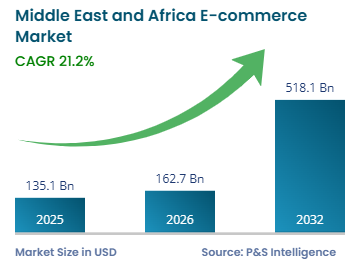
The Middle East and Africa e-commerce market size will be an estimated USD 135.1 billion for 2025, and it will grow by 21.2% during 2026–2032, to reach USD 518.1 billion by 2032.
The market is experiencing robust growth driven by the increasing internet penetration, growing smartphone adoption, expanding digital payment infrastructure, and changing consumer behavior favoring online shopping convenience across the region. In the Middle East and North Africa (MENA), internet penetration stands at 65–70%, with the Arab world averaging about 70.2% (roughly 348 million users out of 496 million people). Moreover, Northern Africa and parts of the Middle East exceed the global average (~68%).
The rapid digital transformation across MEA countries has emerged as a fundamental catalyst for e-commerce growth. The proliferation of smartphones, coupled with improving 4G and emerging 5G networks, has enabled millions of consumers to access online shopping platforms, particularly in urban centers across Saudi Arabia, the U.A.E., Egypt, and South Africa.
The region's young demographic profile significantly contributes to e-commerce adoption, with over 60% of the population under 30 years old actively embracing digital shopping channels. Government initiatives such as Saudi Arabia's Vision 2030, the U.A.E.'s Digital Economy Strategy, and Egypt's Digital Egypt vision have accelerated digital infrastructure development, creating favorable conditions for e-commerce expansion. The COVID-19 pandemic permanently shifted consumer behavior, with many first-time online shoppers continuing to prefer digital channels for their convenience, wider product selection, and competitive pricing.
Middle East and Africa E-commerce Market Segmentation Analysis
Product Analysis
The apparel & footwear category holds the largest market share, of 35%, in 2025, due to the strong demand for fashion products among the region’s young, style-conscious population. E-commerce platforms offer wide selections, international brands, and localized experiences, while social media influence and convenient online shopping drive frequent purchases, boosting their market penetration in the MEA.
The grocery & essentials category will have the highest CAGR, of 21.4%, accelerated by the pandemic-induced behavioral shift toward online grocery shopping. Major retailers have invested heavily in last-mile delivery infrastructure, temperature-controlled logistics, and quick commerce models offering delivery within 30 minutes, making online grocery shopping increasingly convenient and reliable.
The products analyzed in this report are:
Electronics
Apparel & Footwear (Largest Category)
Home Appliances & Furniture
Grocery & Essentials (Fastest-Growing Category)
Health & Beauty Products
Books & Stationery
Toys & Baby Products
Automotive Parts & Accessories
Others
Platform Type Analysis
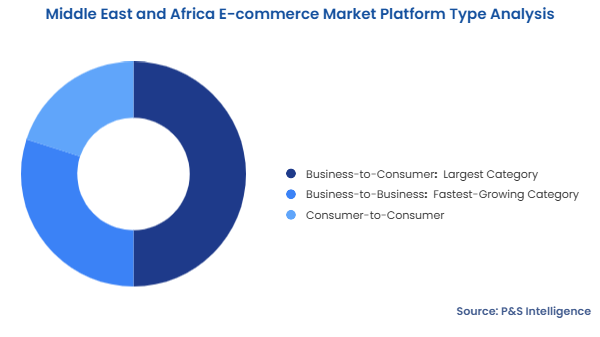
The B2C category holds the largest market share, of 50%, in 2025, reflecting the strong consumer adoption of online shopping across various product categories. B2C platforms benefit from established trust, comprehensive product ranges, secure payment systems, and reliable delivery networks that appeal to individual consumers seeking convenience and value.
The B2B category will have the highest CAGR, of 21.3%, driven by digital transformation initiatives among MEA businesses. The growth is fueled by SMEs seeking cost-effective sourcing solutions, manufacturers digitalizing their distribution channels, and the emergence of specialized B2B marketplaces catering to specific industries.
The platform types analyzed in this report are:
Business-to-Consumer (Largest Category)
Business-to-Business (Fastest-Growing Category)
Consumer-to-Consumer
Payment Method Analysis
The credit/debit cards category holds the largest market share, of 30%, in 2025, due to their convenience, speed, and security. They integrate seamlessly with mobile apps, support contactless and QR payments, and offer features like loyalty programs and instant transfers. Government initiatives, such as CBUAE Regulations & Sandbox, and rising smartphone penetration further accelerate their adoption across consumers.
As of the latest available data (2021), around 37.85% of adults (aged 15+) in the MENA region owned a debit card, while in Sub-Saharan Africa, this figure was significantly lower at approximately 19.28%. Credit card ownership remains limited across the MEA region, with only about 3–4% of adults in Africa reported to have one.
The digital wallets category will have the highest CAGR, of 21.6%, driven by their convenience, security features, and integration with loyalty programs. The adoption has been particularly strong in GCC countries, where smartphone penetration is high and consumers appreciate the seamless checkout experience offered by digital wallets.
As of 2023, digital wallet usage is growing rapidly in the MEA region, especially in MENA, where digital wallets accounted for 20–23% of the online spending, with projections suggesting this will rise to 34% by 2027. In the U.A.E., more than 50% of the population already uses digital wallets.
The payment methods analyzed in this report are:
Digital Wallets (Fastest-Growing Category)
Credit/Debit Cards (Largest Category)
Net Banking
Cash on Delivery
BNPL
Business Model Analysis
The marketplace category holds the largest market share, of 60%, in 2025, benefiting from network effects, asset-light operations, and ability to offer extensive product variety without inventory risk. Leading marketplaces like Amazon.ae, noon.com, and Jumia have established strong positions by providing comprehensive seller support, logistics infrastructure, and customer trust mechanisms.
The hybrid category will have the highest CAGR, 21.5%, during the forecast period, as established retailers and pure-play e-commerce companies blend marketplace and inventory-led approaches to optimize profitability and customer experience. This model allows platforms to maintain control over high-margin or strategic categories while leveraging third-party sellers for long-tail products, creating optimal inventory efficiency and customer choice.
The business models analyzed in this report are:
Marketplace (Largest Category)
Inventory-Led
Hybrid (Fastest-Growing Category)
Delivery Time Analysis
The standard delivery category holds the largest market share in 2025, as most consumers accept 2–5-day delivery windows for non-urgent purchases in exchange for free or low-cost shipping. This segment benefits from operational efficiency, cost-effectiveness for both merchants and consumers, and established logistics networks across MEA markets.
The same-day/next-day delivery category will have the highest CAGR during the forecast period, driven by consumer expectations for instant gratification and competition among e-commerce platforms. The growth for this category is supported by investments in micro-fulfillment centers, dark stores, and partnerships with gig economy delivery providers, enabling rapid order fulfillment.
Drive strategic growth with comprehensive market analysis
Middle East and Africa E-commerce Market Regional Outlook
Saudi Arabia E-commerce Market Size
Saudi Arabia holds the largest market share, of 35%, in 2025, and it will have the highest CAGR, driven by the high disposable income, government digitalization initiatives, and a tech-savvy young population. The Kingdom's Vision 2030 program has prioritized e-commerce development as part of economic diversification efforts, with the Ministry of Commerce reporting that e-commerce contributed 4.8% to GDP in 2024. The country's young demographics, with 70% of the population under 35 years old, demonstrates a high affinity for online shopping across categories from fashion to electronics. The development of NEOM and other smart cities incorporates advanced e-commerce infrastructure, positioning Saudi Arabia as a regional hub for digital commerce innovation.
U.A.E. E-commerce Market Size
The U.A.E. represents the second-largest e-commerce market in MEA with a 25.0% share, benefiting from the highest per capita income in the region, world-class logistics infrastructure, and a diverse expatriate population driving demand for international products. Dubai's strategic position as a global logistics hub facilitates efficient distribution across the region, with Dubai International Airport handling over 2.5 million tons of cargo in 2024.
The U.A.E. government's digital transformation initiatives, including the UAE Digital Economy Strategy, aiming to double the digital economy's contribution to GDP by 2031; have created an enabling environment for e-commerce growth. Free Zones dedicated to e-commerce operations offer 100% foreign ownership, tax advantages, and streamlined licensing procedures, attracting major international players to establish regional headquarters.
South Africa E-commerce Market Size
South Africa is experiencing a significant growth in the MEA e-commerce market, driven by improving internet infrastructure, growing middle class, and increased smartphone penetration. The country's e-commerce development benefits from relatively mature financial services infrastructure, including widespread credit card adoption and emerging digital payment solutions.
The South African government's SA Connect program aims to provide universal broadband access by 2030, addressing the digital divide that has historically limited e-commerce growth. Major retailers like Woolworths, Pick'n Pay, and Takealot have invested heavily in omnichannel capabilities, while international players recognize South Africa as a gateway to broader African markets. The growth of township e-commerce, enabled by innovative last-mile delivery solutions and cash-based payment options, represents a significant opportunity for inclusive digital economy development.
The geographical breakdown of the market is as follows:
Saudi Arabia (Largest and Fastest-Growing Country)
U.A.E.
Kuwait
Qatar
Bahrain
Egypt
South Africa
Rest of MEA
Middle East and Africa E-commerce Market Share
The market is fragmented due to the presence of numerous local and international players competing for market share. Diverse consumer preferences, varying income levels, and cultural differences across countries necessitate tailored strategies, preventing dominance by a single company. Additionally, low barriers to entry and the proliferation of digital platforms and marketplaces encourage new entrants. Regulatory variations, logistics challenges, and regional infrastructure disparities further contribute to market fragmentation, creating opportunities for multiple players to thrive.
Key Middle East and Africa E-commerce Companies:
Noon AD Holdings One Person Company LLC
Jumia Technologies AG
Takealot.com (Pty) Ltd
Amazon.com, Inc.
Majid Al Futtaim Hypermarket LLC
Namshi General Trading LLC
Al Tayer Insignia LLC
Mumzworld FZ LLC
Konga Online Shopping Ltd
Cartona Technologies Ltd
Jumbo Electronics Co. Ltd.
Desertcart LLC
Middle East and Africa E-commerce Market News
In July 2025, Maersk A/S Saudi Arabia and Saudi Post signed an MoU to improve logistics & supply chain services for e-commerce in Saudi Arabia and the GCC. This includes international shipping, bonded fulfilment, and improved last-mile delivery.
In February 2025, Campa Cola Co. Pvt. Ltd. partnered with Noon AD Holdings One Person Company LLC to offer rapid, i.e., minutes-based delivery of its drinks in the U.A.E. This reflects the expansion of quick delivery/micro-fulfillment strategies.
In November 2024, Hellmann Worldwide Logistics SE & Co. KG collaborated with AI-RobotX (MEA) and Geekplus to introduce robotics-based automated storage & fulfillment solutions at its Dubai CommerCity eCommerce center. This boosts efficiency and reduces delivery times.
Want a report tailored exactly to your business need?
Leading companies across industries trust us to deliver data-driven insights and innovative solutions for their most critical decisions. From data-driven strategies to actionable insights, we empower the decision-makers who shape industries and define the future. From Fortune 500 companies to innovative startups, we are proud to partner with organisations that drive progress in their industries.
Client Testimonials
Working with P&S Intelligence and their team was an absolute pleasure – their awareness of timelines and commitment to value greatly contributed to our project's success. Eagerly anticipating future collaborations.
McKinsey & Company
India
Unmatched Standards
Our insights into the minutest levels of the markets, including the latest trends and competitive landscape, give you all the answers you need to take your business to new heights
Complete Data Security
We take a cautious approach to protecting your personal and confidential information. Trust is the strongest bond that connects us and our clients, and trust we build by complying with all international and domestic data protection and privacy laws