Middle East and Africa Blockchain Technology Market Size & Share Analysis - Emerging Trends, Growth Opportunities, Competitive Landscape, and Forecasts (2026 - 2032)
This Report Provides In-Depth Analysis of the Middle East and Africa Blockchain Technology Market Report Prepared by P&S Intelligence, Segmented by Product Type (Applications & solutions, Infrastructure & Protocols, Middleware), Deployment Type (Public Cloud, Private Cloud, Hybrid Cloud), Application (Digital Identity, Exchanges, Payments, Smart Contacts, Supply Chain Management), Industry (BFSI, Government & Public Services, Energy & Utilities, Manufacturing, Healthcare & Life Sciences, IT & Telecommunications, Media & Entertainment, Travel & Hospitality, Retail & Consumer Goods), Enterprise Size (Large Enterprises, Small & Medium Enterprises), and Geographical Outlook for the Period of 2019 to 2032
Middle East and Africa Blockchain Technology Market Revenue Insights
Key Highlights
Study Period
2019 - 2032
Market Size in 2025
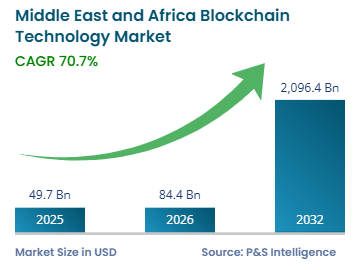
USD 49.7 Billion
Market Size in 2026
USD 84.4 Billion
Market Size by 2032
USD 2096.4 Billion
Projected CAGR
70.7%
Largest Region
U.A.E.
Fastest Growing Region
Saudi Arabia
Market Structure
Fragmented
Market Size
Explore the market potential with our data-driven report
Middle East and Africa Blockchain Technology Market Future Outlook
The MEA blockchain technology market size will be an estimated USD 49.7 billion for 2025, and it will grow by 70.7% during 2026–2032, to reach USD 2096.4 billion by 2032.
The remarkable growth of the market is attributed to the increasing adoption of blockchain across diverse verticals, growing government initiatives for digital transformation, and the region's emergence as a global hub for cryptocurrency and Web3 innovation, particularly in countries such as the UAE and Saudi Arabia. The region's strategic position as a bridge between East and West, combined with progressive regulatory frameworks in key markets, has attracted significant international investment and established MEA as a critical player in the global blockchain ecosystem.
The rapid digital transformation across MEA, driven by national vision programs such as Saudi Vision 2030 and the U.A.E.'s Emirates Blockchain Strategy 2021, has created a conducive environment for blockchain technology deployment. The government-led adoption, coupled with a young, tech-savvy population and increasing venture capital investments, positions the MEA blockchain technology market for sustained expansion throughout the forecast period.
Middle East and Africa Blockchain Technology Market Trends & Drivers
Cryptocurrency Adoption and DeFi Integration Are Key Trends
The MEA region's cryptocurrency adoption has reached unprecedented levels, and it is a key trend driven by inflation hedging to financial inclusion.
With USD 338.7 billion in on-chain value received between July 2023 and June 2024, MENA accounts for 7.5% of the world's total transaction volume.
The rise of decentralized finance platforms is particularly notable in technologically advanced markets.
The trend reflects broader regional dynamics where blockchain technology serves both as a hedge against economic instability and as a pathway to financial services access.
In Africa, where a large portion of the population remains unbanked, and blockchain-based mobile wallets and cryptocurrency exchanges are providing previously underserved populations with access to financial services.
The integration of blockchain with traditional financial infrastructure is accelerating, with major financial institutions establishing operations to capitalize on the crypto economy.
The convergence of traditional finance and blockchain technology is exemplified by tokenization projects and CBDC initiatives.
Government Initiatives and Regulatory Clarity Are Biggest Drivers
The proliferation of government-backed blockchain initiatives across the MEA region represents a fundamental driver for market expansion.
The UAE has solidified its position as a leading global hub for blockchain and virtual asset services companies, with Dubai's Virtual Assets Regulatory Authority establishing comprehensive frameworks that balance innovation with consumer protection.
In March 2025, the Dubai Land Department launched a pilot program that explores real estate tokenization, making the DLD the first real estate registration authority in the Middle East to implement tokenization.
Saudi Arabia's commitment to blockchain technology extends beyond cryptocurrency adoption to encompass diverse applications across government services and financial systems.
Saudi Arabia has been in a partnership agreement with IBM and Elm since 2018 to discuss strategies for providing government and commercial services via the blockchain.
The Kingdom's focus on economic diversification under Vision 2030 has positioned blockchain as a critical enabler for digital transformation, with particular emphasis on Web3 gaming, central bank digital currencies, and fintech innovation.
The regulatory momentum extends to financial services, where traditional banking infrastructure is being revolutionized through blockchain adoption.
The Saudi Arabian Monetary Authority has joined the RippleNet allied banking blockchain network to help domestic banks settle payments and transactions with regional banks to make secure monetary transfers faster and cheaper.
The combination of institutional blockchain adoption and clear regulations provides a strong foundation for market growth and attracting international investment.
Middle East and Africa Blockchain Technology Market Segmentation Analysis
Product Type Analysis
The applications & solutions category holds the largest market share, of 45%, in 2025, driven by the increasing deployment of ready-to-use blockchain applications across various industries. Organizations across MEA are prioritizing practical blockchain implementations that deliver immediate business value, from cryptocurrency trading platforms to supply chain tracking solutions. This dominance reflects the market’s move from experimental pilots to practical, production-ready blockchain applications.
The infrastructure & protocols category will have the highest CAGR, of 70.9%, due to the growing demand for scalable, secure blockchain infrastructure, which is driven by the need to support high-volume transactions, particularly in financial services and government applications. The increasing demand for blockchain standards and protocols such as Ethereum, Openchain, and Hyperledger is driving the segment growth, as users demand protocols that enable them to share information reliably and securely across cryptocurrency networks.
The public cloud category holds the largest market share, of 55%, in 2025, and it will have the highest CAGR during the forecast period, as organizations leverage cloud infrastructure's scalability and cost-effectiveness. Public cloud deployment offers MEA businesses the flexibility to experiment with blockchain applications without significant upfront infrastructure investments, particularly important in emerging markets where capital constraints may limit technology adoption. The segment benefits from major cloud providers' blockchain-as-a-service offerings, enabling rapid deployment and reducing technical barriers to entry.
The deployment types analyzed in this report are:
Public Cloud (Largest and Fastest-Growing Category)
Private Cloud
Hybrid Cloud
Application Analysis
The payments category holds the largest market share in 2025, reflecting blockchain's fundamental value proposition in enabling secure, transparent, and efficient financial transactions. The MEA region's significant cross-border transaction volumes, driven by remittances, trade, and tourism, create natural demand for blockchain-based payment solutions that reduce costs and settlement times.
The digital identity category will have the highest CAGR during the forecast period, driven by increasing adoption of blockchain-based identity solutions by governments and enterprises, rising demand for secure and verifiable digital authentication, and initiatives to enhance e-governance, reduce fraud, and streamline access to financial and public services across the MEA region.
The applications analyzed in this report are:
Digital Identity (Fastest-Growing Category)
Exchanges
Payments (Largest Category)
Smart Contracts
Supply Chain Management
Others
Industry Analysis
The BFSI category holds the largest market share, of 40%, in 2025, driven by the sector's early adoption of blockchain for enhancing security, reducing transaction costs, and improving operational efficiency. Financial institutions across MEA are deploying blockchain for various applications, including cross-border payments, trade finance, Know Your Customer processes, and securities trading.
The energy & utilities category will have the highest CAGR, of 71.0%, as the sector undergoes digital transformation to support renewable energy integration and grid modernization. Blockchain allows decentralized networks where users can buy or sell energy directly with each other through peer-to-peer energy trading, enabling consumers to generate energy through solar panels or wind turbines. The MEA region's ambitious renewable energy targets, combined with the need for transparent carbon credit systems and efficient energy trading mechanisms, position blockchain as a critical enabling technology for the sector's evolution.
The industries analyzed in this report are:
BFSI (Largest Category)
Government & Public Services
Energy & Utilities (Fastest-Growing Category)
Manufacturing
Healthcare & Life Sciences
IT & Telecommunications
Media & Entertainment
Travel & Hospitality
Retail & Consumer Goods
Others
Enterprise Size Analysis
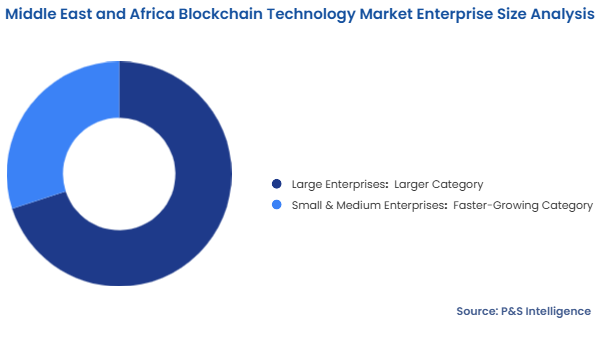
The large enterprises category holds the larger market share, of 70%, in 2025, as they possess the resources, technical expertise, and strategic vision necessary for blockchain implementation. Major corporations across MEA, particularly in financial services, energy, and telecommunications, are leading blockchain adoption through significant investments in pilot projects and production deployments. Large enterprises use blockchain to improve efficiency, lower costs, and develop new business models, with their scale helping absorb implementation costs and manage technical complexities.
The small and medium enterprises category will have the higher CAGR, of 71.1%, as blockchain solutions become more accessible and cost-effective. The emergence of blockchain-as-a-service platforms and simplified development tools is lowering barriers to entry for SMEs. Government initiatives supporting SME digitalization across MEA countries, combined with the availability of cloud-based blockchain solutions, enable smaller organizations to leverage the technology for competitive advantage without substantial infrastructure investments.
The enterprise sizes analyzed in this report are:
Large Enterprises (Larger Category)
Small & Medium Enterprises (Faster-Growing Category)
Drive strategic growth with comprehensive market analysis
Middle East and Africa Blockchain Technology Market Geographical Analysis
U.A.E. Market Size
U.A.E. holds the largest market share, of 30%, in 2025, establishing itself as the undisputed regional hub for blockchain innovation and cryptocurrency adoption. The country's strategic initiatives, including the Emirates Blockchain Strategy and Dubai's ambition to become a global blockchain capital, have created an ecosystem conducive to both innovation and investment.
Dubai established its own Virtual Assets Regulatory Authority in 2022, dedicated to promoting innovation while protecting consumers and ensuring the U.A.E. remains a leader in the cryptocurrency space. This regulatory clarity, combined with world-class infrastructure and a business-friendly environment, has attracted leading blockchain companies and startups from around the globe. The U.A.E. government has actively adopted blockchain across sectors, including digital identity and document verification, to real estate tokenization and supply chain management.
The country's financial free zones, including Abu Dhabi Global Market (ADGM) and Dubai International Financial Centre (DIFC), have implemented progressive blockchain and cryptocurrency regulations that enable innovation while ensuring market integrity. The combination of regulatory support, infrastructure investment, and strategic vision positions the UAE to maintain its leadership position throughout the forecast period.
Saudi Arabia Market Size
Saudi Arabia will have the highest CAGR, of 70.8%, during the forecast period, due to the Kingdom's Vision 2030 initiative, which has positioned blockchain as a cornerstone technology for economic diversification and digital transformation. The Saudi Central Bank's appointment of a dedicated Crypto Chief signals the kingdom's serious commitment to integrating blockchain into its financial infrastructure. Moreover, the Kingdom's blockchain initiatives extend beyond financial services to encompass diverse applications. Major cities like Riyadh and NEOM are positioning themselves as blockchain innovation hubs, attracting international technology companies and fostering local startup ecosystems through accelerators and funding programs.
South Africa Market Size
South Africa holds a significant position in the MEA blockchain technology market, as the most industrialized economy in Africa, South Africa serves as a gateway for blockchain adoption across the continent. The country's sophisticated financial sector, combined with pressing needs for financial inclusion and supply chain transparency, drives blockchain implementation across various use cases.
The South African government and private sector are collaborating on blockchain initiatives to address challenges ranging from identity management to land registry systems. VeChain in South Africa verifies the authenticity of pharmaceutical products through blockchain, combating counterfeit medicines. The country's strong technology infrastructure and skilled workforce make it a key blockchain hub in Africa, with local companies developing solutions for regional challenges and attracting international partnerships.
The geographical breakdown of the market is as follows:
Saudi Arabia (Fastest-Growing Country)
U.A.E. (Largest Country)
Kuwait
Qatar
Bahrain
Egypt
South Africa
Rest of MEA
Middle East and Africa Blockchain Technology Market Share
The market is fragmented, characterized by the presence of numerous international technology giants, regional players, and innovative startups. The competitive landscape reflects the market's early-stage development, where no single player has established dominant market control. This fragmentation is driven by the diverse application areas of blockchain technology, ranging from financial services to supply chain management, each attracting specialized solution providers. Companies are differentiating themselves through specialized industry solutions, integration with local payment systems, and compliance with regional regulations.
Key Middle East and Africa Blockchain Technology Companies:
Rain Management W.L.L.
BitOasis Technologies FZE
MANTRA Tech Limited
Zodia Markets Limited
Fasset Labuan Limited
CoinMENA B.S.C.
Palmex Limited
IdeaSoft Holding Ltd
SEROKELL Ltd
Interexy Ltd
Mazzuma Ltd
Kora Technologies Ltd
Middle East and Africa Blockchain Technology Market News
In September 2025, S.W.I.F.T. SC announced plans to launch its own blockchain to facilitate cross-border transactions among global banks. Partnering with major banks, such as Bank of America, Citigroup, and NatWest; and the blockchain company Consensys, SWIFT aims to build a shared digital ledger for tokenized assets, including stablecoins.
In September 2025, Qatar National Bank announced plans to integrate blockchain technology into its operations, aiming to enhance transparency, reduce fraud, and improve efficiency in financial transactions.
In September 2025, Qatar National Bank transitioned its US dollar corporate payment operations to a blockchain-based platform managed by JPMorgan Chase. The bank began utilizing JPMorgan’s Kinexys Digital Payments system to process dollar payments for its business clients in Qatar. This new arrangement allows payments to be completed within minutes at any hour of the day, including weekends.
In May 2025, Ripple obtained approval from the Dubai Financial Services Authority (DFSA) to offer regulated cryptocurrency payments and services within the Dubai International Finance Centre (DIFC).
In January 2025, MANTRA, a blockchain platform focused on real-world assets (RWAs), entered into a partnership with the Dubai-based DAMAC Group to tokenize assets valued at a minimum of USD 1 billion in the Middle East.
Want a report tailored exactly to your business need?
Leading companies across industries trust us to deliver data-driven insights and innovative solutions for their most critical decisions. From data-driven strategies to actionable insights, we empower the decision-makers who shape industries and define the future. From Fortune 500 companies to innovative startups, we are proud to partner with organisations that drive progress in their industries.
Client Testimonials
Working with P&S Intelligence and their team was an absolute pleasure – their awareness of timelines and commitment to value greatly contributed to our project's success. Eagerly anticipating future collaborations.
McKinsey & Company
India
Unmatched Standards
Our insights into the minutest levels of the markets, including the latest trends and competitive landscape, give you all the answers you need to take your business to new heights
Complete Data Security
We take a cautious approach to protecting your personal and confidential information. Trust is the strongest bond that connects us and our clients, and trust we build by complying with all international and domestic data protection and privacy laws