Key Highlights
| Study Period | 2019 - 2032 |
| Market Size in 2024 | USD 156 Billion |
| Market Size in 2025 | USD 171.8 Billion |
| Market Size by 2032 | USD 358.2 Billion |
| Projected CAGR | 11.1% |
| Largest Region | APAC |
| Fastest Growing Region | APAC |
| Market Structure | Fragmented |

| Study Period | 2019 - 2032 |
| Market Size in 2024 | USD 156 Billion |
| Market Size in 2025 | USD 171.8 Billion |
| Market Size by 2032 | USD 358.2 Billion |
| Projected CAGR | 11.1% |
| Largest Region | APAC |
| Fastest Growing Region | APAC |
| Market Structure | Fragmented |
|
Explore the market potential with our data-driven report
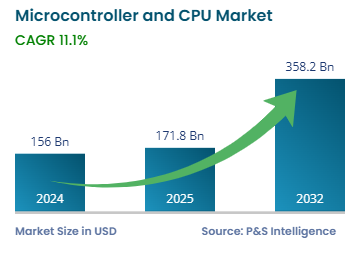
The global microcontroller and CPU market size was USD 156 billion in 2024, and it will grow by 11.1% during 2025–2032, to reach USD 358.2 billion by 2032.
The market is driven by the accelerating digital transformation across industries, rising adoption of electric vehicles, and the exponential expansion of IoT devices requiring sophisticated processing capabilities.
The surge in connected devices is fundamentally reshaping demand patterns across both microcontroller and CPU design segments. According to IoT Analytics, there were 16.6 billion connected IoT devices by the end of 2023, with this number expected to grow 13% to 18.8 billion by the end of 2024. This explosive growth in connectivity is creating unprecedented demand for intelligent processing solutions, from ultra-low-power microcontrollers managing sensor networks to high-performance CPUs powering edge computing infrastructure.
The automotive sector represents one of the most significant growth drivers, with electric vehicle adoption and advanced driver assistance systems requiring increasingly sophisticated microcontroller and CPU designs. According to the International Energy Agency, global electric car sales reached 17 million units in 2024, rising by 25.1% from 2023 and representing close to 20% of the global car market. This electrification trend, coupled with autonomous driving technologies, is driving demand for high-performance processing solutions capable of real-time decision-making and complex data analysis.
The integration of AI across computing platforms is another key factor propelling market expansion. The proliferation of AI-enabled applications, from smartphones incorporating neural processing units to data centers deploying specialized AI accelerators, is creating new requirements for both microcontroller efficiency and CPU computational power. This convergence of AI with traditional processing architectures is opening new market opportunities and driving innovation in chip design methodologies.
Industrial automation spending is projected to reach over USD 300 billion in global spending by 2026, driven by the increasing need for efficiency, precision, and scalability in manufacturing. This surge aligns with government-backed initiatives like Germany’s Industry 4.0 and China’s “Made in China 2025”, which emphasize digitization and smart factory adoption. As automation expands, demand for microcontrollers and CPUs—especially those optimized for real-time processing and edge intelligence—continues to rise.
Complementing this, governments worldwide are investing heavily in digital infrastructure. The EU’s Digital Europe Programme allocates EUR 7.5 billion for advancing AI, cybersecurity, and advanced computing technologies. Similarly, India’s Digital India initiative aims to increase the output of embedded electronics through subsidies and R&D support. These public investments are directly fueling industrial automation by ensuring robust digital ecosystems, further amplifying the need for advanced microcontrollers and processors that support both automation technologies and national digital transformation goals.
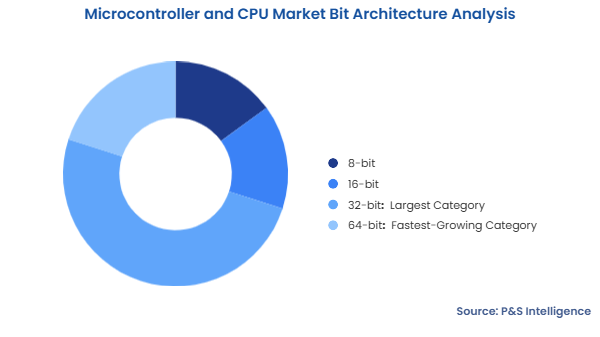
The 32-bit category held the largest market share, of 50%, in 2024, due to the superior processing capabilities and versatility required for complex IoT applications, automotive systems, and industrial automation. 32-bit microcontrollers offer enhanced processing power, expanded memory capacity, and advanced connectivity options essential for applications requiring real-time control, high-resolution data processing, and sophisticated user interfaces. The automotive industry's adoption of advanced electronic systems, including ADAS and electric powertrain management, significantly contributes to the high demand for this variant.
The 64-bit will have the highest CAGR, of 11.4%, reflecting the increasing complexity of embedded applications and the need for enhanced computational capabilities. 64-bit microcontrollers enable handling of larger datasets, support for advanced operating systems, and improved performance in applications involving artificial intelligence and machine learning algorithms. Moreover, the growing deployment of edge computing solutions and high-performance embedded systems drives the adoption of 64-bit architectures.
The bit architectures analyzed in this report are:
The ARM category held the larger market share, of 50% in 2024, reflecting its widespread adoption across mobile devices, IoT systems, and increasingly in data center applications. ARM's energy-efficient RISC architecture and flexible licensing model enable customization for specific applications while maintaining compatibility across diverse product lines. The ARM ecosystem's maturity, extensive software support, and proven scalability from microcontrollers to high-performance CPUs contribute to its market leadership position.
The RISC-V category will have the highest CAGR, of 11.6%, driven by its open-source nature and freedom from licensing restrictions. This helps designers customize instruction sets for specific applications, reducing costs and enabling innovation in specialized processing solutions. The growing ecosystem of RISC-V development tools, software libraries, and hardware implementations supports broader adoption across embedded systems, IoT devices, and emerging applications.
The instruction set architectures analyzed in this report are:
The automotive category held the largest market share, of 30% in 2024, driven by vehicle electrification, ADAS, and autonomous driving technologies. Modern vehicles incorporate hundreds of microcontrollers and sophisticated CPUs for powertrain management, safety systems, infotainment, and connectivity features. The transition to EVs requires specialized processing solutions for battery management, thermal control, and charging systems, while ADAS applications demand high-performance CPUs capable of real-time sensor data processing.
The IoT/smart home devices category will have the highest CAGR, of 11.8%, reflecting the rapid proliferation of connected devices in residential and commercial environments. Smart home automation systems, security devices, environmental monitoring solutions, and wearable technology drive demand for energy-efficient microcontrollers with integrated wireless communication capabilities. The convergence of artificial intelligence with IoT applications further accelerates demand for processing solutions capable of local data analysis and decision-making.
The applications analyzed in this report are:
The microcontrollers category held the largest market share, of 30% in 2024, reflecting their fundamental role as the backbone of embedded systems across diverse applications. Microcontrollers serve as self-contained computing solutions integrating processing, memory, and input/output capabilities on single chips, making them essential for cost-sensitive applications requiring specific functionality. The proliferation of IoT devices, automotive electronics, and industrial automation systems drives sustained demand for microcontroller solutions optimized for specific application requirements.
The processor IP cores category will have the highest CAGR, of 11.5%, due to the rising demand for tailored and scalable processing across industries. Companies are widely adopting licensed processor IP cores, such as those from ARM or RISC-V cores, to create their own applications. These features help minimize costs, accelerate time-to-market, and optimize performance. Moreover, they are used in various sectors, such as smartphones, IoT devices, automotive electronic control units, industrial automation systems, and medical devices.
The product types analyzed in this report are:
Drive strategic growth with comprehensive market analysis
Asia-Pacific held the largest market share, of 45%, in 2024, and it will have the highest CAGR, of 12.5%, driven by the concentration of electronics manufacturing, robust consumer electronics demand, and significant investments in automotive electrification. The region benefits from established semiconductor manufacturing infrastructure, skilled workforce availability, and proximity to major technology companies driving innovation in processing solutions. China's emergence as a leading electric vehicle market and India's expanding electronics manufacturing sector contribute significantly to regional demand. Government initiatives, such as Made in China 2025, supporting domestic semiconductor development and digital transformation, are accelerating market growth across the region.
APAC dominates the global semiconductor and electronics industry, accounting for the majority of global chip manufacturing and electronics exports. Taiwan produces over 60% of the world’s semiconductors and more than 90% of advanced chips. South Korea contributes significantly, with semiconductors making up around 20% of its total exports and over 30% of its GDP. China is a leading consumer and rapidly expanding in design and assembly. Japan remains vital in semiconductor equipment and materials. This sector is deeply integrated into national economies and is critical to global supply chains powering AI, telecom, automotive, and consumer electronics.
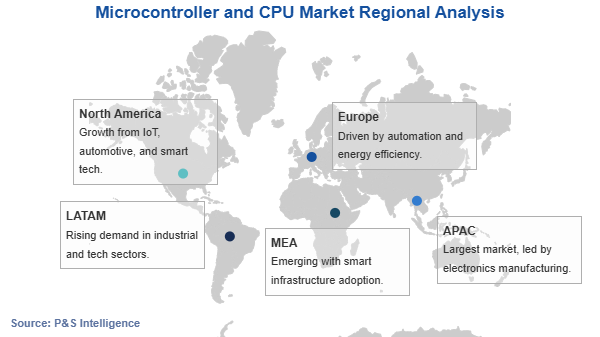
Moreover, the presence of major electronics manufacturers, automotive companies, and technology innovators establishes Asia Pacific as a critical hub for both production and consumption of microcontroller and CPU designs. The region's focus on Industry 4.0 implementation, renewable energy systems, and advanced manufacturing technologies drives demand for specialized processing solutions supporting automation, connectivity, and intelligent control systems.
The geographical breakdown of the market is as follows:
The market is moderately fragmented due to the presence of numerous smaller companies and startups focusing on niche applications and emerging technologies. The market leadership is shared among established semiconductor companies with complementary strengths across different segments, and recent activities include technology acquisitions, strategic licensing agreements, and joint development programs aimed at strengthening competitive positioning and expanding market reach. Moreover, strategic partnerships with automotive manufacturers, cloud service providers, and IoT device makers enable market access and customer relationship development.
Want a report tailored exactly to your business need?
Request CustomizationLeading companies across industries trust us to deliver data-driven insights and innovative solutions for their most critical decisions. From data-driven strategies to actionable insights, we empower the decision-makers who shape industries and define the future. From Fortune 500 companies to innovative startups, we are proud to partner with organisations that drive progress in their industries.

Working with P&S Intelligence and their team was an absolute pleasure – their awareness of timelines and commitment to value greatly contributed to our project's success. Eagerly anticipating future collaborations.
McKinsey & Company
India
Our insights into the minutest levels of the markets, including the latest trends and competitive landscape, give you all the answers you need to take your business to new heights

We take a cautious approach to protecting your personal and confidential information. Trust is the strongest bond that connects us and our clients, and trust we build by complying with all international and domestic data protection and privacy laws


Customize the Report to Align with Your Business Objectives

Request the Free Sample Pages