This Report Provides In-Depth Analysis of the Metallocene Polyethylene Market Report Prepared by P&S Intelligence, Segmented by Product Type (Metallocene Linear Low-Density Polyethylene (mLLDPE), Metallocene High-Density Polyethylene (mHDPE)), Application (Films, Sheets, Injection Molding, Extrusion Coating), End User (Packaging, Healthcare, Automotive, Agriculture, Construction), and Geographical Outlook for the Period of 2019 to 2032
Explore the market potential with our data-driven report
Metallocene Polyethylene Market Overview
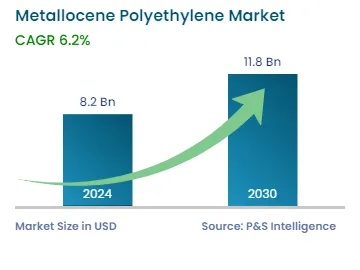
The metallocene polyethylene market size was USD 8.2 billion in 2024, and it will grow by 6.9% during 2025–2032, to reach USD 13.8 billion by 2032.
The market growth is primarily driven by the high demand for this material from the packaging, automotive, and food & beverages sectors and the rise in R&D to improve mPE properties, lower production costs, and develop new applications. This advanced polymer material, produced using metallocene catalysts, offers superior mechanical properties compared to conventional polyethylene, driving its adoption across packaging, automotive, construction, and healthcare industries.
The escalating demand from the packaging sector, technological advancements in catalyst systems, and the growing emphasis on sustainable materials further accelerate the market growth. Moreover, the global shift toward e-commerce has accelerated demand for protective packaging solutions, where metallocene polyethylene's enhanced mechanical properties provide optimal product protection during transit.
Metallocene Polyethylene Market Dynamics
Sustainability Initiatives and Circular Economy Principles Are Key Trends
The metallocene polyethylene market is experiencing a significant transformation driven by the global shift toward sustainability and circular economy principles.
This trend represents a fundamental change in how the industry approaches material design, production, and end-of-life management, creating both opportunities and challenges for market participants.
By enabling reduced material usage, improved recyclability, and compliance with sustainability regulations, this trend is encouraging manufacturers to adopt metallocene polyethylene in innovative packaging solutions.
Metallocene polyethylene's superior mechanical properties enable significant downgauging opportunities, allowing converters to reduce material usage by 15–20%, while maintaining or improving package performance.
This capability addresses both economic and environmental objectives, reducing raw material consumption, transportation costs, and carbon footprint.
Major industry players are investing heavily in developing recyclable metallocene polyethylene grades and establishing partnerships to create closed-loop recycling systems.
Recent initiatives include the development of mechanically recycled grades that maintain performance characteristics suitable for demanding applications.
Chemical recycling technologies specifically designed for polyolefins are advancing rapidly, with several companies successfully demonstrating the production of metallocene-grade materials from post-consumer waste.
These technological breakthroughs address historical concerns about the recyclability of specialized polyethylene grades and position metallocene polyethylene as a key material in the circular economy.
The regulatory landscape is accelerating this sustainability transformation.
The European Union's Circular Economy Action Plan and similar initiatives globally are creating market incentives for materials that support recycling and waste reduction goals.
Brand owners are responding to these regulations and consumer preferences by specifying metallocene polyethylene for applications where its combination of performance and recyclability provides competitive advantages.
The ability to design mono-material packaging structures using metallocene polyethylene eliminates the need for multi-layer constructions that complicate recycling, addressing a critical challenge in packaging sustainability.
Rather than competing directly with biodegradable materials, metallocene polyethylene is positioned as a high-performance, recyclable option that complements the broader sustainable packaging ecosystem.
This positioning allows manufacturers to address diverse customer needs while contributing to environmental goals through improved resource efficiency and circularity.
Rising Healthcare Expenditure Propels Demand for Medical-Grade Packaging
The healthcare sector's expansion globally creates a significant demand for high-performance packaging materials that ensure product safety and sterility.
Metallocene polyethylene's biocompatibility, chemical resistance, and ability to withstand various sterilization methods make it ideal for medical device packaging, pharmaceutical blister packs, and IV bags.
The material's excellent clarity allows for easy product identification and inspection, while its superior seal integrity ensures package sterility throughout the supply chain.
The COVID-19 pandemic has permanently altered healthcare packaging requirements, emphasizing the need for materials that provide enhanced protection and longer shelf life.
Metallocene polyethylene's barrier properties against moisture and oxygen help maintain drug efficacy and medical device functionality.
The increasing preference for home healthcare and the growing demand for biologics and specialty pharmaceuticals further drive demand for advanced polyethylene materials in the healthcare sector.
This is because these products require sophisticated packaging solutions to protect them from contamination, preserve their efficacy and safety, and increase their shelf life.
Metallocene polyethylene meets stringent regulatory requirements for medical and pharmaceutical packaging, including FDA and ISO standards, assuring product safety and compliance across global markets.
The lightweight nature of mPE helps reduce shipping costs and facilitates easier handling within hospitals and pharmacies.
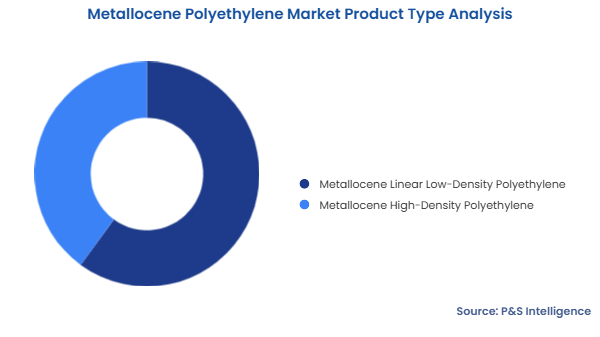
The metallocene linear low-density polyethylene category held the larger market share, of around 60%, in 2024, because it is a high-performance polyethylene formulated by using metallocene catalysts with copolymers. Also, it exhibits properties like uniform comonomer content, narrow molecular weight distribution, higher resistance to puncture & damage, high toughness, tensile strength, and stiffness. In addition, innovations in catalyst technology and polymerization techniques have a positive impact on the market growth, as they are required for the production of metallocene polyethylene.
Additionally, mLLDPE gives high transparency and high gloss, when it is transformed into a film. Further, it is excellent for packaging purposes, due to its tear and puncture resistance properties compared to conventional polyethylene, and it is also a popular choice for packing perishable substances, due to its capability to offer a defensive shield against exterior factors such as gases and moisture.
The metallocene high-density polyethylene category will have the higher CAGR, driven by increasing demand for lightweight, durable materials in automotive applications, where mHDPE's enhanced stiffness and environmental stress crack resistance enable component weight reduction without compromising performance. The construction industry's adoption of mHDPE for pipe applications, particularly in demanding environments requiring superior chemical resistance and long-term durability, further accelerates category growth. Technological advances in mHDPE production have expanded the material's processing window, making it suitable for injection molding, blow molding, and pipe extrusion applications previously dominated by conventional HDPE.
The product types analyzed in this report are:
Metallocene Linear Low-Density Polyethylene (mLLDPE) (Larger Category)
The films category held the largest market share, of approx. 50%, in 2024, due to the surging need for lightweight packaging materials in industries to lower transportation costs and environmental effects. Moreover, these films are suitable for packaging applications because they provide an excellent balance of strength and weight. As disposable income increases, the need for disposable goods, packaged goods, and consumer goods rises, in turn, the requirement for these films for packaging is surging. In addition, infrastructure developments, like transportation, utilities, and construction, can also boost their demand. For example, metallocene polyethylene (mPE) films are used in barriers, wraps, and protective covers in the construction sector.
The sheets category will have the highest CAGR, due to mPE’s superior stiffness, impact resistance, thermoformability, and heat-sealability, which are critical for automotive, construction, and packaging applications. The rising demand for lightweight, durable, and high-performance materials in these industries drives the rapid adoption of mPE sheets. Lightweight materials in the automotive sector offer significant performance and environmental benefits. A 10% vehicle weight reduction can boost fuel economy by 6–8% and increase EV range by up to 13.7%.
It also cuts COâ‚‚ emissions by approximately 8.5 g/km for every 100 kg reduced. Materials like aluminum and carbon fiber reduce component weight by 40–70% compared to traditional steel, enhancing acceleration and overall efficiency. These improvements support compliance with emission regulations, extend electric vehicle range, and improve agility and safety. As a result, lightweighting is a key strategy in modern automotive design and sustainability initiatives.
The applications analyzed in this report are:
Films (Largest Category)
Sheets (Fastest-Growing Category)
Injection Molding
Extrusion Coating
End User Analysis
The packaging category held the largest market share in 2024. This is because this sector is experiencing a transformational change, as a result of evolving consumer preferences, environmental concerns, and technological advancements. Applications of mPE in the packaging sector include trays, crates, bottles, juice bottles, caps for food packaging, industrial bulks, drums, etc. Also, for industrial, consumer, and institutional packaging, a variety of films are used.
Moreover, mPE-based packaging products exhibit properties including chemical resistance, superior toughness, excellent flexibility, and outstanding optical properties. Another packaging benefit is that it maintains the shelf-life and hygiene quotient of food and other goods, which, in turn, provides considerable growth in the usage of mPE-based packaging products.
The healthcare category will have the highest CAGR, driven by increasing healthcare expenditure globally, rising requirement for medical services for an aging population, and stringent regulatory requirements for medical packaging. Metallocene polyethylene's purity, consistency, and ability to maintain sterility make it preferred for pharmaceutical packaging, medical device packaging, and hospital supplies. The material's compatibility with various sterilization methods, including gamma radiation and ethylene oxide, expands its applicability across different medical product categories. As per studies, USD 11,752.8 million worth of medical packaging films could be consumed in 2030, compared to USD 7,904.2 million in 2023.
The end users analyzed in this report are:
Packaging (Largest Category)
Healthcare (Fastest-Growing Category)
Automotive
Agriculture
Construction
Drive strategic growth with comprehensive market analysis
Metallocene Polyethylene Market Regional Outlook
Asia-Pacific Metallocene Polyethylene Market Size
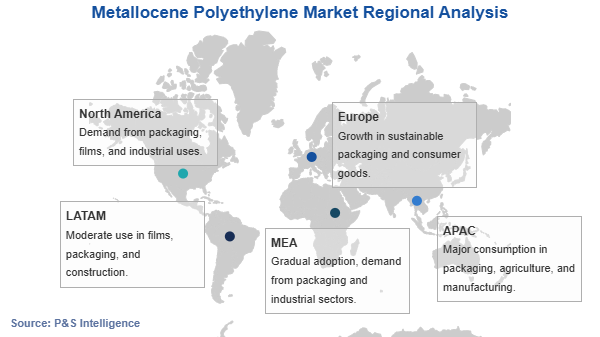
Asia-Pacific held the largest market share in 2024, and it will have the highest CAGR. This can be primarily due to the increasing use of mPE in packaging, automotive, building and construction, healthcare, and other industries. Moreover, the growing population, rapid urbanization, surging spending power, and expanding retail sector China, India, and South Korea drive the growth in the demand for mPE for packaging applications.
Furthermore, the food & beverage business generates billions of dollars in revenue annually, making it one of the continent's largest manufacturing sectors. With the expanding regional food and beverage industry, the need for food packaging also grows, which, in turn, raises the demand for metallocene polyethylene. Additionally, the demand is significantly influenced by the automobile sector. For instance, in 2024, India produced 6,014,691 motor vehicles and China 31,281,592, as per OICA, driving mPE consumption in automotive applications.
In APAC, the Indian packaging sector has made a spot with its exports that encompass flattened cans, packaging machinery, crown cork, printed sheets and components, lug caps, craft paper, paper board, and plastic film laminates, while imports comprise coating and lining compounds, tinplate, and others. Thus, with the increasing popularity of metallocene-catalyzed plastics and the development of the plastics business in the country, the market is growing.
North America Metallocene Polyethylene Market Size
North America has the second-largest metallocene polyethylene market share, underpinned by its advanced manufacturing infrastructure, stringent regulatory standards for packaging materials, and strong emphasis on sustainability. The U.S. leads regional demand, driven by its large food and beverage industry requiring high-performance packaging solutions that extend product shelf life and ensure safety. The pharmaceutical sector's growth, coupled with increasing healthcare expenditure, creates substantial demand for medical-grade metallocene polyethylene in drug delivery systems and medical device packaging.
Moreover, Canada's rising focus on sustainable packaging initiatives and circular economy principles has accelerated the adoption of recyclable materials. The automotive industry's shift toward electric vehicles in North America has created new applications for lightweight, durable plastics in battery components and vehicle interiors. Infrastructure investments in recycling facilities specifically designed for polyolefins enhance the material's sustainability credentials and appeal to environmentally conscious consumers. The region's well-developed supply chain and technical expertise in polymer processing facilitate rapid adoption of new metallocene polyethylene grades optimized for specific applications.
Europe Metallocene Polyethylene Market Size
Europe represents a mature yet steadily growing market for metallocene polyethylene, driven by stringent environmental regulations and strong consumer preference for sustainable packaging. The European Union's circular economy action plan and single-use plastics directive have accelerated the transition toward recyclable, high-performance materials. Germany leads regional consumption, leveraging its advanced manufacturing sector and commitment to technological innovation in polymer applications. The region's automotive industry, particularly in Germany and France, drives demand for lightweight materials that support vehicle electrification and emissions reduction goals.
The geographical breakdown of the market is as follows:
North America
U.S. (Larger Country)
Canada (Faster-Growing Country)
Europe
Germany (Largest and Fastest-Growing Country)
U.K.
France
Italy
Spain
Rest of Europe
Asia-Pacific (Largest and Fastest-Growing Regional Market)
China (Largest Country)
India (Fastest-Growing Country)
Japan
South Korea
Australia
Rest of APAC
Latin America
Brazil (Largest Country)
Mexico (Fastest-Growing Country)
Rest of LATAM
Middle East and Africa
Saudi Arabia (Largest Country)
South Africa
U.A.E. (Fastest-Growing Country)
Rest of MEA
Metallocene Polyethylene Market Share
The market is semi-consolidated due to the concentration that reflects the significant technological barriers to entry, including proprietary catalyst technologies, substantial capital requirements for manufacturing facilities, and extensive patent portfolios protecting key innovations. However, smaller regional and local manufacturers, particularly in developing regions, also participate in the market. Technology licensing agreements and joint ventures enable these smaller players to participate, making the market partially fragmented.
Key Metallocene Polyethylene Companies:
Saudi Basic Industries Corporation (SABIC)
Exxon Mobil Corporation
Reliance Industries Ltd.
INEOS AG
Chevron Phillips Chemical Company LLC
Daelim Co. Ltd.
The Dow Chemical Company
LyondellBasell Industries Holdings B.V.
Sasol Ltd.
Mitsui Chemicals Inc.
Westlake Corporation
Borealis GmbH
Metallocene Polyethylene Market News
In August 2025, SIBUR Holding PJSC introduced a new grade of metallocene LLDPE for flexible FMCG packaging, including barrier and lamination films, dairy packaging, and stretch films for wrapping. Products made from this material exhibit appreciable sealing properties, strength, and resistance to tearing. Its enhanced processability allows film producers to operate blown film lines more effectively. Furthermore, the smooth transition between grades with varying melt flow indices contributes to a reduction in operational expenses.
In May 2025, Univation Technologies LLC announced the next generation of the UNIPOL PE process platform, featuring a new licensed capacity of 800,000 tonnes per year. This design offers high flexibility in polyethylene resin products, including the ability to produce unimodal HDPE, bimodal HDPE, linear low-density PE, and mPE resin products.
In June 2024, Dow Inc. introduced REVOLOOP recycled polyethylene grades incorporating post-consumer recycled content with ISCC Plus certification. They target sustainable packaging applications in e-commerce and retail sectors while maintaining the performance characteristics of virgin metallocene materials.
In September 2023, Zhejiang Petrochemical Co., in collaboration with W. R. Grace & Co.’s ActivCat catalyst technology, gained a large-scale UNIVATION polyethylene process technology licensee in China. This partnership focuses on developing metallocene PE film and Polyethylene of Raised Temperature resins for packaging and pipe applications.
Want a report tailored exactly to your business need?
Leading companies across industries trust us to deliver data-driven insights and innovative solutions for their most critical decisions. From data-driven strategies to actionable insights, we empower the decision-makers who shape industries and define the future. From Fortune 500 companies to innovative startups, we are proud to partner with organisations that drive progress in their industries.
Client Testimonials
Working with P&S Intelligence and their team was an absolute pleasure – their awareness of timelines and commitment to value greatly contributed to our project's success. Eagerly anticipating future collaborations.
McKinsey & Company
India
Unmatched Standards
Our insights into the minutest levels of the markets, including the latest trends and competitive landscape, give you all the answers you need to take your business to new heights
Complete Data Security
We take a cautious approach to protecting your personal and confidential information. Trust is the strongest bond that connects us and our clients, and trust we build by complying with all international and domestic data protection and privacy laws