Key Highlights
| Study Period | 2019 - 2032 |
| Market Size in 2024 | USD 164.3 Billion |
| Market Size in 2025 | USD 171.5 Billion |
| Market Size by 2032 | USD 247.4 Billion |
| Projected CAGR | 5.4% |
| Largest Region | APAC |
| Fastest Growing Region | APAC |
| Market Structure | Fragmented |

| Study Period | 2019 - 2032 |
| Market Size in 2024 | USD 164.3 Billion |
| Market Size in 2025 | USD 171.5 Billion |
| Market Size by 2032 | USD 247.4 Billion |
| Projected CAGR | 5.4% |
| Largest Region | APAC |
| Fastest Growing Region | APAC |
| Market Structure | Fragmented |
Explore the market potential with our data-driven report
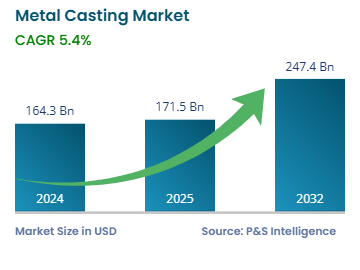
The global metal casting market was valued at USD 164.3 billion in 2024, which is predicted to reach USD 247.4 billion by 2032, growing at a CAGR of 5.4% during 2025–2032.
The market growth is primarily driven by increasing demand from the automotive industry for lightweight components, expanding infrastructure development worldwide, and the growing adoption of electric vehicles requiring specialized cast components.
Metal casting continues to serve as a fundamental manufacturing process across multiple industries, enabling the production of complex geometries and high-performance components that would be difficult or uneconomical to produce through other methods.
According to the International Energy Agency, global electric car sales exceeded 17 million units in 2024, representing over 20% of new car sales worldwide, which has significantly boosted demand for lightweight aluminum and magnesium castings used in battery housings, motor casings, and structural components. The automotive sector's transition toward electrification has particularly accelerated the adoption of advanced casting techniques, as manufacturers seek to reduce vehicle weight while maintaining structural integrity and performance standards.
The rising investments in renewable energy infrastructure have emerged as another significant growth catalyst for the metal casting industry. Wind turbine installations worldwide have surged, with global wind power capacity additions reaching 116 GW in 2024, as reported by energy industry sources, driving substantial demand for large-scale cast components, including rotor hubs, nacelle frames, and gearbox housings. These components require high-strength materials and precision casting techniques to withstand continuous operation under extreme environmental conditions, positioning the metal casting industry as a critical enabler of the global energy transition.
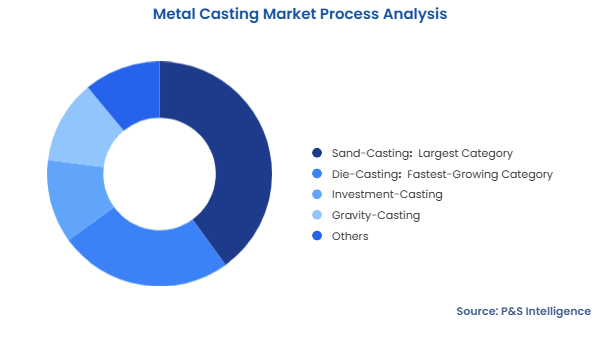
The sand-casting category held the largest share in the metal casting market in 2024, of 40%, and it is expected to maintain its dominant position throughout the forecast period. This is primarily due to the process's versatility, cost-effectiveness, and ability to accommodate a wide range of metals and alloy compositions while producing components ranging from small precision parts to large industrial equipment weighing several tons.
Sand casting's enduring popularity stems from its fundamental advantages, including minimal tooling costs, flexibility in design modifications, and the ability to recycle molding sand, making it both economically and environmentally sustainable. The process excels in producing complex geometries with internal cavities and undercuts that would be challenging or impossible to achieve through other casting methods. Industries particularly rely on sand casting for manufacturing engine blocks, pump housings, valve bodies, and large structural components where the slightly rougher surface finish is acceptable or can be addressed through secondary machining operations.
Die-casting will witness the highest CAGR during the forecast period owing to its ability to produce high-precision components with excellent surface finish and dimensional accuracy at high production volumes. The automotive and electronics industries increasingly favor die casting for manufacturing lightweight structural components, heat sinks, and housings that require tight tolerances and minimal post-processing. The development of advanced die casting technologies, such as vacuum-assisted die casting and semi-solid metal casting, has further enhanced the process's capabilities in producing thin-walled, complex components with reduced porosity and improved mechanical properties.
These processes are covered:
Cast iron commanded the largest market share in 2024, of 40%, driven by its excellent castability, cost-effectiveness, and versatile mechanical properties that make it suitable for diverse applications across automotive, machinery, and construction industries. The material's ability to absorb vibration, combined with good wear resistance and machinability, has sustained its position as the preferred choice for manufacturing engine components, machine tool beds, and heavy equipment parts.
Grey iron continues to be widely used for its excellent damping characteristics and thermal conductivity, making it ideal for brake rotors, engine blocks, and machinery bases. Ductile iron, offering superior strength and impact resistance, has gained prominence in safety-critical applications, including suspension components, crankshafts, and wind turbine components, where fatigue resistance is paramount.
Aluminum has emerged as the fastest-growing category, during the forecast period, propelled by the automotive industry's lightweighting initiatives and the expanding electric vehicle market. Aluminum castings offer weight reductions of up to 50% compared to ferrous alternatives while providing excellent corrosion resistance, thermal conductivity, and recyclability. The material's growing adoption in battery housings, transmission cases, and structural components reflects the industry's commitment to improving fuel efficiency and reducing emissions across both conventional and electric vehicle platforms.
These materials are covered:
The automotive & transportation category held the largest metal casting market share in 2024, of 35%, and it is set to retain its lead till 2032. It is driven by the continuous vehicle production growth and the industry's transition toward electrification and lightweighting strategies. The automotive sector's reliance on cast components spans virtually every vehicle subsystem, from powertrain and chassis components to body structures and interior systems. As per the OICA, 92,504,338 vehicles were manufactured around the world in 2024.
The automotive industry's demand for metal castings is undergoing a fundamental transformation as manufacturers adapt to electrification, autonomous driving technologies, and changing mobility patterns. Electric vehicles require specialized castings for battery enclosures, electric motor housings, and power electronics cooling systems, while traditional powertrain components are being redesigned for improved efficiency and reduced weight. The trend toward larger, single-piece structural castings, exemplified by mega-casting technologies adopted by leading EV manufacturers, demonstrates the industry's pursuit of part consolidation and manufacturing efficiency.
The industrial machinery & equipment category is expected to register the fastest growth during the forecast period, driven by the expanding manufacturing activities, automation trends, and the need for robust components capable of withstanding demanding operational conditions. Industrial applications require castings with exceptional wear resistance, dimensional stability, and fatigue strength, driving demand for specialized alloys and advanced casting processes that can meet increasingly stringent performance requirements.
The manufacturing sector is vital to the global economy, accounting for around 16% of the worldwide GDP and employing approximately 470 million people worldwide. It drives innovation, trade, and infrastructure, forming the backbone of industrial development. In 2023, it contributed nearly 30% of global employment in developing economies, underscoring its significance.
These end-use industries are covered:
Drive strategic growth with comprehensive market analysis
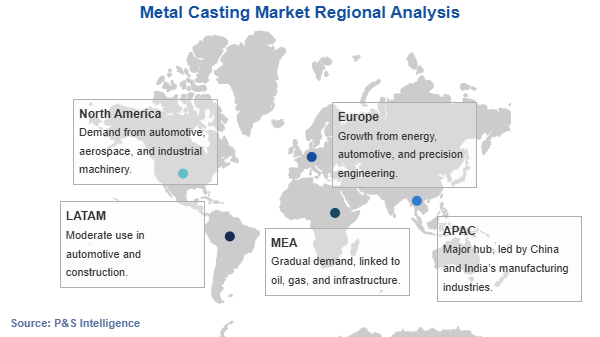
Asia-Pacific held the largest value share in 2024, of 40%, of the global metal casting market, and is expected to register the fastest growth during the forecast period. This is primarily attributed to the region's robust industrial infrastructure, extensive automotive manufacturing base, and significant investments in renewable energy and infrastructure development projects across major economies, including China, India, Japan, and South Korea.
China's position as the world's largest automotive producer and its leadership in electric vehicle manufacturing have established the country as the epicenter of global metal casting demand. According to the IEA, China achieved 8.1 million new electric car registrations in 2023, with NEV sales continuing to expand even after the withdrawal of national subsidies, demonstrating the sustained momentum driving casting demand.
The country's massive infrastructure investments, including its Belt and Road Initiative projects, further reinforce demand for cast components across construction equipment, railways, and energy infrastructure applications.
India's rapidly expanding manufacturing sector and infrastructure development initiatives have positioned the country as a high-growth market for metal casting. The government's Production Linked Incentive schemes and focus on domestic manufacturing through initiatives like "Make in India" have attracted significant investments in automotive and industrial manufacturing, driving demand for local casting production capabilities. The country's growing wind energy sector and expanding railway network modernization programs provide additional growth avenues for the metal casting industry.
North America commanded the second-largest market share in 2024, at 20%, with the region expected to witness steady growth driven by reshoring initiatives, infrastructure modernization programs, and the transition toward electric vehicle manufacturing. The implementation of the Infrastructure Investment and Jobs Act has allocated substantial funding for infrastructure upgrades, creating sustained demand for cast components used in construction equipment, water systems, and transportation infrastructure.
The U.S. metal casting industry has experienced renewed growth as manufacturers increasingly recognize the strategic importance of domestic casting capabilities for supply chain resilience. For 2024, the U.S. Department of Transportation allocated about USD 131 billion toward infrastructure programs, increasing to USD 134 billion in 2025, while IIJA-related commitments grew to USD 568 billion in allocations. The automotive industry's investments in electric vehicle manufacturing facilities across the region have created new opportunities for casting suppliers capable of meeting the technical requirements of next-generation vehicle architectures.
The regions and countries analyzed in this report are:
The global metal casting market exhibits a fragmented structure characterized by the presence of numerous regional and global players competing across different casting processes, materials, and end-use applications. The market's fragmentation reflects the diverse technical requirements across industries and geographical variations in demand patterns that creates natural barriers to market consolidation. While several large multinational corporations maintain significant market positions through technological leadership and extensive production networks, the market also supports thousands of small and medium-sized foundries serving specialized or regional market needs.
The competitive landscape is shaped by ongoing technological evolution, with leading players investing heavily in automation, digitalization, and advanced process technologies to improve efficiency and meet increasingly stringent quality requirements. Companies are differentiating themselves through capabilities in producing complex, high-precision castings for critical applications, particularly in aerospace, automotive, and energy sectors where performance requirements continue to escalate. The adoption of Industry 4.0 technologies, including digital twins, predictive maintenance, and real-time quality monitoring systems, has become a key competitive differentiator as foundries seek to reduce defect rates and improve overall equipment effectiveness.
Want a report tailored exactly to your business need?
Request CustomizationLeading companies across industries trust us to deliver data-driven insights and innovative solutions for their most critical decisions. From data-driven strategies to actionable insights, we empower the decision-makers who shape industries and define the future. From Fortune 500 companies to innovative startups, we are proud to partner with organisations that drive progress in their industries.

Working with P&S Intelligence and their team was an absolute pleasure – their awareness of timelines and commitment to value greatly contributed to our project's success. Eagerly anticipating future collaborations.
McKinsey & Company
India
Our insights into the minutest levels of the markets, including the latest trends and competitive landscape, give you all the answers you need to take your business to new heights

We take a cautious approach to protecting your personal and confidential information. Trust is the strongest bond that connects us and our clients, and trust we build by complying with all international and domestic data protection and privacy laws


Customize the Report to Align with Your Business Objectives

Request the Free Sample Pages