Key Highlights
| Study Period | 2019 - 2032 |
| Market Size in 2024 | USD 299.2 Million |
| Market Size in 2025 | USD 315.7 Million |
| Market Size by 2032 | USD 489.6 Million |
| Projected CAGR | 6.5% |
| Largest Region | APAC |
| Fastest Growing Region | APAC |
| Market Structure | Fragmented |

| Study Period | 2019 - 2032 |
| Market Size in 2024 | USD 299.2 Million |
| Market Size in 2025 | USD 315.7 Million |
| Market Size by 2032 | USD 489.6 Million |
| Projected CAGR | 6.5% |
| Largest Region | APAC |
| Fastest Growing Region | APAC |
| Market Structure | Fragmented |
|
Explore the market potential with our data-driven report
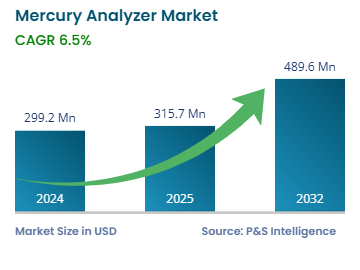
The global mercury analyzer market will generate an estimated revenue of USD 299.2 million in 2024, which is expected to witness a CAGR of 6.5% during 2025–2032, to reach USD 489.6 million by 2032.
This growth can be attributed to the increasing demand for accurate and efficient mercury detection methods across various industries, including environmental monitoring, healthcare, and industrial sectors. As mercury is a highly toxic substance, strict regulations regarding its monitoring and control in air, water, and soil are driving the adoption of mercury analyzers for both regulatory compliance and safety purposes.
Mercury exposure poses serious health risks, including neurological damage, kidney failure, and respiratory problems. According to the World Health Organization, an estimated 10 million people worldwide suffer from mercury poisoning annually, with workers in mining, manufacturing, and chemical industries at highest risk. Chronic exposure can impair cognitive functions, especially in children and pregnant women. Accurate measurement of mercury concentrations in industrial emissions, wastewater, and products is vital to prevent contamination and protect human health. Monitoring helps enforce regulatory limits, reduce occupational hazards, and minimize environmental impact, underscoring the critical role of mercury analyzers across multiple industries.
Moreover, advancements in mercury detection technologies, such as the development of portable and real-time analyzers, are further enhancing market growth. The rising awareness of environmental sustainability and the need for cleaner industrial processes are also contributing factors. With the increasing focus on environmental protection, coupled with technological innovations and regulatory pressures, the global mercury analyzer market is poised for sustained growth in the coming years.
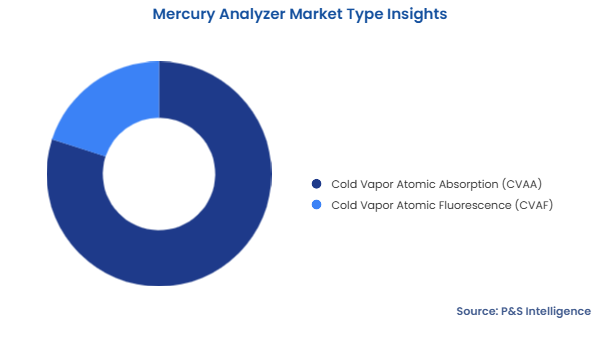
The cold vapor atomic absorption (CVAA) category dominates the market with 80% share in 2024, due to its high sensitivity, accuracy, and cost-effectiveness. It enables detection of ultra-trace mercury levels in air, water, and solids. Its simplicity, low detection limits, and compliance with international regulatory standards make it ideal for routine monitoring. CVAA’s widespread adoption is also driven by its relatively low operational cost and compatibility with automated systems. It requires minimal sample preparation and delivers rapid, reliable results, making it suitable for high-throughput industrial and environmental testing. Its proven performance in regulatory compliance strengthens its position as the preferred mercury detection method.
The cold vapor atomic fluorescence (CVAF) type category is projected to grow at the higher CAGR, during 2025–2032. This is due to its superior sensitivity, precision, and ability to detect low concentrations of mercury in various samples. CVAF technology is particularly valuable in applications that require highly accurate and reliable mercury analysis, such as environmental monitoring, water testing, and industrial emissions control.
This technique involves the use of cold vapor generation to release mercury from samples, which is then measured through atomic fluorescence, offering excellent detection limits, even for trace amounts of mercury. The growing demand for more sensitive and real-time mercury detection methods is driving the adoption of CVAF technology. Moreover, advancements in CVAF instrumentation, making it more user-friendly and cost-effective, are also contributing to its market growth.
During the study, we have analyzed the following types in the report:
The environment monitoring category accounts for the largest share in 2024. This is primarily driven by the increasing need to monitor and control mercury emissions and contamination in air, water, and soil. Environmental monitoring plays a critical role in ensuring compliance with these regulations, as it helps detect mercury levels in various ecosystems, such as rivers, lakes, and industrial discharge zones.
The rising awareness of the detrimental effects of mercury on ecosystems, wildlife, and human health is further fueling the demand for accurate and reliable mercury detection solutions. Mercury analyzers enable environmental agencies, research institutions, and industries to assess mercury concentrations in real-time, identify pollution sources, and take corrective actions when necessary. The growth of environmental protection initiatives, combined with an increasing focus on sustainability, further enhances the demand for advanced mercury monitoring technologies.
Major mercury sources in the environment include coal-fired power plants, artisanal gold mining, industrial waste, and cement production. Natural sources like volcanic eruptions also contribute. These activities release mercury into air, water, and soil, posing risks to ecosystems and human health, making monitoring and control essential.
In 2023, global coal-fired electricity generation reached approximately 10,434 terawatt-hours (TWh), accounting for 35% of the world's total electricity production. China was the largest contributor, producing over 5,700 TWh, representing more than half of the global coal generation.
India followed with about 1,480 TWh, making up 14% of the global total. While coal's share in the global electricity mix declined slightly from 35.7% in 2022 to 35.4% in 2023, the absolute generation increased by 146 TWh. This uptick was primarily driven by low hydroelectric output in certain regions, highlighting coal's continued role in meeting energy demands.
Food & beverages is the fastest-growing category, with approx. 6.5% CAGR. Mercury analyzers are increasingly used in the food and beverage (F&B) sector to ensure product safety and regulatory compliance. They detect trace mercury levels in seafood, grains, beverages, and other consumables, helping prevent toxic exposure.
Given mercury’s bioaccumulation in aquatic life, monitoring fish and shellfish is especially critical. As per the 2024 edition of The State of World Fisheries and Aquaculture (SOFIA) report of the Food and Agriculture Organization, global fisheries and aquaculture production reached 223.2 million tonnes in 2022, reflecting a 4.4 percent rise compared to the year 2020. This production included 185.4 million tonnes of aquatic animals.
Regulatory bodies like the FDA and EFSA set strict limits on mercury content, making precise detection essential. Analyzers also help assess mercury levels in processing water and packaging materials. Their high sensitivity and reliability enable food manufacturers to maintain quality standards, protect consumer health, and avoid costly recalls due to contamination.
The following end users are included in the report:
Drive strategic growth with comprehensive market analysis
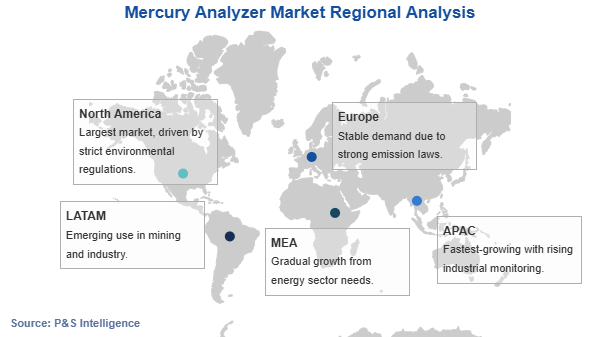
APAC is the largest and fastest-growing market, with 40% share in 2024 and 7.5% CAGR over the forecast period, respectively. The Asia-Pacific (APAC) region is a major driver in the growth of industries demanding precise mercury monitoring, including coal-fired power, petrochemicals, and electronics manufacturing. Rapid industrialization in China, India, Japan, and South Korea has led to increased coal consumption and chemical production, amplifying mercury emissions and exposure risks.
According to the World Health Organization and regional environmental agencies, mercury poisoning cases are notably higher in industrial hubs within China and India due to prolonged exposure in the mining and manufacturing sectors. The demand for mercury analyzers is rising as governments enforce stricter environmental and occupational health regulations. Japan and South Korea, with their advanced semiconductor and electronics industries, also emphasize mercury control to meet both environmental standards and product safety requirements.
The International Energy Agency highlights that coal remains a significant energy source in APAC, sustaining mercury emissions despite cleaner energy initiatives. This ongoing industrial growth, combined with heightened public health awareness reported by agencies like the United Nations Environment Programme, underscores the urgent need for accurate mercury measurement. Overall, APAC’s expanding industrial base and associated health concerns are intensifying demand for reliable mercury monitoring solutions to protect ecosystems and human health.
The Asia-Pacific (APAC) region is experiencing significant industrial growth, leading to increased mercury emissions and exposure risks. China and India, as major coal consumers, contribute substantially to global mercury emissions. The United Nations Environment Programme (UNEP) reports that Asia accounts for just under half of all global mercury releases, primarily from coal combustion and industrial activities.
In Southeast Asia, artisanal and small-scale gold mining is prevalent. A study by the Asia-Pacific Solidarity Network indicates that approximately 500,000 miners, including 100,000 women and children, are exposed to mercury through traditional mining practices. In Sekotong, West Nusa Tenggara, and Paboyo, Central Sulawesi, Indonesia, mercury levels in blood samples have been found to exceed safe standards, with average concentrations recorded at 4.32 parts per million (ppm).
Mercury exposure is also a concern in Pacific Island countries. A study supported by the Minamata Convention's Interim Secretariat found that 96% of women of childbearing age in the Cook Islands, Marshall Islands, Tuvalu, and Kiribati had elevated mercury levels in their hair samples. This is attributed to the possibility of elevated mercury concentrations in the predatory fish species people consume widely.
Further, regions and countries analyzed for this report include:
The market is fragmented and characterized by the presence of numerous small and medium-sized players along with a few large multinational companies. This arises due to the diverse applications of mercury analyzers across various industries such as environmental monitoring, industrial emissions testing, healthcare, and research, each requiring specialized solutions. Companies in this market often cater to specific regional or industry needs, offering a wide range of products, including handheld devices, portable analyzers, and advanced laboratory-grade systems.
While large companies benefit from economies of scale and robust distribution networks, smaller players focus on specialized applications or regional markets, leading to a decentralized market structure. This competitive environment fosters innovation and provides customers with a broad selection of mercury analyzers tailored to specific requirements, keeping the market fragmented.
Want a report tailored exactly to your business need?
Request CustomizationLeading companies across industries trust us to deliver data-driven insights and innovative solutions for their most critical decisions. From data-driven strategies to actionable insights, we empower the decision-makers who shape industries and define the future. From Fortune 500 companies to innovative startups, we are proud to partner with organisations that drive progress in their industries.

Working with P&S Intelligence and their team was an absolute pleasure – their awareness of timelines and commitment to value greatly contributed to our project's success. Eagerly anticipating future collaborations.
McKinsey & Company
India
Our insights into the minutest levels of the markets, including the latest trends and competitive landscape, give you all the answers you need to take your business to new heights

We take a cautious approach to protecting your personal and confidential information. Trust is the strongest bond that connects us and our clients, and trust we build by complying with all international and domestic data protection and privacy laws


Customize the Report to Align with Your Business Objectives

Request the Free Sample Pages