This Report Provides In-Depth Analysis of the Membranes Market Report Prepared by P&S Intelligence, Segmented by Technology (Reverse Osmosis (RO), Ultrafiltration (UF), Microfiltration (MF), Nanofiltration (NF), Other Technologies), Material (Polymeric Materials, Ceramic Materials, Other Materials), Module Configuration (Spiral Wound, Hollow Fiber, Tubular, Plate & Frame), Application (Water & Wastewater Treatment, Industrial Processing, Food & Beverage Processing, Pharmaceuticals & Life Sciences, Energy Transition & Mining), and Geographical Outlook for the Period of 2022 to 2033
Explore the market potential with our data-driven report
Membranes Market Outlook
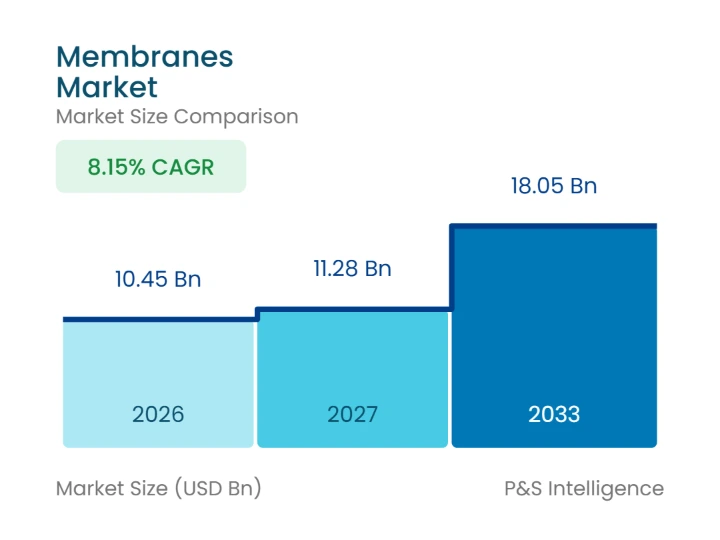
The global membranes market size is estimated at USD 10.45 Billion in 2026 and is set to rise to USD 11.28 Billion in 2027 and USD 18.05 Billion by 2033, at an 8.15% CAGR during 2027-2033. Municipal water utilities, desalination developers, and industrial plant operators place most orders, buying reverse osmosis, ultrafiltration, and nanofiltration elements for new treatment trains and as replacements for elements that foul and lose output in service. Element producers therefore earn from plant construction and from the operating life of plants already running.
Coastal cities and industrial parks short of freshwater are commissioning seawater desalination and wastewater reuse plants, and both routes run on reverse osmosis trains that need a full membrane fill at startup. China's Ministry of Natural Resources counted 167 seawater desalination projects in operation in 2025, with combined capacity of 3.077 million tons per day, up 221,000 tons per day on 2024. Tighter drinking water limits on PFAS and other trace contaminants add a second buyer group in North America and Europe, where utilities retrofit existing plants with nanofiltration and reverse osmosis instead of building new supply.
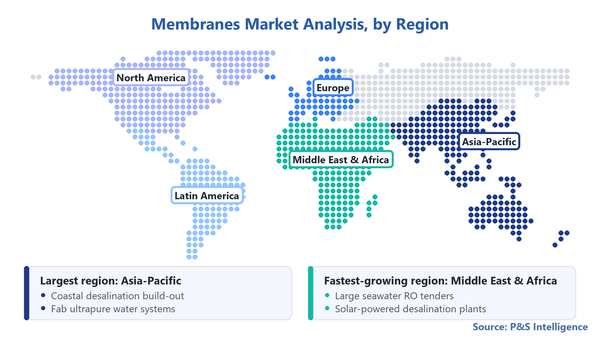
Asia-Pacific accounts for 39.0% of membranes market revenue in 2026, supported by desalination in China, ultrapure water systems at semiconductor fabs in Taiwan, South Korea, and Japan, and zero liquid discharge rules for Indian industry. The Middle East & Africa is projected to grow fastest, at an 8.9% CAGR during 2027-2033, as Saudi Arabia and the United Arab Emirates contract large seawater reverse osmosis plants under long-term water purchase agreements. Asia-Pacific orders come from many municipal and industrial buyers, while Gulf demand arrives in a few large tenders that favor producers able to commit high element volumes.
Key market insights
By technology, reverse osmosis (RO) accounts for 37.0% in 2026, while nanofiltration (NF) is projected to grow at an 11.85% CAGR during 2027-2033.
By material, polymeric materials account for 85.5% in 2026, while ceramic materials are projected to expand at a 12.2% CAGR during 2027-2033.
By module configuration, spiral wound accounts for 52.0% in 2026 and is also projected to grow fastest, at an 8.45% CAGR during 2027-2033.
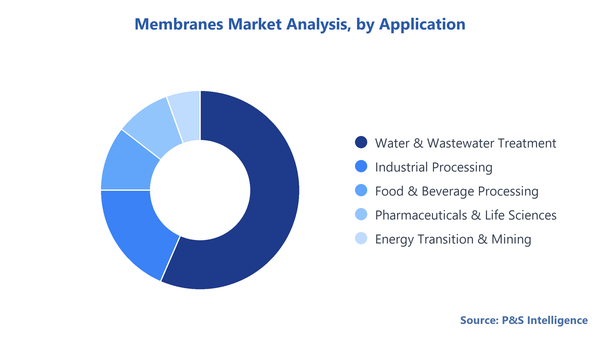
By application, water & wastewater treatment accounts for 56.5% in 2026, while energy transition & mining is projected to expand at a 16.4% CAGR during 2027-2033.
By geography, Asia-Pacific accounts for 39.0% in 2026, while Middle East & Africa is projected to grow at an 8.9% CAGR during 2027-2033.
Membranes Market Dynamics
Direct potable reuse rules are reshaping the membrane content of municipal water projects
Water utilities in the arid southwestern U.S. are preparing direct potable reuse projects, which send purified wastewater into the drinking supply without first passing it through an aquifer or reservoir. Removing that environmental buffer lengthens the treatment train a utility has to buy. A direct reuse plant pairs membrane filtration and reverse osmosis with additional chemical and biological barriers, so each project becomes a combined order for ultrafiltration modules and reverse osmosis elements from a single tender.
California's direct potable reuse regulations, adopted by the State Water Resources Control Board in December 2023, took effect on October 1, 2024, and place ozone and biologically activated carbon ahead of reverse osmosis and advanced oxidation, two barriers added on top of the indirect reuse train. The rules apply only to water systems that choose to build such projects, so orders will arrive one permit at a time. Element producers with operating data from indirect reuse plants, where the same membrane sequence already runs, are likely to be specified more readily, since permit reviewers rely on demonstrated performance.
Enforceable PFAS limits are accelerating membrane retrofits at drinking water plants
Public water systems in the U.S. now face enforceable limits on two PFAS compounds, which turns treatment for these chemicals from an optional upgrade into a funded capital project. Utilities choosing a treatment route compare granular activated carbon, ion exchange resin, and high-pressure membrane systems. Nanofiltration and reverse osmosis tend to be chosen where a plant also needs hardness, salinity, or multi-contaminant removal, though the concentrate stream they leave behind adds disposal cost, which keeps sorbent media competitive at smaller inland systems.
The US Environmental Protection Agency set maximum contaminant levels of 4.0 parts per trillion for PFOA and PFOS in April 2024, with initial monitoring due by 2027 and treatment due by 2029. A May 2026 proposal would keep both limits and let systems request two more years, to 2031. Utilities that exceed the limits still have to buy treatment within this decade, so membrane producers able to document PFAS removal and help with concentrate management gain an opening across this compliance cycle.
Electrolyzer and lithium projects are creating a higher-value channel for specialty membrane grades
Hydrogen producers and lithium developers buy membrane components that sit at the core of their process, so membrane performance affects plant output directly. Proton exchange membrane electrolyzers typically use a perfluorosulfonic acid membrane in every cell stack, and lithium projects can use reverse osmosis and nanofiltration to concentrate and purify brine streams around the extraction step. Because these components are qualified for one process and replaced with the stack or element, a single project award can lead to repeat orders over the plant's operating life.
Installed electrolysis capacity doubled in 2025 to surpass 4 GW, according to the International Energy Agency, which also put more than 2.5 GW under construction for operation in 2026. That base remains small beside municipal water treatment, and hydrogen projects depend on investment decisions that many developers have yet to take. Membrane producers already qualified with electrolyzer stack builders would be better positioned if the construction pipeline converts into operating plants, while lithium demand is likely to rise in steps as individual projects reach financing.
Proposed fluoropolymer restrictions are challenging the material base of hollow-fiber modules
Many hollow-fiber ultrafiltration and membrane bioreactor modules are spun from polyvinylidene fluoride, a fluoropolymer chosen for chlorine tolerance and strength, and fluoropolymers fall within the European Union's proposed universal PFAS restriction. For utilities and industrial operators, the risk is a forced material change partway through a plant's life, which could leave installed racks needing requalified replacement modules. Some purchasing organizations could delay framework orders until the scope and any derogation for water treatment become clear, which would slow order intake in Europe before any restriction applies.
The European Chemicals Agency's Risk Assessment Committee adopted its opinion on the restriction in March 2026, and its Committee for Socio-Economic Analysis is expected to finalize its own opinion by the end of 2026, after which the European Commission drafts a measure for a member-state vote. Producers are already preparing alternatives. In December 2025, Acuriant Technologies launched the CUF|Flow ceramic ultrafiltration module under its Nanostone brand, which the company describes as PFAS-free. Producers that offer polyethersulfone or ceramic lines alongside fluoropolymer products face less disruption whatever the final scope.
Segmentation Outlook
Technology
Reverse osmosis (RO) accounts for 37.0% of membranes market revenue in 2026, because it is the membrane step that utilities and industry rely on to remove dissolved salts at the scale seawater desalination, brackish groundwater treatment, and potable reuse require. RO plants also consume elements throughout their life, since spiral elements foul and lose rejection in service and are replaced in scheduled campaigns. As per the Saudi Water Partnership Company's seven-year statement covering 2024 to 2030, seven independent water plants with about 2.75 million cubic meters per day of combined capacity are planned to start operation between 2028 and 2032.
Nanofiltration (NF) is projected to post the fastest growth, at an 11.85% CAGR during 2027-2033. Its selective rejection removes hardness, natural organic matter, and trace contaminants at moderate pressure, which suits utilities that need cleaner water without demineralizing it, and the same selectivity separates divalent from monovalent ions in lithium brine and offshore sulfate removal. DuPont launched an upgraded FilmTec NF270 element for drinking water utilities in March 2026, stating that it reaches the same flux with 6-10% lower energy use. Lower energy per cubic meter strengthens the case for nanofiltration in municipal tenders that score operating cost.
Material
Polymeric materials hold 85.5% of revenue in 2026. Polyamide thin-film composites, polysulfone, polyethersulfone, and fluoropolymers can be cast or spun into spiral and hollow-fiber formats on high-volume lines, which keeps cost per installed square meter low enough for municipal tenders that compare lifetime cost per cubic meter. Design engineers also hold decades of operating data on these materials, so most specifications start from them. That incumbency lets polymer producers keep most of the replacement business on installed plants, because switching material usually means redesigning the rack.
Ceramic materials are expected to grow fastest, at a 12.2% CAGR during 2027-2033. Industrial operators treating hot, oily, or chemically aggressive streams, such as oilfield produced water, metal finishing rinses, and dairy cleaning loops, choose alumina, titania, zirconia, or silicon carbide because these materials tolerate harsh cleaning chemicals and temperatures that shorten polymer service life. The proposed European PFAS restriction adds a second reason, since ceramics contain no fluoropolymer. Higher purchase prices keep ceramics in applications where longer service life and fewer shutdowns justify the premium, so growth comes mainly from industrial buyers.
Module Configuration
Spiral wound elements hold 52.0% of revenue in 2026, since most RO and NF plants, from small brackish water skids to large seawater trains, wrap flat-sheet membrane leaves into spiral elements built to standard diameters. Standard sizing lets an operator fit another producer's element into existing pressure vessels without changing hardware, which keeps spiral elements in recurring, competitive replacement tenders. Hollow fiber, tubular, and plate-and-frame formats keep their roles in ultrafiltration, membrane bioreactors, and high-solids streams, where open channels resist clogging.
Spiral wound is also projected to grow fastest among configurations, at an 8.45% CAGR during 2027-2033, because seawater RO, brackish RO, and nanofiltration ship mostly in this format. Newer elements with more active area and lower-pressure chemistry let operators raise output inside existing vessels, which turns efficiency upgrades into element orders instead of new skids. Semiconductor fabs can add volume because their ultrapure water plants run multi-pass RO, and SEMI's World Fab Forecast tracks 146 future facilities and lines expected to begin volume production in 2026 or later.
Application
Water & wastewater treatment accounts for 56.5% of revenue in 2026, as municipal utilities install the largest membrane areas per project and fund replacements through water tariffs. Figures from the Orange County Water District put the capacity of its Groundwater Replenishment System, which purifies treated wastewater through microfiltration and reverse osmosis, at up to 130 million gallons a day. Contaminant limits and reuse rules fall on this buyer group, tying its orders to regulatory calendars. Utilities buy through public tenders that weigh lifetime cost, so producers with low-energy elements and service capacity tend to win repeat framework contracts
Copyright P&S Intelligence. Reuse requires attribution under CC BY 4.0.
Energy transition & mining is projected to grow fastest, at a 16.4% CAGR during 2027-2033, from 5.5% of revenue in 2026. Its buyers include proton and anion exchange membrane electrolyzer builders that need an ion exchange membrane in each cell stack, lithium developers that can use RO and NF around the extraction step, and copper miners that depend on desalinated seawater. Each purchase sits inside a project financed against a production target, so volumes rise in steps as plants reach investment decisions. Orders depend on qualification within a specific process, so a producer's position is decided project by project.
The following segments are analysed in this report.
Technology
Reverse Osmosis (RO)
Ultrafiltration (UF)
Microfiltration (MF)
Nanofiltration (NF)
Other Technologies
Material
Polymeric Materials
Ceramic Materials
Other Materials
Module Configuration
Spiral Wound
Hollow Fiber
Tubular
Plate & Frame
Application
Water & Wastewater Treatment
Industrial Processing
Food & Beverage Processing
Pharmaceuticals & Life Sciences
Energy Transition & Mining
Geographical Analysis
Asia-Pacific membranes market outlook
Asia-Pacific holds 39.0% of the global market in 2026, and three buyer groups explain the lead. Coastal Chinese provinces keep adding seawater desalination for cities and industrial parks, semiconductor and display fabs in Taiwan, South Korea, Japan, and Singapore run multi-pass reverse osmosis for ultrapure water, and Indian pollution-control rules push textile, pharmaceutical, and chemical plants toward zero liquid discharge, which depends on high-pressure RO to concentrate brine. China is the region's largest market, combining all three buyer groups with local element production by domestic and Japanese-owned producers.
Singapore shows how far membrane use can extend within one water system. PUB, Singapore's national water agency, operates four NEWater plants in which treated wastewater passes through microfiltration or ultrafiltration, then reverse osmosis, then ultraviolet disinfection, making the utility a repeat buyer of two membrane types at once. The regional lead is likely to hold through 2033 because industrial effluent rules and new fab construction keep adding order points, which favors producers with element manufacturing inside the region and short delivery times.
Middle East & Africa membranes market growth
The Middle East & Africa is projected to post the fastest regional growth, at an 8.9% CAGR during 2027-2033. Gulf states have few rivers or renewable aquifers and depend on desalination for most municipal supply, and new plants are tendered as independent water projects with long purchase agreements awarded on the lowest water tariff. That pricing pushes developers toward seawater reverse osmosis with high-rejection, low-energy elements and toward solar power. Saudi Arabia is the region's fastest-growing market, with a state-run pipeline of independent water plants, while Morocco and Egypt add a second, smaller stream of coastal desalination tenders.
The Dubai Electricity and Water Authority, which reached financial close on the 180 million imperial gallons per day Hassyan seawater reverse osmosis plant in April 2024, received a lowest bid of USD 0.36536 per cubic meter for the solar-powered project. A tariff at that level leaves little room for wasted energy, so elements are judged on feed pressure and rejection over the full term of the purchase agreement. Producers with proven seawater elements and service teams in the Gulf are better positioned for supply and replacement orders as these plants enter operation.
Copyright P&S Intelligence. Reuse requires attribution under CC BY 4.0.
Europe market analysis
Europe holds a smaller share than North America, and its demand depends more on wastewater regulation than on new water supply. Municipal operators upgrading activated sludge plants buy membrane bioreactor cassettes and ultrafiltration modules where land is short or effluent must reach reuse quality. Spain, Italy, and other southern countries add brackish and seawater RO for irrigation and coastal tourism demand, which gives the region a second, desalination-led buyer group.
Directive (EU) 2024/3019, the recast Urban Wastewater Treatment Directive, entered into force on January 1, 2025, and phases in quaternary treatment for micropollutants at plants serving 150,000 population equivalent and above, reaching all such plants by the end of 2045, with pharmaceutical and cosmetics producers covering most of the cost. The directive does not prescribe membrane treatment, and ozonation or activated carbon can meet many of these obligations. Membrane producers therefore compete for the projects where compact footprint or reuse quality justifies a membrane step.
Latin America market analysis
Latin America contributes the smallest regional share, but its membrane demand is unusually concentrated in mining. Copper producers in northern Chile face limits on drawing freshwater from stressed basins, so new and expanded mines pump desalinated seawater to high-altitude operations, and some lithium producers in Chile and Argentina are evaluating extraction routes that rely partly on membrane separation. Municipal reuse and industrial effluent treatment in Mexico and Brazil add steadier but smaller orders.
Cochilco, Chile's state copper commission, projects seawater use in copper mining to rise from 7.5 cubic meters per second in 2024 to 13.9 cubic meters per second in 2034, with close to three-quarters of that seawater desalinated. Each desalination plant built for a mine is a large first-fill RO order followed by replacements paid from mine operating budgets, which ties regional demand to copper investment cycles. Producers with service presence in Antofagasta and the wider Atacama are better positioned to win that replacement business.
North America market analysis
North America trails Asia-Pacific in revenue, and most of its spending upgrades existing plants, with a smaller part going to new supply. Utilities facing the federal PFAS limits retrofit nanofiltration or RO trains, semiconductor fabs under construction in Arizona, Texas, and New York specify ultrapure water systems, and southwestern cities extend potable reuse. Canada adds smaller, mainly municipal ultrafiltration demand, where membrane filtration replaces conventional media filters at drinking water plants.
Under Texas statute, the Texas Water Development Board is directed to finance projects through the New Water Supply for Texas Fund that lead to 7 million acre-feet of new water supplies by December 31, 2033, with marine and brackish desalination, produced water treatment, and water reuse among eligible project types. If that financing reaches construction, Texas utilities could become volume buyers of brackish RO elements. Producers with low-pressure brackish elements and concentrate-management experience would be better positioned for those inland projects.
The following geographies are analysed in this report.
Asia-Pacific
China
India
Japan
South Korea
Taiwan
Singapore
Malaysia
Thailand
Vietnam
Indonesia
Philippines
Australia
Rest of Asia-Pacific
Middle East & Africa
Saudi Arabia
U.A.E.
Israel
Qatar
Oman
Kuwait
South Africa
Egypt
Morocco
Nigeria
Rest of Middle East & Africa
Europe
Germany
U.K.
France
Italy
Netherlands
Spain
Switzerland
Sweden
Belgium
Austria
Finland
Denmark
Rest of Europe
Latin America
Brazil
Mexico
Chile
Argentina
Colombia
Rest of Latin America
North America
U.S.
Canada
Membranes Market Competitive Landscape
The membranes market is moderately fragmented overall, and competition is layered by technology. Spiral-wound RO and NF elements are contested mainly by producers with large interfacial polymerization lines and long plant reference lists, because utilities qualify elements against operating records and the projection software engineers use to design plants. Ultrafiltration, membrane bioreactor, ceramic, and bioprocess products are more open, with producers specializing by material and application. Switching costs differ by layer, since a standard 8-inch spiral element can be replaced with another brand's element in the same vessel, while hollow-fiber racks are usually tied to one producer's module geometry.
Three clusters stand out. DuPont de Nemours Inc., Toray Industries Inc., and Nitto Denko Corporation, through Hydranautics, compete in RO and NF elements on rejection, energy use, fouling resistance, and design-software support. Veolia Environnement S.A., Asahi Kasei Corporation, and Pentair plc compete in hollow-fiber and tubular ultrafiltration and membrane bioreactor systems, with Veolia also selling design-build-operate contracts that bundle membrane supply with long-term service. Sartorius AG and Danaher Corporation, through Pall, serve biopharmaceutical manufacturers with sterile filtration, tangential flow, and viral clearance filters, where validation inside a licensed drug process makes a supplier change slow and costly.
For buyers, the shared sizing of spiral elements keeps replacement tenders price-competitive, while hollow-fiber and bioprocess buyers trade some bargaining power for a single accountable supplier. Newer entrants tend to target niches such as ceramic modules, high-pressure brine concentration, and lithium recovery, where process know-how counts for more than casting scale. The structure is changing faster at those edges than at the core, since PFAS-related material changes and energy transition projects open qualification rounds that specialists can enter alongside incumbents.
Major Companies in Membranes Market:
DuPont de Nemours Inc.
Toray Industries Inc.
Nitto Denko Corporation
NanoH2O Co. Ltd.
Danaher Corporation
Sartorius AG
Veolia Environnement S.A.
Asahi Kasei Corporation
Pentair plc
Kovalus Separation Solutions LLC
MANN+HUMMEL International GmbH & Co. KG
Synder Filtration Inc.
Gradiant Corporation
Membranes Market News & Developments
In September 2026, Gradiant Corporation announced USD 300 million in new contracts from semiconductor manufacturers since the start of 2026, covering five fabrication sites in New York, Virginia, Idaho, and Utah, with ultrapure water, high-recovery wastewater, scrubber reclaim, and zero liquid discharge systems. The awards show US fab construction converting into water treatment orders.
In September 2026, Nitto Denko Corporation and its group company Hydranautics began selling the PRO-XR1-X-LD fouling-resistant reverse osmosis element for reuse of difficult wastewater from semiconductor, mining, and industrial plants, claiming about twice the membrane life of conventional products. Longer element life lowers replacement frequency, which moves reuse tenders toward lifetime cost comparisons.
In June 2026, Toray Industries Inc. announced the TSW-K/M/V series of seawater reverse osmosis elements for release in October 2026, with salt permeability up to 55% lower than its current models. Lower salt passage could let new desalination plants run a single RO pass, which would reduce element counts per plant.
In April 2026, DuPont de Nemours Inc. launched the FilmTec Fortilife XC-Max UHP and XC220 reverse osmosis elements for zero and minimal liquid discharge, rated for brine concentrations up to 250 g/L and 220 g/L sodium chloride at pressures up to 120 bar and 83 bar. Pushing RO further into brine concentration reduces the volume sent to thermal evaporators.
In December 2025, NanoH2O Co. Ltd., formerly LG Water Solutions, began operating as an independent reverse osmosis element producer after Glenwood Private Equity and Mubadala Investment Company closed their co-investment, with more than 95% of its revenue earned outside Korea. Mubadala tied the deal to expansion in the Middle East and North Africa, putting new capital behind a seawater element supplier.
Last Updated: October 2026
Frequently Asked Questions About This Report
What is the size of the membranes market?+
Global membranes market size is estimated at USD 10.45 Billion in 2026 and is set to rise to USD 11.28 Billion in 2027 and USD 18.05 Billion by 2033, at an 8.15% CAGR during 2027-2033.
What is driving demand for membranes?+
Coastal cities and industrial parks short of freshwater are commissioning seawater desalination and wastewater reuse plants, and both routes run on reverse osmosis trains that need a full membrane fill at startup.
Which region dominates the membranes market?+
Asia-Pacific accounts for 39.0% of membranes market revenue in 2026, supported by desalination in China, ultrapure water systems at semiconductor fabs in Taiwan, South Korea, and Japan, and zero liquid discharge rules for Indian industry.
Which region is growing fastest in the membranes market?+
The Middle East & Africa is projected to grow fastest, at an 8.9% CAGR during 2027-2033, as Saudi Arabia and the United Arab Emirates contract large seawater reverse osmosis plants under long-term water purchase agreements.
Which membrane technology has the largest market share?+
By technology, reverse osmosis (RO) accounts for 37.0% in 2026, while nanofiltration (NF) is projected to grow at an 11.85% CAGR during 2027-2033.
What is the largest application of membranes?+
By application, water & wastewater treatment accounts for 56.5% in 2026, while energy transition & mining is projected to expand at a 16.4% CAGR during 2027-2033.
Who are the major membrane manufacturers?+
DuPont de Nemours, Inc., Toray Industries, Inc., and Nitto Denko Corporation, through Hydranautics, compete in RO and NF elements on rejection, energy use, fouling resistance, and design-software support.
Want a report tailored exactly to your business need?
Leading companies across industries trust us to deliver data-driven insights and innovative solutions for their most critical decisions. From data-driven strategies to actionable insights, we empower the decision-makers who shape industries and define the future. From Fortune 500 companies to innovative startups, we are proud to partner with organisations that drive progress in their industries.
Client Testimonials
Working with P&S Intelligence and their team was an absolute pleasure – their awareness of timelines and commitment to value greatly contributed to our project's success. Eagerly anticipating future collaborations.
McKinsey & Company
India
Unmatched Standards
Our insights into the minutest levels of the markets, including the latest trends and competitive landscape, give you all the answers you need to take your business to new heights
Complete Data Security
We take a cautious approach to protecting your personal and confidential information. Trust is the strongest bond that connects us and our clients, and trust we build by complying with all international and domestic data protection and privacy laws