Medical X-Ray Film Processor Market Size & Share Analysis - Trends, Drivers, Competitive Landscape, and Forecasts (2026 - 2032)
This Report Provides In-Depth Analysis of the Medical X-Ray Film Processor Market Report Prepared by P&S Intelligence, Segmented by Type (Semi-Automatic Film Processor, Fully Automatic Film Processor), Application (Dental, Mammography, Orthopedic), End User (Hospitals & Clinics, Diagnostic Centers, Research and Educational Institutions), and Geographical Outlook for the Period of 2019 to 2032
Medical X-Ray Film Processor Market Revenue Insights
Key Highlights
Study Period
2019 - 2032
Market Size in 2025
USD 850 Million
Market Size in 2026
USD 873.8 Million
Market Size by 2032
USD 1083.4 Million
Projected CAGR
3.8%
Largest Region
North America
Fastest-Growing Region
Asia-Pacific
Market Structure
Fragmented
Market Size
Explore the market potential with our data-driven report
Medical X-Ray Film Processor Market Analysis
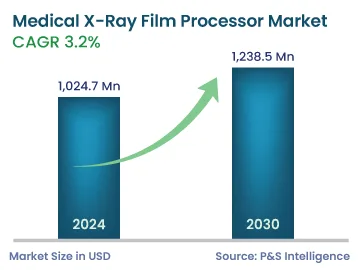
The medical X-ray film processor market size was USD 850 million for 2025, and it will grow by 3.8% during 2026-2032, to reach USD 1083.4 million by 2032.
The medical X-ray film processor market is expanding as healthcare professionals continue utilising X-rays to diagnose bone injuries, dental problems, and chest diseases. According to the World Health Organization, an estimated 10.8 million people fell ill with tuberculosis globally in 2023. Consequently, the continuous need for rapid diagnostic imaging to manage these high-burden diseases creates a steady worldwide demand for film processors. Film-based X-ray systems remain highly prevalent in clinics and newly built hospitals due to their operational simplicity and low costs.
Key Market Insights
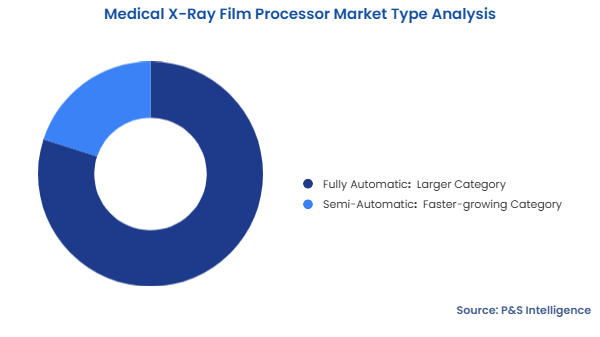
Fully automatic film processors are the larger type with 80% share, providing high-throughput imaging for urban hospitals and clinics.
Semi-automatic film processors are the fastest-growing type, offering an affordable economic alternative for smaller clinics in developing regions.
Orthopaedic is the largest application with 65% share, driven by the massive clinical requirement for diagnosing bone fractures.
Dental is the fastest-growing application as clinics expand globally to treat billions of people with dental caries.
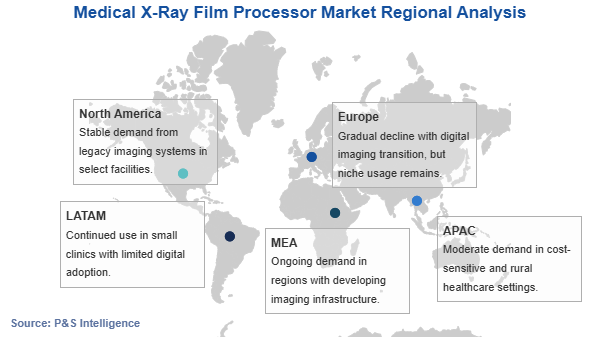
North America remains the largest regional market, while Asia-Pacific is the fastest-growing due to rapid healthcare infrastructure expansion.
Medical X-Ray Film Processor Market Growth Factors
Use of Automated Radiographic Film Processing Systems Is Major Trend
Healthcare facilities utilising film-based imaging are rapidly shifting toward automated film processors to replace manual development methods. These machines independently manage film transport, chemical processing, and drying to significantly reduce technician effort. According to the World Health Organization, a shortage of 11.1 million health workers globally is projected in 2030. This severe lack of clinical staff forces hospitals to adopt automated systems that simplify daily operations without requiring constant human oversight. Furthermore, according to the International Osteoporosis Foundation, approximately 37 million fragility fractures occurred globally among individuals aged over 55 in 2024. This colossal influx of acute orthopaedic patients requires continuous, high-volume radiographic imaging, which manual processing simply cannot sustain.
Rising Demand for X-Ray Imaging for Disease Diagnosis Drives Market
X-ray imaging remains a fundamental medical diagnostic technique for evaluating joint degradation, bone fractures, and dental issues. Hospitals and clinics utilise these fast-imaging procedures daily to view internal structures accurately. According to the World Health Organization, osteoarthritis of the knee affected approximately 365 million people globally in 2023. Furthermore, approximately 37.3 million severe falls requiring clinical medical attention occurred worldwide in 2024. The massive, continuous influx of chronic joint and acute trauma patients forces healthcare organisations to maintain a high volume of radiographic imaging. Consequently, facilities delaying digital upgrades heavily rely on robust film-based radiography systems, sustaining an ongoing need for reliable film processing equipment.
Medical X-Ray Film Processor Market Segmentation Analysis
Type Analysis
Fully automatic is the larger category, holding a market share of 80%, due to their extensive utilisation in hospitals, where rapid turnaround times for radiological images are critical. These devices provide consistent image quality, while significantly reducing technician labour and minimising processing errors in routine studies. According to the World Health Organization, road traffic crashes caused approximately 1.19 million deaths globally in 2023. Consequently, the immense volume of severe trauma stemming from such incidents requires hospitals to maintain fast, automated diagnostic imaging capabilities to manage patient influx efficiently.
Semi-automatic is the faster-growing category during the forecast period, providing smaller clinics and diagnostic facilities with an economical alternative to fully automatic systems. These devices immediately improve workflow compared to manual processing, while remaining highly cost-effective for localised healthcare providers. According to the World Health Organization, an estimated 2 billion people globally suffered from dental caries in their permanent teeth in 2024. This massive burden of oral diseases drives steady patient footfall to independent dental offices, sustaining the demand for affordable, semi-automatic diagnostic imaging solutions.
The types analysed in this report are:
Fully Automatic (Larger Category)
Semi-Automatic (Faster-growing Category)
Application Analysis
Orthopaedic is the largest category, holding a market share of 65%, due to the widespread use of X-ray imaging for examining complex bone and joint structures. Healthcare providers heavily depend on these specific scans to quickly identify fractures, dislocations, and chronic joint issues. According to the World Health Organization, approximately 1.71 billion people globally lived with musculoskeletal conditions in 2025. Because these debilitating medical issues remain extraordinarily common worldwide, healthcare facilities will generate a continuous, long-term demand for reliable film processing equipment to diagnose and manage skeletal disorders.
Dental is the fastest-growing category, registering a CAGR of 3.6% as the rising frequency of routine oral exams drives the rapid expansion of standalone dental clinics. Dentists utilise X-ray technology extensively to view teeth alignment, detect cavities, and accurately assess jawbone conditions. According to the World Health Organization, oral diseases affected an estimated 3.5 billion people globally in 2025. The massive scale of these ongoing oral health issues creates surging demand for compact, fast-processing X-ray systems to handle high patient volumes efficiently.
The applications analysed in this report are:
Orthopaedic (Largest Category)
Dental (Fastest-growing Category)
Mammography
End User Analysis
Hospitals & clinics form the largest category, holding a market share of 60%, as they provide the vast majority of emergency, surgical, and routine examination care. These facilities handle a massive influx of acute medical cases requiring immediate radiographic imaging for accurate triage and treatment. According to the World Health Organization, lower respiratory infections caused an estimated 2.6 million deaths globally in 2024. Consequently, the continuous need to perform chest X-rays on critical respiratory and trauma patients cements hospitals as the primary consumers of high-volume film processors.
Diagnostic centres represent the fastest-growing category, registering a CAGR of 4.0% because specialised imaging procedures are increasingly shifting away from general hospitals. Standalone facilities offer faster scheduling for routine respiratory and skeletal radiological testing, drastically improving patient workflow. According to the World Health Organization, an estimated 10.7 million people fell ill with tuberculosis globally in 2024. Therefore, managing the immense scale of outpatient chest X-ray screenings required for such widespread infectious diseases drives the rapid adoption of dedicated X-ray film processors within independent diagnostic facilities.
The end user analysed in this report are:
Hospitals & Clinics (Largest Category)
Diagnostic Centres (Fastest-growing Category)
Research and Educational Institutions
Drive strategic growth with comprehensive market analysis
Medical X-Ray Film Processor Market Geographical Analysis
North America Market Analysis
North America holds the largest share, of 40%, due to the large number of films used for routine imaging in emergency care, orthopaedics, and chronic disease management. Hospitals across the U.S. have long-standing radiology departments with existing film processing systems. Additionally, many rural clinics and small hospitals are using film-based imaging systems since they are easy to use and do not require a sophisticated digital infrastructure. In addition, regular replacement cycles for imaging equipment, combined with the extensive service networks provided by suppliers of medical devices, drive the demand for film processing systems throughout North America.
U.S. Medical X-ray Film Processor Market
The U.S. is the largest market for X-ray-based medical imaging systems due to its massive clinical infrastructure. According to the American Hospital Association, the U.S. healthcare network contained exactly 6,100 registered hospitals in 2024. High-volume emergency departments and orthopaedic centres heavily utilise diagnostic imaging to triage musculoskeletal trauma efficiently. Furthermore, outpatient clinics maintain dedicated film processing systems to guarantee uninterrupted daily operations and support existing radiography equipment. According to the American Hospital Association, total patient admissions across all U.S. hospitals exceeded 35.6 million in 2024, sustaining extensive demand for reliable film processors.
Canada Medical X-ray Film Processor Market
Healthcare delivery in Canada relies heavily on expanding outpatient imaging access across numerous provincial diagnostic centres. Film-based X-ray technology remains dominant in remote Canadian regions because analogue equipment is significantly less complex and easier to repair locally than digital systems. According to Statistics Canada, exactly 6,330,166 people lived in rural areas across Canada in 2024. Furthermore, approximately 6.84 million Canadians reported having arthritis in 2024. The massive scale of these isolated populations, combined with the rising need to continuously monitor chronic joint degradation, ensures a steady reliance on durable film processors in rural Canadian healthcare settings.
Asia-Pacific Market Analysis
Asia-Pacific has the highest CAGR, of approx. 4.5%, because many developing countries here are establishing or upgrading their healthcare infrastructure to increase the access to diagnostic testing. Large populations continuously drive the need for imaging tests in hospitals, dental clinics and community health centres. Although it is common to see film-based radiography being used in many locations due to lower equipment cost and ease of operation relative to full digital systems, governments are actively promoting the earlier identification of diseases, which will result in additional imaging exams. With new healthcare providers entering the marketplace and those existing healthcare providers updating their medical technology, the demand for film processors continues to grow.
China Medical X-ray Film Processor Market
X-ray technology is a standard medical diagnostic tool in China due to rapid hospital development across urban and rural settings. According to the National Health Commission, the total number of registered hospitals across China reached 38,700 in 2024, creating a substantial demand for diagnostic imaging equipment. Furthermore, newly built grassroots facilities frequently utilise film-based radiography systems because they are significantly cheaper than digital alternatives and require minimal technical expertise. According to the World Health Organization, an estimated 741,000 people fell ill with tuberculosis in China in 2023. Managing this immense respiratory disease burden requires cost-effective film processors to ensure continuous chest X-ray screening capabilities at all healthcare tiers.
India Medical X-ray Film Processor Market
The Indian market is expanding rapidly as healthcare access continuously improves across major metropolitan cities and remote towns. According to the Ministry of Health and Family Welfare, 1,82,944 Ayushman Arogya Mandir primary healthcare centres were operationalised across the country by 2025, creating a significant, widespread demand for fundamental imaging equipment. Furthermore, film-based radiography remains the most-commonly used format here due to its exceptionally low acquisition cost and ease of maintenance. Furthermore, according to the Ministry of Health and Family Welfare, total patient footfall at these primary healthcare centres reached 4.94 billion in 2025. Managing this colossal patient load strictly requires affordable, highly reliable diagnostic film processors.
Europe Market Analysis
Europe shows consistent market growth due to a well-developed network of healthcare facilities, with most locations providing access to diagnostic imaging services. The majority of European hospitals have dedicated radiology departments, which utilise both film-based systems and digital systems for their imaging needs. There are many instances where healthcare providers also have film processors available as backup, when digital systems fail to perform as they need to complete day-to-day imaging tasks. Additionally, the majority of the countries provide good-quality dental and orthopaedic care to their citizens, Thus relying heavily on X-rays for diagnoses.
The regions and countries analysed in this report are:
North America (Largest Regional Market)
U.S. (Larger Country)
Canada (Faster-Growing Country)
Europe
Germany (Largest Country)
Spain (Fastest-Growing Country)
France
Italy
U.K.
Rest of Europe
Asia-Pacific (Fastest-Growing Regional Market)
China (Largest Country)
India (Fastest-Growing Country)
Japan
South Korea
Australia
Rest of APAC
Latin America
Brazil (Largest Country)
Mexico (Fastest-Growing Country)
Rest of LATAM
Middle East and Africa
Saudi Arabia (Largest Country)
U.A.E. (Fastest-Growing Country)
South Africa
Rest of MEA
Medical X-Ray Film Processor Market Share
The market is fragmented due to the number of companies that produce film processing equipment for hospitals, dental clinics, and diagnostic centres. In addition, many players are regional in their distribution or serve specific niches, such as the dental or orthopaedic imaging markets. The primary factors that determine the type of film processing equipment purchased by the buyer are price, service support and compatibility with the existing technology.
As a result of the varying budgets and technical requirements of different types of healthcare facilities, a large number of competitors in this industry are successful. No one company has enough control over the total demand for this product to dominate the market. Thus, the market is very competitive and comprised of many small- to medium-sized firms.
Top Medical X-Ray Film Processor Producers:
Carestream Health
Konica Minolta, Inc.
FUJIFILM Holdings Corporation
Agfa-Gevaert Group
Kodak Alaris
Sekisui Chemical Co., Ltd.
PROTEC GmbH & Co. KG
Siemens Healthineers
GE Healthcare (General Electric)
Philips Healthcare (Royal Philips)
Hitachi, Ltd. (Hitachi Medical Systems)
Shimadzu Corporation
Toshiba Medical Systems (Canon Medical Systems)
FOMA-COM, Inc.
Softex Corporation
Medical X-Ray Film Processor Market News
In January 2026, Carestream Health completed the separation of its international medical imaging operations after a transaction with Midea Group. The restructuring has created a standalone international imaging business, while Carestream retained film manufacturing and radiography operations in selected markets.
In August 2025, PROTEC GmbH & Co. KG introduced updated automatic X-ray film processing equipment for hospital radiology departments and diagnostic imaging facilities operating conventional film-based radiography workflows.
Frequently Asked Questions About This Report
What are the primary factors driving the medical X-ray film processor market?+
Growth is driven by the rising prevalence of chronic diseases, increasing orthopedic surgeries, and the need for cost-effective, reliable diagnostic imaging in developing regions.
Which region currently holds the largest share of the X-ray processor market?+
North America dominates the market due to its highly advanced healthcare infrastructure, high volume of surgical procedures, and the strong presence of major market players.
Which application segment dominates the medical X-ray film processor industry today?+
The orthopedic segment leads the market because X-rays are extensively used to quickly diagnose and monitor bone fractures, joint dislocations, and arthritis conditions globally.
Why are hospitals the largest end-users of medical X-ray film processors?+
Hospitals dominate because of their rapidly expanding patient bases, high volumes of daily orthopedic surgeries, and consistent need for continuous, reliable diagnostic imaging capabilities.
How do fully automatic film processors compare to manual processing methods?+
Fully automatic processors dominate because they deliver superior image quality, significantly reduce processing time, and minimize human error by automatically controlling temperature and chemical replenishment.
Want a report tailored exactly to your business need?
Leading companies across industries trust us to deliver data-driven insights and innovative solutions for their most critical decisions. From data-driven strategies to actionable insights, we empower the decision-makers who shape industries and define the future. From Fortune 500 companies to innovative startups, we are proud to partner with organisations that drive progress in their industries.
Client Testimonials
Working with P&S Intelligence and their team was an absolute pleasure – their awareness of timelines and commitment to value greatly contributed to our project's success. Eagerly anticipating future collaborations.
McKinsey & Company
India
Unmatched Standards
Our insights into the minutest levels of the markets, including the latest trends and competitive landscape, give you all the answers you need to take your business to new heights
Complete Data Security
We take a cautious approach to protecting your personal and confidential information. Trust is the strongest bond that connects us and our clients, and trust we build by complying with all international and domestic data protection and privacy laws