Mass Flow Controller Market Size & Share Analysis - Emerging Trends, Growth Opportunities, Competitive Landscape, and Forecasts (2025 - 2032)
This Report Provides In-Depth Analysis of the Mass Flow Controller Market Report Prepared by P&S Intelligence, Segmented by Type (Thermal, Coriolis, Differential Pressure), Flow Element (Liquid, Gas), Flow Rate (Low, Medium, High), End User (Oil & Gas, Semiconductors, Life Sciences, Chemical, Water & Wastewater, Food & Beverage), and Geographical Outlook for the Period of 2019 to 2032
Explore the market potential with our data-driven report
Mass Flow Controller Market Future Outlook
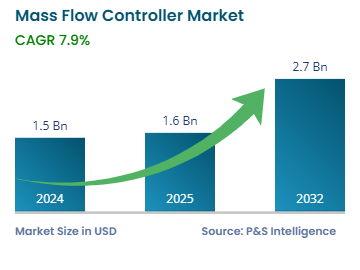
The global mass flow controller market will generate an estimated revenue of USD 1.5 billion in 2024, which is expected to witness a CAGR of 7.9% during 2025–2032, to reach USD 2.7 billion by 2032.
This growth can be attributed to the increasing demand for precise gas flow measurement and control across various industries, such as semiconductor manufacturing, chemical processing, and healthcare. The growing need for automation and process optimization, coupled with advancements in technology, has also contributed to the rising adoption of mass flow controllers.
Additionally, the shift toward renewable energy sources, including hydrogen production, is further driving market expansion, as MFCs play a critical role in ensuring the efficient and accurate handling of gases in diverse applications. The development of smart MFCs with enhanced features such as digital communication and improved accuracy is expected to bolster market growth during the forecast period.
Mass Flow Controller Market Trends & Drivers
Rising Growth in Semiconductor and Electronics Industries Is Key Driver
The rising growth in the semiconductor and electronics industries is a significant driver for the global mass flow controller market.
As the demand for advanced electronic devices such as smartphones, computers, and IoT products increases, semiconductor manufacturers are consistently improving production efficiency and product quality.
MFCs play a crucial role in semiconductor fabrication processes, where precise control of gas flows is essential for applications like chemical vapor deposition (CVD), etching, and ion implantation.
These processes require exact gas measurements to ensure the integrity of the thin films, coatings, and structures being created on silicon wafers.
Additionally, the emergence of next-generation technologies, such as 5G networks, artificial intelligence, and electric vehicles, is driving further growth in the semiconductor sector.
These innovations require advanced chips, increasing the need for sophisticated gas flow control solutions.
Consequently, the growth of the semiconductor and electronics industries is directly fueling the demand for high-precision MFCs.
Semiconductor and electronics production contributes modestly in direct terms—typically under 1% of global GDP—but its indirect impact is vast.
In 2022, East Asia accounted for over 80% of global semiconductor value-added, with China contributing ~32% and Taiwan ~19%.
In countries like Singapore, semiconductors represent around 7% of national GDP. Globally, the industry’s share of GDP has doubled since the 1990s, driven by its integration into high-value sectors like automotive, defense, healthcare, and AI.
This upstream role enables trillions in downstream output, positioning the industry as a critical driver of economic complexity, innovation, and supply chain resilience.
Advancements in Automation and Process Control Are a Key Opportunity
Advancements in automation and process control present a significant market opportunity for the global mass flow controller market.
As industries across various sectors try for greater efficiency, accuracy, and reduced human intervention, the integration of MFCs into automated systems is becoming increasingly essential.
Automation technologies such as Industrial Internet of Things (IIoT), artificial intelligence (AI), and machine learning are transforming manufacturing and processing environments, creating a growing need for precise, real-time control of gas flow.
MFCs are key components in these automated systems, enabling accurate monitoring and adjustment of gas flows without manual intervention.
By automating gas flow control, companies can enhance process optimization, improve product quality, and reduce operational costs.
Moreover, the integration of MFCs with advanced automation systems allows for predictive maintenance, real-time data collection, and remote monitoring, improving overall system reliability and uptime.
Industrial automation and process control drive demand for precise, reliable instrumentation, making mass flow controllers (MFCs) vital.
Over 70% of manufacturing sectors now integrate automation, requiring accurate flow regulation.
As smart factories and IIoT expand, MFCs support real-time data and energy efficiency, enhancing productivity and ensuring consistent process quality.
Complex Calibration and Integration Pose Challenges
A key challenge for the global mass flow controller market is the complexity involved in their calibration and integration processes.
MFCs require regular calibration to ensure optimal accuracy and performance, especially in high-precision applications such as semiconductor manufacturing, chemical processing, and medical devices.
Calibration can be intricate and time-consuming, often requiring specialized expertise and equipment. For industries that rely on continuous, real-time measurements, this can lead to operational downtime, which may negatively impact production schedules and result in significant cost implications.
In addition to calibration, the integration of MFCs into existing systems can be challenging.
Many industries employ a variety of equipment and technologies, and ensuring that MFCs are compatible with these diverse systems can require complex adjustments.
Integrating MFCs into automated control systems, for instance, may necessitate adjustments in communication protocols or hardware interfaces, requiring expertise in both the MFC technology and the specific process control system.
This complexity can delay implementation and increase the total cost of ownership.
Mass Flow Controller Market Segmentation and Category Analysis
Type Insights
The thermal category holds the largest market share, of 60% in 2024. This is due to its superior accuracy, reliability, and versatility in various industrial applications. TMFCs measure gas flow directly by assessing the heat transfer from a heated sensor to the gas flow, making them highly effective for low-flow and high-precision measurements. Moreover, thermal mass flow controllers do not require additional pressure or temperature compensation, enhancing their efficiency and ease of integration into automated systems. The growing demand for advanced automation, coupled with increasing regulatory standards for safety and quality, further drives the adoption of TMFCs.
Coriolis is the fastest-growing category, with approx. 8%, CAGR due to their precision, reliability, and versatility. They directly measure mass flow, unaffected by temperature, pressure, or fluid density variations, making them ideal for chemical processing, pharmaceuticals, and food and beverage production. Industries value their real-time flow measurement and control, which enhances product consistency, reduces waste, and improves process efficiency. Coriolis MFCs also support a wide range of fluids, including gases and slurries, making them suitable for diverse applications. Their low maintenance and high accuracy make them a critical component in modern automated and high-precision industrial systems.
During the study, we have analyzed the following types in the report:
Thermal (Largest Category)
Coriolis (Faster-Growing Category)
Differential Pressure
Flow Element Analysis
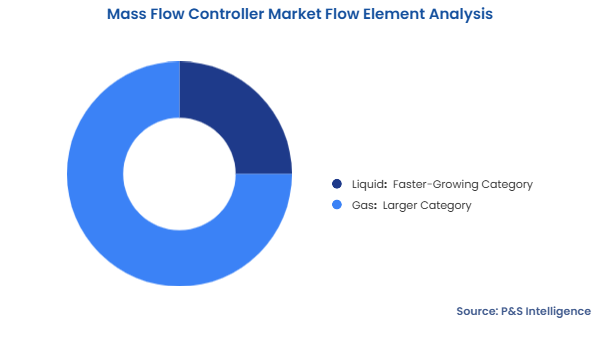
The gas category holds the larger market share, of 75%, in 2024. This is due to its role in accurately measuring and controlling the flow of gases across various industrial applications. Gas flow elements, such as orifice plates, venturi tubes, and thermal mass flow meters, are essential components for ensuring consistent and precise gas flow measurement, which is crucial in industries like oil and gas, chemical processing, and environmental monitoring.
These flow elements offer high accuracy, durability, and low maintenance, which are key factors driving their widespread adoption. They are also capable of handling a wide range of gas types, including natural gas, nitrogen, and other industrial gases, making them highly versatile for different operational requirements. Furthermore, gas flow elements can be integrated into existing systems without the need for significant infrastructure changes, providing a cost-effective solution for companies aiming to optimize their processes.
The liquid category has the higher CAGR, as mass flow controllers (MFCs) are essential for precisely managing liquid flow in various industrial processes. Their ability to maintain consistent flow rates ensures quality and repeatability in sectors such as pharmaceuticals, chemical manufacturing, food processing, and semiconductors. MFCs respond quickly to setpoint changes and are often integrated with automation systems for real-time control.
They help reduce waste, optimize resource use, and ensure product uniformity. Whether handling aggressive chemicals or ultrapure liquids, MFCs offer dependable performance. Their versatility across fluids and operating conditions makes them a preferred choice for modern liquid handling and dosing applications in demanding industrial environments.
Below are the flow elements analyzed:
Liquid (Faster-Growing Category)
Gas (Larger Category)
Flow Rate Insights
The low category accounts for the largest share in 2024. This is due to the increasing demand for precise measurement and control in industries requiring low-volume gas or liquid flows. Low-flow applications are crucial in sectors such as semiconductor manufacturing, pharmaceuticals, medical devices, and environmental monitoring, where even small variations in flow can significantly impact product quality, safety, and operational efficiency.
Technologies that can accurately measure and regulate these small flows, such as thermal mass flow controllers and diaphragm pumps are essential in maintaining optimal conditions for these sensitive processes. Furthermore, advancements in microflow technologies, which enable even finer control over flow rates, have driven the adoption of low-flow measurement solutions. As industries push for greater precision and automation in their operations, the need for low-flow measurement devices has surged.
The high category has the highest CAGR, of approx. 8.5%, as industries requiring large-volume fluid handling increasingly depend on Mass Flow Controllers (MFCs) capable of managing high flow rates with precision. These devices are critical in applications like bulk chemical delivery, fuel systems, water treatment, and industrial gas supply, where stable and accurate flow control enhances efficiency and safety.
High-flow MFCs ensure consistent process conditions even under variable pressure or temperature, reducing downtime and improving throughput. Their compatibility with control systems allows for seamless automation and scalability. As industries expand production capacities and tighten quality standards, the need for robust, high-flow MFCs that support real-time monitoring and precise delivery continues to grow.
The following flow rates are included in the report:
Low Flow (Largest Category)
Medium Flow
High Flow (Faster-Growing Category)
End User Insights
Semiconductor is the largest category, with 35% share. The global semiconductor industry is projected to reach a record capacity of 30 million wafers per month (wpm) in 2024, marking a 6.4% increase from the previous year. This expansion is driven by advancements in generative AI and high-performance computing. As fabrication plants scale, the demand for precise gas and liquid flow control intensifies. Mass flow controllers (MFCs) are integral in processes like chemical vapor deposition and atomic layer deposition, where accurate flow rates ensure consistent film quality and device performance. Their role is vital in maintaining yield and efficiency in modern semiconductor manufacturing.
The water and wastewater category are projected to grow at the highest CAGR, this growth reflects a global shift toward sustainable water management and accelerating urbanization, which has made efficient water supply and advanced wastewater treatment essential. Globally, about 360 billion m³ of wastewater is generated annually, with roughly 225 billion m³ collected and 188 billion m³ treated, though only about 40 billion m³ is intentionally reused. The remaining untreated or partially treated volume—nearly half—is often discharged into the environment.
Governments and industries are investing heavily in infrastructure to expand total installed treatment capacity. Mega-plants such as Egypt’s New Delta facility, which processes 7.5 million m³ per day, demonstrate the scale of modern systems. This expanding capacity supports regulatory compliance, operational optimization, and environmental protection.
This substantial installed base drives demand for advanced flow control and measurement solutions. These technologies enable real-time monitoring, precise control of treatment processes, and optimization of water reuse cycles—helping to reduce waste, ensure consistent quality, and meet tightening environmental standards. Rising awareness about water conservation and ecosystem health further fuels adoption of systems capable of accurately managing water and wastewater flows in large-scale industrial and municipal operations.
During the study, we have analyzed the following end users in the report:
Oil & Gas
Semiconductor (Largest Category)
Life Sciences
Chemical
Water and Wastewater (Faster-Growing Category)
Food & Beverage
Others
Drive strategic growth with comprehensive market analysis
Mass Flow Controller Market Geographical Analysis
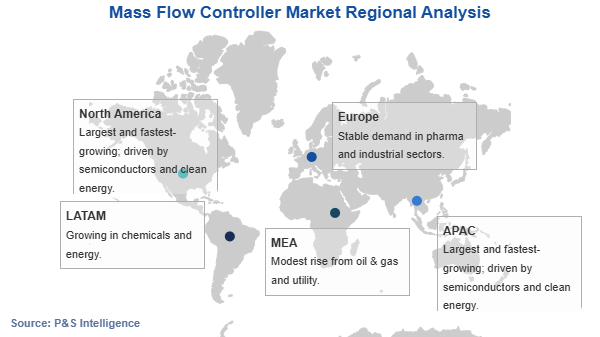
North America holds the largest market share, of 40%, in 2024. This is due to its strong economic infrastructure, advanced technological developments, and high consumer demand. The U.S., as the region's dominant economy, serves as a global hub for innovation, investment, and manufacturing. Its well-established business environment fosters market growth through substantial spending on research and development, enabling the region to stay ahead in technology-driven sectors like software, electronics, and healthcare.
Moreover, North America benefits from a high standard of living, with a large, affluent consumer base that drives demand for various products and services, from luxury goods to tech gadgets. The region’s favorable business policies, access to skilled labor, and robust supply chains also make it an attractive destination for both local and foreign companies looking to capitalize on growth opportunities.
APAC is the fastest-growing market and the Asia-Pacific region leads global semiconductor manufacturing, producing over 50% of the world’s wafers, led by China, South Korea, Taiwan, and Japan. Semiconductor wafer production in APAC has grown by more than 40% over the past five years. The chemical industry in APAC accounts for nearly 30% of global chemical production, driven mainly by China and India. The pharmaceutical sector is growing at around 8–10% annually, supported by India’s rise as a major global supplier of generic drugs and increased healthcare investments.
These expanding industries drive strong demand for precise flow control through mass flow controllers in manufacturing processes. The IEA reports that China is expected to install over 3,200 GW of renewable electricity capacity by 2030, accounting for nearly 60% of global additions. India aims to achieve 500 GW of non-fossil fuel capacity by 2030, with renewables accounting for about 485 GW.
Further, regions and countries analyzed for this report include:
Brazil (Largest and Fastest-Growing Country Market)
Mexico
Rest of LATAM
Middle East and Africa (MEA)
Saudi Arabia (Largest Country Market)
South Africa
U.A.E. (Fastest-Growing Country Market)
Rest of MEA
Mass Flow Controller Market Share
The industry is fragmented in nature. This is characterized by the presence of numerous players across various regions. This is driven by the diverse range of industries that rely on MFCs, including semiconductor manufacturing, pharmaceuticals, aerospace, automotive, and energy. Each industry requires specialized solutions, resulting in a broad spectrum of product offerings from different manufacturers. Many companies, ranging from large multinational corporations to smaller, niche players, compete to meet the specific needs of these sectors, contributing to a fragmented competitive landscape.
Key Mass Flow Controller Companies:
HORIBA Ltd.
Sensirion AG
Teledyne Technologies Incorporated
Christian B
TOKYO KEISO CO. LTD.
Axetris AG
Azbil Corporation
Sierra Instruments Inc.
Alicat Scientific Inc.
Parker-Hannifin Corporation
Vögtlin Instruments GmbH
Bronkhorst High-Tech B.V.
Mass Flow Controller Market News & Updates
In May 2025, Alicat Scientific Inc. unveiled a distinct multivariate interface for its CODA line of miniaturized Coriolis mass flow meters and controllers.
In February 2025, Festo SE & Co. KG unveiled the VEFC mass flow controller in its controlled pneumatics product line. The VEFC accurately regulates the flow of inert gases at rates of up to 200 l/min and measures 24 mm in width.
In April 2024, Bronkhorst High-Tech B.V. expanded its FLEXI-FLOW Compact series to improve precision and versatility in gas flow control and measurement.
In March 2024, Brooks Instrument LLC launched the GF120xHT Series of high-temperature thermal mass flow controllers. They are specifically engineered for use with the liquid and solid precursors consumed during semiconductor manufacturing.
In January 2024, Bronkhorst High-Tech B.V. launched the MASS-STREAM D-6400 mass flow meter and controller series. Their ISO-1179-1 inlet threads and enhanced features make them compatible with standard connectors.
Want a report tailored exactly to your business need?
Leading companies across industries trust us to deliver data-driven insights and innovative solutions for their most critical decisions. From data-driven strategies to actionable insights, we empower the decision-makers who shape industries and define the future. From Fortune 500 companies to innovative startups, we are proud to partner with organisations that drive progress in their industries.
Client Testimonials
Working with P&S Intelligence and their team was an absolute pleasure – their awareness of timelines and commitment to value greatly contributed to our project's success. Eagerly anticipating future collaborations.
McKinsey & Company
India
Unmatched Standards
Our insights into the minutest levels of the markets, including the latest trends and competitive landscape, give you all the answers you need to take your business to new heights
Complete Data Security
We take a cautious approach to protecting your personal and confidential information. Trust is the strongest bond that connects us and our clients, and trust we build by complying with all international and domestic data protection and privacy laws