Marine Engine Monitoring System Market Size & Share Analysis - Trends, Drivers, Competitive Landscape, and Forecasts (2025 - 2032)
This Report Provides In-Depth Analysis of the Marine Engine Monitoring System Market Report Prepared by P&S Intelligence, Segmented by Component (Hardware, Software, Services), Engine Capacity (Up to 500 hp, 501-1000 hp, Above 1000 hp), Engine Type (Propulsion, Auxiliary), Ship Type (Commercial, Naval Ships, Recreational), Deployment (On-board, Remote Monitoring), End User (OEM, Aftermarket), and Geographical Outlook for the Period of 2019 to 2032
Marine Engine Monitoring System Market Size Forecast
Key Highlights
Study Period
2019 - 2032
Market Size in 2024
USD 5.5 Billion
Market Size in 2025
USD 5.8 Billion
Market Size by 2032
USD 9.4 Billion
Projected CAGR
7.1%
Largest Region
North America
Fastest Growing Region
APAC
Market Structure
Fragmented
Market Size
Major Companies
Important Takeaways
Market Size and Forecast
Industry Trend
Regulatory Landscape
Demand Trend Analysis
Companies Recent Strategical Developments
Key Stakeholders
Voice of Industry Experts/KOLs
Future Opportunity
Explore the market potential with our data-driven report
Marine Engine Monitoring System Market Overview
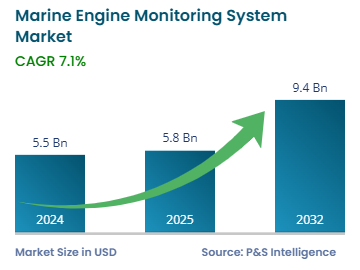
The marine engine monitoring system market size was USD 5.5 billion in 2024, and it will grow by 7.1% during 2025–2032, to reach USD 9.4 billion by 2032.
The market growth is primarily ascribed to the expanding shipping industry, growing challenges in shipping activities, increasing demand for compliance, rising need for optimized fleet management, and increasing focus on navy modernization. These systems are widely used for monitoring engine performance, preventing sudden malfunctions, and optimizing vessel efficiency.
The International Maritime Organization’s IMO 2020 sulfur cap, CII, and EEXI rules mandate marine operators to continuously monitor emissions and engine performance in real-time.
Additionally, the volatile fuel prices and the need to reduce costs have made real-time engine analysis more valuable for operators. Marine engine monitoring systems help make smart decisions on maintenance, power capacity, and efficiency. The integration of smart and advanced technologies, such as cloud-based platforms and IoT sensors, further contributes to the market growth.
Marine Engine Monitoring System Market Dynamics
Technological Advancements in Cybersecurity and Predictive Monitoring Are Key Trend
The rapid shift from traditional scheduled maintenance to predictive maintenance and advanced cybersecurity, making both a key trend in the market.
The interconnectivity of ships’ onboard computers to the shipping companies’ central control room leads to the risk of cyberattacks, which prompts companies to build more-secure systems.
A marine monitoring system integrated with advanced devices, such as IoT sensors, cloud platforms, and satellite communication provides cybersecurity.
In 2024, around 55–70% of the shipping and maritime companies invested in cybersecurity infrastructure, such as firewalls, OT protection, and encryption to safeguard performance and emission data, which is crucial for standard monitoring.
The MSC.428(98) rule of the IMO requires shipping firms to manage their cybersecurity risks with end-to-end encryption, firewalls, and other advanced tools.
In 2024, more than 55,000 cybersecurity services subscriptions were recorded, while more than 1,800 vessels faced cyberattack attempts, which highlights the need for better digital security across the global shipping industry.
These systems are widely used to analyze real-time and historical data, to identify equipment breakdowns and minimize operational disruption.
Traditional maintenance methods can only prevent 23% of the failures, while predictive maintenance approaches can prevent nearly 77%.
This development is vital for large commercial fleets as a sudden failure can lead to major financial and functional damage.
Companies such as MAN Energy and Wartsila, are heavily investing in smart engine monitoring systems.
According to a Wärtsilä report, an AI-powered monitoring engine can reduce fuel costs by 10% and offer savings of up to 25% on maintenance costs.
As per a report, predictive maintenance systems can reduce 50% of the unplanned marine engine downtime.
In 2024, around 2% of the classed vessels have integrated full predictive maintenance globally.
Expansion of Global Shipping Industry Is Biggest Driver
The growth of the global shipping industry, driven by the increasing demand across all major maritime sectors, including cruises, trade, fishing, and recreational boating, is the key driver got the market.
As per the UNCTAD, over 80% of the international trade, by volume of goods, is accomplished via the sea.
As per UNCTAD, in 2024, the global commercial fleet comprised more than 102,000 vessels, including tankers, container ships, and bulk carriers.
All of those require advanced engine monitoring to reduce fuel use, downtime, and emissions.
According to the FAO, the global fishing fleet includes over 4.9 million vessels, around 3.3 million of which are motorized.
Many have digital monitoring solutions to manage fuel efficiency and ensure sustainable operations.
In 2023, approximately 12 million recreational boats were registered in the U.S., reflecting a strong demand for user-friendly engine monitoring systems in personal and leisure boats.
According to the FAO, around 61% of motorized fishing vessels globally have engines under 50 kW, reflecting a strong demand for simple and affordable monitoring technologies in small-scale coastal fleets.
As per the European Commission, maritime transport handles around 75% of the EU’s external and 31% of internal trade.
This drives the adoption of digital tools like engine monitoring systems to meet European Green Deal goals.
Marine Engine Monitoring System Market Segmentation Analysis
Component Analysis
The hardware category held the largest market share, of 65%, in 2024 due to the rising demand for robust sensors, control units, and measurement systems for live engine monitoring. Ships rely on sensors, control modules, and data acquisition to monitor different parameters, such as temperature, RPM, and emissions.
The software category will have the highest CAGR, because of the rising usage of advanced analytics, proactive maintenance, and web-based platforms. OEMs and fleet operators are investing in software-driven systems, including online dashboards and remote problem-solving, for turning raw data into useful information, for smart decisions.
The components analyzed in this report are:
Hardware (Largest Category)
Sensors
Control Modules
Data Acquisition Systems
Software (Fastest-Growing Category)
Services
Engine Capacity Analysis
The up to 500 hp category held the largest market share, of 60%, in 2024, due to the broad usage of small engines in coastal vessels, fishing boats, ferries, recreational craft, and tugboats. These vessels operate in coastal zones and have a robust demand for engine monitoring systems to maintain fuel efficiency. These systems are widely used for live maintenance alerts and for safe operations.
The 501–1,000 hp category will have the highest CAGR. These engines operate medium-sized ships, such as offshore support vessels, which have a rising demand for controlling and monitoring heavy-duty marine engines. They also face strict international rules and take a long time, which increases the need for an advanced system to regulate engine health and control pollution. Moreover, these ships are used for retrofits and new build programs.
The engine capacities analyzed in this report are:
Up to 500 hp (Largest Category)
501–1,000 hp (Fastest-Growing Category)
Above 1,000 hp
Engine Type Analysis
The auxiliary category held the larger market share, of 80%, in 2024, and it will have the higher CAGR. This is driven by the growing number of cruise vessels, passenger ships, and private boats, on which managing the onboard electrical, navigation, and HVAC systems is important. These engines are crucial for ensuring proper power supply and sustaining essential vessel operations, even with a propulsion shutdown. The rising need for hybrid and electric engines also increases the demand for auxiliary engine monitoring systems.
The engine types analyzed in this report are:
Propulsion
Auxiliary (Larger and Faster-Growing Category)
Ship Type Analysis
The commercial category held the larger market share, of 75% in 2024, due to the rising demand for monitoring systems in commercial vessels for better safety and efficiency. Cargo ships, tankers, and container carriers operate globally and depend on engine monitoring systems to enhance fuel efficiency and minimize extended voyages. According to the International Chamber of Shipping, commercial vessels carry about 80% of global trade by volume, driving strong demand for engine monitoring systems to reduce fuel costs and emissions.
The naval category will have the highest CAGR, due to the increasing defense budget and modernization programs in various countries, such as India, China, and the U.S. The U.S. Navy’s digital transformation programs and push for integrated power systems in next-generation ships drive the use of MEMS for energy optimization.
The ship types analyzed in this report are:
Commercial (Largest Category)
Naval (Fastest-Growing Category)
Recreational
Deployment Analysis
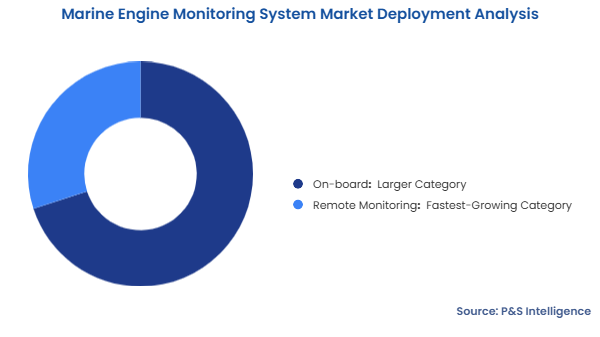
The on-board category held the larger market share, of 70% in 2024, because most vessels depend on physical and on-site engine diagnostic systems. The ship crews can directly access real-time readings, safety alarms, and operational continuity in the absence of any communications network.
The remote monitoring category will have the higher CAGR, due to the rapid progress in satellite communication, 5G, and IoT sensor technologies. Fleet owners and technical teams conduct real-time monitoring of engine conditions, fuel performance, and diagnostics from shore-based centers. This allows for real-time decision-making and predictive maintenance for the whole fleet.
The deployments analyzed in this report are:
On-board (Larger Category)
Remote Monitoring (Fastest-Growing Category)
End User Analysis
The OEM category held the larger market share, of 85% in 2024, as they can be directly integrated by engine or vessel manufacturers on new-build production. The OEM-installed systems are factory-integrated, thus assuring performance and compliance.
The aftermarket category will have the higher CAGR, due to the increasing number of retrofit and upgrade projects on existing vessels. Shipowners are looking to extend vessel lifespans, upgrade compliance, and implement new digital capabilities for the engine monitoring system. Moreover, the strict environmental rules and global fleet age increase the demand to upgrade older ships with modern monitoring technologies.
The end users analyzed in this report are:
OEM (Larger Category)
Aftermarket (Faster-Growing Category)
Drive strategic growth with comprehensive market analysis
Marine Engine Monitoring System Market Regional Outlook
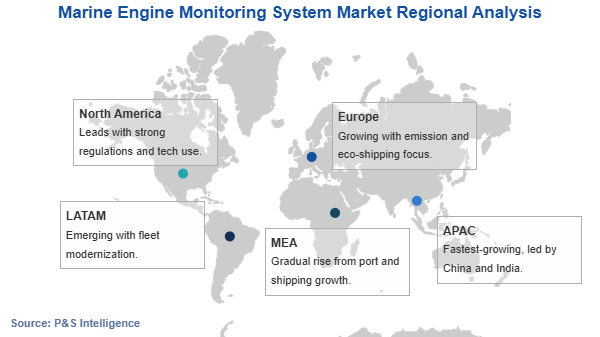
North America held the largest market share, of 40%, in 2024, due to its developed maritime infrastructure, stringent environmental policies, such as CARB and EPA Tier 4, and strong government funding for digitalization and predictive maintenance initiatives. In 2023, the U.S. Maritime Administration awarded more than USD 653 million in Port Infrastructure Development Program grants for 41 port improvement projects. This investment is aimed at enhancing automation, reducing emissions, and modernizing ship-handling systems. Additionally, the presence of OEMs and advanced naval fleets in the U.S. has led to the early usage of MEMS for defense and commercial applications.
Asia-Pacific will have the highest CAGR, due to the modernization of shipbuilding in China, Japan, and South Korea with a focus on a higher level of digitalization and better regulatory compliance. China and India are expanding their naval fleets and investing in small ports and digital technologies. China’s Green Shipbuilding Policy and India’s Sagarmala initiative increase the demand for energy-efficient and emission monitoring systems. According to the Ministry of Ports, Shipping and Waterways, India operates 12 major ports and over 200 non-major ports. As per MIIT and CCTV, in 2024, China secured about 75% of global green ship orders by deadweight tonnage (DWT), confirming its lead in eco-friendly shipbuilding.
The geographical breakdown of the market is as follows:
North America (Largest Regional Market)
North America (Larger Country)
Canada (Faster-Growing Country)
Europe
Germany (Largest Country)
U.K. (Fastest-Growing Country)
France
Italy
Spain
Rest of Europe
Asia-Pacific (Fastest-Growing Regional Market)
China (Largest Country)
India (Fastest-Growing Country)
Japan
South Korea
Australia
Rest of APAC
Latin America
Brazil (Largest Country)
Mexico (Fastest-Growing Country)
Rest of LATAM
Middle East and Africa
Saudi Arabia (Largest Country)
South Africa
U.A.E. (Fastest-Growing Country)
Rest of MEA
Marine Engine Monitoring System Market Competitive Landscape
The market is fragmented due to the presence of large global and regional players providing solutions based on the design of the ship, propulsion type, and deployment modes. Additionally, many companies provide their own systems, which further contributes to the market fragmentation. Different ships have different needs, and regions use these systems based on technology and fuel costs. As a result, no company dominates the market, and it is highly competitive.
Key Marine Engine Monitoring System Companies:
CMR Group SAS
Caterpillar Inc.
Cummins Inc.
Emerson Electric Co.
Hyundai Heavy Industries Co., Ltd.
Kongsberg Gruppen ASA
MAN Energy Solutions SE
Mitsubishi Heavy Industries, Ltd.
Noris Group GmbH
Rolls-Royce Holdings plc
Wärtsilä Corporation
ABB Ltd
Marine Engine Monitoring System Market News
In March 2025, Rolls-Royce plc and the Singapore Institute of Technology partnered to enhance equipment health management for self-driving vessels and hybrid propulsion engines using predictive diagnostic monitoring.
In September 2024, Wärtsilä Corporation and Qatar Shipyard Technology Solutions signed an MoU to collaborate on retrofits, maintenance, and the reduction of carbon emissions. This also includes support for dual-fuel engines and hybrid systems using Wartsila technologies.
In September 2024, Wärtsilä Corporation and Chevron Corporation collaborated to shift six ship engines from dual-fuel to spark-ignited gas engines, aiming to reduce methane emissions and improve monitoring systems.
In October 2023, MAN Energy Solutions and Spire Global partnered to integrate satellite weather and AIS data into the MAN-CEON digital platform. This aims to boost the live-engine performance and reduce the carbon footprint.
Want a report tailored exactly to your business need?
Leading companies across industries trust us to deliver data-driven insights and innovative solutions for their most critical decisions. From data-driven strategies to actionable insights, we empower the decision-makers who shape industries and define the future. From Fortune 500 companies to innovative startups, we are proud to partner with organisations that drive progress in their industries.
Client Testimonials
Working with P&S Intelligence and their team was an absolute pleasure – their awareness of timelines and commitment to value greatly contributed to our project's success. Eagerly anticipating future collaborations.
McKinsey & Company
India
Unmatched Standards
Our insights into the minutest levels of the markets, including the latest trends and competitive landscape, give you all the answers you need to take your business to new heights
Complete Data Security
We take a cautious approach to protecting your personal and confidential information. Trust is the strongest bond that connects us and our clients, and trust we build by complying with all international and domestic data protection and privacy laws