Managed Service Market Size & Share Analysis - Emerging Trends, Growth Opportunities, Competitive Landscape, and Forecasts (2026 - 2032)
This Report Provides In-Depth Analysis of the Managed Service Market Report Prepared by P&S Intelligence, Segmented by Service Type (Managed Infrastructure, Managed Security, Managed Data Center, Managed Network, Managed Communication & Collaboration, Managed Mobility), Enterprise Size (Large Enterprises, SMEs), Industry (BFSI, Healthcare, IT & Telecom, Government, Manufacturing, Retail), and Geographical Outlook for the Period of 2021 to 2032
Explore the market potential with our data-driven report
Managed Service Market Future Prospects
Managed Service Market Key Insights
Managed infrastructure accounted for the largest share, of 35%, in 2025.
SMEs are the faster-growing category during 2026–2032, at a CAGR of approximately 11.3%.
The BFSI sector accounted for the largest share, of 35%, in 2025.
North America held the largest share, of 40%, in 2025.
Asia-Pacific is the fastest-growing region, at a CAGR of approximately 11.6%, during 2026–2032.
Managed Service Market Future Outlook
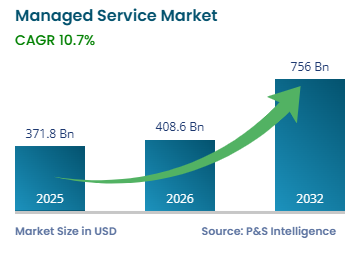
The global managed service market stood at USD 371.8 billion in 2025 and is projected to reach USD 756.0 billion by 2032, expanding at a CAGR of 10.7% over 2026–2032. This growth is driven by the accelerating shift among enterprises from capital-intensive in-house IT operations toward outcome-based outsourcing models, as organizations seek to optimize infrastructure costs, close cybersecurity skill gaps, and accelerate digital transformation without proportionally scaling internal headcount.
The escalating financial consequences of cyber threats are reinforcing enterprise reliance on managed security services in particular. The IBM Cost of a Data Breach Report 2024 found that the global average cost of a data breach reached USD 4.88 million in 2024, a 10% increase from the prior year and the steepest rise since the pandemic. Organizations across BFSI, healthcare, and manufacturing are responding by outsourcing continuous threat monitoring and incident response to specialized providers. The widespread migration to hybrid and multi-cloud environments is creating sustained demand for managed infrastructure and network services. Internal IT teams lack the breadth of expertise required to govern heterogeneous technology estates spanning on-premise systems, private clouds, and multiple public cloud platforms.
Managed Service Market Trends and Drivers
AI Integration and AIOps Adoption Are Major Trends in Market
The integration of artificial intelligence and machine learning into managed service delivery represents the key trend in the market. MSPs are deploying AIOps platforms, which combine big data analytics, machine learning, and automation to streamline IT operations, to transition from reactive, ticket-driven service models toward predictive and autonomous operations. This shift enables MSPs to detect anomalies, forecast infrastructure failures, and initiate automated remediation before clients experience disruption. This fundamentally alters the value proposition from cost arbitrage to proactive business continuity.
The practical effect on service economics is considerable. AI-enabled threat detection, automated patch management, and intelligent ticketing are compressing resolution times and reducing the manual labor intensity of managed services delivery. This allows MSPs to serve larger client bases without proportional headcount growth. The World Economic Forum estimates that 97 million new roles could emerge globally by 2025 due to the evolving division of labor between humans, machines, and algorithms. This reflects the scale of workforce restructuring underway across technology-intensive industries as automation absorbs routine operational tasks.
Providers that successfully embed generative AI into service orchestration and client-facing support interfaces are gaining measurable margin advantages over peers still relying on labor-intensive delivery models. Hyperscalers including Microsoft Azure, Google Cloud, and Amazon Web Services are integrating AI-native management tooling into their platforms. MSPs must deepen their AI capabilities to maintain differentiation, establishing automation maturity as a primary competitive axis through the forecast period.
Escalating Cybersecurity Threats and Workforce Shortages Drive Market
The structural inability of most organizations to build and sustain adequate in-house security operations is the most direct and durable driver of managed security services growth. The ISC2 2024 Cybersecurity Workforce Study found that the global cybersecurity workforce gap reached 4.8 million professionals, a 19% increase year-over-year. 67% of the organizations reported active staffing shortages, with 58% stating that skills gaps place their organization at significant risk.
As cyber threats grow in sophistication, organizations face escalating security obligations that their internal teams are increasingly unable to satisfy. Ransomware, supply chain attacks, and AI-assisted phishing are expanding attack surfaces. Rising threat severity, widening talent deficits, and quantifiable breach cost consequences are compelling organizations to engage managed security providers offering 24/7 SOC operations, automated incident response, and compliance reporting. These services cost multiples more to replicate internally, and demand is strongest across the BFSI, healthcare, and manufacturing sectors.
SME Digitalization Offers Market Opportunities Worldwide
Small and medium enterprises represent the key market opportunity. The structural misalignment between SMEs' accelerating digital adoption and their limited internal IT capabilities is the foundation of this opportunity. The OECD Digital for SMEs (D4SME) Survey 2024 highlights that SMEs often face limited internal capabilities—such as skills gaps and resource constraints—which act as key barriers to digital adoption and may increase reliance on external support. The rising complexity of cybersecurity, cloud management, and data analytics creates growing demand for packaged managed services.
MSPs are offering standardized, subscription-based service bundles covering endpoint management, SOC access, backup and recovery, and network monitoring at affordable rates. This enables MSPs to pursue volume-based growth strategies across thousands of SME clients, creating recurring revenue streams with high retention characteristics. The opportunity will expand as governments implement digital SME support programs and cybersecurity and data protection regulations increasingly apply to smaller organizations that lack internal compliance infrastructure.
Data Sovereignty and Regulatory Fragmentation Constrain Market Growth
The proliferation of data localization mandates and jurisdiction-specific regulatory frameworks constrains the efficiency and scalability of global managed services delivery. The EU's General Data Protection Regulation, China's Data Security Law and Personal Information Protection Law, India's Digital Personal Data Protection Act, 2023, and various national cloud sovereignty requirements regulate and impose conditions on cross-border data flows that underpin centralized managed services delivery models. MSPs serving multinational clients must replicate infrastructure, security controls, and compliance capabilities across jurisdictions. The resulting increase in capital requirements, operational complexity, and service delivery costs erodes the margin advantages that scale would otherwise provide.
This fragmentation is intensifying as more governments introduce data residency requirements, creating compliance complexity that disproportionately affects MSPs lacking regional infrastructure investments. Providers without pre-established in-country delivery capabilities face extended sales cycles and disqualification from public sector and regulated industry contracts in key markets. Sovereign cloud partnerships with hyperscalers offer a partial mitigation path, but the fundamental tension between global delivery efficiency and local regulatory compliance will remain persistent. Regulatory divergence between major markets including the U.S., EU, and China continues to widen.
Managed Service Market Segmentation Analysis
Service Type Analysis
Managed infrastructure accounted for the largest share, of 35%, in the global managed services market in 2025. The universal requirement for server, storage, virtualization, and data center operations management at scale underpins this position. Organizations across industries face increasing complexity in heterogeneous IT estates combining legacy on-premise systems with private and multi-cloud environments, creating continuous oversight requirements that internal teams are structurally unable to meet efficiently. Client dependence on infrastructure uptime is deep, where outages translate directly into business disruption and financial loss, producing high-switching-cost engagements with long contract durations. The World Economic Forum notes that by 2030, 92 million digital jobs globally will be performable remotely. This reinforces the long-term need for resilient, managed infrastructure to support distributed enterprise operations.
Managed security is expected to register the highest growth rate during 2026–2032, of approximately 11.0%. Escalating cyber threats, widening cybersecurity talent gaps, and tightening regulatory mandates are converging to propel this growth. The European Union Agency for Cybersecurity (ENISA) confirms that ransomware remained the most prominent cyber threat across EU member states in 2024. This directly drives demand for managed detection and response services that in-house teams cannot deliver continuously.
The market segments into the following service types:
Managed Infrastructure (Largest Category)
Managed Security (Fastest-Growing Category)
Managed Data Center
Managed Network
Managed Communication & Collaboration
Managed Mobility
Others
Enterprise Size Analysis
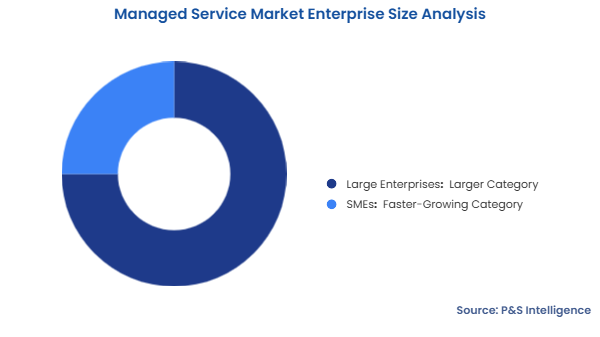
Large enterprises accounted for the larger share, of 75%, in the global managed services market in 2025. The scale and complexity of enterprise IT environments generate managed services requirements that are too broad for internal teams to handle comprehensively and too sensitive to risk coverage gaps. IT environments spanning multiple geographies, business units, and technology stacks drive this structural dependence. Large enterprises carry the highest compliance obligations across GDPR, HIPAA, SOX, and sector-specific regulatory frameworks and engage MSPs to ensure continuous adherence without proportionally scaling internal compliance headcount. The OECD observes that large firms consolidate IT systems through cloud computing services more proactively than smaller counterparts, driving managed services contract value through complex, multi-year engagements.
SMEs are the faster-growing category during 2026–2032. Standardized, subscription-based managed service bundles bring enterprise-grade IT management within reach of organizations with limited budgets. The OECD D4SME Survey 2025 highlights that a lack of talent and skills, along with limited time for training, are key bottlenecks to SME digitalization, often increasing reliance on external technology partners and service providers.
The market segments into the following enterprise sizes:
Large Enterprises (Larger Category)
SMEs (Faster-Growing Category)
Industry Analysis
The BFSI sector accounted for the largest share in the global managed services market in 2025. Banking, financial services, and insurance institutions operate technology estates with the most demanding uptime, security, and regulatory compliance requirements of any industry. These requirements drive managed service spending on infrastructure management, 24/7 SOC operations, identity and access management, and compliance reporting. Real-time payment systems, digital banking platforms, and open banking API ecosystems require continuous managed oversight that financial institutions increasingly source from specialist MSPs. India's Ministry of Finance, in its 2024 Digital Threat Report for BFSI, underscored that cybersecurity is the foundation of financial stability in the digital age. This reinforces the regulatory and institutional imperative driving BFSI entities globally to engage managed security and compliance services.
Healthcare is the fastest-growing category during 2026–2032, registering a CAGR of approximately 11.5%. The rapid digital transformation of clinical and administrative operations is the structural foundation of this growth. Telemedicine infrastructure, EHRs, connected diagnostic devices, and remote patient monitoring platforms require managed IT services to ensure availability, security, and regulatory compliance. The World Health Organization reports that 84% of countries in Europe use teleradiology, while approximately 77% have adopted telemedicine or remote patient monitoring technologies. This reflects the scale of digital health infrastructure now requiring continuous managed oversight across healthcare systems globally.
The market segments into the following industries:
BFSI (Largest Category)
Healthcare (Fastest-Growing Category)
IT & Telecom
Government
Manufacturing
Retail
Others
Drive strategic growth with comprehensive market analysis
Managed Service Market Geographical Analysis
North America Managed Services Market Outlook
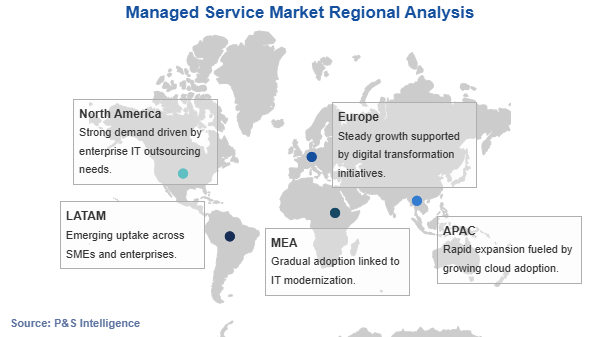
North America held the largest share, of 40%, in the global managed services market in 2025. Federal and state-level government digitalization mandates are accelerating managed services adoption across public sector, defense, and healthcare verticals.
The United States is the primary growth engine. The world's largest concentration of managed service providers, a mature enterprise IT ecosystem, and substantial cybersecurity outsourcing demand underpin this position. The scale of the IT sector creates an unmatched pipeline of large enterprise clients with complex, multi-vendor IT environments requiring ongoing managed oversight. Canada is the fastest-growing country market within the region. Expanding cloud adoption, a growing cybersecurity regulatory framework, and active investment in AI-enabled IT operations are driving this trajectory.
U.S. Managed Services Market Growth
The U.S. is the largest single-country market globally. A high concentration of Fortune 500 enterprises with multi-cloud hybrid environments requiring 24/7 managed oversight and a structural cybersecurity labor shortage are pushing demand toward outsourced security operations centers. The IBM Cost of a Data Breach Report 2024 found that U.S. organizations faced average breach costs of USD 9.36 million, nearly double the global average. This makes managed security services an economic imperative rather than a discretionary spend.
Large federal contracts reflect the growing role of managed services in mission-critical public sector IT, reinforcing the U.S. market's structural depth. Accenture Federal Services received a USD 1.6 billion Cloud One task order from the U.S. Air Force in October 2024.
Europe Managed Services Market Analysis
Europe represented the second-largest regional market in 2025. The EU's General Data Protection Regulation (GDPR) and the NIS2 Directive have significantly expanded cybersecurity and data protection obligations across member states, with NIS2 alone expected to cover more than 160,000 entities. This is compelling organizations to engage managed security providers capable of delivering continuous compliance monitoring and incident reporting within prescribed timeframes.
Germany Managed Services Market Share
Germany holds the largest country share within the region. Manufacturers are increasingly outsourcing IT infrastructure and operational technology management to free internal resources for Industry 4.0 initiatives, reflecting the country's large industrial base. Growing complexity in IT environments, talent shortages, and a shift toward cloud-native architectures are driving adoption across the country's enterprise base.
UK Managed Services Market Scenario
The U.K. is the fastest-growing country market within Europe. Active government cloud adoption programs and a competitive MSP ecosystem provide the structural foundation. Increasing reliance on cloud technologies, cybersecurity challenges, and skills shortages are driving businesses to outsource complex IT functions, improving resilience, scalability, and innovation capacity.
Asia-Pacific Managed Services Market Forecast
Asia-Pacific is the fastest-growing region, registering a CAGR of approximately 11.6% during 2026–2032. Accelerating digitalization across manufacturing, financial services, and public sector verticals in China, India, and Southeast Asia is driving this growth. Hyperscaler partnerships with local MSPs to address sovereign cloud requirements across Japan, South Korea, and Australia are further shaping service delivery architectures across the region.
China Managed Services Market Trends
China dominates the market in Asia-Pacific. The government's sustained investment in digital infrastructure and a broad cloud-first mandate applied across state-owned enterprises and public institutions underpin this position. Domestic technology conglomerates including Alibaba Cloud, Huawei Cloud, and Tencent Cloud are expanding managed service portfolios to capture enterprise outsourcing demand generated by China's growing manufacturing and BFSI sectors. Government-mandated data localization requirements under the Cybersecurity Law and Data Security Law drive demand for domestic MSPs capable of delivering compliant infrastructure management. This limits the addressable market for international providers while reinforcing the position of China-based managed services specialists. Demand for managed network, security, and data center services is expected to sustain as hybrid cloud adoption expands across the country's large enterprise base.
India Managed Services Market Dynamics
India is the fastest-growing market within Asia-Pacific. Rapid digital infrastructure expansion, a growing base of technology-intensive enterprises, and government-led programs accelerating cloud and IT services adoption across public and private sectors are driving this position. The Digital India initiative has catalyzed broadband penetration, cloud migration, and digital services adoption, creating sustained downstream demand for managed IT services across the healthcare, banking, and manufacturing verticals. The estimates from MeitY and NASSCOM indicate that India’s digital economy is expected to reach approximately USD 1 trillion by 2030, supporting its emergence as a high-growth market for managed services.
India's dual role as a major consumer and global delivery hub for managed services further drives the market. Domestic enterprises are increasingly outsourcing IT operations to MSPs, while global providers continue to expand delivery centers in Bengaluru, Hyderabad, and Pune to serve international clients. This reinforces India's structural importance to the global managed services value chain.
Latin America Managed Services Market Trends
Latin America represented a smaller but steadily expanding share of the global market in 2025. This underscores the long-term growth runway for managed services across the region. Brazil's dominance in the regional market reflects its scale as the largest economy in Latin America and the highest concentration of large enterprises actively pursuing cloud migration and cybersecurity outsourcing. Mexico is the fastest-growing country market. Expanding nearshore IT services activity, rising foreign direct investment in manufacturing and technology sectors, and growing SME digitalization demand are driving this trajectory.
Middle East & Africa Managed Services Market Dynamics
The Middle East & Africa region is experiencing expanding managed services adoption. Government-led smart city initiatives and national digital transformation strategies across the Gulf Cooperation Council are the structural foundation of this growth. The UAE is the largest country market in the region, with Dubai and Abu Dhabi functioning as regional technology hubs. The UAE government's proactive cloud adoption policies under its National Cloud Computing Strategy reinforce this position.
South Africa is the fastest-growing country market. Increasing enterprise digitalization, expanding data center infrastructure, and rising cybersecurity outsourcing demand across the banking and telecommunications sectors are driving adoption. Hyperscalers including Microsoft, Amazon Web Services, and Google Cloud are expanding data center capacity across the region.
These regions and countries are covered:
North America (Largest Region)
U.S. (Largest Country Market)
Canada (Fastest-Growing Country Market)
Europe
Germany (Largest Country Market)
U.K. (Fastest-Growing Country Market)
France
Italy
Spain
Rest of Europe
Asia-Pacific (Fastest-Growing Region)
China (Largest Country Market)
India (Fastest-Growing Country Market)
Japan
South Korea
Australia
Rest of APAC
Latin America
Brazil (Largest Country Market)
Mexico (Fastest-Growing Country Market)
Rest of LATAM
Middle East & Africa
Saudi Arabia
South Africa (Fastest-Growing Country Market)
U.A.E. (Largest Country Market)
Rest of MEA
Managed Service Market Share
The global managed services market exhibits a moderately fragmented competitive structure, where no single provider commands a dominant share across all service categories, geographies, and end-use verticals. Managed infrastructure, security, network, communications, and mobility services involve distinct technical competencies, regulatory requirements, and customer relationships that structurally resist consolidation under a single provider. Economies of scale favor large, diversified providers in enterprise-facing segments, while specialization and geographic proximity retain competitive relevance in SME-focused and country-specific segments.
Global technology conglomerates coexist with regional specialists and vertical-focused players across a market too broad for consolidation into a narrow oligopoly. Competitive differentiation is increasingly defined by AI-enabled service delivery capabilities, hyperscaler partnership depth, and demonstrated vertical compliance expertise. This is most pronounced in the BFSI and healthcare sectors, where regulatory complexity raises switching costs and creates durable client relationships.
Top Companies in the Managed Service Market:
Accenture plc
IBM Corporation
Microsoft Corporation
Cisco Systems Inc.
DXC Technology Company
Tata Consultancy Services Limited (TCS)
Fujitsu Limited
HCL Technologies Limited
Wipro Limited
Infosys Limited
Capgemini SE
Atos SE
NTT DATA Corporation
Verizon Communications Inc.
AT&T Inc.
Rackspace Technology Inc.
CGI Inc.
Secureworks Inc.
GTT Communications Inc.
Unisys Corporation
Tech Mahindra Limited
Managed Service Market News
In November 2025, Capgemini SE acquired Cloud4C, an automation-driven managed cloud services provider with a 1,600-member delivery team, to expand its hybrid, private, public, and sovereign cloud managed services portfolio and strengthen AI-enabled SAP cloud migration capabilities for enterprise clients globally.
In June 2025, HCL Technologies Limited launched a managed Secure Service Edge solution developed with Cisco Systems Inc., combining 24/7 security operations center support with advanced threat detection capabilities. The launch targets reduced cybersecurity incident response times for enterprise clients across regulated industries.
In February 2025, IBM Corporation completed its USD 6.4 billion acquisition of HashiCorp, integrating Terraform infrastructure automation and Vault identity-based security tools into its hybrid cloud platform to deliver end-to-end multi-cloud infrastructure management for enterprise managed services clients.
In October 2024, Accenture plc was awarded a task order of up to USD 1.6 billion by the U.S. Air Force to scale and manage its multi-cloud Cloud One environment. Accenture will act as a managed service provider for cloud account services and deliver automated financial management capabilities across the department's enterprise IT infrastructure.
In September 2024, NTT DATA Corporation and IBM Corporation jointly launched SimpliZCloud, a fully managed cloud service built on IBM's LinuxONE platform. The product targets mission-critical workloads in financial services to deliver high availability, AI/ML application support, and subscription-based hybrid cloud adoption for large enterprise clients.
In September 2024, Tata Consultancy Services Limited launched two AI-powered cybersecurity managed services, Managed Detection and Response and Secure Cloud Foundation, developed in collaboration with Google Cloud. The suites provide continuous threat detection and cloud security governance for enterprise clients across hybrid environments.
Frequently Asked Questions About This Report
What will be the managed services market 2032 size?+
In 2032, the market for managed services will value USD 756.0 billion.
Which service type leads the managed service industry?+
Managed infrastructure dominates the managed service industry with 35% revenue.
Which is the largest region in the managed services market?+
North America is the largest market for managed service, with 40% share.
What are the key managed services industry drivers?+
The global managed service industry is driven by growing cloud adoption, increasing IT infrastructure complexity, rising cybersecurity concerns, shortage of skilled IT professionals, need for cost optimization, and focus on digital transformation.
What is the managed services market nature?+
The market for managed services is moderately fragmented.
Want a report tailored exactly to your business need?
Leading companies across industries trust us to deliver data-driven insights and innovative solutions for their most critical decisions. From data-driven strategies to actionable insights, we empower the decision-makers who shape industries and define the future. From Fortune 500 companies to innovative startups, we are proud to partner with organisations that drive progress in their industries.
Client Testimonials
Working with P&S Intelligence and their team was an absolute pleasure – their awareness of timelines and commitment to value greatly contributed to our project's success. Eagerly anticipating future collaborations.
McKinsey & Company
India
Unmatched Standards
Our insights into the minutest levels of the markets, including the latest trends and competitive landscape, give you all the answers you need to take your business to new heights
Complete Data Security
We take a cautious approach to protecting your personal and confidential information. Trust is the strongest bond that connects us and our clients, and trust we build by complying with all international and domestic data protection and privacy laws