Lung Cancer Screening Market Size & Opportunities Analysis - Growth Strategies, Competitiveness, and Forecasts (2026 - 2032)
This Report Provides In-Depth Analysis of the Lung Cancer Screening Market Report Prepared by P&S Intelligence, Segmented by Cancer Type (Non-Small Cell Lung Cancer, Small Cell Lung Cancer), Technology (Low-Dose, Chest X-Ray, Liquid Biopsy), Sample Type (Tissue Biopsies, Fine-Needle Aspirates, Liquid Biopsy), Age Group (50 and Older, Below 50), Patient Type (Male, Female), End User (Hospitals & Clinics, Diagnostics Centers), and Geographical Outlook for the Period of 2019 to 2032
Explore the market potential with our data-driven report
Lung Cancer Screening Market Overview
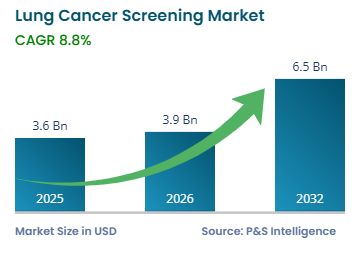
The global lung cancer screening market size will be USD 3.6 billion in 2025, which is predicted to reach USD 6.5 billion by 2032, growing at a CAGR of 8.8% during 2026–2032.
The market growth is primarily driven by the rising incidence of lung cancer worldwide, increasing government initiatives for early detection programs, and technological advancements in screening modalities.
Lung cancer remains the leading cause of cancer-related mortality globally. According to the International Agency for Research on Cancer, approximately 2.5 million people were diagnosed with lung cancer in 2022 and more than 1.8 million people died from the disease. The high mortality rate has intensified focus on early detection methods, as screening with low-dose computed tomography can reduce lung cancer death rates by up to 20% when implemented in high-risk populations. The implementation of structured screening programs across North America and pilot initiatives across Europe is expanding access to life-saving early detection technologies.
The growing adoption of low-dose CT screening represents a major shift in lung cancer management. The U.S. Preventive Services Task Force updated its guidelines in 2021 to expand eligibility criteria, enabling more individuals at high risk to access screening services. Additionally, emerging technologies such as liquid biopsy and artificial intelligence-assisted imaging interpretation are enhancing screening accuracy and workflow efficiency.
Lung Cancer Screening Market Growth Factors
Technological Advancements in Imaging and AI Integration Are Key Trends
Increasing use of low-dose CT (LDCT) has significantly improved early detection accuracy while minimizing radiation exposure.
Artificial intelligence (AI) algorithms are being integrated into imaging workflows to automatically detect lung nodules, reducing diagnostic time and supporting radiologists.
AI-driven computer-aided detection (CAD) systems enhance precision by distinguishing benign from malignant nodules, lowering false positives and unnecessary biopsies.
NHS England is funding the AI Research Screening Platform (AIR-SP) with around GBP 6 million to support large-scale testing and validation of AI screening tools across NHS trusts
Advanced imaging software now enables 3D reconstruction and volumetric nodule measurement, improving tumor monitoring and treatment planning.
Integration of machine learning improves risk stratification by analyzing patient history, smoking exposure, and imaging patterns together.
Cloud-based image sharing platforms support remote consultations and tele-radiology, improving access in rural and underserved regions.
Hybrid imaging systems, such as PET–CT and PET–MRI, provide both functional and anatomical insights, improving staging and treatment response evaluation.
Expanding Eligibility Criteria for Screening Programs Is a Major Growth Driver
Governments and health agencies are lowering the age threshold and reducing minimum smoking history requirements, allowing more high-risk individuals to qualify for screening.
In June 2023, the UK Department of Health and Social Care approved a national targeted lung cancer screening programme for people aged 55–74 with a history of smoking.
This is estimated to cost around GBP 270 million per year once fully rolled out and is expected to deliver nearly 1 million low-dose CT scans annually.
Broader eligibility criteria mean more people are identified early, increasing the number of screening procedures performed each year.
Public health bodies are now, including former smokers and moderate smokers, rather than only heavy current smokers, which widens the screening population base.
The Centers for Medicare & Medicaid Services (CMS) expanded coverage for annual low-dose CT lung cancer screening to individuals aged 50–77 years with a 20-pack-per-year smoking history who currently smoke or quit within the past 15 years.
Expansion of screening to underserved and rural populations is improving access, supported by mobile scanning units and outreach programs.
By screening more individuals at earlier disease stages, healthcare systems are increasing the adoption of LDCT scans, boosting demand for imaging technologies and workflows.
Lung Cancer Screening Market Segmentation Analysis
Cancer Type Insights
The non-small cell lung cancer segment holds the larger share in the lung cancer screening market in 2025, of 70%, due to the significantly higher prevalence of NSCLC compared to other lung cancer types. NSCLC encompasses multiple histological subtypes, including adenocarcinoma, squamous cell carcinoma, and large cell carcinoma, with adenocarcinoma being the most-common subtype globally. According to the American Society of Clinical Oncology, NSCLC is the most-common type of lung cancer in the U.S., accounting for 81% of all lung cancer diagnoses.
The small cell lung cancer segment is expected to witness the higher CAGR of 9.2% during 2026–2032. Despite representing only 13 to 15% of lung cancer cases, SCLC presents unique screening challenges and opportunities. SCLC typically manifests as central lesions and demonstrates rapid growth with early metastatic spread, characteristics that complicate early detection efforts. However, increasing recognition that even small improvements in early SCLC detection can dramatically impact survival outcomes is driving research into specialized screening approaches for this aggressive cancer subtype. Advances in biomarker-based detection methods and refined imaging protocols show promise in identifying SCLC at earlier stages when chemotherapy and immunotherapy combinations remain effective treatment options.
These cancer types are covered:
Non-Small Cell Lung Cancer (Larger Category)
Adenocarcinoma
Squamous Cell Carcinoma
Large Cell Carcinoma
Small Cell Lung Cancer (Faster-Growing Category)
Technology Insights
The low-dose computed tomography segment dominates the market in 2025 with a share of approximately 60%, and it is expected to maintain its lead throughout the forecast period. LDCT has emerged as the gold standard for lung cancer screening based on robust clinical evidence demonstrating mortality reduction in high-risk populations. The National Lung Screening Trial demonstrated that screening with low-dose CT reduced lung cancer mortality by 20% compared to chest radiography, establishing LDCT as the preferred screening modality in major clinical guidelines worldwide. The National Lung Screening Trial demonstrated that screening with low-dose CT reduced lung cancer mortality by 20% compared to chest radiography, establishing LDCT as the preferred screening modality in major clinical guidelines worldwide.
The liquid biopsy segment is projected to register the highest CAGR, of 9.0%, during the forecast period. This emerging technology represents a paradigm shift toward minimally invasive molecular screening approaches. Liquid biopsies detect circulating tumor DNA, circulating tumor cells, exosomes, and other tumor-derived biomarkers in blood and body fluids, offering potential for earlier cancer detection than imaging-based methods. The technology addresses limitations of CT screening, including radiation exposure, high false-positive rates, and inability to characterize nodule biology. Liquid biopsy can provide molecular confirmation of malignancy, identify specific genetic alterations guiding treatment selection, and monitor treatment response through serial sampling. Integration of liquid biopsy with LDCT screening shows promise for reducing unnecessary follow-up imaging and invasive procedures by molecularly characterizing indeterminate nodules.
These technologies are covered:
Low-Dose Computed Tomography (Largest Category)
Chest X-Ray
Liquid Biopsy (Fastest-Growing Category)
Others
Sample Type Insights
The tissue biopsies segment accounts for the largest market share in 2025, at approximately 65%. Tissue biopsy remains the gold standard for definitive lung cancer diagnosis and histological classification. Following abnormal screening results, tissue sampling through bronchoscopy, CT-guided needle biopsy, or surgical biopsy provides essential information, including cancer subtype, grade, and molecular characteristics, which is necessary for treatment planning. Tissue specimens enable comprehensive pathological examination, immunohistochemistry for subtype classification, and molecular testing for actionable mutations and biomarkers guiding targeted therapy selection.
The liquid sample type segment is projected to grow at the highest CAGR, of 9.1%, during 2026–2032. Within liquid samples, blood-based testing represents the most extensively studied and clinically implemented approach. Advancements in molecular diagnostics, next-generation sequencing (NGS), and AI-driven data interpretation are further enhancing the sensitivity and specificity of liquid biopsies, increasing adoption among clinicians.
These sample types are covered:
Tissue Biopsies (Largest Category)
Fine-Needle Aspirates
Liquid (Fastest-Growing Category)
Blood
Sputum
Pleural Effusion
Bronchoalveolar Lavage
Urine
Saliva
Age Group Insights
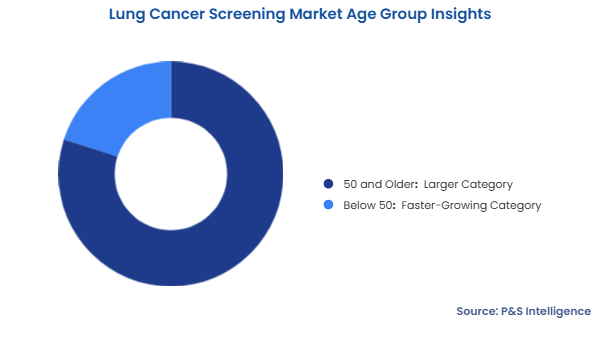
The 50 and older segment dominates the market in 2025 with a share of approximately 80%. This overwhelming dominance reflects current screening guidelines that focus on older adults with significant smoking history as the population at highest lung cancer risk. The updated USPSTF guidelines recommend annual screening for adults aged 50 to 80 years who have a 20-pack-per-year smoking history and currently smoke or have quit within the past 15 years. Lung cancer incidence increases substantially with age, with the median age at diagnosis being 70 years, according to epidemiological data.
The Below 50 segment is projected to witness a CAGR of 9.3% during the forecast period. Growing recognition of lung cancer in younger individuals, particularly never-smokers and those with genetic predisposition or occupational exposures, is expanding screening considerations beyond traditional age boundaries. Certain hereditary cancer syndromes and germline mutations increase lung cancer risk independent of tobacco exposure and may justify earlier screening initiation in selected individuals. Additionally, prolonged exposure to emerging risk factors, including air pollution and second-hand smoke, is contributing to the earlier onset of lung cancer in some populations, particularly in the highly polluted urban areas of developing countries.
These age groups are covered:
50 and Older (Larger Category)
Below 50 (Faster-Growing Category)
Patient Gender Insights
The male segment holds the larger market share in 2025. Men demonstrate higher lung cancer incidence and mortality rates compared to women across most global populations, reflecting historical patterns of higher smoking prevalence and intensity among males. Male-focused screening initiatives have proliferated based on this elevated risk profile. Occupational exposure to lung carcinogens, including asbestos, diesel exhaust, and industrial chemicals, disproportionately affects male workers in construction, mining, transportation, and manufacturing industries, adding to tobacco-related risk.
The female segment is expected to grow at a CAGR during 2026–2032. Lung cancer patterns in women show distinct characteristics requiring tailored screening approaches. Women demonstrate higher proportions of adenocarcinoma histology and harbor EGFR mutations and other targetable oncogenic drivers at higher rates than men. Research suggests women may be more susceptible to tobacco carcinogens at equivalent smoking exposures, potentially justifying lower screening thresholds in female smokers. Lung cancer in never-smoking women represents a particular clinical challenge, with these cancers often arising from genetic susceptibility, air pollution exposure, and other non-tobacco risk factors that may benefit from specialized screening strategies.
These patient genders are covered:
Male (Larger Category)
Female (Fastest-Growing Category)
Others
End User Insights
The hospitals & clinics segment holds the dominant market share in 2025. Hospitals serve as the primary setting for lung cancer screening programs due to their comprehensive infrastructure, advanced imaging equipment, multidisciplinary care teams, and integrated diagnostic capabilities. Large hospital systems have established dedicated lung cancer screening programs featuring low-dose CT scanners optimized for screening protocols, specialized thoracic radiologists, pulmonologists, nurse navigators, and smoking cessation counselors working in coordinated care models.
The diagnostic centers segment is projected to register the fastest CAGR during the forecast period, as freestanding imaging centers and specialized diagnostic facilities offer several advantages. These centers typically provide convenient community locations with flexible scheduling, shorter wait times, and dedicated screening-focused workflows that efficiently process high volumes of asymptomatic screening patients. The business model of dedicated diagnostic centers emphasizes patient experience, affordability, and streamlined operations, making screening more accessible to working individuals who may face challenges accessing hospital-based programs during standard business hours.
These end users are covered:
Hospitals & Clinics (Largest Category)
Diagnostic Centers (Fastest-Growing Category)
Others
Drive strategic growth with comprehensive market analysis
Lung Cancer Screening Market Geographical Analysis
North America Lung Cancer Screening Market Size
North America dominates the global lung cancer screening market in 2025 with a share of approximately 35%, and the region is expected to maintain its leadership position throughout the forecast period. This dominance is driven by well-established screening guidelines, robust healthcare infrastructure, high awareness levels among patients and providers, favorable reimbursement policies, and strong government support for early detection initiatives. The U.S. accounts for most of the North American screening activity, with organized screening programs now operational across major health systems nationwide.
The implementation of USPSTF Grade B recommendation for lung cancer has driven widespread insurance coverage, including Medicare, Medicaid, and private insurers. Major healthcare systems have invested substantially in screening infrastructure, establishing centralized screening registries, quality assurance programs, and patient navigation services supporting the screening continuum from initial evaluation through treatment of detected cancers.
Asia-Pacific Lung Cancer Screening Market Forecast
Asia-Pacific is projected to register the fastest regional CAGR, of 8.9%, during 2026–2032, reflecting rising lung cancer burden, improving healthcare infrastructure, increasing awareness, and growing government commitment to cancer control. The region faces unique screening challenges and opportunities shaped by diverse populations, varying healthcare systems, extremely high smoking prevalence in some countries, and emerging emphasis on screening never-smokers exposed to air pollution and other environmental carcinogens.
China Lung Cancer Screening Market Forecast
China holds the largest share within Asia-Pacific and faces the highest absolute lung cancer burden globally. The country's massive smoking population, severe air pollution in major urban areas, and rapidly aging demographics create an enormous screening need. As per the World Health Organization, China is the foremost producer and consumer of tobacco, with more than 300 million smokers, accounting for 26.6% of the adult population, and 700 million non-smokers who are subjected to second-hand smoke. Chinese health authorities have launched screening demonstration programs in multiple cities, investigating the feasibility of population-level screening implementation. The programs face substantial challenges, including a massive eligible population, limited screening infrastructure in rural areas, high rates of incidental findings requiring follow-up, and healthcare system capacity constraints.
The regions and countries analyzed in this report are:
North America (Largest Regional Market)
U.S. (Larger Country Market)
Canada (Faster-Growing Country Market)
Europe
Germany (Largest Country Market)
U.K. (Fastest-Growing Country Market)
France
Italy
Spain
Rest of Europe
Asia-Pacific (Fastest-Growing Regional Market)
Japan
China (Largest Country Market)
India (Fastest-Growing Country Market)
South Korea
Australia
Rest of APAC
Latin America
Brazil (Largest Country Market)
Mexico (Fastest-Growing Country Market)
Rest of LATAM
Middle East and Africa
Saudi Arabia (Largest Country Market)
South Africa
U.A.E. (Fastest-Growing Country Market)
Rest of MEA
Lung Cancer Screening Market Share
The global lung cancer screening market exhibits a consolidated competitive structure. This concentration reflects the substantial technological expertise, regulatory experience, established distribution networks, and significant capital investment required to compete effectively in the medical imaging and diagnostic technology sectors. Leading medical imaging companies dominate the market through comprehensive product portfolios spanning CT scanners, advanced visualization software, artificial intelligence-powered nodule detection tools, and integrated healthcare information systems supporting screening program management.
These companies leverage decades of experience in medical imaging technology, extensive installed equipment bases in hospitals and imaging centers worldwide, and strong relationships with radiology departments and healthcare administrators. Their dominance is reinforced by continuous innovation in dose reduction technologies, image quality enhancement, workflow optimization, and integration capabilities with electronic health records and radiology information systems.
Key Lung Cancer Screening Companies:
GE HealthCare
Siemens Healthineers AG
Koninklijke Philips N.V.
Canon Medical Systems Corporation
Fujifilm Holdings Corporation
Nuance Communications, Inc.
Vuno Inc.
Volpara Solutions Limited
PenRad Technologies, Inc.
Medtronic plc
Hologic, Inc.
Carestream Health
Lung Cancer Screening Market News
In June 2024, the Canadian province of Nova Scotia launched a comprehensive new lung cancer screening clinic as part of the province's cancer screening program, targeting individuals at elevated risk of developing lung cancer, and emphasizing early detection as critical to improved outcomes.
In January 2024, GE HealthCare Technologies Inc. announced a strategic collaboration with Optellum (a lung health‑AI company) to integrate AI‑powered nodule detection and risk‑scoring capabilities into CT workflows, aimed at enhancing early lung‑cancer detection.
Want a report tailored exactly to your business need?
Leading companies across industries trust us to deliver data-driven insights and innovative solutions for their most critical decisions. From data-driven strategies to actionable insights, we empower the decision-makers who shape industries and define the future. From Fortune 500 companies to innovative startups, we are proud to partner with organisations that drive progress in their industries.
Client Testimonials
Working with P&S Intelligence and their team was an absolute pleasure – their awareness of timelines and commitment to value greatly contributed to our project's success. Eagerly anticipating future collaborations.
McKinsey & Company
India
Unmatched Standards
Our insights into the minutest levels of the markets, including the latest trends and competitive landscape, give you all the answers you need to take your business to new heights
Complete Data Security
We take a cautious approach to protecting your personal and confidential information. Trust is the strongest bond that connects us and our clients, and trust we build by complying with all international and domestic data protection and privacy laws